




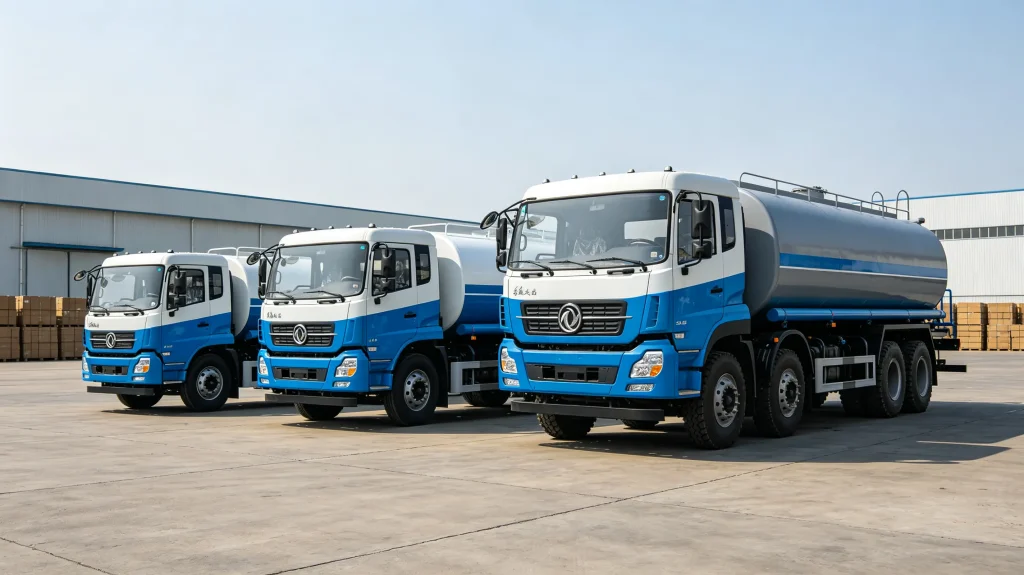
Water tanker trucks, also called water bowser trucks, are essential vehicles for sanitation, construction, landscaping and emergency water supply.
Unlike standard cargo trucks, water tankers are built specifically to store and spray liquids. This makes them highly flexible for outdoor water transport and sprinkling operations.
For global fleet buyers, project contractors and government bidders, choosing the right water tanker truck directly affects operational efficiency and long-term costs.
However, many overseas buyers find the selection process confusing. They often cannot tell drinking water-grade tanks apart from ordinary sprinkler tanks. They also struggle to match tonnage and functions to their real working conditions.
This detailed guide covers everything you need to know before buying. It explains model types, tank materials, key configurations, application matching and practical export buying tips. For verified export-grade water tanker trucks, you can check reliable supplies from Mettlead Truck official site.
Why Buy Water Tanker Trucks from China
Chinese water tanker trucks have become very competitive in global markets. They offer a strong balance of functionality, stable quality and competitive pricing.
First, China’s special vehicle manufacturing industry has developed rapidly in recent years. The supply chain from chassis production to tank customization is highly mature and localized.
This strong industrial base helps control costs while maintaining consistent quality. It also supports faster delivery for bulk fleet orders.
Moreover, Chinese manufacturers offer flexible customization. Buyers can adjust tank capacity, spraying systems, tank materials and auxiliary functions to suit local demands.
In addition, formal Chinese suppliers provide export-oriented upgrades. These upgrades help vehicles adapt to different climates, road rules and registration standards.
Therefore, Chinese water tanker trucks are often the most practical choice for fleet-scale procurement and long-term project use.
Complete Model and Capacity Coverage
Chinese manufacturers produce water tankers across a wide range of sizes. Tank volumes typically start from 5,000 liters and can go up to 40,000 liters or more.
This means buyers can find a suitable model for almost any task. Small urban sanitation trucks and large off-road water supply trucks are both available.
Because of this full-size coverage, importers can complete one-stop procurement. It also makes fleet allocation much easier for multi-scenario project teams. You can browse full special vehicle series at all-categories product page.
Flexible Customization for Global Scenarios
Export water tanker trucks can be customized in many ways. Common options include tank material, spray gun range, water pump flow rate and chassis configuration.
Manufacturers can also adjust emission standards, driving side and anti-corrosion treatments. These changes help the trucks meet the requirements of different countries.
This level of flexibility is especially useful for buyers with specific project needs. It allows them to get a vehicle that matches local operating conditions rather than a generic model.
Affordable Maintenance and Spare Parts Supply
Chinese water tanker chassis and upper structures usually follow mainstream designs. As a result, spare parts are relatively easy to source in many global markets.
Compared with some Western brands, Chinese models often have lower maintenance costs. They also require less specialized technical support for routine repairs.
For fleet buyers, this can mean shorter downtime and lower long-term operating costs. It is one of the reasons why Chinese water tankers remain popular for export.
Main Types of Chinese Water Tanker Trucks for Export
Before buying, you should understand the different model categories. Water tanker trucks are not one-size-fits-all, and each type serves different work scenarios.
Choosing the wrong type can lead to insufficient functions or wasted investment. The mainstream export models are usually grouped by chassis structure and tank capacity.
Small 4×2 Water Tanker Trucks (5,000L–12,000L)
4×2 light-duty water tankers are the most common entry-level models. Their tank capacity usually ranges from 5 cubic meters to 12 cubic meters.
These trucks are compact and easy to drive. They can navigate narrow urban roads, community roads and park lanes more comfortably than larger models.
Typical applications include daily road cleaning, urban greening watering, street dust suppression and residential water supply.
Most small water tankers use economical diesel engines from 120HP to 180HP. This helps keep fuel costs low during high-frequency daily operation.
For municipal sanitation teams and small engineering companies, 4×2 water tanker trucks are often the best daily choice.
Medium 6×4 Water Tanker Trucks (15,000L–25,000L)
6×4 water tanker trucks belong to the medium and large-duty category. Their mainstream capacity ranges from 15 cubic meters to 25 cubic meters.
With dual rear driving axles, the chassis offers stronger load-bearing capacity and road adaptability. It works well on suburban roads, construction sites and provincial highways.
This type of water tanker balances capacity and flexibility very well. It can handle large-area road dust reduction, garden irrigation and project water supply tasks.
Most 6×4 water tankers are equipped with 340HP to 380HP high-torque engines. This allows them to maintain stable performance under full-load continuous working conditions.
For medium-sized engineering projects and municipal batch procurement, 6×4 water tanker trucks are the most cost-effective mainstream option.
You can refer to real project delivery cases of sanitation trucks at cooperative-case page.
Large Off-Road 6×6 Water Tanker Trucks (25,000L–40,000L)
6×6 full-drive water tanker trucks are designed for tough conditions. They are commonly used in deserts, mines, mountainous areas and other complex environments.
The all-wheel drive structure provides strong climbing ability and obstacle-crossing performance. As a result, the vehicle can operate normally on muddy, gravel and rugged roads.
The large tank capacity supports long-distance water transportation and remote project water supply. This makes it suitable for mining areas, field engineering and desert road construction.
Some models can also be fitted with high-pressure fire water cannons. This adds emergency fire extinguishing and high-altitude watering capabilities.
Semi-Trailer Water Tankers (40,000L–60,000L)
Semi-trailer water tankers are super-large capacity units. Their volume can reach 40 cubic meters to 60 cubic meters in some configurations.
They are mainly used for long-distance centralized water transfer, drought relief water delivery and large construction base water supply.
However, semi-trailer water tankers focus on large-volume transport. They are not always suitable for flexible short-distance spraying operations.
Core Tank Material Options & How to Choose
Tank material is one of the most important factors to consider. It directly affects water quality safety, corrosion resistance and the vehicle’s service life.
Different materials suit different scenarios and budgets. Export water tankers mainly use three mainstream materials.
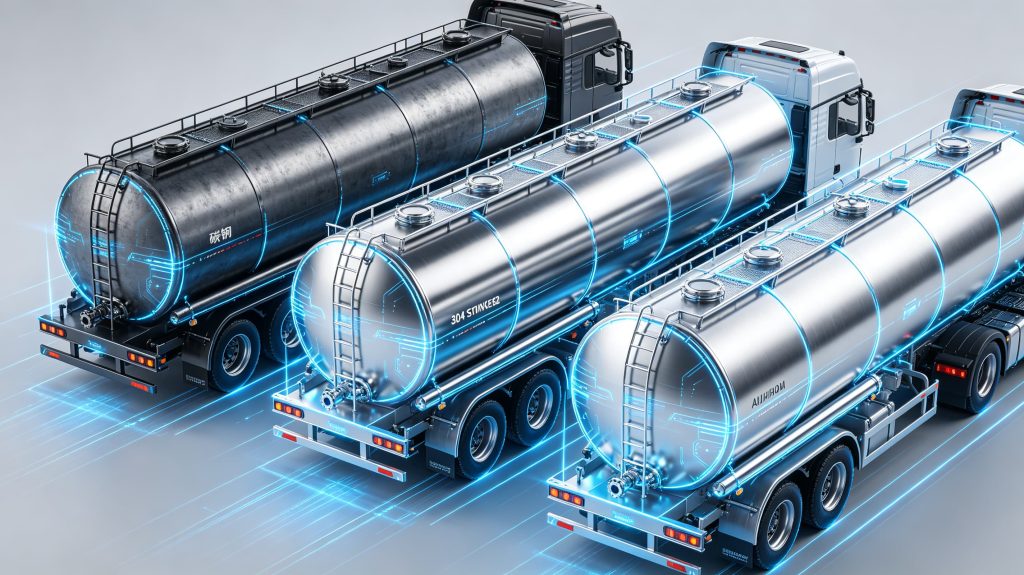
Carbon Steel Tank (Q235B)
Carbon steel is the most common and cost-effective tank material. It offers high structural strength and good impact resistance.
With proper anti-rust and anti-corrosion treatment, carbon steel tanks can meet many daily sprinkling and water storage needs.
They are suitable for storing ordinary non-drinking water. Typical uses include road dust suppression, construction water and greening irrigation.
If your business does not involve drinking water supply, carbon steel water tankers can help reduce procurement costs significantly.
Stainless Steel Tank (304 Food Grade)
304 stainless steel is a food-grade material. It is corrosion-resistant, rust-free and non-polluting.
Because of these properties, stainless steel tanks are widely used for residential water supply, emergency drinking water delivery and clean water transfer projects.
Although the initial cost is higher, stainless steel tanks usually last longer. They also reduce the risk of secondary water pollution.
For government drinking water projects and community water supply fleets, stainless steel water tankers are often the standard choice.
Aluminum Alloy Tank
Aluminum alloy tanks are lightweight and anti-corrosive. They can reduce the overall vehicle weight and increase the actual water loading capacity.
This material is often used in high-end export models and long-distance water transport vehicles. It offers a good balance of durability and energy efficiency.
Key Functional Configurations for Export Water Tankers
Many buyers focus only on tank capacity. However, spraying range, water pump performance and auxiliary functions also determine real working efficiency.
Therefore, you should check both capacity and configuration before placing an order.
Multi-Function Spraying System
Standard export water tankers usually support multi-position spraying. This includes front flushing, side spraying, rear watering and a high-pressure water cannon.
The front flushing function cleans sediment from road surfaces. The side spray helps keep green belts moist. The rear wide spray covers large areas for dust reduction.
The rear water cannon can rotate vertically and horizontally. Its spraying distance can reach 12 to 16 meters, which supports high-altitude tree watering and emergency fire fighting.
High-Pressure Water Pump System
Export-grade water pumps are designed for stable water absorption and fast water outlet speed. Many models support self-priming water intake from rivers, ponds and reservoirs.
A high-quality pump system reduces the risk of failure during long-hour continuous operation. It also helps improve daily work progress.
Because the water pump is such a critical component, buyers should not overlook its quality when comparing quotations.
Anti-Corrosion and Sealing Structure
Export water tanker tanks often use integral welding technology. The internal anti-corrosion coating is sometimes thickened for overseas humid and coastal environments.
Multi-layer sealing design helps prevent liquid leakage during long-distance transportation and bumpy driving.
These details may seem minor, but they can have a big impact on long-term durability.
Safety Auxiliary Devices
Formal export models are usually equipped with overflow ports, drain valves, anti-wave baffles and pressure relief devices.
Internal anti-wave plates reduce water fluctuation during driving. This helps avoid vehicle shaking and improves driving safety.
For fleet operation, these safety features are especially important for reducing accident risks.
Difference Between Domestic and Export Spec Water Tanker Trucks
Overseas buyers must distinguish domestic trucks from export-spec trucks. The two versions often differ in adaptation and configuration details.
If you buy a domestic model by mistake, it may not meet local registration or operational requirements.
Climate Adaptive Upgrade
Export water tankers are often optimized for specific climate conditions. For coastal countries, manufacturers may strengthen salt fog corrosion resistance.
For high-temperature tropical regions, the heat dissipation system and water pump heat resistance may be upgraded.
For cold regions, vehicle preheating and pipeline antifreeze configurations may be added. These changes help prevent freezing damage.
You can check more factory export technical advantages at about-us page.
Electrical and Circuit Optimization
Export-spec water tankers usually use waterproof and dustproof electrical components. The whole circuit layout is designed to handle sea freight and long-term overseas use.
Domestic ordinary water tankers often have simpler circuit protection. As a result, they may be more prone to short circuits and aging after long-distance overseas transportation.
This is one of the key differences that many first-time buyers overlook.
Complete Export Document Support
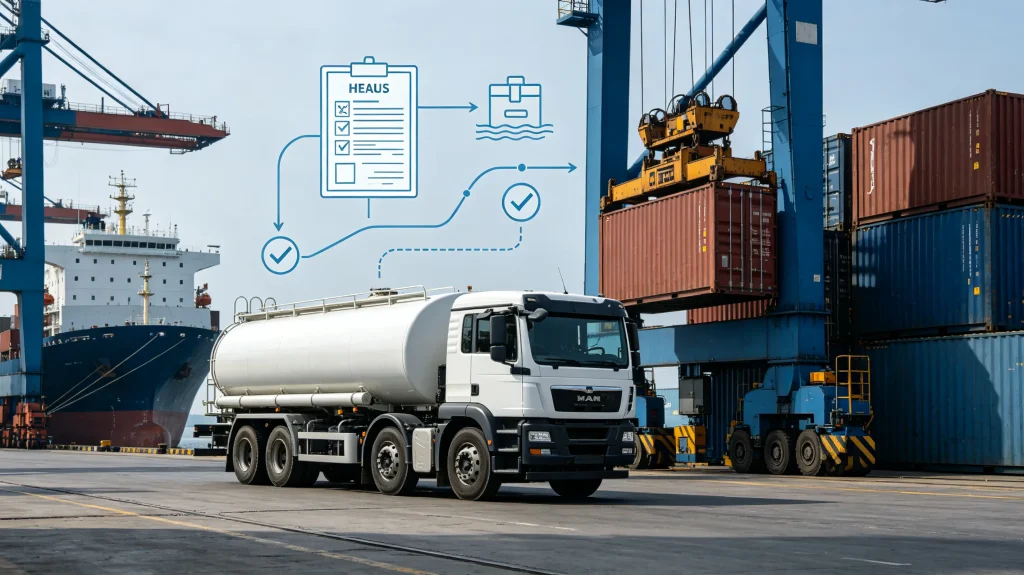
Formal export water tanker trucks come with full sets of documents. These typically include customs declaration files, factory certificates and vehicle conformity files.
These legal documents are essential for smooth overseas customs clearance and local vehicle registration.
Domestic trucks usually cannot provide the same complete export certification package.
How to Match Water Tanker Model with Your Working Scenario
Choosing the right model depends on your actual work requirements. A truck that works well in one scenario may be inefficient in another.
Therefore, you should evaluate capacity, functions and operating conditions before making a decision.
Urban Sanitation & Road Maintenance
For urban road cleaning, green belt watering and daily dust reduction, 4×2 small and medium water tankers are usually the best choice.
Their flexible body size adapts well to urban traffic rules and complex road networks. They also meet high-frequency daily operation demands.
If your work is mainly inside cities, a smaller model may be more efficient than a larger one.
Construction Site & Mining Operation
Construction sites and mining areas usually have harsh road conditions and high water demand.
In these cases, 6×4 large-capacity water tankers or 6×6 off-road water tankers are often recommended. They can support long-hour continuous dust suppression and project water supply.
The stronger chassis and larger tank capacity make them more suitable for heavy-duty field operations.
Drinking Water Supply & Emergency Rescue
For community drinking water delivery, drought relief and emergency rescue, food-grade stainless steel water tankers are necessary.
These tanks help ensure water quality safety and meet public health service standards.
Using an ordinary carbon steel tank for drinking water supply is not recommended. It may cause water quality contamination and project compliance issues.
Large-Scale Water Transfer Project
For long-distance large-volume water transfer, semi-trailer super-large water tankers can be a good option.
They improve single transportation efficiency for large water transfer projects. However, they are less suitable for flexible spraying tasks.
Step-by-Step Buying Guide for First-Time Overseas Buyers
If you are buying a water tanker truck from China for the first time, following a standard process can help reduce risks.
A clear buying process helps avoid configuration errors, missing documents and delivery delays.
Confirm Local Import Policy and Access Standard
First, confirm local vehicle emission standards, left/right-hand drive rules and commercial vehicle import tariff policies.
Clarifying these policy thresholds in advance is critical. It is the foundation for legal vehicle registration and use.
If you are unsure about any requirement, ask your supplier or local transport authority before ordering.
Determine Required Capacity and Core Functions
Define your daily water demand, working radius and main functions. This will help you choose between an ordinary sprinkler type and a drinking water type.
Do not blindly pursue large capacity or excessive functions. They can increase costs without bringing practical benefits.
Instead, select a model that matches your most frequent operating scenario.
Confirm Configuration Details and Customization Demands
Confirm tank material, spraying range, pump power, chassis horsepower and emission standards.
If you need special color marking, logo printing or other custom features, mention them early.
Early confirmation helps avoid misunderstandings during production.
Verify Quotation, Trade Terms and Delivery Cycle
Check the unit price, total amount, deposit ratio and balance payment method. Also clarify whether the quotation is based on FOB, CIF or CFR terms.
Confirm the production cycle and shipping schedule. This will help you arrange project deployment more reasonably.
Clear terms are especially important for bulk orders.
Factory Inspection and Loading Confirmation
After vehicle production, you can conduct a video or on-site inspection. Check the appearance, functions and parameters against your order.
If everything is correct, you can then arrange container loading or bulk ship loading.
This inspection step helps reduce the risk of delivery errors.
Customs Declaration, Shipment and After-Sales Handover
The manufacturer will usually complete export customs declaration and provide the full document set. After sea shipment, you can track logistics information in real time.
Once the goods arrive at the port, complete local customs clearance and registration procedures.
For professional after-sales support, refer to customer-service page.
Key Factors That Affect Water Tanker Truck Prices
Water tanker truck prices are not fixed. Several factors determine the final procurement cost.
If you only compare factory prices, you may miss important cost differences caused by configuration and customization.
Tank Capacity and Material
Larger tank volume usually means higher manufacturing cost. Stainless steel tanks are also more expensive than carbon steel tanks.
You can select materials according to actual needs. This helps balance budget and performance.
For non-drinking water projects, carbon steel tanks are often sufficient.
Chassis Configuration and Horsepower
High-horsepower chassis and multi-axle models generally have higher purchase costs.
Economical chassis configurations may work well for conventional urban scenarios. However, heavy-duty field operations may require more powerful models.
Therefore, horsepower should be chosen based on road conditions and workload.
Functional Configuration Upgrade
Additional features such as a high-pressure water cannon, remote control spraying, food-grade internal treatment and off-road upgrades will increase the total cost.
These functions may be necessary for some projects. For others, they may be unnecessary extras.
Review each upgrade carefully before paying extra.
Export Customization and Shipping Cost
Overseas adaptive upgrades and sea freight charges will also affect the final landing price.
For example, anti-corrosion treatment, special painting and document preparation may add costs. Shipping fees depend on the destination and order quantity.
Make sure all these costs are included in your budget.
Common Buying Mistakes to Avoid
Most procurement risks come from information asymmetry and poor configuration decisions.
By understanding these common mistakes, you can make a more rational purchase.
Confusing Ordinary Tank with Drinking Water Tank
Using ordinary carbon steel tanks to store drinking water can cause water quality problems. It may lead to project non-compliance and public health risks.
If drinking water supply is your main task, choose a food-grade stainless steel tank.
This is not just a technical detail—it is a core requirement for many public water projects.
Blindly Pursuing Low Price
Ultra-low-price water tankers may cut corners on tank thickness, anti-corrosion treatment and pump quality.
Hidden failures may appear later, increasing repair costs and downtime.
For long-term fleet operation, a slightly more expensive but reliable model is often a better choice.
Mismatching Model and Working Condition
Buying small-capacity trucks for high-intensity engineering operations can lead to insufficient efficiency.
Conversely, buying large trucks for urban daily use can cause unnecessary fuel waste.
Always match the model to your main working scenario.
Ignoring Export Document Completeness
Incomplete export documents can cause customs clearance failure. They may also prevent you from registering the vehicle locally.
Before shipment, confirm that the supplier will provide all required documents.
This step is essential for smooth delivery.
After-Sales Service and Spare Parts Guarantee
Stable after-sales service is important for long-term fleet operation. Formal export manufacturers usually provide global standardized services.
These services may include remote technical guidance, overseas spare parts supply and official warranty protection.
For fleet buyers, after-sales support is as important as the initial product quality.
Buyers can stock common wearing parts in advance to reduce vehicle downtime. For business cooperation and customized quotation, contact via contact-us page.
FAQ About Buying Water Tanker Trucks from China
Q1: What is the most popular water tanker truck for export?
4×2 10,000L–12,000L and 6×4 20,000L water tankers are the most common export models. They suit most municipal and engineering scenarios.
Q2: Is stainless steel water tanker necessary?
It is necessary if you need to store and supply drinking water. For ordinary road sprinkling and dust suppression, carbon steel tanks are usually sufficient and more cost-effective.
Q3: Can Chinese water tankers adapt to tropical and coastal climates?
Yes. Export models can be upgraded with anti-corrosion, heat dissipation and moisture-proof treatments. These changes help them adapt to various overseas climates.
Q4: How long is the production and delivery time?
Standard models usually take 15–25 days. Custom functional upgrades may take 30–40 days. Sea freight time depends on the destination port.
Q5: Can I customize spraying functions and tank size?
Yes. Full customization is supported. Tank volume, spray range, water pump flow and auxiliary functions can be adjusted according to your needs.
Final Summary
Chinese water tanker trucks cover a wide range of capacities and functional types. They can meet municipal sanitation, engineering construction, greening irrigation and emergency water supply demands.
When purchasing, buyers should match tank material, chassis configuration and functions to their actual scenarios.
Choosing formal export-spec vehicles and following standardized import procedures can reduce policy risks and quality problems.
For professional model recommendation, detailed parameter lists and exclusive export quotations, you can contact the official team for one-on-one customized service.