


Introduction
Buying a truck is rarely a simple decision. You compare power, axle configuration, cabin comfort, and price. But there is one factor that many buyers overlook until it is too late: emission standards.
Emission rules decide whether a truck can be registered in your country. They also affect fuel cost, maintenance, and resale value. For a fleet buyer, this is not a paperwork detail. It is a long-term operating decision.
Euro 5 and Euro 6 are the two standards that dominate the conversation today. They look similar on paper. In real life, however, they behave very differently under the hood.
This guide breaks down the differences in plain language. You will learn the exact limits, the technology behind each standard, which markets still accept Euro 5, and how to choose the right truck for your operation.
If you want to skip straight to available models, you can browse our truck product category page and filter by emission level, axle layout, and body type.
What Are Truck Emission Standards?
Emission standards are legal limits on what a diesel engine can release into the air. They control nitrogen oxides, particulate matter, carbon monoxide, and hydrocarbons.
The European Union introduced these rules in stages. Each stage is called a Euro level. Euro 1 appeared in 1992. Euro 2, 3, 4, 5, and 6 followed over the next two decades.
Each new level is stricter than the one before it. For instance, Euro 6 cuts nitrogen oxide emissions by 80 percent compared with Euro 5. That is a massive step, not a small tweak.
Manufacturers must prove that new engines meet these limits. They run official tests, fit special exhaust systems, and build the truck around the technology.
Therefore, the standard you choose does not just label the vehicle. It shapes the engine design, the exhaust layout, and the parts you will buy for years to come.
Why Do Emission Standards Matter for Truck Buyers?
You might ask why a buyer in Africa or South America should care about European rules. The answer is simple: most developing markets follow European standards as a baseline.
Many countries adopt Euro 4, Euro 5, or Euro 6 as their national regulation. Some use the exact limits. Others copy the structure and adjust the timeline.
China, for example, built its national standards around the European framework. China 5 mirrors Euro 5. China 6 goes beyond Euro 6 in several areas.
So the Euro number on your truck is the first thing customs and registration offices check. A truck with the wrong standard can sit at the port for weeks.
Beyond registration, the standard affects daily operation. Euro 6 trucks need more complex exhaust systems and consume more AdBlue. Euro 5 trucks are simpler and cheaper to run in markets with lower fuel quality.
In short, the emission level is a business decision. It changes your initial cost, your operating budget, and your ability to sell the truck later. You can read more about practical fleet choices in our truck knowledge base.
Euro 5 Explained
Euro 5 became mandatory for new heavy-duty trucks in Europe in 2009. It was a big improvement over Euro 4, mainly because it cut particulate matter significantly.
Under Euro 5, nitrogen oxides are limited to 2.0 grams per kilowatt-hour. Particulate matter is capped at 0.02 grams per kilowatt-hour. Hydrocarbons stay at 0.46 grams.
Manufacturers reached these levels mainly with Selective Catalytic Reduction, or SCR. The system injects AdBlue, a urea solution, into the exhaust. The catalyst then converts harmful NOx into nitrogen and water.
Euro 5 engines still use exhaust gas recirculation in many designs. EGR recirculates a portion of the exhaust back into the combustion chamber. This lowers combustion temperature and reduces NOx formation.
In practice, Euro 5 trucks proved reliable. The technology was mature by the end of the production cycle. Spare parts were easy to find. Drivers understood the AdBlue routine.
For this reason, Euro 5 remains popular in many export markets even today. It offers a good balance between performance, cost, and emissions.
Euro 6 Explained
Euro 6 is the strictest European standard for heavy-duty trucks so far. It took full effect for new vehicles in 2014.
The headline change is the NOx limit. Euro 6 cuts it from 2.0 grams to 0.4 grams per kilowatt-hour. That is an 80 percent reduction compared with Euro 5.
Particulate matter drops from 0.02 to 0.01 grams. Euro 6 also introduced a particle number limit, which counts tiny particles that older tests ignored.
To hit these numbers, manufacturers could not rely on a single technology. Euro 6 trucks combine SCR with a diesel particulate filter, or DPF. Many models also add a diesel oxidation catalyst.
The DPF traps soot in the exhaust. Periodically, the system burns it off in a process called regeneration. This keeps the filter clean but adds complexity.
Euro 6 engines are also tuned differently. Combustion is cleaner at the source. The engine computer monitors far more sensors and adapts constantly.
Because the whole package is heavier and more complex, Euro 6 trucks usually cost more to build and to maintain. Yet they also meet the toughest regulations in the world.
For more technical details on aftertreatment systems, check the blog page where we post regular maintenance guides.
Euro 5 vs Euro 6: The Key Differences
On the surface, the two standards look like a simple numbers game. The reality is different. They represent two generations of engine design.
Here is a quick comparison table that summarizes the main differences.
| Parameter | Euro 5 | Euro 6 |
|---|---|---|
| NOx limit | 2.0 g/kWh | 0.4 g/kWh |
| PM limit | 0.02 g/kWh | 0.01 g/kWh |
| Particle number limit | Not required | Required |
| Main exhaust technology | SCR, EGR | SCR, DPF, DOC |
| AdBlue consumption | Lower | Higher |
| System complexity | Moderate | High |
| Initial price | Lower | Higher |
| Fuel quality tolerance | Better | More sensitive |
| Regeneration requirement | No DPF | Regular DPF regeneration |
As the table shows, Euro 6 is not just stricter. It is a different machine. The extra hardware changes the whole exhaust system, the engine calibration, and the maintenance schedule.
Meanwhile, Euro 5 keeps a simpler layout. For many operators, that simplicity is a real advantage.
NOx Emission Limits: The Biggest Gap
Nitrogen oxides are the main target of modern emission rules. They contribute to smog and respiratory problems. That is why regulators push them down hard.
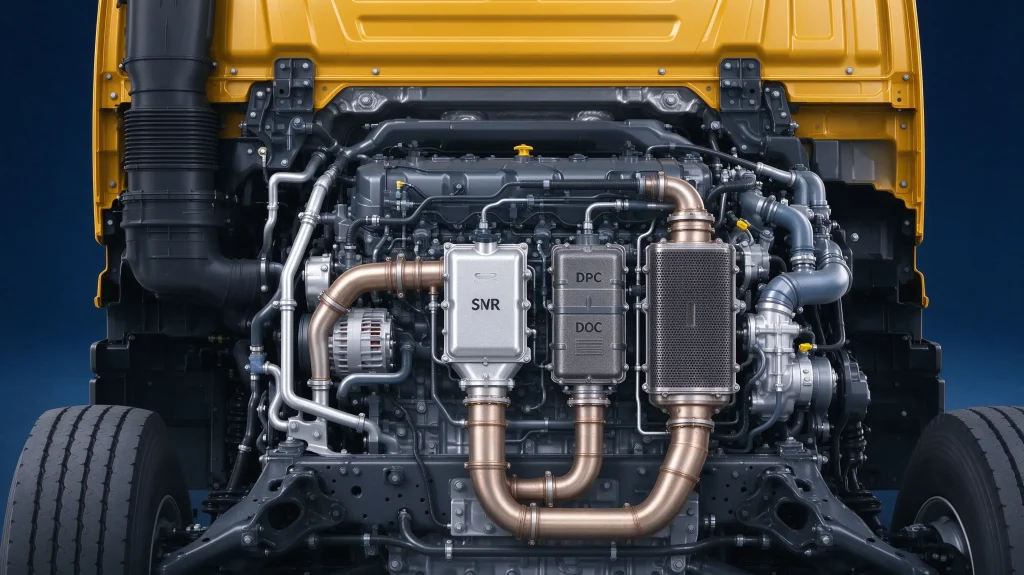
Euro 5 allows 2.0 grams per kilowatt-hour of NOx. Euro 6 allows only 0.4 grams. The gap is five times.
To close that gap, the engine must work harder in multiple ways. First, combustion itself is optimized. Second, more exhaust is recirculated. Third, the SCR system must handle a much larger share of the cleanup.
In real driving, the difference shows up in AdBlue usage. A Euro 5 truck may consume AdBlue at roughly 3 to 5 percent of fuel volume. A Euro 6 truck often runs at 5 to 8 percent.
Higher AdBlue consumption is not a defect. It is the price of meeting the limit. Operators who plan their fluid budget ahead avoid surprises.
Note that these percentages vary with load, terrain, and driving style. A truck working on steep mountain roads will always inject more AdBlue than a highway cruiser.
Particulate Matter and Particle Number
Particulate matter, or PM, is the visible black soot in diesel exhaust. Euro 5 caps it at 0.02 grams per kilowatt-hour. Euro 6 halves that to 0.01 grams.
More importantly, Euro 6 introduced a particle number limit. This counts tiny particles, even those that weigh almost nothing. Older engines could pass the mass test while still emitting millions of small particles.
The diesel particulate filter is the answer. It physically traps soot in a ceramic mesh. The filter fills up over time and must be cleaned through regeneration.
Regeneration burns the trapped soot at high temperature. It happens automatically when the engine detects that the filter is full. In most cases, the driver does not even notice.
However, there are conditions that block regeneration. Short trips, stop-and-go traffic, and constant idling prevent the exhaust from reaching the required temperature.
When that happens, the filter stays blocked, the warning light appears, and the engine may lose power. This is one of the most common problems with Euro 6 trucks in urban use.
Euro 5 trucks, without a DPF, simply do not have this failure mode. That is a meaningful advantage for buyers who work in cities or on congested routes.
Technology Behind Euro 5 and Euro 6
Both standards rely on the same family of technologies, but they use them in different combinations. Understanding the layout helps you maintain the truck and buy the right spare parts.
Selective Catalytic Reduction (SCR)
SCR is the backbone of modern diesel emission control. It injects AdBlue into the exhaust stream. The mixture then passes through a catalyst that breaks NOx into harmless nitrogen and water.
Euro 5 trucks use SCR on most models. The system is proven, and the dosing strategy is relatively simple.
Euro 6 trucks also use SCR, but with tighter dosing control. The engine computer reads more sensors and adjusts injection constantly to meet the 0.4 gram limit.
Exhaust Gas Recirculation (EGR)
EGR sends a portion of the exhaust back into the intake. This lowers the oxygen level in the cylinder and reduces peak combustion temperature. Cooler combustion produces less NOx.
Euro 5 engines use EGR to reduce the load on the SCR system. Some models lean on EGR heavily; others use it lightly.
Euro 6 engines use more EGR in many designs, especially at low and medium load. The trade-off is slightly higher fuel consumption and more soot production, which the DPF then catches.
Diesel Particulate Filter (DPF)
The DPF is the defining hardware of Euro 6. Euro 5 trucks rarely carry one. Euro 6 trucks cannot pass the particle limits without it.
The filter works passively most of the time. When soot builds up, the engine raises exhaust temperature to burn it away. This is called active regeneration.
For buyers, the DPF means extra maintenance. Filter cleaning, ash removal, and sensor checks become part of the service schedule. Parts are more expensive than Euro 5 equivalents.
Diesel Oxidation Catalyst (DOC)
The DOC sits before the DPF. It oxidizes carbon monoxide and hydrocarbons into carbon dioxide and water. It also helps heat the exhaust for regeneration.
Euro 6 systems almost always include a DOC. Euro 5 systems may include a simpler version or none at all, depending on the engine family.
In combination, SCR plus DPF plus DOC forms a complete aftertreatment line. That line is longer and heavier than the Euro 5 setup, which affects chassis space and total vehicle weight.
Fuel Consumption: Euro 5 vs Euro 6
Fuel is the biggest cost in trucking. Buyers naturally ask whether Euro 6 burns more diesel than Euro 5.
The short answer is yes, in most real-world conditions. The extra EGR, the DPF regeneration, and the heavier exhaust system all take energy.
In practice, the difference usually sits in the range of 2 to 5 percent. A Euro 6 truck may use slightly more fuel than an equivalent Euro 5 model under the same load.
That said, Euro 6 engines are newer and often more efficient at the combustion level. Modern calibration recovers some of the losses. The net penalty is modest but real.
Operators should also count AdBlue as an operating cost. Higher NOx reduction means higher AdBlue use. Combined, Euro 6 running costs are higher than Euro 5 for the same work.
So, if your market accepts both standards and fuel prices are high, Euro 5 can be the cheaper daily option. If regulations force Euro 6, you simply plan for the extra cost.
Which Markets Still Accept Euro 5?
Euro 5 has not disappeared. Many regions still register Euro 5 trucks without trouble. Knowing your destination market is half the buying battle.
Africa is a major destination for Euro 5 trucks. Many countries in West, East, and Central Africa accept Euro 4 and Euro 5 as the import standard. Nigeria, Ghana, Kenya, Tanzania, and Angola commonly register such trucks.
The Middle East also absorbs a large number of Euro 5 units. Countries like Iraq, Syria, and some Gulf markets focus more on condition and age than on the exact emission letter.
Parts of Southeast Asia still work with Euro 4 or Euro 5 baselines. Import rules vary by country, so buyers must confirm with local authorities before ordering.
South America is a mixed picture. Brazil follows its own Proconve stages that mirror European levels. Argentina and Peru are more flexible. Again, local verification is essential.
Meanwhile, Europe, the UK, and most of the developed world have moved on. Euro 5 is effectively phased out for new registrations there.
The pattern is clear: Euro 5 remains viable in price-sensitive and infrastructure-limited markets. Euro 6 rules in markets with strict environmental enforcement.
Which Markets Require Euro 6?
Euro 6 is mandatory across the European Union for new heavy trucks. The UK follows the same rules after leaving the EU.
Norway, Switzerland, and several other high-income countries also enforce Euro 6-level standards. Their clean air zones and city access rules often target older trucks.
China 6, which is comparable to or stricter than Euro 6, applies to new vehicles across China. The country has also pushed older China 3 and China 4 trucks out of many cities.
Japan has its own post-new-long-term standards that are similar in strictness. South Korea and Singapore enforce modern emission rules as well.
Even within Europe, low-emission zones are spreading. Cities such as London, Paris, Berlin, and Amsterdam restrict older diesels. A Euro 6 truck can enter these zones; a Euro 5 truck may be barred or taxed.
Therefore, if you plan to sell trucks into the EU or operate in clean air zones, Euro 6 is not optional. It is the only acceptable choice.
Price Difference: Euro 5 vs Euro 6
Price is where the two standards separate most visibly at purchase time. The gap is not small.
A new Euro 6 truck costs more than a Euro 5 model with the same chassis and body. The extra DPF, DOC, sensors, and software account for a large share of the premium.
On top of that, Euro 6 development costs are spread across fewer units in export markets. This pushes the factory price up further for small-order buyers.
In the used market, the relationship flips in an interesting way. Used Euro 5 trucks are often cheaper to buy and cheaper to repair. Used Euro 6 trucks cost more upfront but hold value better in strict markets.
In flexible markets, however, a used Euro 6 truck can be a poor value. The buyer pays for technology that the local environment does not demand.
Our advice is simple: match the standard to the market. Do not overbuy. A Euro 5 truck that fits the local rules will serve you better than a Euro 6 truck that nobody there needs.
For a quote on either standard, you can reach the sales team through our contact page.
Operating and Maintenance Costs
Maintenance is where small differences become big numbers over time. Euro 6 trucks demand more attention, and the parts cost more.
DPF cleaning is a recurring expense. Depending on usage, the filter may need professional cleaning every 150,000 to 300,000 kilometers. Some operators replace it entirely.
NOx sensors fail on Euro 6 trucks and are not cheap. A single sensor can cost a noticeable share of a monthly revenue. Euro 5 systems use fewer sensors, so there is less to fail.
AdBlue is a recurring cost for both standards, but heavier for Euro 6. In high-use fleets, the difference adds up to real money each year.
Service intervals also differ. Euro 6 engines often require oil designed for low-ash engines to protect the DPF. That oil is more expensive than standard heavy-duty oil.
Euro 5 trucks run on conventional oils and filters. In regions where workshop skills are basic, Euro 5 is easier for local mechanics to handle.
In summary, Euro 5 is cheaper to run in flexible markets. Euro 6 is more expensive but necessary where the law demands it.
How to Identify a Euro 5 or Euro 6 Truck
Before buying, you need to know exactly which standard a truck meets. Paperwork and visual checks both matter.
First, check the chassis plate and the vehicle registration document. The emission class is usually printed there as Euro 5 or Euro 6.
Second, look at the exhaust system. A visible DPF canister near the exhaust outlet is a strong sign of a Euro 6 vehicle. Euro 5 trucks typically have a simpler pipe layout.
Third, ask for the engine type approval certificate. This document states the official emission level and the test standards used.
Fourth, check the engine computer. A diagnostic scan tool can read the emission-related software and system status directly.
Finally, confirm with the seller in writing. Verbal promises about emission class are not enough for customs clearance.
When you buy from a reliable exporter, these checks are part of the standard handover. Our customer service team can guide you through the document list before shipment.
Buying a Used Euro 5 Truck
Used Euro 5 trucks are among the best value in the heavy-duty market today. They are plentiful, proven, and affordable.
The Euro 5 generation was built in large numbers. Fleet operators in Europe and China replaced them in waves, creating a steady supply for export.
Maintenance is straightforward. Local mechanics understand the SCR system. AdBlue pumps and injectors are widely available, often at reasonable prices.
Used Euro 5 trucks are also forgiving on fuel quality. They tolerate slightly off-spec diesel better than newer engines.
However, check the basics carefully. Look at the engine hours, the SCR system history, and any warning codes. A poorly maintained Euro 5 truck can still cost you money.
If you need help choosing a used unit that matches your work, our cooperative case page shows how different buyers matched trucks to their local conditions.
Buying a Used Euro 6 Truck
Used Euro 6 trucks make sense in strict markets. In flexible markets, they need more caution.
The DPF is the first thing to inspect. Ask when it was last cleaned and whether the regeneration history shows frequent active cycles.
NOx sensors and the SCR system deserve a full diagnostic check. Any stored fault code should be explained and documented before purchase.
Battery health matters too. Euro 6 trucks rely on electronics that draw power even when parked. A weak battery causes strange fault codes and failed regenerations.
Also consider the oil. If the previous owner used standard oil instead of low-ash oil, the DPF may be damaged internally. That damage is expensive to fix.
In short, a good used Euro 6 truck is a great asset. A neglected one is a costly project. Get an independent inspection before you commit.
Chinese Truck Export: Which Standard Should You Choose?
Chinese manufacturers export both Euro 5 and Euro 6 trucks in large numbers. Brands like Sinotruk, Shacman, FAW, and Dongfeng build to both levels.
China 5 trucks match Euro 5 limits and are common in African and Middle Eastern markets. They offer strong performance with simple, proven technology.
China 6 trucks exceed Euro 6 in some areas. They are built mainly for the domestic market, but export versions are available for strict markets.
For most export destinations, Chinese Euro 5 trucks offer the best balance. They are affordable, reliable, and easy to maintain with local skills.
If your target market enforces Euro 6, choose a truck built on the China 6 platform. The aftertreatment package will match the local requirement.
Whichever you pick, confirm the emission certificate, the chassis plate, and the test report before production. These documents are your ticket through customs.
To understand how our factory structures emission options, visit our about us page for details on our export process.
Emission Standards Timeline
Seeing the full timeline puts the current choice in perspective. Each step has been a response to growing environmental pressure.
| Standard | Year (new heavy trucks, EU) | Key change |
|---|---|---|
| Euro 1 | 1992 | First common EU limits |
| Euro 2 | 1996 | Stricter PM and CO |
| Euro 3 | 2000 | NOx below 5.0 g/kWh |
| Euro 4 | 2005 | NOx down to 3.5, PM 0.02 |
| Euro 5 | 2009 | NOx down to 2.0, PM 0.02 |
| Euro 6 | 2014 | NOx down to 0.4, DPF required |
Looking at the table, Euro 5 and Euro 6 sit at opposite ends of a twenty-year tightening cycle. Euro 6 is roughly ten times stricter on NOx than Euro 3.
That trajectory explains why regulators, cities, and banks treat the standard as a proxy for vehicle age and cleanliness.
It also explains why buyers should think ahead. A truck bought today must still be registerable and sellable five years from now.
Common Myths About Euro 5 and Euro 6
Misinformation spreads fast in the truck trade. Let me clear up a few myths that cause real buying mistakes.
Myth 1: Euro 6 is always better. Not for your wallet. In a market that accepts Euro 5, the simpler truck is often cheaper to buy and run.
Myth 2: Euro 5 trucks are banned everywhere. Wrong. They remain legal and popular across Africa, the Middle East, and parts of Asia and Latin America.
Myth 3: Euro 6 never breaks down. Euro 6 systems are more complex, which means more components can fail. The DPF and sensors are known weak points.
Myth 4: AdBlue is optional. Running without AdBlue damages the SCR catalyst, triggers engine derating, and may void the warranty. It is not optional.
Myth 5: Emission class is just a label. It determines registration, customs, resale, and even access to city zones. It is a business factor, not a sticker.
Keeping these facts straight prevents expensive surprises at the port and in the workshop.
Frequently Asked Questions
Here are the questions buyers ask most often about Euro 5 and Euro 6 trucks.
Can I still buy a new Euro 5 truck? Yes, from Chinese and other exporters that build for flexible markets. New Euro 5 production continues for export destinations that allow it.
Is Euro 6 the same as China 6? Similar, but not identical. China 6 has its own test cycles and some stricter requirements. Check the specific certificate for each vehicle.
Does Euro 6 use more AdBlue? Yes. Expect roughly 5 to 8 percent of fuel volume versus 3 to 5 percent for Euro 5 in comparable duty.
Can a Euro 5 truck be upgraded to Euro 6? Practically no. The changes involve the engine calibration, exhaust hardware, and electronics. Retrofitting is rarely economical or certifiable.
Which standard is better for resale? It depends on the market. In the EU, Euro 6 resells well. In flexible markets, Euro 5 is often easier to sell because it is cheaper.
How long will Euro 5 remain acceptable? Many developing markets show no rush to phase it out. Still, check your destination every year because rules do change.
What documents prove the emission standard? The registration certificate, chassis plate, type approval certificate, and the engine test report. Get all of them before payment.
Final Buying Checklist
Use this checklist when you compare trucks across suppliers and standards.
- Confirm the emission class required by your country before you negotiate.
- Ask for the type approval certificate and chassis plate photo in advance.
- Compare the full specification, not just the price tag.
- Check AdBlue availability and cost in your region.
- Verify workshop skills for DPF and SCR service if you choose Euro 6.
- Ask about fuel quality and whether the engine matches local diesel.
- Review the warranty terms for engine, SCR, and DPF components.
- Plan for resale value in your target market.
If you follow this list, you will avoid most of the common mistakes that cost buyers thousands of dollars.
Conclusion
Euro 5 and Euro 6 are two very different generations of truck technology. Euro 5 offers simplicity, lower cost, and wide acceptance in flexible markets. Euro 6 delivers the strictest emission control and access to the most regulated markets.
The right choice depends on one question: where will the truck work and for how long? Match the standard to the regulation, the fuel, the workshop skills, and the resale market in your country.
Do not let a salesperson push you toward a higher standard you do not need. Do not buy an older standard either if your country enforces the newer one.
Get the paperwork right, plan the running costs, and choose a supplier who understands your market. That combination protects your investment from day one.
If you are ready to compare trucks, start from our homepage and browse the models available for export. Our team will help you match the right emission level to your operation.