


What is the difference between 4×2 and 6×4 tractors? Compare weight, traction and cost to pick the best tractor truck configuration for heavy hauling.
The quote is on the desk, the axle count is ticked, and nobody has yet added up what the loaded combination weighs or where that weight lands.
- Weight first: Work out loaded combination weight before choosing axles.
- Distribution matters: Legal totals can still overload a single axle.
- Route decides: Traction needs and duty cycle shape the layout.
Why do tractor trucks for sale get mis-specified at the axle-load step?
The mistake looks routine. A buyer comparing tractor trucks for sale picks 4×2 because it is cheaper and familiar, or 6×4 because it feels safer, and only afterwards checks what the truck will actually carry. By then the price, the delivery slot and the dealer’s recommendation are already anchored to the wrong layout.
The axle count is an output of the weight calculation, not an input to it. Three things feed that calculation: the heaviest realistic trailer and cargo you will run, the legal axle and combination limits where you register and operate, and how the load sits on the axles once the trailer is coupled.
That last point is where nominally legal combinations go wrong. Fifth wheel position, trailer kingpin load and cargo placement shift weight between the steer axle and the drive axle. A combination can be inside its gross limit and still overload one axle. Fixing it afterwards usually means a different layout, a different coupling position or a lighter payload.
Traction is the second input. A drive axle that carries enough weight on steep grades, wet ground or loose surfaces behaves very differently from one that does not, and axle count is only one way of changing that.
Tip: Before you request a single quote, write down your heaviest loaded combination, the axle limits in your jurisdiction and the worst grade or surface on your routes. Ask every supplier to quote against those numbers.
What is the difference between 4×2 and 6×4 tractors?
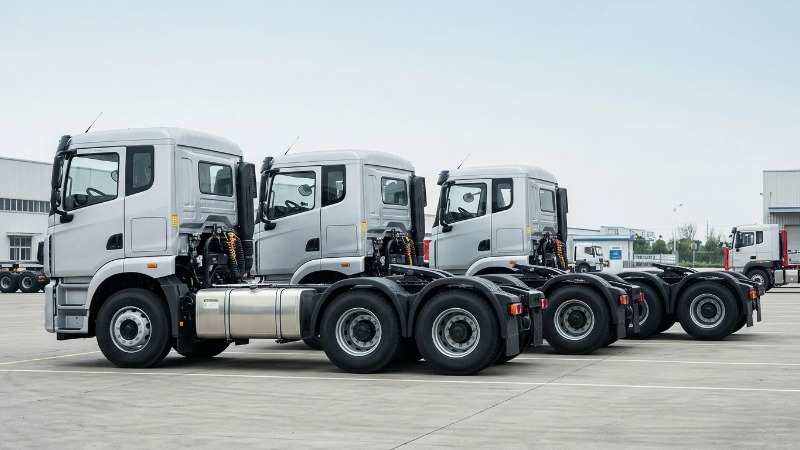
A 4×2 tractor truck has four wheel positions on two axles, and it drives two of them. A 6×4 has six positions on three axles and drives four, so it carries more legal weight and finds more grip, but it costs more to buy, weighs more empty and wears more tyres.
The notation is simple. The first number counts wheel ends, the second counts driven wheel ends. A 4×2 therefore drives one rear axle, while a 6×4 drives both axles of a rear tandem.
- Traction: a 6×4 puts power through two axles, helping on grades and soft ground.
- Capacity: the extra axle usually raises permitted combination weight.
- Cost: a 6×4 adds purchase price, tare weight and tyre exposure.
The practical difference shows up in what the truck can legally and physically move. A third axle spreads load across more contact area, which is why heavy combinations are commonly built on tandem drive. The same axle also adds steel, tyres and drivetrain components that you carry on every trip, loaded or not.
That extra tare weight is the trade-off people underweight. On a route where the trailer runs full but never meets an axle limit, a 6×4 can reduce payload rather than raise it. A 4×2 is lighter and cheaper to run, but it leaves less margin in both permitted weight and drive-axle grip.
Neither layout is better in the abstract. The right one depends on the weight you actually haul and the surfaces you actually cross, and the following sections work through both.
Which terms decide the configuration?
Learn seven terms before you compare quotes, because most spec disputes come from two people using the same word for different things. Each definition below is how the trade generally uses it, and the legal values behind them vary by jurisdiction.
- Axle notation — a two-number code in which the first number is the total wheel positions and the second is how many of them are driven, so 6×4 means six positions with four driven.
- Gross vehicle weight rating (GVWR) — the maximum loaded weight the manufacturer allows for the tractor itself, including its own weight, fuel, driver and the load carried on the fifth wheel.
- Gross combination weight (GCW) — the loaded weight of tractor and trailer together, which the engine, driveline, brakes and local law must all accommodate. Manufacturers often publish this as a gross combination weight rating.
- Fifth wheel coupling — the plate on the tractor chassis that locks onto the trailer’s kingpin and carries part of the trailer’s weight.
- Kingpin load — the share of the trailer’s weight that rests on the fifth wheel and, through it, on the tractor’s axles.
- Tag and pusher axles — non-driven axles fitted behind the drive axle (tag) or ahead of it (pusher) to spread weight and raise legal capacity.
- Lift axle — a non-driven axle that can be raised off the road when running light, which cuts tyre wear and rolling resistance and can be lowered to carry load.
Two of these are easy to confuse. GVWR limits the tractor alone, while GCW limits the whole combination, and a truck can satisfy one and fail the other.
The rule that holds is simple: the heavier your kingpin load and GCW, the more axles you need to carry them legally. It breaks when a fifth wheel sits too far forward or back, because moving it shifts load between the steer and drive axles. That is why axle load distribution, not axle count, is the real test.
4×2 vs 6×4 tractor truck: how do they compare on cost, traction and payload?
A 4×2 is the cheaper, lighter and more fuel-frugal tractor, but it has the least grip and the lowest legal combination weight. A 6×4 reverses each of those points: more traction and capacity, paid for in price, tare weight and tyre wear. Neither wins everywhere.
| Factor | 4×2 | 6×4 |
|---|---|---|
| Purchase price | Lower | Higher |
| Fuel use | Lower, with less weight and friction | Higher, mainly from extra tare weight and driveline drag |
| Tyres and maintenance | Fewer tyres, one drive axle to service | More tyres, a second drive axle and an inter-axle differential |
| Traction on grades and soft ground | Limited, especially unladen or on low-grip surfaces | Stronger, with two driven axles sharing the load |
| Permitted combination weight | Lower, set by the two-axle limit | Higher, subject to local axle rules |
The key takeaway: a 6×4 earns its extra cost only when weight or terrain demands it.
| Layout | Advantages | Limitations |
|---|---|---|
| 4×2 | Lower purchase price; lighter tare, so more payload within a given limit; simpler to maintain | Can spin on wet grades or loose surfaces; capped by lower legal weight limits |
| 6×4 | Better traction and gradeability; higher legal combination weight; load shared across more tyres | Higher price; heavier tare; more tyre wear and driveline upkeep; usually thirstier on flat highway runs |
Where each loses is predictable. A 4×2 loses on a steep, slippery site, where a stalled truck costs more than the price gap ever saved. A 6×4 loses on steady motorway freight, where you carry the extra axle’s weight and running cost without ever using its grip.
What are the 6×2 tractor truck advantages, and what do you give up?
A 6×4 pays for grip with two driven rear axles. A 6×2 makes the opposite bet: it drives one rear axle, carries a second that isn’t driven, and accepts less traction in return for lower running cost.
The second axle is either a tag axle behind the drive axle or a pusher ahead of it. Many are liftable, so the driver can raise the axle when the trailer is empty and lower it when the combination is loaded.
On steady highway work the case is straightforward. Dropping the second driven axle usually removes some drivetrain weight and friction, which tends to help fuel use. A lifted axle also cuts tyre contact and rolling resistance on empty runs, and the third axle still gives you more legal weight capacity than a 4×2 in most jurisdictions. That is the core of the 6×2 tractor truck advantages for long-haul freight.
| Advantages | Limitations |
|---|---|
| Usually lower fuel use than a 6×4 on steady highway routes | Less traction on grades, wet surfaces and soft ground |
| Lighter drivetrain, with less to maintain | Lifting the axle moves load onto the drive axle, which needs care on slippery roads |
| Fewer tyres wearing on empty runs when the axle is lifted | Lift controls and axle load settings add driver and maintenance discipline |
| Extra axle capacity compared with a 4×2 | Weaker off-highway ability and, often, weaker resale outside highway markets |
The trade-off is operational. A 6×2 rewards fleets with predictable routes and trained drivers, and it punishes sites where the truck must climb or start on loose surfaces. Check how your jurisdiction treats a lifted axle under axle limits before you rely on it.
How do GVWR and legal axle limits decide the layout?
Work backwards from the law, not forwards from the catalogue. Start with the axle and combination limits that apply where the truck is registered and operated, then test each layout against your real loads. Four checks do most of the work.
Combination limit. Gross combination weight (GCW) must stay under both the tractor’s rated figure and the legal maximum for the axle arrangement. A 4×2 pulling a tandem-axle trailer usually reaches its legal ceiling sooner than a 6×4 on the same trailer, because the third axle on the tractor adds permitted weight. Many jurisdictions tie the allowed total to axle count and spacing, so confirm the local rule rather than the brochure.
Per-axle limit. Steer, drive and trailer axle groups each carry their own cap. A combination that is legal on total weight can still be overweight on the drive axle, which is the usual failure on a 4×2 hauling dense cargo.
Fifth wheel position. Sliding the coupling forward shifts load onto the steer axle, while moving it back loads the drive axle. Kingpin load changes with trailer loading, so check the extremes, not just the average.
Typical versus worst-case cargo. Weigh the heaviest realistic payload, including fuel and driver, and not the figure on a good day.
Tip: Run the numbers on a weighbridge-style axle sheet before ordering. If the drive axle is within a few percent of its limit with the fifth wheel mid-travel, the layout is too small for the job.
Which tractor truck configuration is best for heavy hauling?
A fleet owner runs the same three-axle tractor on a quarry shuttle, a port container run and a 1,000 km highway lane. It works on the first, copes on the second and wastes money on the third. No single layout wins across all three, because the answer depends on route and load profile.
Heavy, slow and off-highway work
Quarry, mine-haul, timber and heavy-haul work on soft shoulders or steep grades favours a 6×4. Two driven rear axles hold traction when the surface gives way. The extra purchase price and tyre wear are the cost of not stalling on a loaded grade.
Steady long-haul freight
On a sealed highway at steady speed, a 4×2 or a 6×2 is usually the more economical choice. Less driveline friction and lower tare weight mean better fuel use and more payload. A 4×2 suits lighter combinations, and a 6×2 suits operations that need a higher legal combination weight without driving a second axle.
Regional distribution and drayage
These duty cycles sit in between. Stop-start work, yard moves and mixed road surfaces put more load on traction than a long-haul lane does, yet annual mileage is lower, so a 6×4’s fuel penalty hurts less. A 6×2 with a liftable axle can serve operators who run loaded one way and light the other, as long as drivers manage the axle correctly.
A generic example
Take a container operator whose tractors mostly run on paved roads but occasionally enter an unpaved, sloped yard. A 4×2 may slip there when loaded, while a 6×4 would carry its extra weight on every trip. A 6×2 with a lift axle can be a compromise, provided the yard is rare and the drivers are trained. If the yard is part of the daily route, choose the 6×4.
Does the engine and drivetrain choice change the answer?
Yes, but less than most spec sheets imply. Engine output, gearbox and rear axle ratio shape how a given axle layout performs. They do not replace the layout.
Will a bigger engine fix a traction problem?
No. Traction depends on the weight resting on driven wheels and on the grip of the tyres, not on horsepower. A high-output engine such as the Cummins X15 diesel engine, a 15-litre heavy-duty diesel, can deliver more torque to a 4×2’s single drive axle, and that axle will simply spin sooner on a wet grade. If the shortfall is grip, a second driven axle or a 6×2 with a controlled lift axle addresses it. Torque does not.
Can the engine be too big for the job?
Yes. On a light-duty cycle, such as short regional runs at moderate weights, a high-output rating adds purchase cost and often fuel burn without shortening trips. Match the rating to the heaviest realistic combination weight on your actual route, not the heaviest the chassis could ever carry.
Where do gearing and axle ratio come in?
The rear axle ratio sets the trade-off between pulling power and cruising speed. A numerically higher ratio helps on grades and heavy starts but raises engine speed at highway pace. A lower ratio suits steady long-haul freight and saves fuel. Pair it with a transmission whose steps fit the engine’s torque band, and confirm the pairing with the manufacturer rather than assuming any combination is approved.
Tip: Settle axle count first, then engine rating, then ratio. Reversing that order tends to produce an expensive tractor that still slips.
How do braking and compliance standards affect the purchase?
Buy against the braking standard that governs your registration, not the one printed in the brochure. A tractor built for one rulebook is not automatically legal under another.
The two reference systems are FMVSS (Federal Motor Vehicle Safety Standards) in the United States and ECE Regulation No. 13 (R13), the UN braking regulation used across Europe and in many markets that adopt UN regulations. FMVSS rests on manufacturer self-certification. ECE R13 relies on type approval, where an authority approves the vehicle type before it can be registered.
Axle count matters here. A 6×4 or a 6×2 with a liftable axle has more brake positions and more load-sensing logic than a 4×2, so the approval has to cover that exact layout and its weight rating. A lift axle fitted after delivery can void the approval unless the manufacturer allows it.
The rule breaks at the edges. Some markets accept either system, some accept only one, and used imports often face extra inspection. Trailer compatibility is a separate check, because the tractor’s air and electrical couplings must match the trailer’s braking system.
Before you sign, ask the seller for the following in writing:
- The standard the tractor was certified to
- The approval or certification document for this exact configuration
- Confirmation that your registry accepts it
If a seller cannot produce these, treat the quote as incomplete.
How do you choose a configuration, step by step?
Run the decision in this order, because each step narrows the options left for the next one.
- Define the heaviest realistic combination: tractor, trailer and the densest cargo you will actually load, not the average run.
- Check legal limits for that combination: the per-axle limits, the combination limit and the rated gross combination weight (GCW) of the tractor.
- Map the routes by grade, surface, distance and stop frequency, and note how much of the work is off paved roads.
- Test traction needs by asking whether the weight on the driven axle holds the grade, wet or loose surface you will meet in the worst week of the year.
- Compare total cost over your holding period, including purchase price, fuel, tyres, maintenance and expected resale, rather than the sticker price alone.
- Match the engine rating and rear axle ratio to the layout you have shortlisted, not the other way round.
Steps one and two usually eliminate a layout outright. If a 4×2 cannot legally carry your heaviest combination, no amount of cost analysis rescues it.
Steps three and four separate the survivors. Steady highway work tends to favour the lighter, cheaper layouts, while soft ground and steep grades push you toward two driven axles.
Rule of thumb: choose the lightest layout that stays legal at your heaviest load and still holds traction in your worst conditions. Pay for extra axles only when one of those two tests fails.
Which common mistakes and myths lead to the wrong tractor?
The common assumption is that more axles always means more payload. It doesn’t. A third axle raises the legal ceiling only where local rules allow it, and it adds tare weight, so cargo capacity can shrink on a lightly loaded lane even as the permitted combination weight grows.
“6×2 is unsafe”
The worry is usually about braking and stability when the non-driven axle is lifted. In practice, a lift axle is meant to be lowered under load, and a 6×2 that is operated that way, with a braking system certified to the governing standard, is not inherently less safe. The real risk is poor axle handling: driving a loaded combination with the axle raised, or on slick surfaces where the driven axle carries less weight than the driver assumes.
“4×2 can’t handle heavy loads”
A 4×2 can pull a heavy trailer on a paved highway if the combination stays within its rated and legal weight. What it lacks is grip. On steep grades, wet ground or unpaved yards, only one driven axle carries traction weight, so the limit is traction, not engine output or frame strength.
“The engine will make up the difference”
Extra horsepower does not add grip. Check the traction weight on the driven axle before you pay for a bigger rating.
Tip: Test every myth against the trade-off it hides: tare weight, traction or axle handling. If a claim ignores one of those, it is a sales line, not a spec.
What should you check before you buy a tractor truck?
Run this list against the written quote and the type-approval paperwork before you sign. Each item is cheap to verify now and expensive to fix after delivery.
- Confirm the axle ratings on the plate and in the quote match your planned gross combination weight.
- Verify the fifth wheel type, its mounting position and its height against the trailers it will actually pull.
- Request the brake certification for the exact configuration, under the standard your registration requires.
- Test the lift axle controls, including any automatic reloading and the pressure limits that apply.
- Read the warranty terms for exclusions on driveline, axles and engine, and for any weight or duty-cycle conditions.
- Itemise what the quoted price includes, such as tyres, fifth wheel, delivery, registration and inspection.
- Compare the stated tare weight with your payload calculation, since optional extras change it.
A quote that cannot answer these points in writing usually signals a spec nobody has finished checking. Ask for the missing items before you negotiate price.
FAQ
Can a 4×2 pull a heavy trailer?
Yes, within its rated combination weight. The limit is usually traction and the legal maximum for two axles, not engine power, so grades and wet ground are where it struggles.
Is a 6×2 worth it for short-haul work?
Usually not. Fuel savings build up over steady highway miles, while stop-start routes add axle handling and wear without much payback.
How much does a 6×4 weigh compared with a 4×2?
A 6×4 is heavier because of its extra axle, tyres and driveline. Check the tare weights on both quotes, since the gap reduces payload where weight limits bind.
Can a 6×2 be converted to a 6×4?
Rarely in a practical sense. It changes the driveline, axle and approvals, so ask the manufacturer first.
Which layout holds resale value better?
The one matching local demand. In quarry and heavy-haul markets that is often the 6×4; in highway freight, the 4×2 or 6×2.
Which configuration should you take away from this?
Choose the layout that matches your real loaded weight and your route, not the one with the most axles or the lowest sticker price. Three-axle tractors earn their cost where weight or terrain demands them. Elsewhere they add tare weight, tyre wear and purchase price.
In practice the answer usually falls into three groups. A 4×2 suits steady highway freight within its rated combination weight. A 6×2 suits the same work when fuel savings can build up over long, constant-speed miles and your drivers handle the liftable axle properly. A 6×4 suits quarry, timber, heavy-haul and soft-ground work, where grip and legal capacity matter more than running cost.
Regional distribution and drayage are the real judgment calls. Here the deciding factor is the heaviest realistic combination you will actually run, and how often you run it.
Before you request quotes, run that heaviest combination through the axle-load check: combination limit, per-axle limit, fifth wheel position and worst-case cargo. Ask each supplier to quote against the same figures, and confirm the layout is type-approved for the braking standard that governs your registration. Quotes built on one shared weight calculation are easy to compare. Quotes built on a catalogue are not.