


Buying a used Sinotruk Howo for African mining or quarry work? Check engine, axle rating, drive side and parts supply before price. Avoid costly mistakes.
Most expensive used-Howo mistakes happen while reading the listing, when the buyer compares price and model year and skips the engine variant, axle rating and drive side. Those three details decide how long Sinotruk Howo trucks used in Africa last on a particular route. Read the spec plate first. Negotiate after that.
A used Sinotruk Howo is a sound choice for mining, quarry and construction haulage in Africa when its configuration matches the payload, the road surface and the import rules of the destination country. Check the engine family, axle rating, drive side and local parts supply before price. A cheap truck with the wrong specification usually costs more within the first year of work.
- Configuration before cost: engine, axles and drive side matter more to service life than the year of manufacture.
- Compliance can stop the deal: age limits, steering-side rules and axle-load laws can block registration or lead to fines.
- Parts depth varies by variant: WD615-family trucks are the easiest to keep running in most African hubs.
- Maintenance decides reliability: shorter service intervals and load control matter more than the brand on the grille.
Why Price and Model Year Are the Wrong Place to Start
A used Howo pays off only when its configuration matches the payload, road surface and regulations it will face. Price and age are secondary filters. Two trucks of the same year can have very different working lives if one was built for its job and the other was not.
Look at what a listing price leaves out. A 2015 tipper with a lower-output engine and light-duty rear axles might look like a bargain next to a 2013 unit with heavier hub-reduction axles. On a laterite haul road carrying wet ore, though, the “newer” truck will wear out its driveline sooner and spend more days off the road.

Year of manufacture also tells you little about the hours a truck has actually worked. Many Howos run double shifts on mine sites, and odometers get replaced or fail. A truck’s recorded age and its real condition can be far apart.
Start with three filters instead:
- Duty match: payload, gradient, cycle length and road type compared with the engine output, gearbox and axle rating.
- Legal match: steering side, import age limits and axle-load compliance in the country where the truck will be registered.
- Support match: whether filters, injectors, clutch kits and axle parts for that exact variant are stocked within reasonable reach of the site.
Only units that pass all three belong on the shortlist. Comparing prices across that shortlist is a fair comparison. Comparing prices across everything listed is not.
Why Are Sinotruk Howo Trucks Used in Africa So Widely?
Sinotruk Howo trucks became a default choice in African mining and construction haulage because they pair simple, serviceable mechanicals with a low entry cost. A large existing fleet has also built up mechanic skills and parts networks around a few well-known engine families. That ecosystem is now as important as the truck itself.
China National Heavy Duty Truck Group (Sinotruk) has exported Howo models to Africa for well over a decade. They are now a common sight on quarry sites, road projects and mineral corridors in East, Southern and West Africa. A used Howo usually costs considerably less than a comparable European-brand truck of similar age, which matters to contractors who price tenders on tight margins.
The mechanical design helps. The WD615 engine family uses conventional mechanical or early electronic fuel systems that local workshops can diagnose without dealer software. Fleet managers often say a truck their own mechanics can fix in the yard is worth more than one with better specifications that waits weeks for a dealer technician.
The fleet size also feeds itself. As more units operate, more parts traders stock components, more mechanics learn the platform and the resale market gets deeper. That makes the next purchase less risky.
There are trade-offs. Cab comfort, fuel efficiency and emissions technology on older units lag behind current European and Japanese trucks. For short-cycle, high-load work, most operators accept that trade.
Terms and Configurations You Will See in Listings
Used Howo listings rely on shorthand that hides important differences. Read correctly, the axle formula, engine code, gearbox model, emission level, steering side and weight ratings tell you whether a truck suits your work before you spend money on an inspection. Misreading any one of them is a common reason buyers end up with the wrong truck.
- 6×4 tipper (dump truck) — a three-axle truck with six wheel positions, four of them driven (both rear axles), fitted with a hydraulically raised body for unloading bulk material.
- WD615 diesel engine — a family of inline six-cylinder diesel engines derived from a Steyr design and built by Weichai, widely used in older Howos in several output ratings.
- HW-series gearbox — Sinotruk’s own manual transmission range, such as the 10-speed HW19710, matched to the engine and expected load.
- Euro II/Euro III emission standards — European exhaust emission tiers that many older Howos meet, which matter where import rules set a minimum emission level.
- Right-hand drive (RHD) configuration — steering on the right side of the cab, required or preferred in countries that drive on the left.
- Axle load limits — the legal maximum weight each axle or axle group may carry on public roads, enforced at weighbridges.
- GVW (gross vehicle weight) — the total permitted weight of the truck, body and payload together.
Check every term against the chassis plate, not only against the seller’s description.
Which Howo Configuration Fits Your Haulage Work?
The job decides the Howo configuration. Tipper body volume, engine output band, axle and suspension rating, and cab type should follow the material density, cycle length and road quality. A truck that is right for an urban site will usually wear out quickly in open-pit work, and the reverse wastes fuel and capital.
Cab choice matters more than many buyers expect. The Sinotruk Howo A7 is a later-generation heavy truck with a more refined cab and generally higher-spec drivelines, and it suits longer shifts and road runs. The standard Howo cab is simpler and cheaper to repair, and it is common on site-bound tippers.
| Duty | Engine output | Axles / suspension | Cab |
|---|---|---|---|
| Quarry, short cycle | Mid to high WD615 rating | Hub-reduction, heavy leaf springs | Standard Howo |
| Open-pit mining | Higher rating | Heaviest available rating | Standard, reinforced |
| Urban construction | Mid rating | Road-legal axle loads | Standard or A7 |
| Cross-border mixed roads | Higher rating | Compliant axle spacing | Howo A7 |
The main point of the table: as haul severity rises, axle and suspension rating should rise with it, and cab comfort should rise as road distance grows.
Matching the Truck to the Job
- Quarry contractor: needs fast loading cycles on short, rough tracks. Look for a reinforced body floor, hub-reduction axles and an intact PTO.
- Open-pit mine operator: needs trucks that tolerate heavy, abrasive loads on steep ramps. Look for heavy axles, a sound frame without repair welds and strong cooling.
- Urban builder: needs trucks that stay within public-road axle limits. Look for a moderate body volume and clean registration papers.
- Cross-border hauler: needs comfort and compliance across several jurisdictions. Look for an A7 cab, the correct steering side and documents that satisfy every border.
Are Chinese Trucks Reliable in Africa?
Chinese trucks such as the Howo are reliable in Africa when they are correctly specified, not run chronically overloaded and serviced on time. Most failures come from a short list of known weak points: poor fuel quality, dust ingress, corroded electrical connectors and sustained overloading, rather than from basic design faults.
Contaminated or high-sulphur diesel damages injectors and pumps. Dust gets past tired air-filter seals and wears out cylinders. Connectors exposed to washdown water and mud cause intermittent electrical faults, and these are often misdiagnosed as engine problems. Overloading cracks frames and overheats wheel-end bearings.
Several common mistakes make these problems worse:
- Assuming the brand explains failures. Blaming the manufacturer hides a specification or maintenance gap. Record the root cause of each breakdown before deciding a model is unreliable.
- Treating rated payload as a target to exceed. Regular overloading shortens frame and axle life and adds weighbridge fines. Set a site payload limit and check it with scales or load-sensing.
- Keeping factory service intervals in severe duty. Intervals written for normal operation are too long for dusty mine work. Shorten them based on oil analysis or filter condition.
- Buying a mixed fleet of variants. Every extra engine or gearbox type adds parts stock and mechanic training. Standardise on one or two configurations.
How to Choose Used Heavy Duty Trucks in Africa: Key Criteria
Choosing used heavy duty trucks in Africa comes down to legal fit first and mechanical condition second. Drive side, import age limits, emission rules and axle-load compliance decide whether a truck can be registered at all. Engine hours, chassis condition and documentation then decide what the registrable truck is actually worth.
- Drive side: confirm whether the destination country requires RHD or left-hand drive (LHD). Some markets restrict registration of the other configuration.
- Import age limits: many countries cap the age of imported used commercial vehicles or add duty penalties above a threshold. Check the current rule before you bid.
- Emission rules: confirm whether a minimum Euro tier applies to imported trucks.
- Axle load compliance: make sure axle spacing and ratings let the truck carry a working payload legally.
- Engine hours and chassis condition: ask for service records and judge wear from physical evidence, not the odometer.
- Documentation: confirm that the title, export papers and the VIN on the chassis all match.
Rule of thumb: if a truck cannot be registered and run legally loaded in the destination country, no price makes it a good buy.
Regulations and Inspections to Check Before Import
In East Africa, the EAC Vehicle Load Control Act (2016) sets harmonised axle-load and GVW limits across member states. SADC and ECOWAS have their own regional axle-load frameworks, and enforcement varies by country and corridor. National rules on used-vehicle age differ widely and change from time to time. Some markets also require a pre-export roadworthiness inspection by an approved agency before shipment.
Note: Confirm age, steering-side and inspection rules with the destination country’s revenue authority or a licensed clearing agent shortly before purchase. Rules can change between shortlist and shipment.
Buying Used Dump Trucks in Africa: Inspection and Purchase Steps
Buying used dump trucks in Africa safely follows a fixed order: identity checks, physical inspection, a loaded test, written terms, then shipping, clearance and registration. Skipping identity or inspection steps to save time is how buyers end up with cloned VINs, hidden frame repairs or trucks that will not pass local roadworthiness tests.
- Verify that the VIN and engine number on the truck match the title and export documents.
- Inspect the truck yourself or appoint an independent third-party inspector with heavy-truck experience.
- Test-drive the truck under load, including a gradient and a full tipping cycle.
- Agree contract terms that cover condition at handover, payment milestones and the Incoterm, such as FOB or CIF.
- Book shipping with a forwarder that handles RoRo or flat-rack cargo to your port of entry.
- Clear customs through a licensed agent who has the full document set.
- Pass the national roadworthiness inspection and register the truck before it goes into service.
On-Site Inspection Checklist
- Check blow-by at the oil filler and watch the exhaust smoke from cold start and under load.
- Engage every gear and the PTO, and listen for grinding or slipping.
- Raise the body fully and inspect the tipping ram and hoses for leaks.
- Examine chassis rails for cracks, fishplates and fresh welds.
- Jack each axle and test the hubs for play.
- Measure tread depth and look for cuts and mismatched tyres.
- Trace the electrical harness for corrosion, splices and bypassed fuses.
How Easy Is Used Truck Spare Parts Availability in Africa?
Used truck spare parts availability in Africa is usually good for WD615-family Howos in major hubs such as port cities and mining regions. Newer or less common engine and transmission variants can mean longer lead times, sometimes weeks if parts have to come from China. Check the supply for your exact variant before buying.
The parts market has three tiers. Genuine parts come through Sinotruk or Weichai channels and cost the most. OEM-equivalent parts come from manufacturers who supply the same specification, often at a lower price. Aftermarket parts vary widely in quality, especially filters, injectors and brake linings.
Before you commit, ask two or three local parts dealers to quote a standard list for the exact engine and gearbox code: a filter set, injector nozzles, a clutch kit, wheel bearings and a tipping-ram seal kit. Quick quotes with stock on the shelf point to a well-supported variant. Vague answers or “order from China” point to downtime risk.
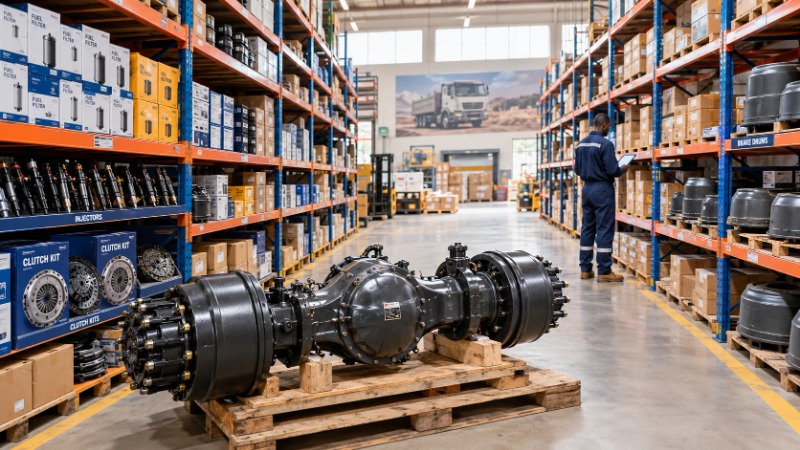
After-sales spare parts availability also depends on distance. A truck based several hundred kilometres from the nearest stockist needs a larger on-site stock of fast-moving parts.
Tip: Photograph the engine and gearbox data plates during inspection and send them to local dealers. Part numbers matched to plates prevent costly ordering mistakes.
Chinese Tipper Truck Maintenance Tips for Harsh Operating Conditions
Chinese tipper truck maintenance in harsh conditions works best with shorter filter and fluid intervals, better fuel filtration, strict greasing and firm load control. These four habits do more to extend service life in dusty, hot and overloaded work than any single component upgrade. Most of them cost little compared with one major breakdown.
- Air filtration: check the air filter and its seals often, daily on dusty sites, and fit pre-cleaners where dust is heavy.
- Oil and filters: severe-duty fleets commonly change oil at well under the normal-duty interval. Oil analysis helps set the right point.
- Fuel: add a water-separating pre-filter and drain it every day. Buy diesel from controlled sources where you can.
- Greasing: grease the body hinge pins, kingpins, propshaft joints and spring shackles on a fixed schedule.
- Cooling: blow out radiator fins regularly, because packed dust causes overheating on long climbs.
- Electrical: seal exposed connectors with dielectric grease and avoid pressure-washing them.
For example, a quarry fleet with repeated injector failures might trace the cause to water in bulk-stored diesel, then fix it with a tank drain routine and an extra separator rather than replacing injectors again and again.
Load control finishes the picture. Weigh trucks regularly and train loader operators on target bucket counts, so payloads stay consistent.
FAQ: Used Howo Trucks for African Operations
Do used Howo trucks hold resale value in Africa?
Yes, reasonably well in markets with large Howo fleets. Demand from smaller contractors keeps WD615-powered tippers in good condition easy to resell, while rare variants and trucks with frame repairs sell more slowly and at deeper discounts.
Can an LHD Howo be converted to RHD?
Sometimes, but it is rarely worth it. A conversion involves the steering box, column, pedal box and dashboard, and some countries restrict registering converted vehicles. Buying a truck already built in the required configuration is usually cheaper and avoids approval problems.
Is it better to buy from Asia, the Middle East or locally?
It depends on your ability to inspect. Overseas sources often offer more choice and lower prices but add shipping, duty and inspection costs. Buying locally lets you test the truck in person and may simplify registration.
What service intervals suit severe-duty Howo tippers?
Shorter than the manufacturer’s normal-duty figures. Many operators roughly halve the oil and filter intervals on dusty mine or quarry work and adjust from there using oil analysis results and filter condition.
Can used Howo trucks be financed?
Often yes, through asset finance or equipment leasing, though lenders may cap the truck’s age and require an independent valuation. A clear title and a professional inspection report make approval more likely.
Final Checks Before You Commit
The order that protects a used Howo purchase is simple: fit the specification to the route, confirm compliance and parts supply for the destination, and only then negotiate price. A truck that clears those checks will usually earn back its cost. One that fails any of them tends to turn into a long-running repair bill.
Your next step is to write a one-page spec sheet before looking at listings. It should state the payload, haul road type, required steering side, maximum import age, target engine family and axle rating. Use it to filter sellers, then arrange an independent inspection of each shortlisted truck before any deposit leaves your account.
Send your spec sheet, the number of trucks and the destination country to an experienced heavy-truck inspector or a licensed clearing agent and ask for an inspection and landed-cost estimate on your shortlisted units.