




Introduction
Freight transportation forms the core foundation of all commercial and infrastructure industries. Whether you run local distribution businesses, cross-border logistics fleets, supply chain companies or international truck dealerships, reliable cargo trucks directly determine your daily delivery efficiency and long-term profit margins.
In the global commercial vehicle market, fleet owners now face obvious cost challenges. European and American brand cargo trucks deliver stable performance, yet their extremely high purchase costs and expensive spare parts greatly squeeze business profits. Meanwhile, local used trucks often come with hidden faults, inconsistent maintenance and unpredictable downtime risks.
For these practical reasons, more and more global logistics operators choose to purchase genuine Chinese heavy-duty trucks. Among all export truck series, the HOWO cargo truck stands out as the most cost-effective and widely verified option for global freight scenarios.
Sinotruk HOWO cargo trucks cover full-range models including 4×2 light-medium logistics trucks, 6×4 heavy-duty flatbed trucks and customized heavy-duty variants. They perfectly adapt to urban distribution, intercity long-haul transportation, cross-border freight and industrial material delivery.
Compared with other Chinese truck brands, HOWO cargo trucks feature more mature chassis structure, lower comprehensive fuel consumption and more flexible export customization. Even for buyers new to Chinese truck imports, HOWO series always bring stable and low-risk procurement experience.
However, many overseas buyers lack systematic knowledge when sourcing HOWO cargo trucks. Without clear model matching, supplier verification and import procedures, you may encounter configuration errors, customs clearance failures and after-sales gaps.
This complete buying guide elaborates on HOWO cargo truck model parameters, applicable scenarios, factory customization, import workflows, document preparation and risk avoidance. If you want to browse genuine factory-new truck displays, you can visit Mettlead Truck official website.
Why Global Buyers Choose HOWO Cargo Trucks for Freight Business
Before you confirm your truck order, it is essential to understand the core competitive advantages of HOWO cargo trucks. Their huge global market share does not come from simple low pricing. Instead, it originates from practical performance that fits real freight operation needs.
First and foremost, HOWO cargo trucks offer outstanding cost performance. Under the same load capacity and power configuration, genuine HOWO trucks reduce overall procurement costs by 40% to 50% compared with Western brands. For fleet buyers and truck dealers, this advantage greatly improves profit space for vehicle investment.
In addition, HOWO adopts fully mature industrial supply chain. As the core export series of Sinotruk, every core component including engine, gearbox, axle and chassis is mass-produced with unified standards. Stable part quality effectively reduces long-term failure rates during high-frequency freight operations.
Furthermore, model coverage is extremely comprehensive. The HOWO cargo truck product line ranges from lightweight 4×2 urban delivery models to heavy-duty 6×4 long-haul flatbed trucks. It can fully cover small-batch local distribution and large-volume cross-country logistics transportation demands.
Meanwhile, export-oriented customization capability solves regional usage barriers. Different countries have different traffic rules, emission standards and cargo transportation habits. Professional Chinese exporters can adjust steering mode, emission grade, cargo platform structure and auxiliary configurations to meet local market access requirements.
Another key advantage lies in global spare part compatibility. Since HOWO trucks have been exported globally for decades, wearing parts and core accessories are widely available in overseas local markets. This greatly shortens maintenance cycles and avoids long-term fleet stagnation caused by missing parts.
Finally, standardized one-stop export services lower the threshold for cross-border procurement. Formal export suppliers can complete production tracking, pre-shipment inspection, document sorting and sea shipping arrangements. If you want to learn professional truck selection skills, you can check our blog about how to choose a heavy truck manufacturer in China.
Complete Model Classification of HOWO Cargo Trucks for Sale
Different HOWO cargo truck models correspond to completely different operation scenarios. Many buyers make procurement mistakes by only referring to price rather than matching actual business needs. In fact, reasonable model selection can directly reduce fuel consumption, maintenance costs and improve transportation efficiency.
In general, export HOWO cargo trucks are divided into three core categories: 4×2 light-medium cargo trucks for short-haul logistics, 6×4 heavy-duty flatbed trucks for long-distance freight and customized heavy-duty models for special industrial transportation.
HOWO 4×2 Cargo Truck | Light & Medium Short-Haul Logistics Model
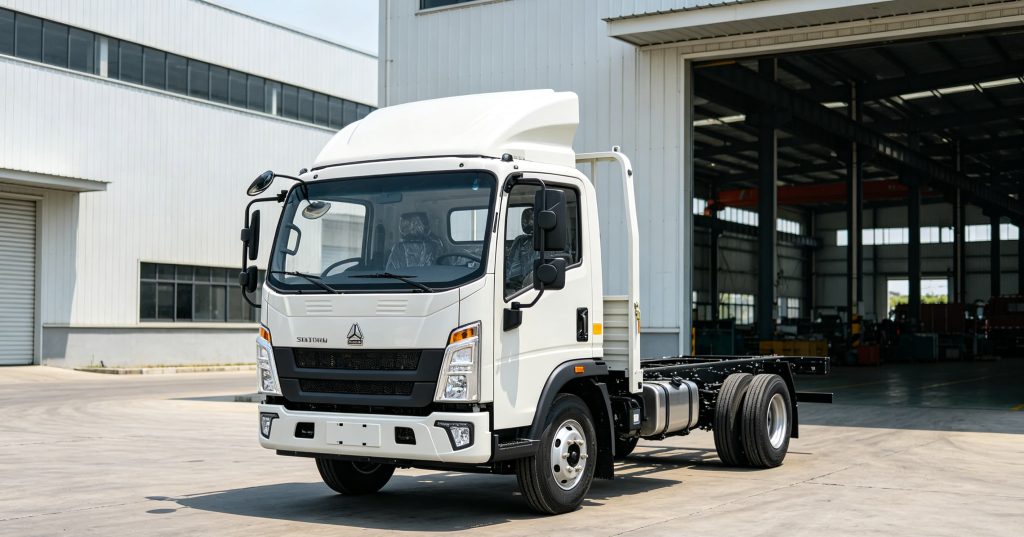
The HOWO 4×2 cargo truck is the most popular entry-level logistics model. It is specially designed for urban distribution, rural commodity transportation, small-batch cargo delivery and regional short-distance freight tasks.
This model features flexible body size and sensitive driving response. It can easily adapt to narrow urban roads, village lanes and complex suburban traffic environments. For small logistics companies and individual truck owners, it is the most practical daily operation model.
In terms of power configuration, mainstream export versions adopt 160HP to 220HP diesel engines. The power output is stable and fuel consumption is economical, fully meeting daily light-load and medium-load transportation needs.
The cargo body can be customized into box type, stake type and flatbed type. Closed box structures protect goods from rain, dust and sun exposure. Stake structures are suitable for agricultural products, textile goods and irregular bulk cargo.
Overall, the HOWO 4×2 cargo truck features low purchase cost, low maintenance difficulty and high operational flexibility. It is the preferred model for startup logistics fleets and local distribution businesses in emerging markets.
HOWO 6×4 Cargo Truck | Heavy-Duty Long-Haul Freight Model
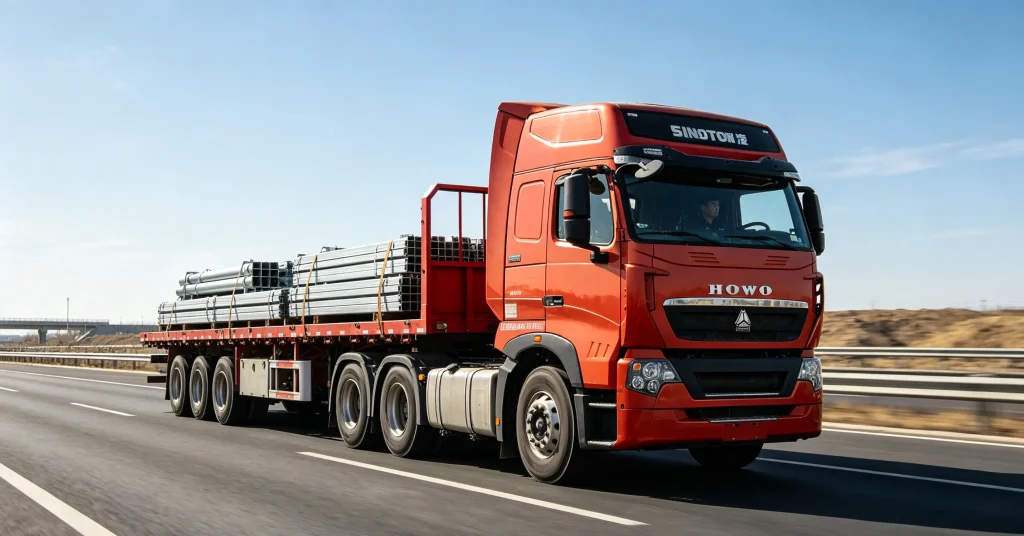
The HOWO 6×4 cargo truck belongs to standard heavy-duty logistics equipment. It mainly targets intercity long-haul transportation, cross-border freight, large-volume industrial material delivery and highway bulk cargo transportation.
Equipped with 371HP to 420HP high-power engines, this model provides sufficient power reserve for full-load long-distance driving. The matched heavy-duty gearbox and reinforced chassis ensure stable performance during continuous high-speed operation.
Compared with 4×2 models, the 6×4 layout has stronger load-bearing capacity and better road grip performance. It can adapt to long-time highway driving and occasional complex road conditions, greatly improving single-trip cargo volume.
Most professional logistics fleets and large freight companies choose HOWO 6×4 cargo trucks for batch procurement. Its comprehensive stability and durability can effectively support high-intensity daily operation and create stable long-term revenue.
HOWO Heavy-Duty Custom Cargo Truck | Special Industrial Transport Model
In addition to standard logistics models, Sinotruk also supports personalized heavy-duty cargo truck modification. These customized models are aimed at special industrial scenarios that ordinary trucks cannot adapt to.
Customization items include widened and lengthened cargo platforms, reinforced beam structures, anti-slip cargo beds, hydraulic auxiliary devices and special vehicle lighting systems. It can transport mechanical equipment, construction materials, steel structures and oversized goods.
Meanwhile, factories can carry out climate-oriented modifications according to target regions. High-temperature heat dissipation upgrades, dust-proof processing, chassis anti-rust treatment and waterproof circuit settings can effectively adapt to deserts, humid coastal areas and rainy tropical regions.
Key Parameter Comparison of HOWO Export Cargo Trucks
To help buyers quickly screen suitable models, we sort out the core parameter differences between mainstream export HOWO cargo trucks. Clear parameter comparison can avoid blind ordering and configuration mismatch.
For the HOWO 4×2 cargo truck, the total vehicle length is usually between 6.8 meters and 9.6 meters. The load capacity ranges from 5 tons to 12 tons. It is suitable for short-distance and high-frequency light cargo transportation.
For the HOWO 6×4 cargo truck, the vehicle length is generally 12 meters. The load capacity can reach 25 tons to 30 tons. It focuses on high-volume, long-cycle highway freight tasks.
In terms of fuel economy, 4×2 models have lower daily fuel consumption, which is friendly for low-profit small-batch distribution. 6×4 models have higher single-haul efficiency, which is more cost-effective for large-volume long-haul logistics.
In terms of road adaptability, 4×2 models are flexible and suitable for complex urban and rural roads. 6×4 models have stable chassis and are more suitable for long-distance straight highway driving.
You can select the most matching model according to your daily cargo weight, transportation distance and road environment. If you need professional parameter matching suggestions, you can refer to verified real cases on our cooperative case page.
Export Customization Options for HOWO Cargo Trucks
Standard domestic HOWO cargo truck configurations cannot fully adapt to overseas market rules. Therefore, factory-level customization is a necessary step for successful import and legal road operation.
Steering mode adjustment is the most basic and common modification. Many countries and regions implement right-hand drive traffic rules. Professional factories can complete standard right-hand drive conversion during production, ensuring the whole vehicle meets local traffic standards.
Emission standard customization directly affects vehicle registration. Chinese factories support Euro 2 to Euro 6 multi-level emission configurations. Buyers need to confirm local environmental protection policies in advance to avoid registration failure caused by inconsistent emission standards.
Cargo body structure can be freely adjusted according to business attributes. Box type, stake type, flatbed type and semi-enclosed structures are all optional. You can also customize cargo bed thickness, side plate height and binding fixed structures.
Regional adaptive modification greatly improves vehicle service life. For high-temperature desert areas, enhanced heat dissipation and dust-proof systems can reduce engine failure. For humid and rainy areas, chassis anti-corrosion and waterproof treatment can avoid aging damage.
Auxiliary functional configurations can also be upgraded freely. Reversing radar, monitoring system, shock absorption optimization and interior configuration upgrades can improve driving comfort and operational safety.
It is worth emphasizing that all key modifications must be completed in the original factory. Post-purchase secondary refitting will damage vehicle original performance and invalidate certification documents, resulting in customs clearance obstacles.
How to Screen Qualified HOWO Cargo Truck Suppliers
Many overseas buyers encounter procurement risks not because of poor vehicle quality, but because of unqualified suppliers. The market is flooded with informal intermediaries who sell refurbished trucks and modified vehicles as brand-new factory products.
First, you must verify the supplier’s official Sinotruk OEM authorization. Only authorized export companies can obtain pure original factory HOWO cargo trucks. Unauthorized traders often assemble vehicles through small workshops, leading to unstable quality and no official after-sales guarantee.
Second, check the completeness of export certification documents. Formal export vehicles are equipped with CE, ISO and SGS certification reports. These documents are essential for overseas customs clearance and vehicle registration.
Third, inspect vehicle factory information. Every genuine HOWO cargo truck has a unique chassis number and engine number. The numbers correspond to factory production records, which can effectively identify refurbished vehicles.
Fourth, confirm supplier’s after-sales and spare part supply capacity. Cross-border truck investment is long-term asset deployment. Only suppliers with mature global spare part channels can ensure long-term stable fleet operation.
Fifth, judge quotation transparency. Standard factory quotations list all configurations, service contents and charging items in detail. Too low abnormal quotations often imply configuration reduction and quality cutting.
If you want to find reliable long-term cooperative suppliers, you can learn more industry experience through our truck knowledge base.
Step-by-Step Guide to Import HOWO Cargo Truck from China
Cross-border truck import seems complicated, but it is actually a standardized and repeatable process. As long as you follow formal steps, you can avoid most procurement risks and complete import efficiently.
First, sort out your accurate demand parameters. Clarify truck model, drive type, horsepower, cargo body type, emission standard, steering mode, working environment and purchase quantity. Clear demand is the premise of accurate quotation and production.
Second, obtain official written quotation and configuration list. Compare multiple formal quotes and confirm all configuration details. Do not trust oral promises. After confirming no doubts, sign a formal sales contract and pay deposit to start production.
Third, track real-time production progress. Reliable export suppliers will regularly update production photos and videos. You can check chassis assembly, engine debugging, cargo body installation and overall vehicle quality in real time.
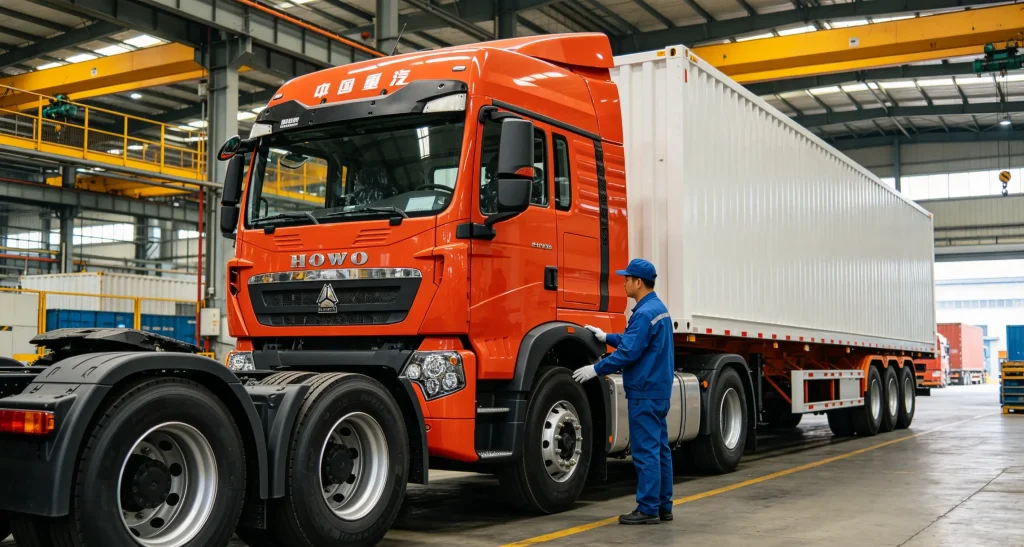
Fourth, complete strict pre-shipment inspection. Before delivery, comprehensively check vehicle appearance, power performance, braking system, electrical system and cargo body quality. At the same time, verify the integrity of all export documents.
Fifth, arrange balance payment and export shipment. After passing inspection, pay the final payment. The export team will complete China customs declaration, container loading or ro-ro shipment and arrange sea transportation.
Sixth, receive documents and complete local customs clearance. After shipment, you will get full set of customs clearance files. You can complete destination port declaration, tax payment and vehicle pickup according to local import rules.
For bulk fleet buyers and long-term dealers, you can contact the professional team through our contact us page to obtain exclusive bulk procurement solutions.
Necessary Customs Clearance Documents for HOWO Cargo Truck Import
Complete document preparation determines whether customs clearance can be completed smoothly. Missing documents or inconsistent information will lead to cargo detention, high warehouse fees and delayed project progress.
Basic trade documents include commercial invoice, packing list and original bill of lading. These three files are used for cargo verification and tariff calculation, which are essential for all import declarations.
Vehicle qualification documents include original factory certificate, factory inspection report, CE certificate, SGS test report and ISO qualification documents. These certificates prove that the vehicle meets international export standards.
The certificate of origin is also very important. It can help buyers in many regions enjoy preferential tariff policies, effectively reducing overall import costs.
All document information must be completely consistent with vehicle chassis number and engine number. Professional export suppliers will double-check all files before shipment to ensure zero errors.
Common Procurement Risks and Practical Avoidance Methods
Many first-time importers encounter unnecessary losses due to lack of experience. Summarizing common risk points can help you standardize procurement operations and protect capital safety.
The first risk is ultra-low misleading quotations. Some informal traders attract orders with extremely low prices. After receiving deposits, they replace core parts with inferior accessories or reduce standard configurations, resulting in unqualified vehicle performance.
The second risk is configuration mismatch. Insufficient early communication may lead to vehicles failing local emission standards, traffic rules or cargo capacity requirements, making them unable to be registered and used locally.
The third risk is incomplete after-sales service. Many small trading companies only complete delivery without follow-up technical support and spare part supply. Once the vehicle fails, buyers cannot get effective solutions.
The fourth risk is false certification documents. Individual vendors forge certificates to save costs. Once detected by customs, the goods will be detained and buyers will face economic losses.
To avoid the above risks, you must choose factory-authorized suppliers, sign standardized contracts, retain all configuration confirmation records and strictly implement pre-shipment inspection.
Regional Application Advantages of Export HOWO Cargo Trucks
Different global regions have different freight characteristics and environmental conditions. HOWO cargo trucks can adapt to diversified market demands through targeted configuration adjustments.
For African markets, road conditions are complex and dust is heavy. Modified dust-proof and reinforced chassis HOWO cargo trucks can adapt to local long-distance freight and material transportation needs.
For Southeast Asian markets, right-hand drive models are mainstream. Humid and rainy climate requires chassis anti-rust and waterproof modifications to extend vehicle service life.
For Middle Eastern markets, high temperature and sandstorms are common. Heat dissipation system upgrades and sand-proof configurations ensure stable vehicle operation in desert environments.
For South American and Central Asian markets, cost performance and durability are the core demands. Standard 4×2 and 6×4 HOWO cargo trucks can fully meet local logistics and industrial transportation needs.
After-Sales Service and Global Spare Part Guarantee
Purchasing cargo trucks is a long-term fleet asset investment. Perfect after-sales system directly determines the long-term operation efficiency and maintenance cost of your fleet.
Formal export suppliers provide 24-hour online technical support. Professional engineers can remotely guide fault diagnosis, daily maintenance and standardized operation to reduce vehicle failure rates.
In terms of spare part supply, HOWO truck accessories have a global mature supply chain. Core wearing parts and key components can be shipped quickly to reduce fleet downtime.
Bulk procurement customers can also obtain free spare parts, regular maintenance training and priority after-sales service, helping fleets achieve standardized and low-cost management.
Bulk Procurement Tips for Truck Dealers & Large Fleets
If you are an international truck dealer or large logistics fleet operator, bulk procurement can obtain more favorable factory prices and exclusive service policies.
First, confirm factory mass production capacity to ensure delivery cycles match your market deployment plan. Stable delivery is the foundation of long-term cooperative development.
Second, negotiate long-term framework cooperation agreements. Long-term partners can enjoy fixed preferential pricing, priority production rights and customized service solutions.
Third, synchronously purchase batch spare parts during vehicle procurement to build local spare part inventory and improve maintenance response speed.
Fourth, arrange sampling inspection for batch orders to ensure unified quality of all vehicles and avoid individual configuration errors.
FAQs About Buying HOWO Cargo Trucks from China
Q1: Is there a minimum order quantity for HOWO cargo truck export?
A1: No strict MOQ. Formal suppliers support single trial orders and large-scale bulk orders, adapting to individual users, small fleets and dealers.
Q2: Can I customize right-hand drive and local emission standards?
A2: Yes. All export configurations can be adjusted according to local traffic rules and environmental policies to ensure legal registration.
Q3: What is the production and shipping cycle?
A3: Standard stock models can be shipped within 7-15 working days. Conventional customized orders take 20-30 working days. Special modifications take 30-45 working days.
Q4: Are all exported HOWO cargo trucks brand new original factory vehicles?
A4: Regular export suppliers only provide 100% brand-new OEM original trucks without refurbishment or secondary assembly.
Q5: How to solve vehicle faults after arriving at the destination?
A5: Professional suppliers provide lifelong online technical guidance and global spare part supply support to ensure timely fault solving.
Conclusion
As a mature and cost-effective logistics transportation equipment, the HOWO cargo truck has always been the preferred choice for global freight fleets and truck dealers. The full-series models including 4×2 light-medium trucks and 6×4 heavy-duty flatbed trucks can cover all types of freight operation scenarios.
With reliable manufacturing quality, flexible export customization, affordable factory pricing and complete after-sales system, HOWO cargo trucks help global buyers reduce procurement costs and improve fleet operation benefits.
When importing HOWO cargo trucks, standardized supplier screening, accurate model matching, reasonable factory customization and complete document preparation are essential links to ensure smooth project progress.
If you are looking for genuine factory-new HOWO cargo trucks and one-stop export services, Mettlead Truck provides professional customized solutions, full-set certification documents and reliable global shipping support. You can contact our team to get the latest factory quotation and free procurement guidance.