


Is bigger always better? Learn how to buy a truck, compare new vs used, find used trucks for sale near me, and know what to check before you pay.
The rule gets repeated at every dealer lot and job site: buy the biggest truck you can afford, and buy it used. Each half holds up in some cases and fails in others, and this guide shows where. It covers matching the truck to the job, choosing new or used, inspecting, and financing across the trucks for sale you are likely to see.
- Rated capacity: match GVWR and payload to your heaviest load.
- Licensing: check CDL thresholds before shortlisting any unit.
- Condition: verify records and inspect, rather than trust mileage.
- Total cost: compare financing and ownership cost, not payments.
Why does “buy the biggest truck you can afford” fail so often?
Oversizing is expensive because size is not capacity. A larger truck raises the purchase price, insurance, fuel use and tire and brake costs, and it can push you across the weight line into CDL territory. What matters is rated capacity: the GVWR, payload and towing figures that fit your actual loads.
That is the first myth. Three more travel with it.
“Low mileage means healthy”
Mileage tells you distance, not how the truck was used. Short stop-and-go trips, long idling hours and heavy towing wear a truck in ways the odometer hides, so engine hours and service records say more.
“A clean title means clean history”
A clean title only means no brand has been recorded in that state. A VIN history report can show accident, flood or odometer problems that never reached the title, though even it misses unreported damage.
“Dealer financing is always the convenient choice”
It is convenient, but convenience is not the same as a good rate or good terms. Get a bank or credit-union quote first, so you have something to compare the dealer’s offer against.
How do you match a truck to the job before you look at a single listing?
Start with the heaviest load you realistically carry, then work backward to a rated capacity with margin. Six criteria do most of the filtering, and they are worth settling in writing before any listing tempts you.
Load
Heaviest realistic load. Use the worst day you expect to repeat, not the one-off. Add the weight of the cargo, tools, passengers and any trailer, then size GVWR, payload and towing capacity above that figure. A margin of some tens of percent is common practice, because a truck run at its limit wears faster and stops worse.
Route and duty cycle
Route and duty cycle. Short stop-and-go delivery, steep grades and long highway hauls stress different parts of the truck. Annual mileage and idle time matter as much as weight, since they decide what engine and cooling setup earns its keep.
Axle and drivetrain
Axle and drivetrain. Single or dual rear wheels, 4×2 or 4×4, and axle ratings set real limits on load and traction. Pay for four-wheel drive only if you work on soft or unpaved ground.
Body type
Body type. A pickup bed, flatbed, stake body or box changes usable payload and how fast you can load. Choose the body that fits the cargo’s shape first.
Fuel and service access
Fuel and service access. Diesel suits heavy, high-mileage work; gasoline often costs less up front and for light duty. Whatever you pick, confirm that a qualified shop and parts supply are within practical reach of your route.
Two regulatory lines should shape the shortlist. In the US, a vehicle with a GVWR of 26,001 lb or more generally falls into commercial driver’s license territory, and Class 8 begins above 33,000 lb GVWR.
Note: Payload is GVWR minus curb weight, and upfitting eats into it. A toolbox, crane, liftgate or steel flatbed can remove a meaningful share of the payload you thought you had.
Which trucks for sale fit your work: pickup, flatbed or Class 8?
A pickup with a bed or a flatbed suits light and medium work. A box truck suits protected, repeatable deliveries. A Class 8 tractor only earns its keep when it runs heavy and runs far, week after week.
The table sets the four common configurations side by side. The pattern is simple: each step up in capacity adds licensing, compliance and running cost, so move up only when the work forces you to.
| Configuration | Typical use | License needs | Upfit flexibility | Running cost and main trade-off |
|---|---|---|---|---|
| Pickup bed | Tools, light materials, towing a trailer | Usually standard license | Moderate | Lower cost; payload runs out quickly |
| Flatbed or stake body | Pipe, lumber, pallets, machinery | Standard or CDL, depending on GVWR | High | Moderate cost; cargo is exposed and needs securing |
| Box truck | Enclosed freight, furniture, parcels | Standard or CDL, depending on GVWR | Lower once built | Moderate cost; fixed body limits load types |
| Class 8 tractor | Long-haul and heavy trailer work | CDL in nearly all cases | Depends on the trailer | Highest cost; needs steady high-weight, high-mileage duty |
Configuration spotlight: the flatbed
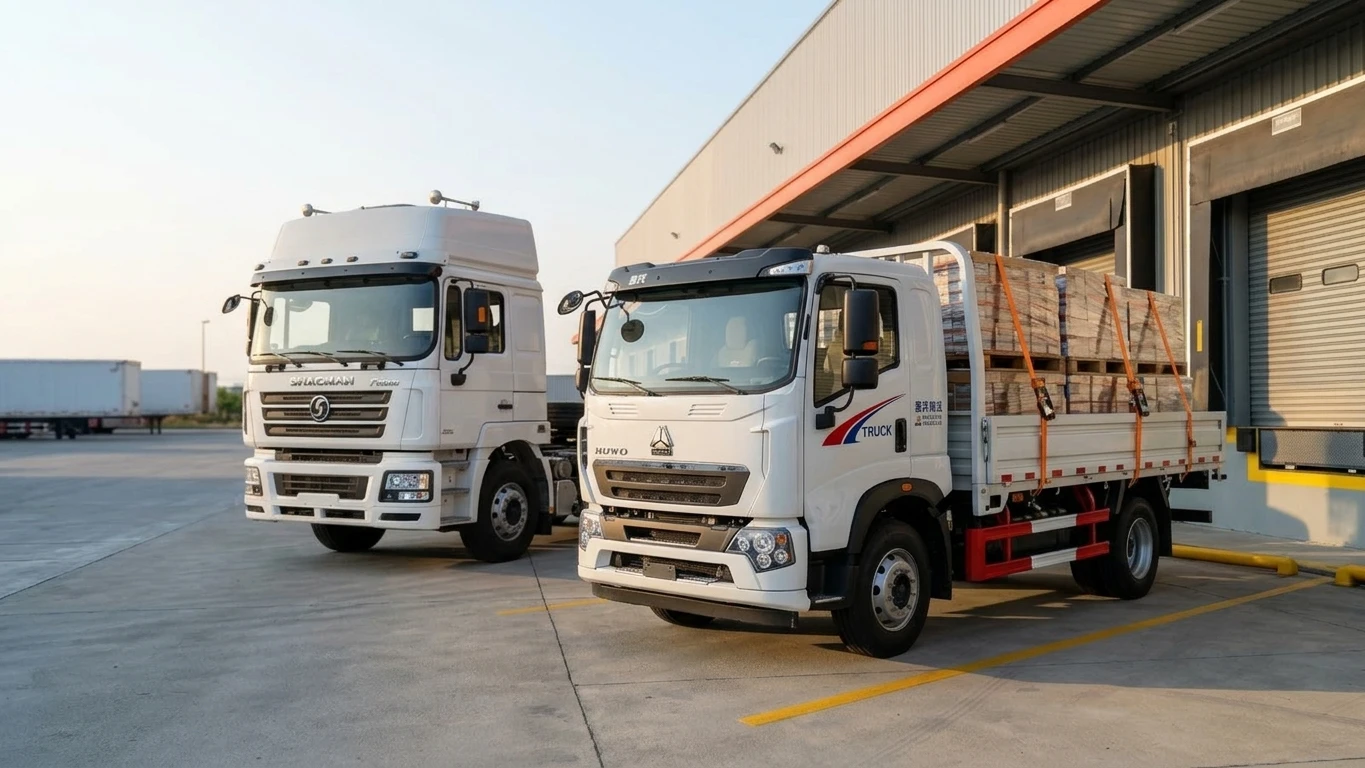
A flatbed is a truck with an open, flat cargo deck and no fixed sides or roof. That openness is its strength, since you can load from the side, the rear or overhead with a forklift or crane, and oversized items are no problem. The price is weather exposure and the need for straps, chains or tarps on every load. Check the deck, headboard and tie-down points for wear before you check anything else.
Do CDL requirements and inspection standards change your shortlist?
Yes, and the rule of thumb is simple: check the GVWR before you check the price. A truck’s gross vehicle weight rating (GVWR) is the maximum loaded weight set by the manufacturer and printed on the certification label in the door jamb. In the US, a commercial driver’s license (CDL) is generally required once a single vehicle’s GVWR exceeds 26,000 lb, or once the combination of truck and trailer exceeds that figure with a trailer rated above 10,000 lb.
The rule breaks at the edges. A heavy pickup or flatbed pulling a large trailer can cross the combination threshold even though the truck alone sits below it. Cargo matters too: hazardous materials and passenger-carrying can trigger CDL endorsements regardless of weight. If your drivers don’t hold the right license, the truck is off your list before it reaches a test drive.
Compliance costs follow the same lines. Federal Motor Carrier Safety Administration (FMCSA) rules cover commercial vehicles in interstate service, including annual DOT inspection requirements, and states layer on their own registration, periodic inspection and intrastate rules. Confirm local requirements with your state agency before buying. Also check that the Federal Motor Vehicle Safety Standards (FMVSS) certification label is present and legible, since a missing or altered label complicates registration.
Terms worth knowing
- GVWR — the maximum loaded weight of the truck as rated by the manufacturer.
- GCWR — the maximum combined weight of truck, trailer and cargo.
- Curb weight — the empty truck’s weight with fluids but no cargo or driver.
- Payload — what the truck may carry, roughly GVWR minus curb weight.
- VIN history report — a record of reported titles, accidents and odometer readings tied to the vehicle identification number.
- Title brand — a permanent title notation such as salvage or flood.
New vs used truck buying guide: when does “used is cheaper” stop being true?
A used truck wins on purchase price and depreciation. A new truck wins on predictability. Which one costs less over the years you’ll keep it depends on mileage, paperwork and how much a day off the road costs your business.
| Factor | New | Used |
|---|---|---|
| Price | Higher upfront | Lower upfront |
| Depreciation | Steepest in the early years | Much of the early loss already absorbed |
| Warranty | Manufacturer coverage | Often none, or limited dealer coverage |
| Downtime risk | Lower | Higher, and harder to predict |
| Spec choice | Built to your order | Limited to what is on the market |
| Financing terms | Often broader, with longer terms | Typically shorter terms, sometimes higher rates |
The table’s takeaway: used saves money up front, while new buys certainty.
Used stops being cheaper when the discount is smaller than the cost of what you can’t see. High mileage with thin service records, a spec that doesn’t match your load, or deferred repairs that surface in the first year can erase the saving.
Fleet managers generally say a day of downtime can cost more than the discount you negotiated on the purchase price.
The practical rule: buy used when the job is flexible and the history is documented. Buy new when a missed delivery costs more than the premium.
How to buy a truck: what is the right order of steps?
Sequence matters because each step narrows the next one, and skipping ahead is how buyers end up negotiating on a truck they never should have shortlisted. Work through these in order.
- Define the job: write down the heaviest realistic load, typical route and annual mileage.
- Set a total-cost ceiling that includes insurance, fuel, maintenance, registration and expected downtime, not only the price.
- Build a shortlist of units whose GVWR, payload and body type fit the job with margin.
- Inspect each finalist in person, and book an independent mechanic for any unit you can’t verify yourself.
- Pull the VIN history report and compare title, odometer and service records against what the seller told you.
- Negotiate using inspection findings and history gaps, and get financing terms from at least one lender besides the dealer.
- Confirm paperwork: a clean title, a bill of sale, and the correct VIN on every document.
- Arrange insurance and registration before you hand over payment.
Steps four and five carry the most risk. Skip a stage only if you can explain why the risk it covers doesn’t apply to your purchase.
What should I check when buying a used truck?
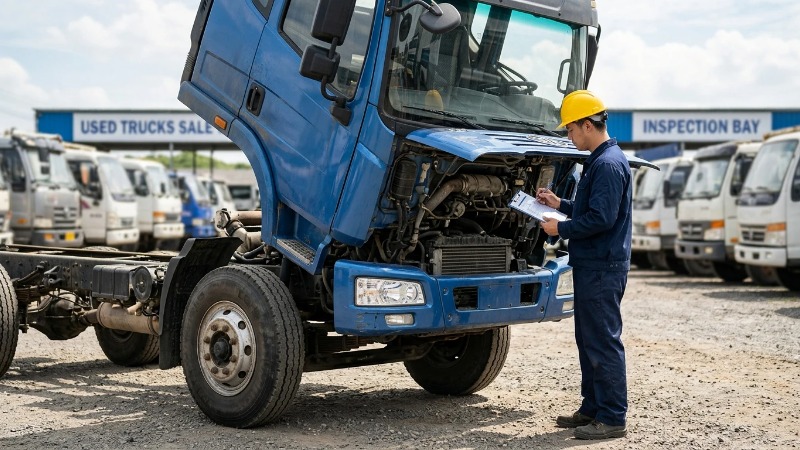
The costly mistake is negotiating first and inspecting second. By the time a price is agreed, you are emotionally committed, and a rusted frame or a mismatched VIN becomes something you talk yourself past. Inspect first, then price what you find.
Work through these checks in person, and treat any refusal to show a document as an answer.
- Inspect the frame for corrosion, cracks, weld repairs and bends.
- Check tires for uneven wear and brakes for pulsing or soft pedal.
- Examine oil, coolant and transmission fluid for milkiness, metal or a burnt smell.
- Review engine and emissions system records, including any warning lights or deleted components.
- Request service records and the last DOT inspection record.
- Match the VIN on the dash, door label and title.
- Compare the odometer reading with service and inspection dates.
- Run a VIN history report for accident, flood and title brand entries.
Uneven tire wear often points to alignment or suspension damage, and a VIN history report only shows what was reported, so a clean one does not replace a physical look.
Tip: Pay for a third-party mechanical inspection on any unit you can’t verify yourself. If the seller won’t allow one, walk away.
Where do you find used trucks for sale near me, and how do you vet the seller?
A contractor loses a pickup on Monday and needs a replacement by Friday. That deadline is how buyers end up at the first lot with a clean-looking unit and no time to ask for paperwork. Each source trades price against recourse, so vet the seller before you vet the odometer.
Dealers, auctions, fleet disposals and private sellers
Dealers usually charge more, but they offer a business address, a documented title process and sometimes a limited warranty. Auctions run cheaper, with little inspection time and almost no recourse once the hammer falls. Fleet disposals tend to bring maintenance logs and consistent servicing, though the unit may have idled hard or run heavy for years. Private sellers can offer the best price and the least protection.
Three buyers, three priorities
The contractor needing one pickup fast should accept a dealer premium in exchange for speed and a clear title. A small fleet adding a flatbed can wait for a fleet retirement, where service records often exist and several similar units allow a comparison. An owner-operator weighing a Class 8 tractor should insist on engine records and a third-party inspection, because a bad drivetrain there costs far more than the discount saves.
As a generic illustration, a fleet-retired truck with a full service file is a lower unknown than a private-sale truck with a story and no paperwork. Confirm the seller’s name matches the title, and walk away if it doesn’t.
How should you finance a truck, and what does the real cost look like?
Compare dealer financing with a bank or credit-union loan on three terms: rate, length and prepayment rules. Then judge the truck by total ownership cost, not the monthly payment.
Dealer financing is convenient and sometimes tied to promotions, but the convenience can hide a markup or a bundled add-on. A bank or credit-union loan, arranged before you shop, gives you a benchmark and turns the dealer’s offer into something you can measure. Get written quotes from both. Ask whether early payoff carries a penalty, because you may want to clear the loan if the truck is sold or replaced sooner than planned.
A longer term lowers the payment but raises the interest you pay. It also leaves you owing more than the truck is worth for longer.
Note: Total cost covers insurance, fuel, maintenance, tires, registration, downtime and resale value. Add them up over the years you expect to keep the truck. A cheaper unit with higher fuel use or frequent downtime can cost more than a pricier, better-documented one.
FAQ
Is a high-mileage diesel still worth buying?
Yes, if service records are complete and an independent inspection is clean. Documented maintenance matters more than the odometer.
Do I need a CDL for a heavy pickup or flatbed?
Usually not below 26,001 lb GVWR, though trailer weight and cargo type can change that. Confirm with your state.
Can I trust a clean VIN history report alone?
No. Reports miss unreported repairs, so pair one with an inspection.
Should I buy from a dealer or privately?
Dealers cost more but give recourse. Private sales are cheaper and riskier.
Next step: shortlist by job, then inspect before you negotiate
Capacity fit and verified condition outweigh size and sticker price. A truck that matches your heaviest load, carries a clean VIN history report and passes an independent inspection will cost you less over its life than a bigger or cheaper unit that fails any of those tests.
Put the order into practice this week. Write down your heaviest realistic load and your annual mileage, then convert them into a GVWR and payload target with some margin. Those two numbers decide whether you are looking at a pickup, a flatbed or something that needs a CDL.
Use them to filter every listing, whether it comes from a dealer, an auction or a private seller. Drop anything that falls short on rated capacity, however attractive the price. Inspect the units that remain before you discuss money, and let the findings set your offer.