


Buying China trucks for sale? Learn how to get truck quotes from China, make supplier quotes comparable, and find the best price with a step-by-step method.
The usual advice for pricing China trucks for sale is to ask several suppliers and take the lowest figure. That advice hides the real decision: which quote describes the same truck, delivered to the same place, with the same paperwork and the same risk.
What follows is a method for making quotes comparable before you compare their prices.
What Are You Actually Comparing When Two Truck Quotes Differ by Thousands?
You are usually comparing two different trucks, two different delivery points, or two different scopes of supply, not two margins on one product. The gap between quotes tends to sit in specification, Incoterm and exclusions.
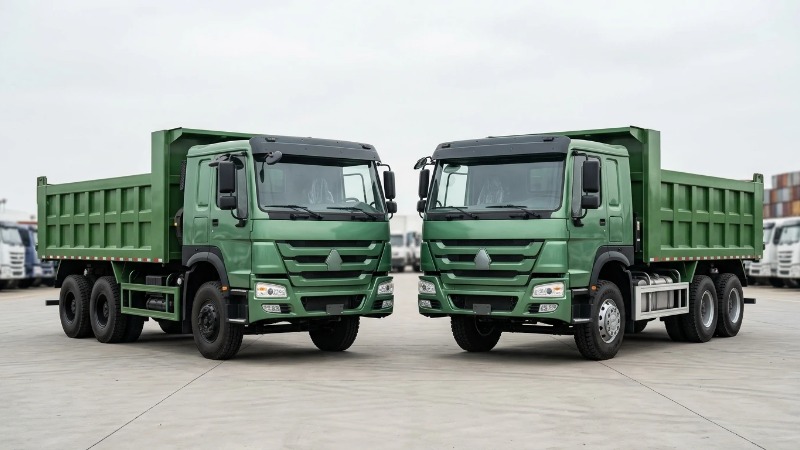
Specification is the first place it opens up. A dump truck quoted as a “HOWO 6×4” can differ in engine output, emission level, axle rating, tyre brand, cab grade and body steel thickness, and each of those changes the cost of building it. A quote that names only a model family leaves the supplier free to choose the cheaper option at every point.
The Incoterm is the second. FOB (Free On Board) prices the truck to the point where it is loaded on the vessel at the Chinese port. CIF (Cost, Insurance and Freight) adds ocean freight and cargo insurance to the destination port. Set an FOB figure beside a CIF figure and the difference looks like a discount when it is really a different scope of delivery.
Exclusions are the third. Spare parts kits, tools, body modifications, lashing for RoRo (roll-on/roll-off) shipping, pre-shipment inspection and local port charges are often left out of the headline number, and they come back later as extras.
So before you rank anyone on price, put every quote on the same specification, the same Incoterm and the same list of inclusions. Only then does a difference of thousands mean something.
How Do I Buy Trucks from China, Step by Step?
The sequence below is the one most Chinese truck exports follow, whatever the brand or the destination. Each step depends on the one before it, and a mistake in step one tends to surface only at step six, when it costs the most to fix.
- Fix the specification in writing. Set brand and model, engine output and emission level, transmission, axle layout, tyres, body and cab options. Every later error traces back to a vague line here, so treat this as the step that decides the quote.
- Check destination rules before you ask for prices. Confirm which emission level, type approval and documents your country requires, because a truck that cannot be registered is not cheap at any price.
- Send the same request to several suppliers. Ask each to quote on one named Incoterm, such as FOB or CIF, and to list what the price includes and excludes. Identical requests are what make the answers comparable.
- Verify the supplier and the unit. Ask for business registration, the chassis or VIN details of the actual stock or build slot, and references you can check independently.
- Sign a contract that repeats the specification. Include payment schedule, delivery window, warranty terms and what happens if the delivered truck differs from the order. Keep deposits proportionate and tied to milestones where you can.
- Arrange pre-shipment inspection. An independent inspector such as SGS can check the truck against the contract before the final payment is released.
- Book shipping and insurance. Trucks usually move by RoRo or in containers, and the choice depends on size, port facilities and cost. Confirm who books and who insures under your Incoterm.
- Prepare import clearance and registration. Collect the commercial invoice, packing list, bill of lading, certificate of origin and any conformity papers your customs authority asks for, and budget for duties, taxes and port charges.
The order matters more than the speed. Buyers who start at step three, with a model name and a target price, often discover at step eight that the truck needs a different emission package or paperwork. Changing the specification after the contract is signed is possible, but it reopens the price.
Which Scenario Are You In? Four Buying Situations That Change the Quote
Two people send the same request for a tipper truck. One needs a single unit to start work next month. The other is filling a government tender with a fixed delivery window. They will get similar-looking quotes, yet the right answer for each is different, because the same price line carries different risks.
Four situations come up most often, and each moves your priorities in a different direction.
A single truck for your own operation. Price matters, but parts availability and a clear warranty matter more, since one breakdown idles your only vehicle. You have little leverage on volume, so you gain more by fixing the specification tightly than by pushing the discount.
A mixed fleet order. Here you can trade volume for terms: staged delivery, a shared spare parts package, and consistent components across units. Flexibility on specification helps if it lets a supplier group your order into one production batch.
Stock for resale. The cheapest chassis is not always the cheapest stock. Brand recognition, documentation and local approval decide how fast units sell, so after-sales support and paperwork carry more weight than the unit price.
A tender or project purchase. The tender fixes emission level, certificates and delivery dates before any supplier is asked. Spec flexibility is close to zero, so you build the quote request backwards from those documents and reject anything that does not match.
Identify your row first. The next four sections take each one in turn and show what to ask for.
Scenario One: A Contractor Buying a HOWO Dump Truck for Local Quarry or Construction Work
Take a contractor who needs one tipper for hauling aggregate from a quarry to a construction site. Two quotes arrive for a HOWO dump truck, a HOWO being a heavy-duty tipper built on the Sinotruk platform. One is noticeably cheaper. The contractor’s first instinct is to take it.
Lined up against each other, the two quotes differ in places the headline price never shows. The cheaper one lists a lower-output engine, a lighter axle configuration, and a body with thinner steel in the floor and sides. The dearer one specifies a stronger body, a higher-rated engine, and a parts kit for wear items.
On a quarry run, those differences decide how the truck lives. Rock and loaded aggregate punish a thin tipper floor, and a body that cracks or deforms in the first year means welding downtime, not savings. An engine that is underpowered for steep ramps and full loads works harder, burns more fuel, and wears faster. The axle layout, such as 6×4 versus 8×4, sets legal payload and how the truck behaves on soft ground.
Parts availability is the quiet variable. A contractor running a single truck has no spare. If filters, brake components, and suspension parts take weeks to arrive, the truck sits idle and the daily revenue lost can outweigh the original price gap.
The lesson: for local heavy work, compare the quotes on the duty the truck will face, then on parts access. Ask the supplier to state body steel thickness, engine rating, and axle configuration in writing, and ask what wear parts can ship with the unit. The price difference between those two quotes may shrink once the specs match.
Scenario Two: A Fleet Owner Ordering Several Units of Mixed Types
Ordering five identical tippers is a pricing exercise. Ordering a tipper, a tractor unit, and a cargo truck from the same supplier is a specification exercise, and the two need different handling.
With a single unit, you compare one truck against another. With a mixed order, a supplier can quote the headline models sharply and recover the margin elsewhere: on the tractor’s axle options, on the cargo body, or on the parts that come with each chassis. Line-by-line comparison matters more here than the total at the bottom.
Keep the specification consistent where it can be
Every difference between units adds a part number to your stock. Where the duty allows, ask for the same engine family, the same transmission, and the same axle brand across the order. Common filters, belts, brake components, and service intervals cut what you hold on the shelf and what your mechanics must learn. Where a unit really needs something different, such as a higher-rated rear axle on the tipper, have the quote say so explicitly.
Stage delivery, but fix the price
Splitting shipments eases cash flow and yard space, though each shipment carries its own freight, inspection, and clearance cost. Ask whether the price holds across all batches, and what happens if the supplier’s cost shifts between the first and last. Put the batch schedule and the payment schedule in the same contract.
Ask for one shared parts package
A single parts list covering the whole fleet is usually cheaper per item than separate kits attached to each truck, and it avoids duplicates. Build it from the common components first, then add the model-specific wear parts. Compare quotes on total landed cost across all units, not on the cheapest single line.
Scenario Three: A Dealer Buying Stock for Resale
A dealer is not buying a truck to run. The truck is inventory, and its price has to survive a second negotiation with your own customer. That changes what a good quote looks like, and four criteria carry most of the weight.
Brand recognition in your market. A chassis from an established maker such as Sinotruk, whose HOWO line is widely sold in export markets, is usually easier to resell than an unfamiliar badge. Buyers ask about parts and resale value before they ask about horsepower. A cheaper unknown brand can sit on the lot for months, and that carrying cost rarely appears in the quote.
Documentation that follows the truck. Your customer needs a commercial invoice, packing list, bill of lading, certificate of origin where required, and the export-side papers that let them register the vehicle. Ask the supplier to confirm the full set before you commit, and check that chassis and engine numbers match across every document. A mismatch can hold a unit at the port.
Local homologation. Registration rules decide whether a truck is saleable at all. Check emission level, steering side, lighting and any type-approval requirement in your country first. A unit built to the wrong standard is a retrofit cost or an unsellable truck.
Specification you can resell repeatedly. Stock the configurations your local buyers ask for, not exotic variants. Common axle layouts, standard bodies and a parts package that covers fast-moving wear items make each unit easier to move.
So the cheapest chassis is not always the cheapest stock. Compare quotes on what you can sell the unit for, less landed cost and the time it sits unsold.
Scenario Four: A Tender or Project Purchase with Fixed Compliance Requirements
Rule of thumb: in a tender, read the compliance clauses before you read any price. The documents set the emission level, the certificates, the delivery window and often the penalty for missing it, so the quote has to be built backwards from those lines.
The rule holds because a tender removes the flexibility that makes other purchases negotiable. A truck that is cheaper but built to a lower emission standard is not a cheaper option; it is a disqualified one. Supplier quotes that look close on price can differ sharply on whether they meet the clauses at all.
In practice, copy each requirement into your request as a numbered line: emission standard (for example Euro V or Euro VI equivalence), type approval or conformity documents, required certificates, body and axle specification, delivery date, and any warranty or parts-support terms. Ask each supplier to answer line by line and to state in writing which items are standard, which need modification and which they cannot meet. Documents such as the certificate of origin or a factory inspection report should be named in the request, not assumed.
Delivery windows deserve the same scrutiny. Production time, inspection, shipping and port clearance all sit inside the date, so ask for a schedule with each stage, not a single lead-time figure.
The rule breaks when a tender allows alternatives or equivalents. Where it does, ask the issuing body in writing what counts as equivalent before you pay for a higher specification you may not need.
What Specification Details Must a Quote Request Contain?
Enough that two suppliers cannot answer with different trucks. A vague request such as “6×4 tipper, 40 tonnes” invites each supplier to fill the gaps with whatever is cheapest for them, and the quotes you get back will not line up.
Start with brand and model. A Sinotruk-built HOWO variant is a different proposition from an unbranded assembled tipper, so name the exact model code and ask the supplier to confirm it in writing. Then fix the powertrain: engine make, rated output and emission level (Euro V or Euro VI equivalent, as your market requires), plus gearbox type and ratio. The rest of the chassis and body follow from there.
Every line below should appear in the request, so each quote answers the same questions.
- State the brand, model code and model year.
- Specify engine output, emission level and fuel type.
- Name the transmission, including manual or automated and the number of gears.
- Define the axle configuration, axle load ratings and suspension type.
- List tyre size, brand preference and whether a spare is included.
- Describe the body: cargo volume, steel grade and thickness, and tipping mechanism.
- Choose the cab: sleeper or day cab, air conditioning, and steering side.
- Ask for the supplier’s response in the same line order as your request.
The last item matters more than it looks. When every quote follows your template, a missing line shows up at once, and a missing line is usually where the later price increase hides.
How Do FOB, CFR, and CIF Change the Price You See?
A FOB quote stops at the Chinese port: the supplier delivers the truck on board the vessel, and you pay for ocean freight and cargo insurance separately. CFR adds the sea freight to the destination port. CIF adds insurance on top of that. Free on Board (FOB), Cost and Freight (CFR) and Cost, Insurance and Freight (CIF) are Incoterms, the standard trade terms published by the International Chamber of Commerce.
The same truck can therefore look cheaper or dearer depending only on the term. Under FOB the freight has not vanished, it has moved to your side of the ledger.
| Term | Supplier pays for | You pay for | Suited to |
|---|---|---|---|
| FOB | Export clearance, loading at the Chinese port | Ocean freight, insurance, destination charges | Buyers with a trusted forwarder and their own cargo cover |
| CFR | Everything under FOB, plus sea freight | Insurance, destination charges | Buyers who already hold annual cargo insurance |
| CIF | Everything under CFR, plus minimum insurance | Destination charges, any extra cover | First-time buyers who want one figure to the port |
The key takeaway: compare FOB with FOB, or convert every quote to one term before you look at the totals.
If you ship regularly and have a forwarder whose rates you know, FOB usually gives the most control and the clearest view of the truck’s own price. For a first order, CIF is simpler, though the insurance under CIF is typically the minimum level, so check what it covers for a heavy vehicle. Either way, destination port charges, duties and inland delivery sit outside all three terms.
Which Standards and Certificates Decide Whether the Truck Can Be Registered?
A truck that cannot be registered at destination is a stranded asset, whatever the quote said. Four checks decide it, and the order matters: start with the rules of the country where the truck will run, then work back to what the Chinese side must supply.
Destination emission requirement. Many markets set a minimum emission level for new heavy vehicles, often expressed as Euro V or Euro VI, and some still accept lower levels. Confirm the exact level your registration authority demands, then ask the supplier to name the engine and the emission standard it meets. “Euro V-equivalent” in a quote is not proof; a type-approval or test document is.
Local type approval and import rules. Some countries require vehicle type approval, a conformity certificate, or pre-export verification before customs will release the truck. Others restrict vehicle age, steering side or axle load. Your customs broker or the licensing authority can tell you which applies.
Chinese-side compliance. GB standards are China’s national standards, and domestic-market trucks are built to them. China Compulsory Certification (CCC) applies to certain regulated products and vehicles sold in China, and it often does not govern export units. Ask the supplier which documents they can issue for your specific model rather than assuming either way.
Document set. Registration usually needs the commercial invoice, packing list, bill of lading, certificate of origin and a vehicle certificate of conformity or export certificate. Agree the list before payment, because corrections after shipment are slow.
What Do Suppliers Leave Out of a Quote?
The quote looks complete, the price is attractive, and then the extras start arriving. A parts invoice, a lashing fee, a port bill. By then the deposit is paid and your leverage is gone.
Omissions are rarely hidden. They are simply not written down, so the quoted price covers a bare truck and nothing more. The common gaps are a spare parts kit and the tool set, any body modification beyond the standard tipper or cargo box, and the securing of the vehicle for transport. Lashing and blocking for RoRo (roll-on/roll-off) shipping or container loading is often treated as a separate cost. So is pre-shipment inspection, and so are destination port charges such as terminal handling, storage and customs brokerage, which no Chinese-side term normally covers.
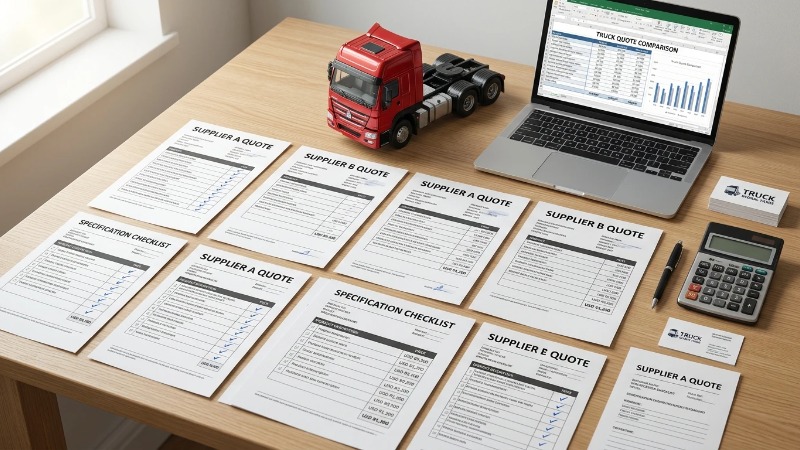
The fix is procedural. Send a quote template with a line for each item and require “included”, “excluded” or a price against it. Ask the supplier to state which Incoterm point their price ends at. An unanswered line is a future invoice.
Tip: When two quotes differ, ask each supplier to add every missing item at their own price. Compare the totals, not the headline figures.
Common Mistakes When Comparing Chinese Truck Supplier Quotes
The common assumption is that the lowest figure on the table is the best deal, and that a supplier who sounds confident has the details covered. Neither holds up once the truck arrives.
Choosing the lowest figure. The low quote is often the one with the most exclusions or a thinner specification. Convert every quote to the same Incoterm and the same scope before ranking, then compare the landed cost.
Ignoring payment terms. A small discount does not justify a large deposit paid to a supplier you cannot verify. Check the deposit share, the balance trigger and what documents you receive against payment. Ask for terms that tie the final payment to inspection results.
Skipping pre-shipment inspection. Once the truck is loaded, a defect becomes a cross-border claim. Book an independent inspector such as SGS, or a comparable firm, to check the unit against the signed specification before the balance is released.
Accepting vague specifications. “HOWO dump truck, 6×4” can describe several different trucks. Insist on engine output, emission level, axles, tyres and body details in writing, and attach them to the contract.
How to Choose a Supplier and Compare Quotes Line by Line
Put every quote into one sheet and score it on the same six criteria. Gaps show up quickly, and so do the suppliers who left cells blank.
Spec match. Check engine output, emission level, axles, tyres, body and cab against your written request. A quote that substitutes a component without saying so is not a match.
Incoterm. Convert every quote to the same term, FOB or CIF, to the same destination port, before comparing totals.
Documents. Confirm which certificates, invoices and export papers come with the truck, and whether they meet your registration rules.
Inspection access. Ask whether a third-party pre-shipment inspection can be done before the balance is paid, and who bears its cost.
Warranty terms. Read what is covered, for how long, and how a claim is settled across borders: replacement parts shipped, or a refund.
Parts support. Look at what the quote includes at handover and how fast further parts can be sent.
The rule of thumb: the best price on Chinese truck exports is the lowest landed cost on a matched specification, not the lowest line on the page. If a cheaper quote fails two or more criteria, treat the gap as deferred cost.
FAQ
What deposit and payment terms are normal?
Usually a deposit on order, with the balance paid before shipment or against shipping documents. Terms vary by supplier and order size, so write them into the contract.
Is RoRo or container shipping better?
It depends on the truck. RoRo suits driveable units that fit the vessel, while containers can suit smaller or partly dismantled units. Compare both on landed cost.
Should I buy used or new?
New units are easier to register and warrant. Used units need a documented history and independent inspection.
How do warranty claims work across borders?
Typically through replacement parts shipped to you, not repair by the supplier. Agree the claim process and parts list beforehand.
How long does a quote stay valid?
Often a few weeks, but check the stated validity date, since steel, freight and exchange rates move.