




Foton trucks & pickups: real-world total-cost-of-ownership beats legacy brands. The fleet buyer’s guide to specs, lineup & smart purchasing.
A professional buyer’s reference for fleet managers, dealers, and commercial transport operators evaluating Foton’s truck and pickup lineup.
Every fleet decision starts with a spreadsheet. You calculate acquisition cost, then fuel burn, then maintenance intervals, and finally resale value three or five years down the road. When those numbers get run against a Foton commercial vehicle, something interesting happens: the total-cost-of-ownership column often tells a very different story than the legacy brands your accountant expects to see.
That gap between perception and real economics is exactly why Foton deserves a closer look. This guide breaks down the full lineup, the specifications that actually matter for working vehicles, and the buying logic that separates a good sticker figure from a genuinely smart purchase.
Introduction: Why Foton Commands Attention in the Commercial Segment
Consider a mid-sized last-mile logistics operator running twelve light-duty trucks across an urban delivery grid. Each vehicle covers roughly 120 to 180 kilometres per shift, six days a week. Over a single year, marginal differences in fuel efficiency, downtime, and parts cost compound into figures large enough to fund another vehicle entirely.
In that scenario, the acquisition price is only the opening bid. What matters is the lifetime economics — and this is precisely the terrain where Foton has built its reputation among commercial operators worldwide.
Rather than positioning itself purely as a budget option, Foton has spent the last two decades engineering vehicles that deliver dependable duty-cycle performance at a competitive entry point. For fleet buyers weighing capital efficiency against operational reliability, that combination is difficult to ignore.
The Foton Brand Positioning at a Glance
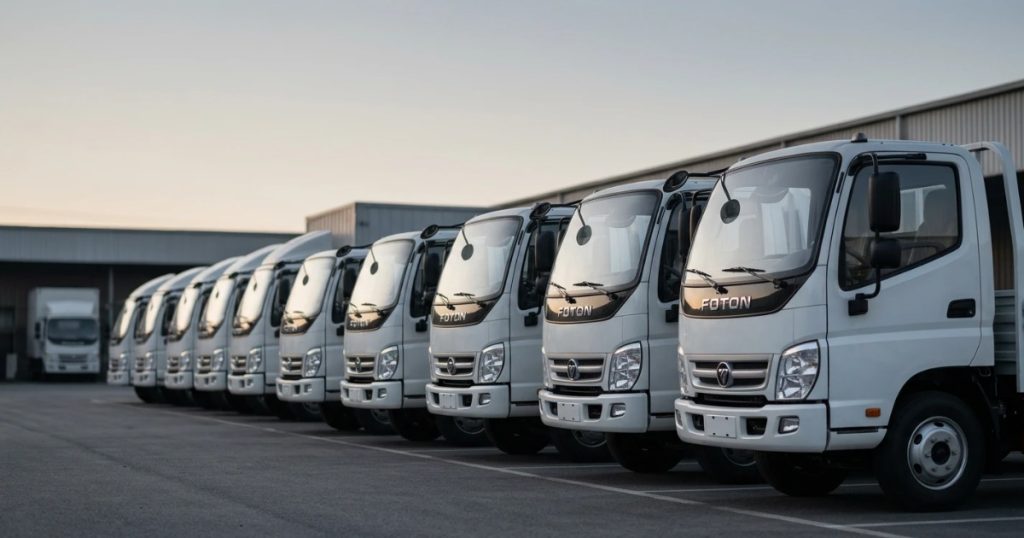
Foton Motor, founded in 1996 and headquartered in Beijing, has grown into one of the largest commercial vehicle manufacturers on the planet by unit volume. The company produces light, medium, and heavy trucks, pickups, vans, buses, and construction equipment under a single industrial umbrella.
Its manufacturing scale is significant. Foton operates multiple production bases and has exported vehicles to more than 110 countries and regions. That global footprint matters for commercial buyers because it underpins parts availability, engineering support, and long-term brand continuity.
Among operators in emerging and developed markets alike, Foton has earned a working reputation for practical engineering. The vehicles are designed to be serviceable, adaptable to local bodybuilders, and forgiving under the kind of continuous duty cycles that punish lesser platforms.
Who This Buying Guide Is For
This guide speaks directly to three audiences. First, fleet purchasers who must justify every acquisition against a total-cost-of-ownership model. Second, independent operators and tradespeople choosing a single work vehicle that has to earn its keep daily.
Third, dealers and resellers who need an authoritative reference when advising commercial clients. Whether you are comparing a light truck against a rival brand or scoping a Foton Tunland pickup for a small crew, the sections below are structured to support real purchasing decisions.
Throughout, we reference indicative price bands rather than exact figures, because commercial vehicle pricing shifts dramatically by market, configuration, and volume. For current, market-specific quotes, we recommend working directly with an authorized source such as the team at Mettle Truck.
Understanding the Foton Commercial Vehicle Range
Before comparing any Foton commercial vehicle price list, it helps to understand how the lineup is organized. Foton structures its commercial range around duty classes, each engineered for a distinct band of gross vehicle weight and application.
Getting this segmentation right is the single most important step in the buying process. A vehicle that is over-specified wastes capital and fuel; one that is under-specified fails prematurely and inflates your true cost of ownership. Let’s walk through each tier.
Light-Duty Trucks (Aumark & Ollin Series)
The light-duty segment is Foton’s commercial backbone. The Aumark and Ollin series target urban distribution, last-mile logistics, and general regional haulage where maneuverability and payload efficiency both count.
These trucks typically sit in the sub-7.5-tonne gross vehicle weight bracket, though configurations vary by market. They pair compact turning circles with generous cargo volume, making them ideal for congested delivery routes and stop-start duty cycles.
Typical applications include parcel and courier fleets, beverage and food distribution, furniture delivery, and municipal services. For operators moving moderate loads across short-to-medium distances, this class hits the value sweet spot.
The Aumark line generally represents the more refined, premium-positioned option within light-duty, while Ollin emphasizes rugged simplicity and lower running costs. Choosing between them comes down to route profile and how much cabin comfort your drivers require over long shifts.
Medium & Heavy-Duty Trucks (Auman Series)
When the job scales up, the Auman series steps in. This range covers medium rigids through to heavy tractor units built for long-haul freight, construction logistics, and bulk material transport.
Auman vehicles are engineered for endurance. They feature higher-output engines, reinforced chassis architecture, and drivetrain options suited to sustained highway cruising or heavy off-road duty on construction sites.
For fleet operators in mining support, aggregate haulage, or regional trunk routes, the Auman platform offers a credible alternative to established heavy-truck brands. The value proposition here rests on lower acquisition cost paired with competitive fuel and maintenance economics.
Because heavy-duty specifications vary widely by market and application, buyers evaluating this class should consult the full Foton truck categories to match tractor and rigid configurations to their specific duty profile.
Pickup Trucks (Tunland Series)
The Foton Tunland is the brand’s flagship pickup, designed as a dual-purpose work-and-utility vehicle. It appeals to tradespeople, small fleets, agricultural operators, and businesses that need a vehicle capable of transitioning between job-site duty and everyday transport.
The Tunland typically offers both single and double-cab body styles, rear-wheel and selectable four-wheel-drive systems, and a payload capacity competitive with mainstream pickup rivals. Its ladder-frame construction supports towing and load-bed workloads without the premium price tag of legacy nameplates.
For a builder, landscaper, or utility contractor, the Tunland delivers a compelling balance of ruggedness, running cost, and versatility. It sits at the accessible end of the pickup market while still offering the durability that commercial use demands.
Vans & Special-Purpose Vehicles
Beyond trucks and pickups, Foton produces a range of cargo vans and vocational builds. These include panel vans for enclosed urban delivery, refrigerated units for cold-chain logistics, and chassis-cab platforms ready for specialist upfitting.
Special-purpose configurations extend to tippers, box bodies, tankers, and mounted equipment builds. Because these vehicles are frequently customized by regional bodybuilders, buyers should confirm chassis compatibility and upfit clearances before committing.
This vocational flexibility is a genuine strength. A single Foton chassis can be the foundation for dozens of application-specific vehicles, simplifying fleet standardization and parts inventory.
Foton Commercial Vehicle Price List: Model-by-Model Breakdown
This section anchors the guide. Below you will find indicative comparison tables covering the core segments. A critical caveat first: commercial vehicle pricing is never a single number.
Final figures depend on market region, engine specification, cab configuration, body build, emission-standard requirements, and — crucially — purchase volume. The tables that follow use qualitative price bands rather than exact currency figures precisely so they remain useful across markets. For a precise, current quotation tailored to your configuration, reach out through the contact page.
Foton Light Truck Pricing & Payload Capacity
Light trucks are where most commercial buyers begin. The table below summarizes representative models by weight class, payload, and engine profile, with an indicative relative price band to aid comparison.
| Model | GVW Class | Payload Capacity (indicative) | Engine Type | Relative Price Band |
|---|---|---|---|---|
| Aumark S (compact) | 3.5–4.5 t | 1.5–2.0 tonnes | Diesel, ~110–130 hp | Entry |
| Aumark C | 5.0–6.5 t | 2.5–3.5 tonnes | Diesel, ~140–160 hp | Mid |
| Ollin standard | 4.5–6.0 t | 2.0–3.0 tonnes | Diesel, ~120–150 hp | Entry–Mid |
| Aumark heavy light-duty | 7.0–7.5 t | 3.5–4.5 tonnes | Diesel, ~160–180 hp | Upper-Mid |
These payload figures assume a standard cargo body. Once a refrigerated unit, tipper mechanism, or specialist upfit is added, kerb weight rises and usable payload falls. Always confirm the specific chassis-cab payload before finalizing your specification.
As a practical rule, buyers should specify at least a 10 to 15 percent payload margin above their expected maximum load. Running a light truck consistently at its ceiling accelerates wear and erodes reliability over the ownership period.
Foton Tunland Pickup Price & Specifications
For pickup buyers, the Tunland range offers several trim and drivetrain combinations. The table below outlines typical configurations and their relative positioning.
| Tunland Configuration | Drivetrain | Cab Style | Payload (indicative) | Relative Price Band |
|---|---|---|---|---|
| Tunland Work (base) | 4×2 RWD | Single cab | ~1.0 tonne | Entry |
| Tunland Utility | 4×2 RWD | Double cab | ~0.9 tonne | Entry–Mid |
| Tunland 4WD | 4×4 selectable | Double cab | ~0.9 tonne | Mid |
| Tunland G-series (premium) | 4×4 selectable | Double cab | ~0.9 tonne | Upper-Mid |
Against mainstream pickup rivals, the Tunland’s core appeal is value. It typically undercuts legacy nameplates on acquisition cost while delivering comparable payload and towing ability, which makes it attractive for fleets that need multiple units.
The choice between two-wheel and four-wheel drive should follow your terrain honestly. If your work rarely leaves sealed roads, a rear-drive configuration saves cost and improves fuel economy without any real operational penalty.
Medium/Heavy-Duty Auman Price Overview
Heavy-duty pricing carries the widest variance of any segment because tractor and rigid configurations span an enormous range of axle counts, horsepower ratings, and body applications. The table below offers a broad orientation.
| Auman Configuration | Typical Application | Axle Layout | Engine Power (indicative) | Relative Price Band |
|---|---|---|---|---|
| Auman rigid (medium) | Regional freight, box body | 4×2 | ~180–240 hp | Mid |
| Auman rigid (heavy) | Construction, tipper | 6×4 | ~280–350 hp | Upper-Mid |
| Auman tractor | Long-haul trunk routes | 6×4 | ~380–430 hp | Upper |
| Auman heavy tractor | Bulk / heavy haulage | 6×4 / 8×4 | ~430+ hp | Upper |
For fleet buyers, the heavy-duty conversation should always move quickly beyond sticker figures toward operating economics. A tractor unit’s fuel efficiency and uptime over hundreds of thousands of kilometres dwarf the initial acquisition difference between brands.
Factors That Shift the Final On-Road Price
The number on a quotation and the amount that actually leaves your account are rarely identical. Several layers of cost sit between the two, and understanding them prevents budget surprises.
- Registration and taxes: Vehicle registration fees, import duties where applicable, and value-added or sales taxes vary substantially by jurisdiction.
- Insurance: Commercial vehicle insurance premiums scale with vehicle class, usage profile, and driver history.
- Financing costs: Interest and lease charges add to the effective purchase price over the term.
- Bodybuilding and upfit: Refrigeration, tipper gear, box bodies, and mounted equipment can add significant cost on top of the base chassis.
- Dealer add-ons: Extended warranties, service packages, telematics, and delivery charges all contribute.
The lesson for buyers is straightforward: always request an out-the-door quotation that itemizes every line, not just the base vehicle figure. This transparency is a hallmark of a reputable dealer and something the customer service team can walk you through in detail.
Key Specifications Comparison: What Matters for Fleet Buyers
Specification sheets are dense, and not every line item carries equal weight for a commercial buyer. This section isolates the specifications that genuinely move the needle on total cost of ownership.
The discipline here is to connect each spec back to money. A higher horsepower rating only matters if your duty cycle demands it; a longer service interval only helps if it aligns with your route uptime requirements.
Engine, Emissions & Fuel Efficiency
Powertrain choice is the most consequential specification decision you will make. Foton offers a range of diesel engines across its lineup, with power outputs matched to each duty class, and increasingly incorporates newer emission-control technology to meet tightening standards.
Emission-standard compliance deserves careful attention. Markets are progressively adopting stricter regulations, and buying a vehicle that already meets the incoming standard protects against premature regulatory obsolescence and preserves resale value.
Fuel economy is where the largest lifetime savings hide. On a light truck covering 40,000 kilometres annually, even a small percentage improvement in consumption compounds into meaningful savings across a multi-year ownership period.
When comparing engines, look beyond peak power to the torque curve. A commercial vehicle spends most of its life in the mid-range, and strong low-end torque translates directly into better drivability and lower fuel burn under load.
Payload, Towing & Bodybuilder Compatibility
Payload capacity is deceptively simple on paper but complex in practice. The published figure applies to a bare chassis; every body, upfit, and accessory subtracts from it.
Before purchase, map your actual duty cycle. Calculate your heaviest realistic load, add the weight of your intended body build, and confirm the vehicle retains a comfortable margin. Overloading is the fastest route to premature drivetrain and suspension failure.
Towing capacity matters most for pickups and lighter rigids used with trailers. Confirm both the braked towing limit and the gross combination weight rating, since these define the safe envelope for your operation.
Bodybuilder compatibility is a specialist concern that pays dividends. A chassis engineered with clear upfit points, accessible power take-off, and documented mounting specifications dramatically simplifies vocational conversion. For guidance on matching chassis to build, the knowledge base offers useful technical background.
Warranty, Service Intervals & Parts Availability
A vehicle is only as good as its supporting ecosystem. Warranty terms, service intervals, and parts availability collectively determine whether a strong specification becomes a strong ownership experience.
Warranty coverage should be read carefully for both duration and scope. Powertrain warranties, corrosion coverage, and mileage caps each affect the real risk you carry as the owner.
Service intervals influence uptime directly. Longer, well-defined intervals mean fewer workshop visits and more revenue-earning days on the road, which is central to fleet profitability.
Parts availability is the concern most commonly raised about non-legacy brands, and it is a fair one. Foton’s global scale and established distribution networks have improved this considerably, but the practical answer always comes down to your local dealer’s parts inventory and supply chain — another reason to buy through an authorized, well-stocked source.
How to Choose the Right Foton Commercial Vehicle
With the lineup and specifications understood, the decision framework becomes manageable. The goal is to align vehicle capability with operational need at the lowest sustainable total cost.
Too many purchases go wrong not because the vehicle was bad, but because the match between vehicle and application was poor. This section provides a structured approach to avoid that trap.
Matching Vehicle Class to Your Business Use Case
Start with the work, not the vehicle. Different applications demand fundamentally different capabilities, and the right class follows naturally once the duty cycle is defined.
- Urban delivery and last-mile: Light-duty Aumark or Ollin trucks, prioritizing maneuverability, cargo volume, and stop-start fuel efficiency.
- Construction and site logistics: Medium or heavy Auman rigids and tippers, prioritizing chassis strength and off-road capability.
- Agriculture and rural utility: Tunland pickups or light trucks with four-wheel drive, prioritizing traction and versatility.
- Long-haul freight: Auman tractor units, prioritizing engine efficiency, driver comfort, and drivetrain durability.
- Mixed fleets: A standardized chassis family to simplify maintenance, driver familiarity, and parts inventory.
Standardization is an underrated lever. A fleet built around a small number of platforms reduces training complexity, streamlines parts stock, and often unlocks better volume pricing.
Total Cost of Ownership vs. Sticker Price
The lowest number on a price list rarely wins the real contest. Total cost of ownership — acquisition plus fuel, maintenance, downtime, insurance, and depreciation, minus resale value — is the metric that determines actual profitability.
Consider the illustrative comparison below between two hypothetical light trucks over a five-year, 40,000-kilometre-per-year operating life. The figures are relative indices for illustration, not currency.
| Cost Component (5-year index) | Lower-Priced Option | Higher-Priced Option |
|---|---|---|
| Acquisition | 100 | 125 |
| Fuel | 210 | 185 |
| Maintenance & parts | 70 | 60 |
| Downtime cost | 40 | 25 |
| Insurance | 55 | 55 |
| Resale recovery | -45 | -60 |
| Net TCO index | 430 | 390 |
The table demonstrates the core point: the higher-priced option can deliver lower lifetime cost through better fuel economy, reduced downtime, and stronger resale. Foton’s competitive position frequently sits in the favorable corner of this analysis because it combines an accessible entry point with solid running economics.
Build your own version of this model with realistic figures for your routes. It is the single most valuable exercise in the entire buying process.
New vs. Used Foton: When Each Makes Sense
The new-versus-used decision hinges on your capital position and risk tolerance. Each path carries distinct trade-offs.
A new Foton commercial vehicle offers full warranty coverage, the latest emission compliance, predictable maintenance history, and maximum service life. For core fleet vehicles that must maximize uptime, new is usually the sound choice.
A used vehicle reduces upfront capital and sidesteps the steepest phase of depreciation. This can suit operators expanding cautiously, covering seasonal peaks, or building experience with the brand before committing to a larger order.
Whichever path you choose, verify service history and inspect for the wear patterns typical of overloaded operation. Reviewing real deployment outcomes in the cooperative case studies can also help set realistic expectations for both new and used performance.

Where to Buy: Finding a Foton Commercial Vehicle Dealer
Where you buy matters as much as what you buy. The dealer relationship shapes your warranty experience, parts access, and long-term support — all of which feed directly into total cost of ownership.
This final practical section covers how to find the right dealer, negotiate effectively, and structure the purchase for a commercial context.
Locating an Authorized Foton Dealer Near You
An authorized dealer is not a formality; it is a safeguard. Authorized dealers carry genuine parts, honor manufacturer warranty, and employ technicians trained on the specific platforms you are buying.
To verify authorization, confirm the dealer’s official status, ask about their parts inventory depth, and inquire about workshop capacity and turnaround times. A dealer that can service what it sells protects your uptime.
Proximity also counts for commercial buyers. A nearby authorized dealer reduces the logistics burden of scheduled servicing and cuts recovery distance in the event of a breakdown. To confirm coverage in your region, get in touch through the contact page and the team can point you to the right authorized channel.
Negotiating the Best Foton Commercial Vehicle Prices
Commercial pricing has more flexibility than retail, and prepared buyers capture it. A few tactics consistently improve outcomes.
- Buy in volume: Fleet purchases unlock discounts unavailable on single units. Even bundling two or three vehicles improves your position.
- Time the purchase: Quarter-end and year-end periods often coincide with dealer targets, creating room to negotiate.
- Negotiate the package, not the price: Service plans, extended warranty, telematics, and delivery can be bundled to improve total value.
- Come prepared with your TCO analysis: Demonstrating that you understand lifetime economics signals a serious buyer and shifts the conversation constructively.
Transparency works both ways. A dealer who understands your operation and duty cycle can specify more accurately, which prevents costly over- or under-buying down the line. Learn more about the company’s approach on the about us page.
Financing & Fleet Purchase Options
How you fund the purchase affects both cash flow and total cost. Several structures suit different commercial situations.
Outright purchase maximizes long-term value if capital allows, since it avoids financing charges entirely. It suits established operators with strong balance sheets.
Leasing preserves working capital and can simplify fleet renewal cycles, making it attractive for operators who prioritize predictable monthly costs and regular vehicle turnover.
Loans and hire-purchase arrangements sit between the two, spreading acquisition cost while building toward ownership. Fleet-specific programs may also offer bundled maintenance and telematics. Discuss the options best suited to your operation with the customer service team before committing.
Frequently Asked Questions (FAQ)
What is the price range of Foton commercial vehicles?
Foton’s commercial range spans from accessible light-duty trucks and Tunland pickups at the entry end to heavy Auman tractor units at the upper end. Exact figures depend heavily on market, configuration, emission standard, and body build, which is why the comparison tables above use relative price bands rather than fixed numbers. For a precise, current quotation matched to your specification, request a direct quote from an authorized source.
How does the Foton Tunland compare to other pickups on price and payload?
The Tunland typically undercuts legacy pickup nameplates on acquisition cost while delivering comparable payload — around one tonne on work-oriented trims — and competitive towing ability. For tradespeople and small fleets, this value positioning makes it a strong choice, especially when multiple units are needed and total fleet cost becomes the deciding factor.
Are Foton parts and service readily available?
Parts and service availability is the most common concern buyers raise, and it is a reasonable one. Thanks to Foton’s global manufacturing scale and established distribution networks, genuine parts are increasingly accessible in most markets. The practical answer always depends on buying through an authorized dealer with a well-stocked parts inventory and trained technicians, which safeguards both warranty and uptime.
What payload capacity do Foton light trucks offer?
Foton light trucks in the Aumark and Ollin series typically offer payloads ranging from roughly 1.5 tonnes on compact models up to around 4.5 tonnes on the heavier light-duty variants, as shown in the specifications table above. Remember that adding a specialist body — refrigeration, tipper, or box — reduces usable payload, so always confirm the finished-vehicle figure.
Is Foton a reliable choice for commercial fleets?
For professional buyers, Foton represents a credible, value-driven option. Its vehicles are engineered for serviceability and sustained duty cycles, and the brand’s global scale supports long-term parts and engineering continuity. As with any commercial purchase, reliability in practice depends on correct specification, avoiding overloading, and consistent scheduled maintenance through an authorized service network.
Conclusion & Next Steps
Foton’s core value proposition for commercial buyers is clear: competitive acquisition cost combined with running economics that hold up under real-world total-cost-of-ownership analysis. Across light trucks, the Tunland pickup, and the heavy Auman range, the brand offers capability that consistently punches above its price band.
The smartest purchase, however, is never the cheapest sticker — it is the vehicle correctly matched to your duty cycle, bought through an authorized dealer, and specified with a genuine payload and powertrain margin. Run your own TCO model, verify dealer authorization, and negotiate the full package rather than the headline figure.
Do that, and Foton’s price-to-capability advantage becomes a durable operational edge rather than just an attractive number on a quotation.
Call to Action
Ready to move from research to a real decision? Explore the complete lineup across every duty class in the Foton truck categories, then request a fleet quote tailored to your configuration and volume through the contact page. To locate your nearest authorized dealer or discuss financing and service options, connect with the customer service team — or start by getting to know the company on the Mettle Truck homepage. Your next fleet vehicle should earn its keep from day one; make the choice with the full picture in hand.
Meta description: Foton commercial vehicle price, models, specs & buying guide for fleets.