




FAW Jiefang tractor trucks buying guide for fleet operators & importers—compare models, pricing, import steps & after-sales support.
A comprehensive procurement and technical guide for fleet operators, importers, and commercial vehicle distributors evaluating FAW Jiefang tractor trucks for international purchase.
Sourcing heavy-duty trucks across borders can feel overwhelming. There are dozens of specifications to weigh, suppliers to vet, and logistics puzzles to solve. This guide brings clarity to that process, focusing on one of the most trusted names in the industry.
Whether you manage a growing logistics fleet or import commercial vehicles for resale, understanding how to buy the right prime mover matters. Below, we walk through everything from model lineups to after-sales support, all with a practical, real-world lens.
Introduction: Why FAW Dominates the Global Heavy-Duty Tractor Market
FAW, formally known as First Automobile Works, ranks among the largest automotive manufacturers in China. Its commercial truck division exports tens of thousands of units annually to markets across Africa, Southeast Asia, Central Asia, and Latin America.
For industry professionals, the appeal is straightforward. Chinese-built tractor trucks now offer a compelling blend of durability, modern engineering, and competitive value that rivals established Western and Japanese brands.
Over the past decade, the perception of trucks made in China has shifted dramatically. Buyers who once hesitated now report years of reliable service from their fleets. The FAW Jiefang truck range sits at the center of this transformation.
This shift did not happen by accident. Sustained investment in research, engine technology, and international quality standards has repositioned FAW as a serious global contender rather than a budget alternative.
Who This Guide Is For
This resource speaks directly to decision-makers. If you fall into one of the following categories, you will find actionable value here.
- Fleet managers seeking dependable long-haul or vocational tractor units.
- Import and export businesses that resell commercial vehicles in regional markets.
- Logistics companies expanding capacity with cost-effective prime movers.
- Commercial vehicle wholesalers exploring bulk purchasing opportunities.
In short, if procurement decisions land on your desk, this guide equips you to make them with confidence.
What You Will Learn
We structured this article to follow the natural arc of a buying journey. First, you will explore the model lineup and technical differences that separate one configuration from another.
Next, we cover pricing dynamics, supplier vetting, and the full import process. Finally, we address after-sales support, real-world case studies, and the questions buyers ask most often.
By the end, you will have a clear procurement action plan rather than a list of vague generalities. Let us begin with the manufacturer itself.
Understanding FAW: China’s Legacy Truck Manufacturer
Founded in 1953, FAW carries one of the longest heritages in China’s automotive history. It produced the nation’s first domestically built truck, an achievement that still shapes its brand identity today.
That legacy translates into deep engineering experience. Few Chinese manufacturers can claim seven decades of continuous truck production and refinement.
The History and Heritage of FAW Jiefang
The Jiefang brand, which means “liberation” in Chinese, launched with the CA10 truck in 1956. Since then, the line has evolved through multiple generations, each improving on power, comfort, and reliability.
Today’s models represent the culmination of that journey. The reputation for durability in demanding environments has been earned across dusty construction sites, mountain highways, and cross-continental freight routes.
Operators in harsh climates frequently cite the robustness of Jiefang chassis and driveline components. That field-tested toughness is precisely what makes the brand attractive to buyers who cannot afford downtime.
FAW’s Global Manufacturing and Export Footprint
As a leading Chinese FAW truck manufacturer, the company operates several large-scale production facilities. Annual commercial vehicle output reaches into the hundreds of thousands of units.
Export destinations span more than 80 countries. Key markets include Nigeria, Kenya, Algeria, the Philippines, Vietnam, Kazakhstan, Peru, and Chile, among many others.
The table below illustrates the general distribution of FAW commercial truck exports across major world regions.
| Region | Primary Applications | Market Characteristics |
|---|---|---|
| Africa | Long-haul freight, mining, construction | High demand for durability and simple maintenance |
| Southeast Asia | Port logistics, container haulage | Preference for fuel efficiency and reliability |
| Central Asia | Cross-border freight, oil and gas | Cold-climate readiness valued |
| Latin America | Agriculture, mining, general cargo | Strong interest in high-horsepower units |
| Middle East | Construction, heavy haulage | Heat tolerance and payload capacity prioritized |
Quality Certifications and International Standards
Credibility matters when you import heavy machinery. FAW production facilities operate under ISO 9001 quality management systems.
For export markets, vehicles can be configured to meet ECE regulations and regional homologation requirements. This flexibility helps importers clear customs and register vehicles without unnecessary delays.
Reputable suppliers will provide the certificates of conformity and compliance documentation your destination country requires. Always confirm these details before finalizing an order. You can learn more about our credentials on our about us page.
FAW Tractor Truck Model Lineup: A Technical Breakdown
The tractor truck, also called a prime mover or tractor head, forms the core of freight transport. FAW offers several platforms tailored to different duty cycles and budgets.
Understanding these differences is essential before you commit capital. Let us examine each major series in detail.
FAW Jiefang J6 Series Overview
The J6 series is the workhorse of the FAW export catalog. It strikes an ideal balance between capability, comfort, and value, which explains its global popularity.
Buyers seeking a proven, versatile platform gravitate toward the FAW J6 tractor truck for export. It performs reliably across long-haul, regional, and vocational roles.
The series splits into several sub-variants, each targeting a specific weight class and application. We break these down below.
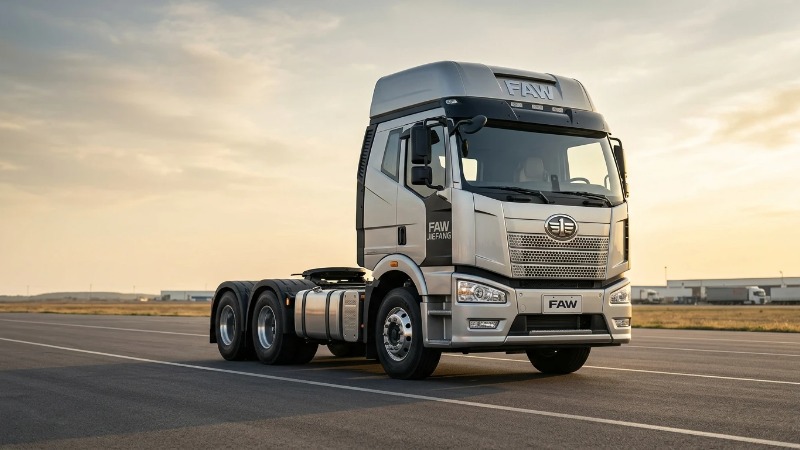
FAW J6P Heavy Duty Tractor Truck
The J6P is the heavy-duty flagship of the J6 range. It is engineered for maximum payload and continuous high-load operation.
Typical configurations pair the J6P with high-horsepower engines ranging from 420HP to 560HP. This power band suits demanding long-haul freight and heavy haulage.
Fleet operators favor the J6P for its rugged chassis and strong pulling capacity. It handles fully loaded trailers on challenging terrain with confidence, making it the go-to choice for serious freight work.
The spacious sleeper cab also supports driver retention on multi-day routes. Comfort is no longer a luxury in competitive freight markets; it directly affects operational efficiency.
FAW J6M and J6L Variants
Not every operation requires the full muscle of the J6P. The J6M serves as a capable mid-range option for regional and medium-duty haulage.
The J6M typically features engines in the 350HP to 460HP range. It offers a lighter curb weight, which can translate into better fuel economy for lighter loads.
The J6L, meanwhile, addresses lighter-duty and cost-sensitive applications. It suits shorter routes and operations where maximum horsepower is unnecessary.
Choosing between these variants comes down to your typical load and route profile. A thoughtful match here saves fuel and reduces total operating cost over the vehicle’s lifespan.
FAW Jiefang J7 Series: The Premium Flagship
The J7 represents the next generation of FAW engineering. It targets buyers who prioritize premium comfort, aerodynamics, and long-haul efficiency.
Its redesigned cab offers a more refined driving environment, with improved noise insulation and ergonomics. For fleets that run continental distances, this comfort reduces driver fatigue.
Aerodynamic refinements also improve fuel efficiency at highway speeds. Over hundreds of thousands of kilometers, those savings accumulate meaningfully.
While the J7 commands a higher position in the range, it appeals to operators building modern, image-conscious fleets. It signals a step up in both technology and prestige.
Axle Configurations Explained
Axle configuration profoundly affects a truck’s capability, cost, and suitability. Getting this decision right is one of the most important steps in the procurement process.
The three most common configurations for export are 4×2, 6×4, and 8×4. Each serves distinct operational needs.
4×2 Tractor Head Applications
A 4×2 tractor head uses a single drive axle. This lighter configuration excels in on-road applications with moderate loads and good infrastructure.
Because it carries less weight and complexity, the 4×2 typically delivers better fuel economy. It is popular for port drayage, container transport, and highway freight in developed regions.
However, it offers less traction on rough or slippery surfaces. Buyers operating in challenging terrain usually look toward a higher-traction setup.
6×4 Tractor Head Applications
The 6×4 configuration features two drive axles, delivering superior traction and payload capacity. It remains the undisputed workhorse choice across most export markets.
This setup handles heavy trailers, uneven roads, and demanding conditions with ease. Its versatility explains why the FAW 6×4 tractor head price is one of the most researched figures among importers.
For African, Central Asian, and Latin American buyers, the 6×4 is often the default recommendation. It balances capability and value in a way few configurations can match.
If you want to browse available configurations, our truck category page lists the current lineup in detail.
8×4 and Specialized Configurations
For the heaviest loads and off-road duty, 8×4 and specialized configurations come into play. These platforms add axles for extreme payload distribution.
They are common in mining, heavy haulage, and oversized cargo operations. Where roads are poor and loads are enormous, this added capability justifies the investment.
Specialized adaptations may also include reinforced frames, upgraded cooling, and enhanced suspension. Suppliers can often tailor these features to your exact use case.
Model Comparison Table
To simplify your decision, the following table compares the flagship models side by side. Figures are representative and will vary by exact configuration.
| Attribute | FAW J6P | FAW J6M | FAW J7 |
|---|---|---|---|
| Duty Class | Heavy-duty | Mid-range | Premium heavy-duty |
| Horsepower Range | 420–560 HP | 350–460 HP | 460–560 HP |
| Common Engines | Weichai / Xichai | Xichai / FAW | Weichai / FAW |
| Typical GVW | 40–100 tons (with trailer) | 25–60 tons | 40–100 tons |
| Cab Type | High-roof sleeper | Standard/sleeper | Premium high-roof sleeper |
| Best For | Long-haul, heavy freight | Regional haulage | Premium long-haul fleets |
Key Technical Specifications Buyers Must Evaluate
Beyond the model name, the underlying specifications determine real-world performance. Savvy buyers dig into these details before signing.
Below, we highlight the engineering factors that most affect performance, compliance, and return on investment.
Engine Options and Emission Standards
The engine is the heart of any tractor truck. FAW models are commonly offered with Weichai, Xichai (a FAW subsidiary), and FAW’s own engine platforms.
Horsepower typically ranges from 350HP for lighter duties up to 560HP for the most demanding heavy haulage. Torque figures scale accordingly, which matters for climbing gradients under load.
Weichai engines enjoy an especially strong reputation for reliability and parts availability. This makes them a popular choice for buyers focused on uptime.
Euro Emission Compliance for Export Markets
Emission standards vary widely between destination countries. Matching the engine’s emission level to local regulations is critical for legal operation.
The table below outlines common emission tiers and typical target markets. Always confirm current requirements with local authorities before ordering.
| Emission Level | Typical Markets | Notes |
|---|---|---|
| Euro II | Parts of Africa, Central Asia | Simple, robust, low-cost maintenance |
| Euro III | Many developing markets | Balanced emissions and reliability |
| Euro IV / V | Emerging regulated markets | Requires cleaner diesel fuel |
| Euro VI | Highly regulated regions | Advanced aftertreatment systems |
Selecting the wrong emission tier can create serious import and registration problems. When in doubt, consult your supplier and local customs broker early.
Transmission and Drivetrain Systems
Transmission choice affects both driver experience and maintenance. FAW tractor trucks are available with manual, automated manual (AMT), and Fast gearbox options.
Manual transmissions remain popular in developing markets for their simplicity and easy repair. Drivers and mechanics there are well accustomed to them.
AMT systems, however, reduce driver fatigue and can improve fuel efficiency. For the FAW Jiefang J6 heavy duty truck, buyers increasingly opt for AMT on long-haul routes.
Fast gearbox options, widely used in Chinese heavy trucks, offer proven durability under heavy loads. Discuss your preference clearly during specification confirmation.
Cab Design, Safety, and Driver Comfort
A comfortable cab is more than a luxury. It directly influences driver retention, alertness, and overall fleet productivity.
Modern FAW sleeper cabs include air suspension seats, climate control, and improved sound insulation. These features make multi-day trips far more manageable.
Safety features have also advanced considerably. Depending on configuration, options may include ABS, disc brakes, and reinforced cab structures.
For fleets that struggle to recruit and retain qualified drivers, cab quality can be a deciding factor. Do not overlook it in the rush to compare prices.
Fuel Efficiency and Total Cost of Ownership
Purchase price is only one part of the equation. Fuel and maintenance often dominate the total cost of ownership over a truck’s life.
The illustrative table below compares typical operating characteristics across configurations. Actual figures depend on load, terrain, and driving style.
| Configuration | Relative Fuel Use | Maintenance Complexity | Best TCO Scenario |
|---|---|---|---|
| 4×2 Tractor Head | Lowest | Low | On-road, moderate loads |
| 6×4 Tractor Head | Moderate | Moderate | Heavy loads, mixed roads |
| 8×4 Configuration | Higher | Higher | Extreme payloads, off-road |
The lesson is clear. A slightly higher upfront investment in the right configuration can yield lower lifetime costs.
Our knowledge base offers additional technical resources to help you calculate these trade-offs for your specific routes.
FAW Tractor Truck Pricing: What to Expect
Pricing is often the first question buyers ask. While we avoid quoting specific figures here, we can explain the factors that shape your final cost.
Understanding these variables helps you budget accurately and negotiate effectively. Let us break them down.
Factors That Influence FAW Jiefang Tractor Head Price
Several elements combine to determine the FAW Jiefang tractor head price you ultimately pay. No single figure applies universally.
- Configuration: Axle setup, cab type, and optional features all add cost.
- Engine and horsepower: Higher-output engines command higher prices.
- Emission level: Advanced emission systems increase complexity and cost.
- Order volume: Larger orders unlock better per-unit pricing.
- Shipping terms: The chosen Incoterm shifts responsibility and cost.
Because these factors interact, two buyers can receive very different quotes for seemingly similar trucks. Clarify your requirements precisely to get accurate numbers.
Price Ranges by Model and Configuration
Rather than list specific figures, the table below shows relative positioning. This helps you understand where each model sits within the range.
| Model / Config | Relative Price Position | Value Proposition |
|---|---|---|
| J6L / 4×2 | Entry level | Cost-efficient light duty |
| J6M / 6×4 | Mid tier | Balanced regional workhorse |
| J6P / 6×4 | Upper mid tier | Heavy-duty long-haul value |
| J7 / 6×4 | Premium tier | Comfort and efficiency flagship |
For exact, current pricing tailored to your destination, request a formal quotation. Our team can prepare one through the contact page.
Understanding Incoterms for Truck Import
Incoterms define who pays for and manages each stage of shipping. Misunderstanding them is a common and costly mistake.
- FOB (Free On Board): The seller delivers to the port of loading; you handle sea freight onward.
- CFR (Cost and Freight): The seller covers freight to your destination port.
- CIF (Cost, Insurance, Freight): Like CFR, but insurance is included.
For first-time importers, CIF often provides the most peace of mind. Experienced buyers with their own freight arrangements may prefer FOB for cost control.
Volume Discounts and Wholesale Pricing
Buyers exploring Chinese FAW commercial trucks wholesale opportunities benefit significantly from volume. Larger orders typically unlock more favorable per-unit terms.
Consolidating multiple vehicle types into one order can also improve overall economics. Combining tractor trucks with dump trucks or spare parts, for example, streamlines logistics.
If you plan to build a full fleet, discuss wholesale terms early. A supplier can structure a package that balances cost, delivery timing, and after-sales support.
How to Choose a Reliable FAW Prime Mover Supplier in China
Perhaps no decision matters more than choosing the right supplier. The same truck sourced through a poor partner can become a costly headache.
This section provides a practical framework for vetting a FAW prime mover supplier. Follow it carefully to protect your investment.
OEM Dealers vs. Trading Companies vs. Exporters
Chinese suppliers generally fall into three categories. Each offers distinct advantages and drawbacks.
OEM dealers connect directly to the manufacturer. They offer strong product knowledge but may lack broad export experience or flexibility.
Trading companies handle export logistics and paperwork smoothly. However, some add margin without adding value, so verify their expertise.
Specialized truck exporters often combine the best of both worlds. They understand the product deeply and manage international shipping with confidence.
Supplier Verification Checklist
Before committing, run every potential supplier through a rigorous checklist. The table below outlines the essential criteria.
| Verification Item | What to Confirm | Why It Matters |
|---|---|---|
| Business License | Valid registration and export scope | Confirms legal legitimacy |
| Export Experience | Years active and destination markets | Reduces logistics risk |
| Factory Access | Ability to audit or video-inspect | Verifies real capacity |
| Client References | Contactable past customers | Proves track record |
| Documentation | Certificates and compliance papers | Ensures smooth customs |
| Communication | Responsiveness and clarity | Predicts partnership quality |
Red Flags to Avoid When Sourcing
Vigilance protects you from costly mistakes. Watch for these warning signs during your search.
- Prices dramatically below market with no clear explanation.
- Reluctance to share company registration or references.
- Pressure to pay 100% upfront to an unverified account.
- Vague or inconsistent technical answers.
- No physical address or verifiable presence.
If something feels off, slow down and investigate. A trustworthy supplier welcomes scrutiny rather than resisting it.
Evaluating Export Experience and Track Record
Experience shipping to your specific region carries real weight. A supplier familiar with your market’s paperwork and standards saves you time and stress.
Ask direct questions. How many units have they shipped to your country? Can they provide references from similar buyers?
A confident, established partner answers these readily. You can review our documented history on the cooperative case page.
Payment Terms and Trade Assurance
Secure payment structures protect both parties. Never rush this stage under pressure.
Common secure methods include Letters of Credit (L/C), telegraphic transfer (T/T) with balance on inspection, and third-party escrow. Each balances risk differently.
A typical arrangement involves a deposit to begin production, with the balance paid after successful pre-shipment inspection. This structure aligns incentives on both sides.
The Import Process: From Order to Delivery
Once you have chosen a supplier, the practical work begins. Understanding the full import journey helps you avoid surprises.
Below is a step-by-step walkthrough suitable for both first-time and experienced importers.
Placing Your Order and Contract Negotiation
A detailed contract is your foundation. It should specify exact configurations, quantities, prices, delivery terms, and warranty coverage.
Confirm every technical detail in writing. Ambiguity here leads to disputes later, so leave nothing to assumption.
Key clauses to review include penalty terms for delays, inspection rights, and dispute resolution mechanisms. A clear contract benefits everyone.
Manufacturing Lead Times and Production Timelines
Trucks are not always sitting in stock. Custom configurations require production time.
Standard models may ship within a few weeks, while specialized builds can take longer. Confirm realistic timelines before committing to your own delivery promises.
Communicate these lead times to your end customers to manage expectations. Transparency preserves your reputation downstream.
Shipping Methods: RoRo vs. Container Shipping
Two primary methods move tractor trucks across oceans. Each has trade-offs in cost and protection.
| Method | Advantages | Considerations |
|---|---|---|
| RoRo (Roll-on/Roll-off) | Cost-effective, simple loading | Vehicle exposed on deck |
| Container Shipping | Enhanced protection and security | Higher cost, may require partial disassembly |
RoRo suits complete, driveable units and offers economical rates. Container shipping better protects the vehicle and any accompanying parts.
Your choice depends on budget, cargo value, and destination port capabilities. Discuss options with your supplier and freight forwarder.
Customs Clearance and Documentation
Proper paperwork keeps your shipment moving. Missing documents can trigger expensive delays at port.
Typical requirements include the commercial invoice, packing list, bill of lading, certificate of origin, and any homologation or compliance certificates.
Engaging a knowledgeable customs broker in your country is strongly advised. They navigate local rules that can be difficult to interpret from abroad.
Inspection and Quality Assurance Before Shipment
Pre-shipment inspection (PSI) is your final safeguard. Never skip it, even with a trusted supplier.
A thorough PSI verifies that specifications match the contract, checks build quality, and confirms functionality. You may inspect personally or hire a third-party agency.
Documenting the inspection with photos and reports protects you. It also creates a clear record should any dispute arise later.
After-Sales Support and Spare Parts Availability
The relationship does not end at delivery. Long-term support determines whether your fleet stays profitable.
This is where a truly reliable supplier distinguishes itself. Consider these factors carefully.
The Importance of a FAW Jiefang Spare Parts Supplier
Even the most reliable truck eventually needs parts. Access to a dependable FAW Jiefang spare parts supplier keeps your vehicles on the road.
Downtime is expensive. A truck waiting for parts earns nothing and disrupts your entire operation.
Before purchasing, confirm parts availability and typical lead times. A supplier who stocks common wear items and ships them quickly offers immense value.
Warranty Coverage and Terms
Warranty terms vary between suppliers and should be negotiated clearly. Understand exactly what is covered and for how long.
Clarify the process for warranty claims from your location. How are defective parts replaced, and who bears shipping costs?
A strong warranty demonstrates the supplier’s confidence in their product. It also signals a commitment to your long-term success.
Building a Long-Term Supplier Partnership
The best outcomes come from lasting partnerships, not one-off transactions. A supplier invested in your growth becomes a strategic asset.
Consolidating your purchases of trucks and parts through one trusted partner simplifies everything. Communication improves, and pricing often becomes more favorable.
Explore our full support offering on the customer service page to see how ongoing partnership works in practice.
FAW Beyond Tractor Trucks: Related Commercial Vehicles
Many fleets require more than tractor units. Fortunately, FAW’s catalog extends well beyond prime movers.
Sourcing multiple vehicle types from one supplier brings efficiency and better terms. Here are the adjacent categories worth exploring.
FAW Jiefang Dump Truck Options
Construction and mining operations depend on robust dump trucks. FAW offers a range built for heavy vocational duty.
Buyers who need both freight and vocational vehicles benefit from a single FAW Jiefang dump truck exporter relationship. It consolidates logistics and support.
These dump trucks share many components with the tractor range, simplifying parts inventory. That commonality reduces maintenance complexity across a mixed fleet.
Cargo Trucks, Concrete Mixers, and Specialized Vehicles
The lineup also includes cargo trucks, concrete mixers, and various specialized vehicles. These serve construction, distribution, and municipal applications.
For distributors, offering a broad product range attracts more customers. For fleet operators, standardizing on one brand streamlines training and repairs.
Whatever your mix of needs, a well-stocked supplier can likely accommodate them. Browse the complete range on our category page.
Real-World Case Studies and Market Applications
Specifications tell part of the story. Real-world performance completes it.
The following examples illustrate how FAW tractor trucks perform in demanding conditions across different regions.
Case Study: Long-Haul Logistics Fleet in Africa
A regional freight operator in East Africa needed dependable prime movers for cross-border routes. They selected a fleet of 6×4 J6P units.
Over three years of operation, the fleet delivered strong uptime despite harsh road conditions. The operator cited straightforward maintenance and readily available parts as key advantages.
Fuel costs remained competitive, and driver feedback on cab comfort was positive. The combination of durability and value produced a solid return on investment.
This outcome reflects a common pattern. The FAW heavy duty tractor truck performs reliably precisely where infrastructure is toughest.
Case Study: Mining and Construction Operations
A construction firm operating in a mountainous mining region required maximum traction and payload. They deployed heavy-duty tractor units with high-horsepower engines.
The trucks handled steep gradients and heavy trailers without strain. Robust cooling and reinforced components withstood the punishing environment.
Maintenance intervals proved manageable, and downtime stayed low thanks to a proactive spare parts arrangement. The firm subsequently expanded its fleet with the same platform.
Regional Performance Data
The table below summarizes illustrative durability and maintenance observations across key export regions. These reflect general field patterns rather than guarantees.
| Region | Typical Application | Reported Reliability | Parts Availability |
|---|---|---|---|
| East Africa | Long-haul freight | Strong | Good |
| Central Asia | Cross-border logistics | Strong | Good |
| Southeast Asia | Port and container haulage | Very strong | Excellent |
| Latin America | Mining and agriculture | Strong | Good |
The consistent theme is durability paired with practical serviceability. That balance underpins the brand’s growing global reputation.
Frequently Asked Questions (FAQ)
Below, we address the questions buyers ask most frequently. These concise answers should clarify common concerns quickly.
What is the price of a FAW 6×4 tractor truck?
The price of a 6×4 tractor truck depends on engine power, emission level, cab configuration, and order volume. Because these variables shift the final figure considerably, we recommend requesting a tailored quotation for your specific market and specifications.
Is FAW a reliable truck brand for export?
Yes. FAW is one of China’s oldest and largest truck manufacturers, with decades of engineering heritage. Its vehicles are widely exported and have earned a solid reputation for durability across demanding markets in Africa, Asia, and Latin America.
What engine does the FAW J6 tractor truck use?
The FAW J6 tractor truck is commonly equipped with Weichai, Xichai, or FAW’s own engine platforms. Horsepower ratings typically range from 350HP to 560HP, allowing buyers to match power output to their specific load and route requirements.
How long does shipping take from China?
Shipping time depends on the destination and method. RoRo and container shipping transit times generally range from two to six weeks by sea, plus production lead time before dispatch. Your supplier can provide a precise estimate based on your port.
Are FAW Jiefang spare parts easy to source?
Generally, yes. FAW’s large global presence means spare parts are widely available, and reliable suppliers stock common wear items. Confirming parts availability and lead times with your supplier before purchase helps ensure minimal downtime later.
What is the minimum order quantity (MOQ)?
MOQ varies by supplier. Many exporters accommodate single-unit purchases for buyers testing a new market, while wholesale terms and better pricing typically apply to larger fleet orders. Discuss your volume plans upfront to secure the best arrangement.
Conclusion and Next Steps
Sourcing a tractor truck from China is a significant decision, but it need not be daunting. With the right knowledge and a trusted supplier, the process becomes straightforward and rewarding.
FAW’s combination of heritage, engineering, and value makes its tractor range a compelling choice. From the versatile J6 to the premium J7, there is a configuration suited to nearly every operation.
Your Procurement Action Plan
To move forward with confidence, follow this concise checklist.
- Define your operational needs, including load, terrain, and route profile.
- Select the appropriate model and axle configuration.
- Confirm the correct emission level for your destination market.
- Vet potential suppliers thoroughly using the verification checklist.
- Negotiate clear contract terms and secure payment structures.
- Arrange pre-shipment inspection before final payment.
- Confirm warranty coverage and spare parts availability.
Work through each step methodically. This disciplined approach protects your investment and sets your fleet up for years of reliable service.
Call to Action: Request a Custom Quote Today
Ready to take the next step? Our team is prepared to help you source the ideal tractor trucks, dump trucks, and spare parts for your operation.
Reach out for personalized pricing, detailed specifications, and a complete export consultation tailored to your market. Visit our contact page to start the conversation, or explore the full lineup on our homepage.
Let us help you build a dependable, cost-effective fleet with confidence. Your reliable prime mover partnership begins here.
Meta Description: FAW Jiefang truck buyer’s guide: models, pricing, sourcing tips, and export advice for reliable China prime movers.