




Compare FAW Jiefang truck models, vet Chinese suppliers, and calculate landed costs with this expert 2026 buyer’s guide for fleet operators.
A comprehensive buyer’s guide for fleet operators, importers, and commercial vehicle dealers evaluating FAW Jiefang trucks and vetting Chinese suppliers.
Sourcing heavy commercial vehicles across borders is rarely a simple transaction. For fleet managers and importers, the stakes are high, and one wrong decision can lock capital into equipment that underperforms for years.
That is precisely why the FAW Jiefang truck has become a benchmark for buyers who need proven reliability without paying a premium for European or Japanese badges. This guide walks you through everything that matters, from lineup selection to supplier vetting and landed cost.
Why FAW Jiefang Remains a Leading Choice for Global Fleet Buyers
FAW Jiefang carries a legacy that few Chinese manufacturers can match. As one of the founding pillars of China’s automotive industry, the brand has produced commercial vehicles for more than seven decades.
For industry professionals, this heritage translates into something practical. It means mature engineering, a deep parts ecosystem, and a manufacturing discipline honed over millions of units. When you commit to a fleet, that stability reduces operational risk.
Moreover, the brand consistently balances upfront affordability with long-term serviceability. That combination is what keeps repeat buyers returning order after order.
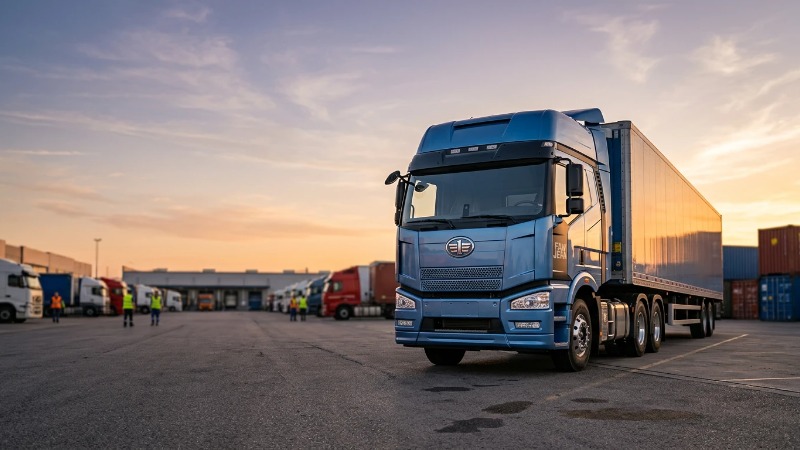
FAW Jiefang’s Manufacturing Scale and Export Footprint
Scale matters when you evaluate a supplier’s ability to fulfill large orders on schedule. FAW Group operates some of the largest commercial vehicle facilities in Asia, producing hundreds of thousands of trucks annually.
Beyond domestic demand, the brand has aggressively expanded into emerging markets. Africa, Southeast Asia, the Middle East, and Latin America now represent significant export destinations for Chinese FAW commercial trucks wholesale programs.
The table below offers a representative snapshot of production and export dynamics based on recent industry reporting.
| Metric | Representative Figure | Notes |
|---|---|---|
| Annual heavy-truck output | 250,000+ units | Across all commercial families |
| Primary export regions | Africa, SE Asia, Middle East | High-growth infrastructure markets |
| Key application sectors | Logistics, mining, construction | Broad configuration range |
| Export share of production | 15–20% | Steadily rising year over year |
These numbers illustrate a manufacturer with genuine capacity. For bulk buyers, that depth reduces lead-time risk during peak demand cycles.
Reputation for Durability in Harsh Operating Conditions
Specifications on paper mean little until a truck faces real terrain. FAW Jiefang units have earned a reputation for withstanding punishing environments where downtime is expensive.
In mining operations, dump variants routinely handle overloaded cycles on unpaved haul roads. In long-haul logistics, the drivelines deliver consistent fuel economy across thousands of kilometers.
Consequently, operators in dusty, high-temperature, and high-altitude regions frequently cite these trucks for their resilience. You can explore documented deployments in our cooperative case studies to see how they perform under load.
Understanding the FAW Jiefang Truck Lineup
Choosing the right model starts with understanding how the range is structured. The lineup spans light-duty vans through heavy tractor units, each tuned for specific missions.
For commercial importers, the heavy and medium segments generate the most inquiries. Below, we break down the families that matter most to professional buyers.
FAW Jiefang J6 Heavy Duty Truck: Flagship Overview
The FAW Jiefang J6 heavy duty truck anchors the premium end of the range. It targets buyers who prioritize comfort, durability, and high-torque performance over the lowest possible sticker price.
Engine options typically span from roughly 350 to 550 horsepower, paired with heavy-duty gearboxes engineered for sustained loads. Cab ergonomics have improved substantially, which matters for fleets running long shifts.
Typical use cases include intercity freight, container haulage, and demanding construction logistics. When operators need a workhorse that keeps rolling, the J6 platform consistently makes the shortlist.
Tractor Heads, Dump Trucks, and Cargo Configurations
Beyond the flagship, buyers select body types according to cargo and route profile. Each configuration serves a distinct commercial purpose.
- Tractor heads: Optimized for pulling semi-trailers over highway distances, with emphasis on fuel efficiency and torque.
- Dump trucks: Built for construction and mining, featuring reinforced beds and robust hydraulic tipping systems.
- Cargo trucks: Versatile flatbed and box configurations for regional distribution and mixed freight.
Understanding these distinctions early prevents costly mismatches. Browse the full range on our truck category page to compare available builds.
Comparison Table: Model, Engine, Horsepower, GVW, and Typical Application
| Configuration | Engine Type | Horsepower | GVW / Capacity | Typical Application |
|---|---|---|---|---|
| J6 6×4 Tractor Head | Diesel, turbocharged | 420–500 hp | 40–60 t combined | Long-haul container freight |
| J6 8×4 Dump Truck | Diesel, heavy-duty | 350–420 hp | 30–40 t payload | Mining, construction |
| Medium Cargo 4×2 | Diesel, medium-duty | 240–320 hp | 10–18 t GVW | Regional distribution |
| J6 6×4 Mixer Chassis | Diesel, high-torque | 380–460 hp | 8–12 m³ drum | Concrete transport |
Use this reference as a starting point. Final specifications should always be confirmed against your route regulations and load requirements.
Pricing Guide: What to Expect When Buying FAW Jiefang Trucks
Price transparency is where many first-time importers struggle. A quoted figure rarely tells the full story until you understand the variables behind it.
In general, FAW units offer strong value relative to Western equivalents. However, the final cost depends heavily on configuration, emission standard, and order volume.
FAW Jiefang Tractor Head Price Ranges by Configuration
The FAW Jiefang tractor head price shifts according to horsepower, axle layout, and cab specification. The table below shows indicative ex-works ranges to guide your budgeting.
| Configuration | Emission Standard | Indicative Price Range (USD) |
|---|---|---|
| 6×4 Tractor, 420 hp | Euro III | $32,000 – $38,000 |
| 6×4 Tractor, 460 hp | Euro V | $40,000 – $48,000 |
| 8×4 Dump Truck, 380 hp | Euro III | $38,000 – $45,000 |
| 4×2 Cargo, 280 hp | Euro V | $26,000 – $32,000 |
These figures are illustrative and fluctuate with steel prices and exchange rates. Always request a live quotation before finalizing a budget.
Cost Factors: Emissions Standards, Customization, and Volume
Several levers move the final number. Understanding them helps you negotiate from a position of knowledge.
First, higher emission standards raise unit cost because of advanced aftertreatment systems. Second, customization—such as reinforced chassis or specialized bodies—adds to the base price.
Volume works in your favor. When buying Chinese FAW commercial trucks wholesale, larger orders unlock meaningful per-unit discounts and better payment terms. Our customer service team can model tiered pricing for your target quantity.
Hidden Costs: Freight, Duties, Insurance, and Compliance
The ex-works price is only the beginning. Landed cost includes several components that inexperienced buyers frequently underestimate.
- Ocean freight: Varies by route, vessel type, and whether trucks ship RoRo or in containers.
- Import duties and taxes: Determined by your country’s HS classification and trade agreements.
- Marine insurance: Typically 0.3–1% of cargo value for full coverage.
- Compliance and homologation: Local certification, inspection, and registration fees.
- Port handling and inland transport: Terminal charges plus delivery to your yard.
Build these into your model early. A truck that looks cheap ex-works can become uncompetitive once fully landed.
How to Identify a Reliable FAW Jiefang Supplier in China
The single biggest determinant of a successful import is supplier quality. A strong product from a weak partner still leads to disappointment.
Therefore, disciplined vetting protects your capital. The framework below reflects how experienced buyers separate credible partners from opportunists.
Distinguishing Authorized Dealers from Trading Companies
Two supplier types dominate the market, and each suits different buyer profiles. Knowing the difference shapes your negotiation strategy.
Authorized dealers hold direct manufacturer relationships. They generally offer better warranty backing and parts access, though sometimes at a slightly higher margin.
Trading companies, by contrast, aggregate supply from multiple sources. They can be flexible on mixed orders, but accountability may be thinner if problems arise. Learn how our sourcing model works on our about us page.
Key Due Diligence Checklist for Verifying Suppliers
Before wiring a deposit, verify these essentials. Skipping any step introduces avoidable risk.
- Confirm a valid business license and matching company name on official records.
- Request export licenses and confirm recent shipping history.
- Arrange a third-party factory or inventory audit where possible.
- Obtain references from prior buyers in your region.
- Verify banking details independently to avoid payment fraud.
Documented verification builds confidence on both sides. It also signals to the supplier that you are a serious, professional buyer.
Red Flags That Signal an Unreliable FAW Jiefang Dump Truck Exporter
Certain patterns should stop a deal in its tracks. A trustworthy FAW Jiefang dump truck exporter welcomes scrutiny rather than deflecting it.
- Prices dramatically below market with no clear explanation.
- Reluctance to provide company registration or export documents.
- Pressure to pay large deposits into personal accounts.
- Vague or evasive answers about warranty and after-sales support.
- Inconsistent contact details across communications.
When you spot these signals, walk away. Protecting your working capital always outweighs the appeal of an unusually low quote.
Evaluating Quality, Warranty, and After-Sales Support
The purchase is one moment; ownership lasts years. Long-term value depends on quality control and reliable support after delivery.
Smart buyers weigh these factors as heavily as price. A modest saving upfront rarely justifies years of parts headaches.
Inspection Standards and Pre-Shipment Quality Control
A proper QC process catches defects before trucks leave the yard. Never rely solely on the supplier’s word.
A robust inspection should cover the following areas at minimum:
- Engine start, idle stability, and fluid checks.
- Transmission and driveline function under test conditions.
- Brake system integrity and electrical operation.
- Frame, welds, and body panel quality.
- VIN verification against contract specifications.
- Photographic and video documentation of each unit.
Where feasible, commission an independent inspector. The modest fee is insurance against costly surprises at the destination port.
Warranty Terms and Access to a FAW Jiefang Spare Parts Supplier
Parts availability quietly determines total cost of ownership. A truck grounded for weeks waiting on components erodes any purchase-price advantage.
Confirm warranty duration, coverage scope, and the claims process in writing. Just as importantly, verify that your partner functions as a dependable FAW Jiefang spare parts supplier with stock or fast replenishment.
Buyers who stock fast-moving components locally minimize downtime. For guidance on building a parts strategy, review our knowledge base articles.
The Ordering and Shipping Process Explained
International procurement follows a predictable rhythm once you understand the sequence. Clarity at each stage prevents delays and disputes.
The overview below outlines what a smooth transaction looks like from first contact to delivery.
From Inquiry to Delivery: A Typical Procurement Timeline
| Stage | Responsible Party | Estimated Duration |
|---|---|---|
| Inquiry and quotation | Buyer & supplier | 1–3 days |
| Contract and deposit | Buyer | 3–7 days |
| Production or allocation | Manufacturer | 15–40 days |
| Pre-shipment inspection | Buyer / inspector | 2–5 days |
| Booking and loading | Supplier / forwarder | 5–10 days |
| Ocean transit | Shipping line | 15–45 days |
| Customs and delivery | Buyer / broker | 5–15 days |
Timelines vary by season and destination. Building buffer into your schedule keeps operations predictable.
Payment Terms, Incoterms, and Documentation
Trade terms define who bears cost and risk at each step. Aligning on them early avoids friction later.
Common structures include a 30% deposit with balance before shipment, often against a letter of credit for larger orders. Frequently used Incoterms are FOB, CIF, and CFR, each shifting responsibility at different points.
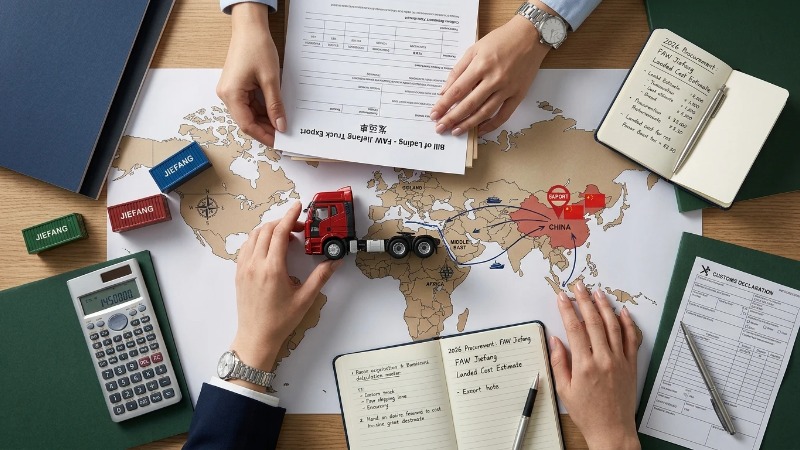
Essential documents include the commercial invoice, packing list, bill of lading, certificate of origin, and any required inspection certificates. Have your import team coordinate directly with the supplier to keep paperwork clean.
Real-World Case Examples: FAW Jiefang in Operation
Abstract specifications become meaningful when tied to outcomes. The following scenarios illustrate typical performance in the field.
Long-Haul Logistics Fleet Deployment
Consider a regional logistics operator running a mixed fleet across roughly 1,200 km corridors. After adding several J6 tractor units, management tracked fuel consumption and uptime over twelve months.
Average fuel economy held steady around competitive benchmarks for the class, while unscheduled downtime stayed low thanks to accessible parts. The result was a payback period well within the operator’s target window.
For fleets running high mileage, that combination of efficiency and availability is decisive. It directly protects margins in a thin-margin business.
Construction and Mining Dump Truck Applications
In a separate case, a construction contractor deployed 8×4 dump units on unpaved sites with frequent overload cycles. Durability under abuse was the primary concern.
The reinforced beds and heavy-duty suspensions absorbed the punishment with minimal structural fatigue. Maintenance costs remained manageable, and the return on investment tracked ahead of projections across the first two operating seasons.
These outcomes reflect why the brand keeps winning repeat orders in heavy sectors. When conditions are brutal, resilience translates directly into profit.
Frequently Asked Questions
What is the minimum order quantity for FAW Jiefang trucks?
MOQ varies by supplier and configuration. Many trading partners accommodate single units for standard models, while manufacturer-direct programs and best pricing often start at small batch quantities. For customized builds, minimums may be higher, so confirm early in your inquiry.
How long does shipping from China take?
Transit depends on destination and method. RoRo or container shipping to Africa and Southeast Asia commonly ranges from 15 to 30 days, while routes to Latin America can extend to 40 days or more. Add time for booking, customs, and inland delivery when planning.
Are FAW Jiefang spare parts easy to source internationally?
Yes, the brand’s scale supports a broad parts network. Fast-moving components are widely available, and a reliable supplier can arrange consolidated parts shipments. Stocking critical items locally is strongly recommended to minimize any downtime risk.
Can suppliers customize trucks for local regulations?
Absolutely. Options include left- or right-hand drive, adjusted emission systems, tailored axle configurations, and specialized bodies. Share your local regulatory requirements up front so the supplier can confirm compliance before production begins.
What emission standards are available for export models?
Export configurations commonly span Euro III through Euro V, with cleaner standards available for markets that require them. The right choice depends on your country’s import rules, so verify the mandated standard before ordering.
Partner With a Trusted FAW Jiefang Truck Supplier
Choosing the right vehicle is only half the equation. The right partner ensures that quality, pricing, and after-sales support align with your operational goals.
If you are ready to move forward, we can provide a customized quotation, arrange factory verification, and share a complete product catalog. Our team specializes in transparent pricing and dependable support throughout the ownership lifecycle.
Take the next step today. Visit our homepage to explore the full range, then contact our sales team to request pricing tailored to your fleet requirements. Reliable trucks and responsive service are just one conversation away.