


Biggest brand isn’t safest. Learn how to choose a Chinese truck manufacturer by spec control, traceability, documentation and local after-sales support.
The largest, best-known name is often not the safest choice for your fleet, because a reliable truck manufacturer in China is defined by specification control, service reach and documentation discipline rather than headline volume.
This guide corrects the most common beliefs in the trade, one by one, and ends with a plain next step you can act on.
Why Is “Biggest Brand Wins” a Weak Way to Pick a Truck Maker?
The common assumption is simple: the bigger the maker, the lower the risk. Large volume, a famous badge and a long dealer list seem to promise a dependable truck.
Scale does help in two real ways. Parts supply is usually deeper for high-volume platforms, and resale is easier when local mechanics and buyers recognize the model. Those advantages are worth pricing in.
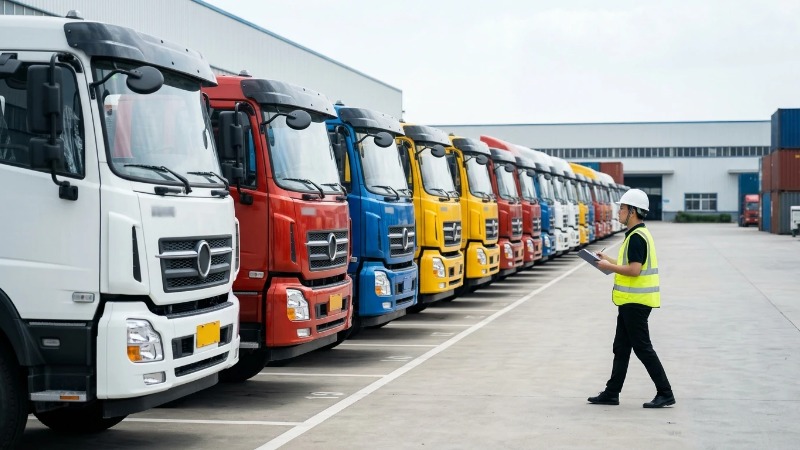
But they describe the brand, not your delivery. A large maker sells many configurations through many assemblers, dealers and trading channels, and the truck that arrives can differ from the one you inspected. Axle ratio, gearbox, tyre fitment, cab options and even frame specification can shift between batches or between sellers using the same model name.
That is where the belief breaks down. Reputation is an average across an entire production base. You are buying a specific unit, or a specific batch, and the question that matters is whether the build you receive matches the build you approved on paper.
Reliability shows up in repeatability. A maker that delivers the same contracted specification order after order, documents every deviation and answers warranty claims in your country is a safer choice than a famous name that cannot guarantee any of those things. A smaller supplier with tight specification control can outperform a larger one with loose control.
So treat the brand as one input, not the filter. The sections that follow set out what to check instead.
What Actually Makes a Chinese Truck Manufacturer Reliable?
A reliable Chinese truck manufacturer is one that delivers the same specification every time, can trace its components, documents the vehicle accurately and supports it in your country. Four checks cover this: build consistency, component traceability, documentation honesty and local after-sales capability. None of them depends on brand size.
Build consistency means unit number fifty matches the unit you approved. Ask how the maker controls the process: whether there are end-of-line test records, whether weld and paint checks are logged, and whether a change to a supplier or part is notified to you before it reaches the vehicle. A maker that cannot describe its change-control routine will probably change things without telling you.
Component traceability is the ability to say which engine, gearbox, axle and chassis steel went into a given vehicle, tied to its VIN. Without it, a warranty claim or a recall becomes a guessing exercise. Request the bill of materials for the exact configuration, not a brochure list.
Documentation honesty covers more than having papers. Check that the specification sheet, the certificate of conformity, the invoice description and the physical truck all agree. Small mismatches, such as a different axle ratio or a swapped cab option, are common warning signs in this trade.
After-sales capability in your country is the check buyers most often leave until after the deposit. Look for a named service point, a parts stock you can verify, and technicians who have worked on this configuration. Warranty terms matter little if no one nearby can honor them.
Weigh these four above reputation, and ask for evidence on each in writing.
Which Truck Type and Duty Cycle Should Decide the Shortlist First?
Define the job before you look at a single supplier. A maker that builds a sound tipper may be unremarkable at tractor units, and a price list says nothing about whether a chassis suits your route. Four criteria turn a vague need into a shortlist you can defend.
Payload and axle configuration. State the real loaded weight, including body, tools and the overload habits common in your market. Then match it to the axle layout and rated capacity, rather than to a model name. A tractor unit pulling a semi-trailer and a rigid cargo truck stress different parts of the driveline, so makers with strength in one are not automatically strong in the other.
Terrain and road surface. Mining haul roads, mountain grades and paved highways call for different frame strength, suspension, gear ratios and cooling capacity. Tippers working on loose ground tend to expose weak frames and body mounts first. Ask each candidate which specification they would fit for your terrain, and why.
Daily distance and utilisation. A truck covering long daily distances rewards fuel efficiency, cab comfort and service intervals that fit your schedule. A short-haul truck used heavily with frequent stops puts more wear on the clutch, brakes and starter. Higher utilisation also leaves less downtime for waiting on parts.
Fuel availability and quality. Check what diesel is actually sold along your routes, including its sulfur level, before you choose an engine and its aftertreatment. Fuel that the engine tolerates poorly will cost more than any saving on the purchase price.
Tip: Write these four answers on one page and send it with every request for a quote. Suppliers who respond to your duty cycle, rather than pushing a standard model, are showing you how they will behave after the sale.
Rule of thumb: pick the truck type first, the duty cycle second, and only then compare makers who have a track record in that exact configuration.
How Do You Read Certificates Without Being Misled?
Treat a certificate as proof of the one thing it was issued to examine, and nothing broader. A document that audits a management process says little about a specific truck, and that gap is where many buyers get misled.
The rule holds because certification schemes have narrow scopes. It breaks when a certificate looks relevant but names a different legal entity, a different product, or has expired.
Certificates worth requesting and what each proves
ISO 9001 is a quality management system standard. It shows that a manufacturer has documented procedures and is audited against them. It does not rate the truck, and a factory with mediocre output can hold it.
Product conformity documents carry more weight. China Compulsory Certification (CCC) applies to certain vehicle categories and components on the Chinese market, and in China a vehicle must also appear in the national vehicle announcement catalogue to be sold domestically. For your own market, the decisive paper is the vehicle type approval or homologation your authority requires. Ask for the certificate number, the issuing body, the exact model covered and the validity date, then check these against the VIN plate and the contract specification.
Certificates that sound impressive but prove little
Be cautious with certificates that cover a trading arm rather than the plant that builds the truck. The same applies to awards, membership badges and “export qualification” letters, which describe business standing rather than build quality. Engine or component certificates also do not transfer to the complete vehicle.
A practical test: ask what the document would let you do if the truck failed. If the answer is nothing, it belongs in the background file, not in the decision.
Do Established Platforms Like Sinotruk HOWO Remove the Need for Due Diligence?
A proven platform lowers the risk of the design. It does not lower the risk of the specific truck on the quote. Those are two different questions, and buyers often treat the first as an answer to the second.
Sinotruk HOWO is a heavy-duty truck range sold in many markets, which means mechanics in those markets have usually seen its engines, cabs and axles before. Parts channels tend to be deeper, and resale buyers recognise the name. These are real advantages, and they are the reason a shortlist often includes it.
The weakness is that a model name describes a family, not a build. Within one family you can find different engine outputs, gearbox and axle suppliers, frame thicknesses, cab grades and emission packages. The vehicle may also be finished by a different assembler or sold through a dealer with its own modifications and its own service standards.
Two quotes, same model name
Consider a generic example. Two importers each order a 6×4 tipper described as the same HOWO model. One unit has the heavier-spec rear axles and a reinforced body floor for quarry work. The other has lighter axles suited to general haulage, and a dealer-fitted body of unknown origin. Both invoices read the same, and the two trucks wear out at different rates.
A second example is the dealer layer. One dealer stocks common wear parts and has trained technicians. Another sells the truck and leaves service to whoever will take the call. The brand is identical, but the ownership experience is not.
What to do instead
Use the platform as a starting point and verify the configuration line by line against a written specification. Ask who built the truck, who sold it, and who will honour the warranty in your country. Treat the model name as shorthand and the contract specification as the actual product.
What Should You Inspect Beyond the Engine Brand?
Two trucks can carry the same engine badge and age very differently: one has a frame built from a specified high-strength steel grade, branded axles and a sealed, well-protected cab, while the other uses lighter rails, unbranded axles and bare seams. The engine is one component of a drivetrain that sits on a chassis. Under load, the chassis, axles, gearbox, cab and wiring usually fail first.
Ask for these items in writing, by supplier and specification, and compare them as a set rather than one by one.
| Component | What to request | Why it matters | Typical warning sign |
|---|---|---|---|
| Chassis and frame steel | Steel grade, rail thickness, cross-member count | Governs fatigue life and overload tolerance | Grade described only as “high strength” |
| Axles | Named manufacturer, rated capacity, ratio | Sets true payload margin and parts supply | Capacity stated without a maker |
| Gearbox | Brand, model, torque rating | Must match engine output and duty cycle | Substitution allowed “if unavailable” |
| Cab protection | Pretreatment and coating process, seam sealing | Determines corrosion life in wet or salted regions | No process detail offered |
| Wiring and electrics | Harness routing, connector sealing, fuse layout | Drives intermittent faults and downtime | Loose looms, taped splices |
The takeaway: a component named in the contract can be enforced, while a vague description cannot.
If you must prioritise, start with the frame and axles. They are the hardest and costliest parts to correct after delivery, and they define the real payload the truck can carry for years. Cab coating and wiring come next, particularly for humid, coastal or heavily salted road conditions.
Finally, confirm that any substitution requires your written approval. Silent component swaps between production batches are a common source of the gap between an approved sample and delivered units.
Is Euro 5 Compliance Enough for Your Destination Market?
A truck arrives with a Euro 5 plate, then derates or throws fault codes within weeks because the local diesel is dirtier than the engine was built for. It happens more often than quotes suggest, and a compliance label on the paperwork does nothing to prevent it.
Euro 5 is a European emission standard that limits exhaust pollutants such as nitrogen oxides and particulate matter for heavy-duty engines. Your country may not recognise it at all, may require a different tier, or may accept it only with local testing. Check the regulation that governs registration where the truck will run, not the one printed in the supplier’s brochure.
Fuel quality is the quiet failure point
Euro 5 heavy-duty engines typically rely on selective catalytic reduction (SCR), which injects urea solution (often sold as AdBlue) into the exhaust to cut nitrogen oxides. These systems generally expect low-sulfur diesel. High-sulfur fuel can foul catalysts and sensors, and in many markets the urea itself is hard to find or of uncertain purity.
Ask the manufacturer in writing which maximum fuel sulfur level the engine and aftertreatment are rated for. Then compare that figure with what your filling stations actually sell, which may differ from the national specification.
Note: Some operators in markets with poor fuel buy Euro 3 or Euro 4 variants without SCR on purpose, because they tolerate local diesel better. If your rules permit it, a lower tier can be the more reliable choice. Ask the supplier whether an alternative engine calibration exists and what it does to warranty terms.
Finally, confirm that urea supply, replacement sensors and diagnostic tools are available through a dealer or distributor near you before you commit.
How Do Left-Hand Drive Conversion and Market Adaptation Affect Reliability?
A fleet owner receives a batch of tippers built for a right-hand-drive market and has them converted locally before registration. Within months, the steering feels vague, the heater core leaks and a wiring harness chafes against the new column bracket. Nobody agrees on who pays.
Left-hand drive (LHD) conversion is the rework of a truck’s steering, pedals, dashboard and related linkages so the driver sits on the opposite side from the original design. Done in the factory on a purpose-built line, it is routine. Done afterward by a third party, it is a modification, and modifications are where reliability tends to erode.
The same logic applies to broader market adaptation. A truck for hot, dusty or high-altitude operation may need a larger radiator, upgraded air filtration or reinforced suspension, and these changes are only as dependable as the engineering behind them.
Ask the supplier four things in writing:
- Is the steering side factory-built for your market, or converted after assembly?
- Were cooling capacity and air intake specified for your climate and altitude?
- Is the suspension rated for your typical load and road surface?
- Who holds warranty on any modified system, and does the main warranty remain valid?
Warranty is the practical test. If the manufacturer excludes modified components, or the converter’s warranty is short or hard to enforce, you carry the risk. A factory-built unit with a single warranty is generally the safer route; a post-assembly conversion can work, but only with documented workmanship and clear liability.
How Should You Compare Quotes Under Incoterms FOB and CIF?
Put every quote on the same basis before you look at price. The steps below turn an FOB figure and a CIF figure into one comparable landed cost.
- Confirm the Incoterms rule and named port on each quote. FOB (Free On Board) means the seller’s price ends once the goods are loaded on the vessel at the named port of shipment. CIF (Cost, Insurance and Freight) adds sea freight and minimum insurance to the named destination port.
- Add freight to every FOB quote, using written quotations from a forwarder for your route and your shipping method.
- Check the insurance cover on CIF quotes, since CIF typically requires only minimum cover, and price fuller cover if your risk is higher.
- Add destination port charges, unloading, inland transport and storage, which neither term normally includes.
- Calculate import duty and taxes on the classification your customs authority applies. Heavy goods vehicles generally fall under HS code 8704, but confirm the subheading locally.
- Add compliance work such as inspection, registration, testing and any conversion required before the truck can be used.
The result is often a narrower gap than the headline prices suggest, and sometimes a reversed one. A low FOB quote can also signal thin specification, so compare it against the contract’s equipment list rather than the price alone.
One caution: CIF is convenient, but you rely on the seller’s choice of carrier and insurer. If you have a trusted forwarder and want control over claims, FOB usually serves you better.
RoRo Shipping or Container Shipping: Which Suits Your Trucks?
You’ve probably asked it already: should the trucks roll onto a vessel, or go into boxes? Short answer, RoRo (roll-on/roll-off, where vehicles are driven onto a purpose-built carrier) is usually simpler for complete units, while container shipping tends to suit smaller or partly dismantled vehicles.
RoRo’s appeal is handling. A finished tractor unit or tipper is driven on and driven off, with no lifting frames or lashing inside a box. The catch is that RoRo needs a port with the right ramps and yard space at both ends, and sailings are less frequent on some routes. Confirm that your discharge port actually handles heavy, high vehicles before you price anything.
Container shipping shifts the question to unit size. Many full-size heavy trucks exceed standard container dimensions, so they often ship with cabs removed or axles dismantled, or on flat-rack and open-top equipment. That adds labour at loading and reassembly on arrival, and every disassembly step is a place where damage or missing parts can creep in. Smaller cargo trucks and light-duty units are far easier to fit.
A practical rule: choose RoRo for complete heavy units if your port supports it, and containers where port facilities or vehicle size rule RoRo out. Whichever you pick, ask the forwarder who is liable for damage during lashing, and make sure the insurance covers that handling method.
What Does a Proper Pre-Shipment Inspection Cover?
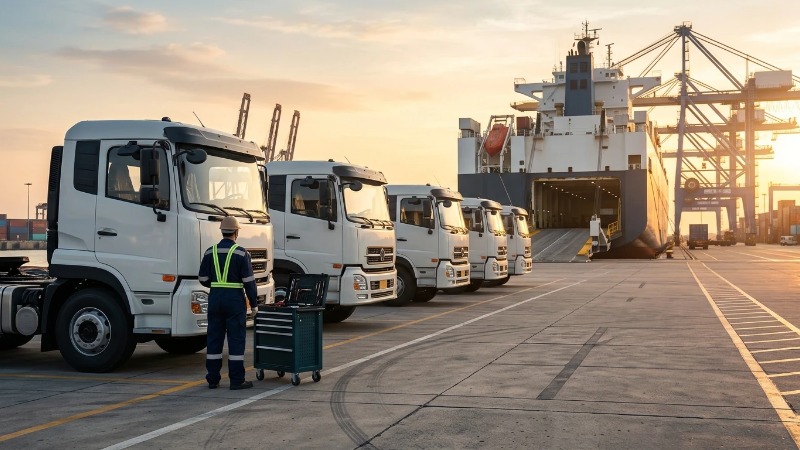
A pre-shipment inspection is a documented check of each truck, done before loading, that confirms the unit matches the contract. Three or four criteria carry most of the weight, and an independent inspector, not the seller’s own staff, should apply them.
Identity and specification. Match the vehicle identification number (VIN) on the chassis, cab plate and papers, then check engine, axles, gearbox, tyres and cab options against the signed specification line by line.
Function. Fluids, electrics and a short test run show whether the truck works as built. Look for leaks, warning lights, brake response, gear changes and unusual noise.
Paperwork. Certificates, invoices and packing lists must carry the same VIN and description, since customs and registration offices compare them.
Loading condition. Record the state of paint, glass and tyres before loading, and photograph lashing points and fuel level. These records settle damage claims later.
- Confirm VIN matches every document.
- Compare each component against the contract specification.
- Check oil, coolant, brake and hydraulic fluid levels.
- Test lights, gauges, wipers and warning indicators.
- Drive each unit and note any fault.
- Photograph the truck before and after loading.
Agree the checklist in the contract, so a failed item delays shipment instead of becoming a dispute at the destination port.
Should You Buy Outright or Consider Fleet Leasing?
Take a mid-sized haulage operator that needs ten tractor units but wants to keep cash for fuel, drivers and working capital. Buying outright ties up most of that cash on day one, so the owner asks a local lessor for terms on Chinese-built units.
The lessor’s answer usually turns on two questions. What will each truck be worth at the end of the term, and who can keep it running in the meantime? A lessor with no resale history for the make will price in a low residual value, and the monthly payment rises accordingly. Some will decline the units altogether.
Parts support is the second test. Lessors commonly want a written parts-availability commitment, a named service network and a clear warranty route before they finance anything. A supplier that already supplies documented specifications and inspection records makes that conversation far easier.
The lesson is that leasing is not a choice you make in isolation. It lowers upfront capital and moves some residual risk to the lessor, but only if a lender in your country will carry that risk. Ask a lessor for indicative terms before you settle on a supplier, since their appetite may narrow your shortlist.
Terms Worth Knowing Before You Sign
Two of these terms describe the truck itself, and three describe the deal around it. Mixing them up is where contract disputes tend to start, so the definitions below stick to words that carry weight in a purchase agreement.
- VIN — the Vehicle Identification Number, a 17-character code that identifies one specific chassis and must match the invoice, packing list and registration papers.
- Type approval — an authority’s confirmation that a vehicle design meets set technical requirements, which is separate from any single unit’s quality.
- Homologation — the process of getting a vehicle model accepted for road use in a particular country, often requiring local tests or modifications.
- CKD/SKD — Completely Knocked Down and Semi Knocked Down, meaning trucks shipped as part kits or partial assemblies for final assembly near the destination.
- Incoterms — the International Chamber of Commerce rules, such as FOB and CIF, that fix who pays for transport and insurance and where risk passes.
Type approval and homologation are often used interchangeably, but they are not the same step. Check which one your registration authority requires, and write into the contract who is responsible for obtaining it.
Frequently Asked Questions
What are the minimum checks before placing an order?
Verify the exact specification in writing, the certificates and type approval your registration authority requires, and the supplier’s service presence in your country. Then agree an independent pre-shipment inspection in the contract.
Is a warranty from a Chinese manufacturer enforceable?
Only if it is specific and local. Name who performs repairs, who pays for parts and labor, and what voids cover, especially after modifications.
How much spare parts stock should you hold?
Usually enough wear and service items to cover the first year, plus parts that would ground a truck for weeks, such as filters, belts and sensors.
Can you finance Chinese-built trucks?
Often, but it depends on local lenders’ appetite and parts support terms. Ask lessors early.
Before you request a single quote, compare your own duty cycle, destination rules and service needs against the criteria in this guide.
Choosing a reliable truck manufacturer in China comes down to evidence, not reputation alone: a specification confirmed in writing, certificates that match your registration authority’s rules, and a supplier that can actually support your trucks after they arrive. When you put those pieces together with an independent pre-shipment inspection, clear Incoterms and a realistic spare parts plan, you shift the risk from your fleet back to the seller. Your next step is simple: write a one-page brief covering your duty cycle, destination regulations and service expectations, send it to two or three shortlisted manufacturers, and judge them by how specifically and transparently they respond.