


Introduction
Sourcing heavy-duty trucks for Middle East fleet projects is far different from purchasing standard commercial vehicles for regular road use. In GCC countries, extreme desert climates, strict customs policies, unique construction scenarios and standardized certification rules create a series of unique barriers for foreign fleet buyers.
Most fleet managers, project contractors and municipal procurement teams in Saudi Arabia, the UAE, Oman, Kuwait, Qatar and Bahrain face identical challenges when importing trucks from China. First-time buyers often encounter unclear configuration standards, confusing certification requirements, untransparent export processes and uncertain after-sales support systems.
In most cases, simple online answers cannot solve practical on-site problems. Many generic guides only introduce basic truck parameters but ignore the localized adaptation details that determine whether vehicles can run stably in Middle East deserts and pass GCC customs smoothly.
For this reason, this comprehensive FAQ guide sorts out all high-frequency real questions raised by Middle East fleet buyers in recent years. Different from rigid template articles, every answer combines actual export cases, on-site construction feedback and latest 2026 GCC import policy updates.
Furthermore, this guide optimizes every procurement link from supplier selection, model matching, desert customization and certification application to production supervision, shipping arrangement and after-sales maintenance. Working with professional China truck export teams allows you to avoid universal procurement pitfalls and build a high-cost-performance desert fleet efficiently.
By reading this full-page FAQ, you will obtain systematic, operable and localized truck import guidance, helping you make accurate purchasing decisions suitable for your project scale and working environment.
Basic Questions About Chinese Truck Manufacturers & Exporters
What is the essential difference between a Chinese truck manufacturer and an export trading company?
To begin with, it is critical for Middle East buyers to distinguish between vehicle manufacturers and export service providers, as this distinction directly determines vehicle quality, configuration accuracy and after-sales reliability. Many procurement risks stem from confusing these two roles.
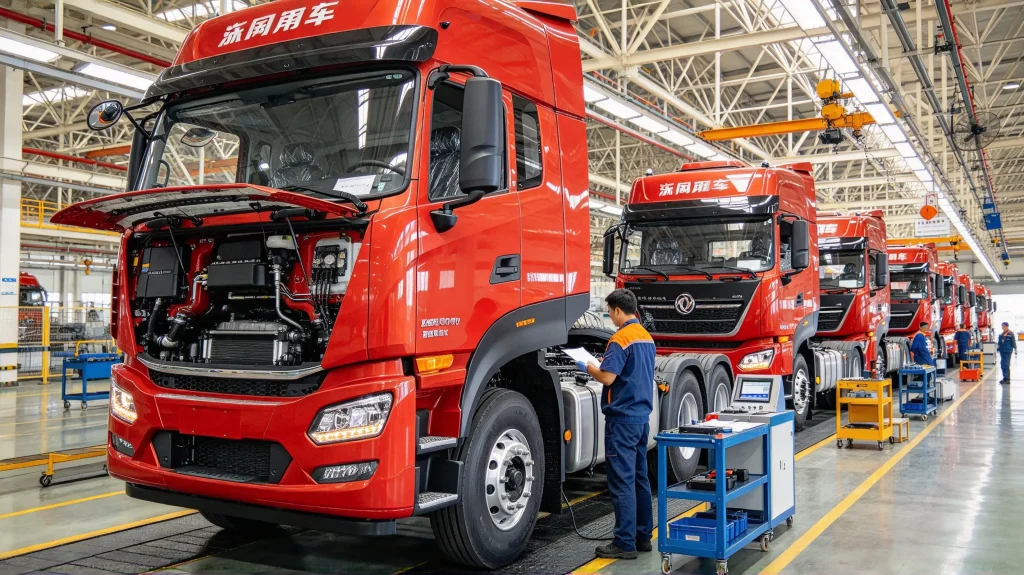
A truck manufacturer refers to the official OEM factory responsible for vehicle research and development, production assembly and quality control. Mainstream Chinese heavy truck brands including HOWO, Shacman, FAW and Foton all have standardized large-scale production bases and complete production lines. They formulate official vehicle parameters, factory configurations and original factory warranty standards.
However, most original factories do not undertake independent international sales business for scattered foreign orders. Factory sales teams usually only serve large bulk orders and long-term cooperative groups, lacking one-stop service capabilities for small and medium-sized fleet buyers, especially in terms of multilingual communication, document sorting and personalized customization.
By contrast, professional export exporters are authorized service providers docking with official factories. They do not produce vehicles independently but focus on international market adaptation, policy docking, customized modification, document processing and cross-border shipping services.
Reliable export companies have long-term stable authorization from mainstream factories, can lock official customized configurations, supervise factory production processes and provide complete export supporting services. Meanwhile, some unqualified small trading companies have no factory authorization, cannot modify desert configurations and often deliver standard domestic vehicles in the name of export models.
Therefore, for Middle East GCC buyers, the most ideal cooperation mode is choosing an authorized professional truck exporter with factory qualification verification and rich Middle East project experience, which can guarantee both official vehicle quality and standardized export services.
How can Middle East buyers accurately verify the authenticity and reliability of Chinese truck exporters?
In the cross-border truck export industry, mixed suppliers lead to uneven service quality. Many buyers suffer losses due to choosing unqualified intermediaries, including inconsistent vehicle configurations, missing certification documents, delayed delivery and unavailable after-sales support. Thus, supplier verification is the first and most critical step of procurement.
First, you can verify basic enterprise qualifications. Formal export companies have complete business licenses, export right certificates and factory authorization certificates. You can require suppliers to provide electronic copies of qualification documents for cross-checking, avoiding individual freelancers and unregistered small workshops.
Second, focus on Middle East market project experience. A truly professional GCC truck exporter must have a large number of completed delivery cases in Saudi Arabia, UAE and other regions. You can ask for actual delivery photos, port loading videos, customer cooperation feedback and bulk order delivery records.
Third, inspect pre-sales service professionalism. Experienced exporters can take the initiative to recommend targeted desert upgrade schemes according to local climate, road conditions and project types, while unqualified brokers only blindly recommend low-priced models without considering on-site adaptability.
Fourth, confirm after-sales and document capabilities. Formal suppliers can clearly list GCC certification processes, spare parts supply cycles and overseas technical support modes, while informal intermediaries often evade detailed after-sales clauses.
To simplify the verification process, Middle East buyers can directly check official enterprise background and verified export project records to quickly confirm supplier qualification and GCC market service experience.
Is direct import from Chinese exporters better than purchasing through local Middle East agents?
This question is one of the most debated topics among GCC fleet operators. Both direct import and local agent procurement have their own advantages and applicable scenarios, and buyers can make choices according to their own order scale, professional team configuration and budget planning.
For large and medium-sized fleets with long-term procurement plans, direct import from Chinese exporters is more cost-effective. Local Middle East agents usually add 15%–30% service fees on the basis of factory prices, and secondary agents even have higher markup rates. Direct cooperation can eliminate intermediate price differences and reduce overall fleet procurement costs.
In addition, direct import allows buyers to independently control vehicle configuration, production progress and document standards. You can put forward personalized desert modification requirements and supervise the whole production process, avoiding unified fixed configurations provided by local agents that cannot adapt to special project scenarios.
For small fleets and first-time buyers without cross-border import experience, local agents seem more convenient on the surface. Agents will complete customs clearance and landing procedures, but buyers will lose configuration autonomy and face higher unit vehicle costs.
At present, most professional Chinese exporters provide one-stop full-process export services, including customization, certification, inspection, shipping and document sorting. Buyers only need to complete local customs clearance after vehicles arrive at the port, which greatly reduces the threshold of direct import. Therefore, direct import has gradually become the mainstream choice for GCC fleet procurement in 2026.
Truck Model Selection & Desert Configuration FAQ for GCC Projects
Which Chinese truck models are most suitable for different types of Middle East desert projects?
There is no universal best truck model for the Middle East market. The most suitable vehicle must be matched according to project attributes, working environment, road conditions and load standards. Different GCC countries have different mainstream project types, so the demand for truck models also varies significantly.
For long-distance highway logistics and container transportation projects concentrated in Dubai, Abu Dhabi and Saudi coastal cities, 6×4 tractor heads are the core mainstream model. These vehicles feature stable power output, fuel-saving optimization and comfortable driving experience, fully adapting to high-frequency long-distance highway transportation scenarios.
For mining projects, mountain earthwork and large-scale infrastructure construction in Saudi Arabia and Oman, heavy-duty dump trucks are the first choice. 8×4 models with super-large cargo boxes and reinforced bearing structures can meet high-load and high-frequency earthwork operations.
For municipal engineering, road maintenance, dust suppression and water supply support projects in various GCC cities, water tank trucks, light flatbed trucks and medium-duty cargo trucks are more applicable. These models are flexible, easy to maintain and suitable for short-distance and low-load urban operation.
For special equipment transportation, generator transportation and engineering machinery transfer scenarios, reinforced flatbed trucks can ensure stable cargo transportation on bumpy desert roads.
Buyers can accurately match models according to their own project needs by browsing the full range of GCC export truck models and parameter details to avoid blind model selection affecting construction efficiency.
Why can’t standard Chinese domestic trucks adapt to Middle East desert working conditions?
Many first-time buyers choose low-priced domestic standard trucks out of cost considerations, which eventually leads to frequent on-site failures and huge maintenance losses. In fact, Chinese domestic trucks and GCC export-specific trucks are completely different in configuration and performance orientation.
First of all, the climate adaptability is different. The summer surface temperature in the Middle East can reach 60°C, while domestic trucks are designed for temperate climates. The original heat dissipation system cannot support long-term full-load operation under ultra-high temperature, resulting in frequent engine overheating alarms and power attenuation.
Secondly, the dust prevention level is different. The desert environment is filled with floating fine sand all year round. Domestic single-stage filter elements cannot intercept ultra-fine sand particles, which will cause sand ingestion in the engine, cylinder wear and shortened service life of core components.
In addition, domestic truck lighting systems, circuit standards and safety configurations do not meet GCC unified certification standards. Such vehicles cannot pass local customs clearance at all and can only be detained at the port, resulting in serious demurrage losses and project delays.
Moreover, domestic trucks lack anti-corrosion and anti-rust treatment for coastal humid environments. During ocean transportation and long-term parking in coastal GCC ports, the chassis and metal parts are prone to rust and corrosion, affecting the overall structural strength of the vehicle.
In summary, standard domestic trucks are completely unable to adapt to the high-temperature, high-dust and high-humidity composite environment of the Middle East. Only export-specific models with professional desert upgrades can meet long-term stable operation needs.
What core desert upgrade configurations are essential for GCC export trucks?
Professional desert adaptation upgrades are the core guarantee for Chinese trucks to operate stably in the Middle East. All upgraded configurations are targeted at local climatic characteristics and working scenarios, and each item has practical functional value.
The first essential upgrade is the enhanced heat dissipation system. Export trucks are equipped with oversized thickened radiators and independent high-power heat dissipation fans, which increase the heat dissipation area by more than 30% compared with domestic models. It can continuously stabilize the engine temperature under 45°C+ ambient temperature and full-load driving conditions.
The second core upgrade is the three-stage progressive dust filtration system. The multi-layer filter structure intercepts coarse sand and fine dust layer by layer, effectively solving the problem of engine sand ingestion. This configuration greatly reduces the frequency of filter replacement and engine maintenance costs for fleets.
In addition, reinforced chassis and high-temperature resistant tire matching are indispensable. The reinforced main beam improves the torsion resistance of the vehicle and adapts to uneven desert gravel roads. High-temperature resistant rubber tires avoid tire burst risks caused by long-term high-temperature friction.
The fully sealed heat-insulated cabin is also a standard configuration for GCC exports. The sealing structure isolates external hot air and floating sand, improving driver comfort while preventing dust from entering the vehicle and causing circuit failure.
Finally, the overall anti-corrosion and anti-rust spraying process protects the chassis, suspension and metal accessories from sea fog corrosion during transportation and coastal humidity erosion after landing.
What are the applicable scenarios for 6×4 and 8×4 axle configurations of export dump trucks?
Dump trucks are the most in-demand models in Middle East construction and mining projects, among which 6×4 and 8×4 are the two mainstream axle configurations. Many buyers cannot accurately distinguish the applicable scenarios of the two models, resulting in low vehicle matching degree and wasted construction capacity.
The 6×4 dump truck has a flexible body and strong passing performance. It is suitable for narrow construction sites, urban foundation projects and short-distance earthwork transportation. Its maneuverability is outstanding in complex road sections with many turns and limited space.
The 8×4 heavy-duty dump truck focuses on high payload and high efficiency. The four-axle structure increases the bearing capacity of the whole vehicle, with a single load capacity far exceeding that of 6×4 models. It is very suitable for large-scale mining, large-area land leveling and long-distance bulk earthwork transportation.
For large mining projects in Saudi Arabia and Oman that require high-efficiency continuous operation, 8×4 GCC dump trucks for desert mining scenarios can effectively improve fleet operation efficiency and reduce the number of single trips.
GCC Certification & Middle East Import Policy Detailed FAQ
Why is GCC GSO certification a rigid requirement for importing Chinese trucks into GCC countries?
GCC GSO certification is a unified mandatory safety and quality standard formulated by the Gulf Cooperation Council, covering all member states including Saudi Arabia, UAE, Oman, Kuwait, Qatar and Bahrain. The core purpose is to unify vehicle safety, emission and electrical standards in the Gulf region.
All imported heavy commercial vehicles must pass unified GSO testing and obtain official certification reports before shipment. Customs of all GCC countries will strictly check the certification files of incoming vehicles. Vehicles without valid certification will be directly detained and cannot complete customs clearance and road registration.
It is worth noting that the 2026 GCC certification standard has been partially upgraded, with stricter detection indicators for vehicle braking performance, lighting system, emission parameters and electrical safety. Early expired certification files and non-compliant configuration vehicles cannot pass customs inspection.
In addition, each country has added localized review links on the basis of unified certification. For example, Saudi Arabia requires strict consistency verification of vehicle chassis number, model parameters and certification data, and any minor deviation will trigger customs risk inspection.
Which party is responsible for GCC certification application and data docking in truck export transactions?
In formal Sino-GCC truck export transactions, the professional Chinese exporter is responsible for the overall certification application work, but the specific responsible scope must be clearly defined in the sales contract to avoid subsequent disputes.
Qualified export suppliers have long-term cooperative certification institutions, familiar with GCC standard update rules and localized review requirements. They can complete vehicle sample testing, parameter filing and report issuance in strict accordance with the latest standards.
During the certification process, the exporter needs to lock all vehicle configurations in advance, including engine model, axle parameters, lighting specifications and desert upgrade items. Once the certification is successful, all vehicle configurations in mass production must be completely consistent with the certified parameters.
Buyers need to confirm in advance whether the supplier’s certification covers the full set of vehicle configurations to avoid the situation that the basic vehicle has certification but the modified desert configuration lacks supporting certification files.
What complete documents do Middle East buyers need for truck customs clearance?
Smooth customs clearance depends on complete and consistent document materials. Many procurement delays are caused by missing documents or inconsistent data. A full set of legal customs clearance documents for GCC truck imports includes multiple core files.
The core certification file is the GCC GSO official certification report, which is the most critical basis for customs inspection. In addition, it is necessary to provide commercial invoices that conform to customs declaration standards, detailed packing lists, official certificates of origin and ocean bill of lading.
For individual countries such as Saudi Arabia and Oman, additional factory inspection reports, vehicle parameter confirmation letters and English version of factory qualification certificates are required. All data on different documents must be 100% consistent, including model number, chassis number, gross vehicle weight and configuration description.
Professional exporters will conduct three rounds of manual data verification before shipment to ensure zero errors in all documents and avoid customs detention and demurrage fees caused by data mismatch.
Order Production, Inspection & Delivery Cycle FAQ
What is the complete cycle from order placement to vehicle landing in the Middle East?
The full import cycle of Chinese export trucks is divided into four core stages: customized production, pre-shipment inspection, ocean transportation and local customs clearance. The total cycle is affected by order quantity, customization complexity and shipping schedule.
For conventional desert upgraded export trucks, the factory production cycle is 30–40 working days. If it involves special customized configurations such as special cargo box transformation, left-hand drive conversion and special lighting matching, the production cycle will be extended appropriately.
After the vehicles are produced, a strict pre-shipment inspection stage is required, including full vehicle performance testing, appearance inspection and document sorting. The inspection cycle is about 3–5 working days.
The ocean transportation cycle from Chinese major ports to GCC ports is 18–30 days. Ro-ro shipping is fast with stable schedules, while container shipping takes a slightly longer time due to packing and unpacking procedures.
Finally, the local customs clearance and vehicle pickup cycle is 3–7 working days under normal document conditions. On the whole, the conventional full-cycle is about 2 months, which can be accurately evaluated by professional exporters according to order details.
Can Middle East buyers conduct remote factory inspection and pre-shipment inspection?
Absolutely. Formal Chinese truck export suppliers support full-process remote supervision and pre-shipment inspection services, which is an essential link to guarantee vehicle quality for cross-border buyers.
During the production stage, the exporter can regularly send factory production photos, video materials and progress reports, covering chassis assembly, engine docking, customized accessory installation and vehicle painting links. Buyers can remotely supervise the whole production process in real time.
Before shipment, the professional QC team will conduct comprehensive item inspection on the finished vehicle, including power performance, braking system, electrical circuit, tire matching, sealing performance and appearance quality. All inspection data can be fed back to the buyer in the form of videos and pictures.
For bulk fleet orders, buyers can also appoint a third-party international inspection agency to conduct on-site factory inspection to ensure that the vehicle quality fully meets order requirements and GCC export standards.
Is small-batch trial order supported for Middle East new buyers?
Professional Chinese truck export manufacturers fully support small-batch trial orders, which is a very friendly policy for new buyers who have not cooperated before and need to verify vehicle performance and service quality.
Many Middle East fleets worry about risks after large-scale procurement. Therefore, placing 1–3 unit trial orders first can effectively verify the supplier’s customization capability, production quality, document standard and shipping service level.
It is worth emphasizing that trial orders and bulk orders adopt the same factory production standards, the same desert upgrade processes and the same GCC certification procedures. There will be no quality discount for small orders, ensuring that buyers can truly test the actual vehicle performance and full-process service level.
Shipping Mode & Cross-Border Transportation FAQ
What are the differences between ro-ro shipping and container shipping for truck export to GCC?
At present, there are two mainstream shipping modes for Chinese trucks exported to Middle East ports: ro-ro shipping and container shipping. The two modes have obvious differences in cost, cycle, vehicle protection and order applicability.
Ro-ro shipping is the mainstream mode for large fleet orders. Trucks can be directly driven into the ship’s cabin for fixed loading, without disassembly and assembly. The loading efficiency is high, the transportation cost is low, and the vehicle body will not be damaged by disassembly.
Container shipping is suitable for small trial orders. Trucks need partial disassembly and modular packing into containers. The closed container can avoid sea wind and salt spray erosion during transportation, with better vehicle protection effect, but the handling cost and freight are higher.
For long-distance highway logistics fleets with large procurement volume, choosing ro-ro shipping for GCC-spec 6×4 highway tractor heads can effectively reduce the overall transportation cost of the fleet.
How to clarify freight, insurance and risk liability in cross-border truck export contracts?
Unclear liability division in transportation links is one of the common causes of Sino-GCC trade disputes. Therefore, buyers must clarify Incoterms rules and risk liability boundaries in advance when signing contracts.
Common trade terms include FOB, CFR and CIF. Under FOB terms, the buyer is responsible for booking space, paying freight and purchasing cargo insurance, and bears all risks after vehicle loading. Under CIF terms, the exporter is responsible for freight and insurance, and the risk is transferred after shipment.
Buyers need to confirm in writing which party shall bear the responsibilities of vehicle damage, cargo loss and demurrage fees during loading and transportation, so as to avoid economic losses caused by unclear verbal agreements.
After-Sales Support, Spare Parts & Long-Term Fleet Operation FAQ
Can Chinese truck exporters provide stable spare parts supply for Middle East long-term operation?
Spare parts supply capacity determines the long-term operating efficiency of the fleet, and it is also the core difference between professional exporters and small intermediaries. Formal export suppliers build exclusive spare parts supply channels for GCC market customers.
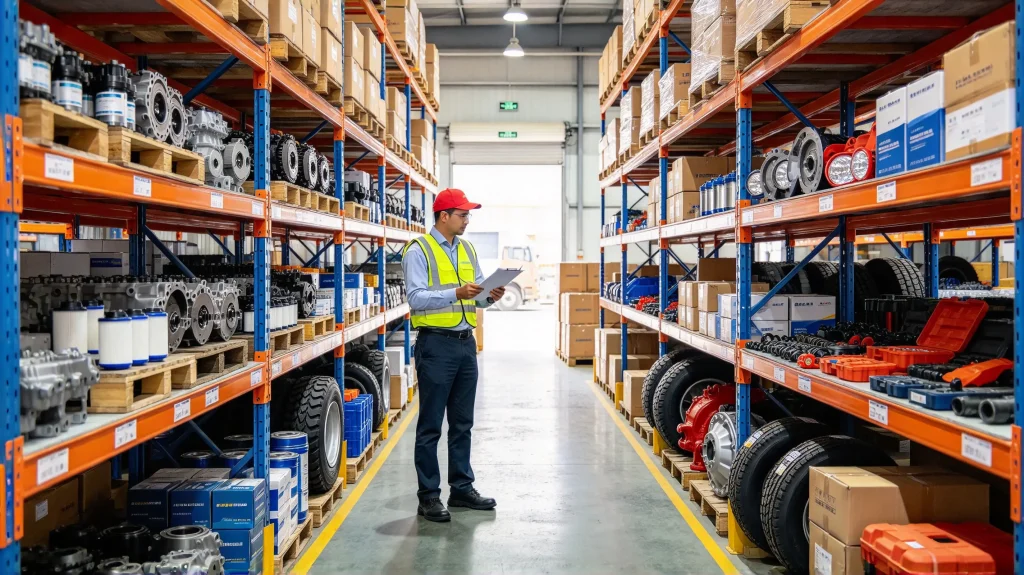
Reliable exporters have long-term spare parts inventory reserve cooperation with OEM factories, which can quickly provide original factory filters, brake parts, engine accessories, electrical components and wearing parts. Some suppliers even set up spare parts transfer warehouses in GCC core ports to realize rapid distribution.
In contrast, unqualified brokers cannot provide continuous spare parts support. After the vehicle is delivered, once parts are damaged, buyers can only purchase high-priced accessories through local channels, greatly increasing fleet operating costs.
For various on-site operation failures and spare parts replacement needs, buyers can consult the professional after-sales and technical support team at any time to obtain targeted solutions and spare parts supply guidance.
What is the standard warranty scope and cycle of Chinese export trucks in the Middle East?
The warranty policy of export trucks is formulated based on official OEM standards, and the warranty scope of core components and wearing parts is clearly distinguished.
Core power components such as engine, gearbox and drive axle enjoy a long-term official warranty. During the warranty period, quality problems caused by factory production can enjoy free maintenance and replacement services.
Wearing parts such as tires, brake pads, filter elements and wiper blades are consumables in daily use, which are not included in the basic warranty scope. Buyers can purchase batch spare parts in advance through exporters for daily replacement.
Before ordering, buyers must confirm the warranty start time, warranty scope and after-sales service mode in the contract to avoid inconsistent oral promises and actual services.
Where can buyers refer to real GCC fleet import cases for risk reference?
Learning from mature cooperative cases is the most effective way for new buyers to avoid procurement risks. Real delivery cases can intuitively show the model selection scheme, configuration matching mode and import process details of different GCC projects.
Different project scenarios such as Saudi mining, UAE logistics, Oman road construction and Kuwait municipal engineering have corresponding mature fleet procurement cases. Buyers can summarize matching experience and risk avoidance skills from actual cases.
You can browse authentic GCC fleet delivery project cases to refer to standardized procurement processes and configuration schemes of peer fleets.
Typical Procurement Mistakes & Professional Avoidance Suggestions
After sorting out a large number of Middle East truck import data, we found that most buyer losses are not caused by high technical thresholds, but by some common low-frequency mistakes. These errors are repetitive and avoidable, but they often bring huge economic losses and project delays.
The first typical mistake is pursuing low price blindly and ignoring configuration adaptation. Many buyers only compare unit prices and ignore whether the vehicle has complete desert upgrade configurations. Standard domestic vehicles with low prices will have frequent failures in desert operation, and the later maintenance cost far exceeds the saved purchase cost.
The second common mistake is neglecting document consistency inspection. Many buyers only pay attention to whether there are certification files but do not check whether the certification parameters are consistent with the actual vehicle configurations. Minor data mismatch will lead to customs detention and high demurrage fees.
The third mistake is not locking after-sales terms in the contract. Oral promises of spare parts supply and technical guidance cannot be guaranteed. Once the supplier delays the service, the fleet operation will be seriously affected.
The fourth mistake is unreasonable model selection. Choosing logistics vehicles for mining projects or light-load vehicles for heavy-load earthwork will lead to insufficient vehicle performance and greatly reduced construction efficiency.
To sum up, scientific procurement must take configuration adaptation, document standardization and after-sales guarantee as the core, rather than single price competition.
Practical Procurement Tips for Middle East GCC Fleet Buyers
After solving all common FAQ problems, we summarize a set of standardized and operable procurement tips for Middle East buyers, covering the whole process from pre-sales consultation to after-delivery operation.
First, clarify project demand indicators in advance. Before consulting suppliers, sort out project type, working environment temperature, road condition complexity, daily operation hours and load requirements, which help suppliers accurately match models and upgrade schemes.
Second, prioritize supplier qualification and experience. When comparing multiple suppliers, focus on GCC project experience, certification service capacity and after-sales system, not just price advantage.
Third, realize full contract regularization. All customized items, certification obligations, delivery cycles and after-sales commitments must be written into formal contracts to standardize the rights and obligations of both parties.
Fourth, attach importance to pre-shipment inspection. No matter the order size, complete vehicle inspection and document verification must be done before shipment to ensure zero risk of customs clearance.
Fifth, reserve spare parts in advance. According to the fleet scale and operation cycle, purchase conventional wearing parts in batches together with the vehicle to avoid subsequent operation shutdown caused by missing accessories.
Conclusion
Importing Chinese trucks for Middle East fleet projects is a systematic project involving model selection, customized modification, certification application, production supervision, cross-border transportation and after-sales maintenance. Every link is closely linked and affects the final fleet operation effect.
Most procurement difficulties faced by GCC buyers are caused by information asymmetry and unfamiliarity with export rules. Through this comprehensive FAQ guide, buyers can systematically understand the whole logic of China truck export and avoid various common procurement pitfalls.
In the future, with the continuous upgrading of Chinese truck desert adaptation technology and the continuous improvement of GCC export service system, Chinese heavy trucks will occupy a higher market share in the Middle East engineering and logistics fields. Choosing standardized export suppliers and scientific procurement schemes will become the key for GCC fleets to reduce costs and improve efficiency.