


Is buying from a truck manufacturer cheaper? See how dealers buy trucks directly, what wholesale quotes include, and the hidden costs of bulk fleet orders.
Buying from a truck manufacturer directly pays off only when you can absorb the volume, the compliance work and the shipping risk that a distributor normally carries for you. The lower unit price is real, but it is not the whole bill.
The sections below cover how direct orders work, what a quote includes, which Incoterm to use, how to check a supplier, and where these purchases tend to go wrong.
Is Buying Direct from a Truck Manufacturer Actually Cheaper?
Usually the unit price is lower, but the total cost often is not. Going direct removes the distributor’s margin and moves homologation, freight, parts and warranty handling onto your side of the ledger.
Those costs are easy to underestimate because they never appear on the quote. A distributor spreads them across many customers and many trucks. You carry them alone, on a smaller base.
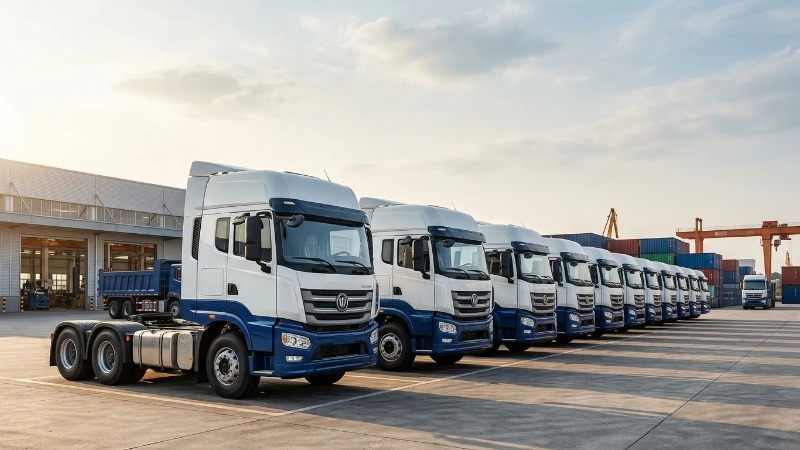
Homologation is the first one. It means getting a vehicle approved for road use in your market. If the factory builds to its domestic rules, someone has to cover the gap in lighting, emissions, markings and paperwork, and that someone is now you.
Freight and insurance come next. A delivered price from a distributor already contains them, while a direct ex-factory or FOB quote leaves them open. Parts and warranty are the third gap. Without a local stockholder, a failed component can mean a truck parked for weeks while a replacement part travels from the other side of the world.
So the comparison to make is landed, road-ready cost per truck against the distributor’s delivered price, including what a day of downtime costs you. Going direct tends to win when you buy repeat volume of one specification, already have a workshop and a parts routine, and know your import rules. At low volume or for a first order, the distributor’s margin is often payment for work you would otherwise do yourself, and do less well.
How Do Dealers Buy Trucks Directly from Manufacturers?
The route is usually a dealer or distribution agreement, or a run of volume orders placed against a price list. Which one you land on depends on territory, volume and who will handle after-sales. These steps show the typical sequence.
- Define your territory, expected annual volume and the two or three specifications you intend to sell, so the manufacturer can judge whether you fit its network.
- Ask for the current price list, the model range approved for your market and the manufacturer’s standard terms before any negotiation starts.
- Decide which route you want: an exclusive or non-exclusive dealer agreement, or open-ended volume orders with no territory protection.
- Read the agreement for the clauses that move money: minimum purchase commitments, exclusivity conditions, warranty claim handling, parts stocking duties and termination terms.
- Agree the after-sales split in writing. State who diagnoses faults, who pays for warranty parts and labor, and how quickly replacement parts must ship.
- Place a trial order of one specification before committing to a full volume schedule.
- Set payment milestones for the production order, typically a deposit followed by a balance tied to inspection and shipping documents.
- Review each shipment against the contract, then adjust volumes and the price list once the first trucks are sold and serviced.
Order matters. Dealers who sign the agreement before settling after-sales usually discover the gap when the first warranty claim arrives.
Exclusivity is the trade-off worth weighing early. It protects your territory, but it normally comes with minimum volumes you must hit whether the market cooperates or not. Without it, you keep flexibility and lose protection from a second dealer undercutting you next door.
Which Wholesale Route Fits: Factory Order, Authorized Distributor or Stock Lots?
A factory order gives you the lowest unit price and the most say over specification, but you carry the lead time and the risk. An authorized distributor charges a margin and gives you local support in return. Stock lots sit in between on speed: trucks already built, available quickly, with little room to change anything.
The table sets the three side by side. Treat the ratings as general tendencies, since terms vary by maker and market.
| Factor | Factory order | Authorized distributor | Stock lots |
|---|---|---|---|
| Unit price | Lower | Higher | Varies with the seller’s need to clear units |
| Control over spec | High | Medium | Low |
| Lead time | Longest | Short if the distributor holds stock | Shortest |
| After-sales support | Mostly yours to arrange | Usually included | Often limited |
| Compliance burden | On you | Largely on the distributor | On you, with fixed specs |
The takeaway: price falls as responsibility moves toward you, and speed only comes from giving up specification control.
Where each route fits
Go to the factory when you have a repeatable specification, a steady sales pipeline and the capacity to handle homologation and warranty yourself. Choose a distributor for a first order, a small fleet or a market where parts and service matter more than the last few points of margin. Stock lots suit a dealer filling a gap in the yard, provided the units already match your market’s emission and registration rules.
Advantages and limitations
| Advantages | Limitations |
|---|---|
| Factory order: best chance at a lower unit cost and a tailored spec | Factory order: long wait, deposit exposure, you own after-sales |
| Distributor: local support and less compliance work for you | Distributor: added margin and less negotiating room |
| Stock lots: fast delivery and a known, inspectable unit | Stock lots: fixed spec, uncertain age and parts history |
What Does Truck Dealer Wholesale Pricing Actually Include?
A quoted unit price is rarely what the truck costs once it is parked in your yard. Treat the quote as the starting line of a landed-cost calculation, and check five things before comparing one offer with another.
Chassis and body scope. Ask whether the price covers a complete, drivable truck or only a bare chassis. For tippers, the body, hoist, and tailgate may be priced separately, and a thinner body plate can make a quote look cheaper without being comparable.
Options and specification. Air conditioning, a second fuel tank, a different tyre brand, or a sleeper cab are often listed as extras. Get the base specification written out line by line so every competing quote is measured against the same truck.
Tooling and spare parts. Check whether the quote includes the standard tool kit, a spare wheel, and a starter package of wear parts such as filters, belts, and brake components. If parts are quoted separately, price them early, because they decide how long a truck sits idle after its first breakdown.
Documentation. Certificates of origin, commercial invoices, inspection reports, and the paperwork your registration authority requires may carry fees or take time. Confirm who prepares each document and when it ships.
Freight and related charges. Depending on the Incoterm, ocean freight, insurance, port handling, and inland delivery may or may not sit inside the price. Anything left out still has to be paid by someone.
Rule of thumb: ask every supplier for an itemised quote on an identical specification, then add freight, duties, and registration costs yourself. The cheapest unit price often is not the cheapest truck.
FOB or CIF: Which Incoterm Protects You Better?
Under FOB (Free On Board), the seller delivers the truck onto the vessel at the named port of shipment, and you take over from there: you book the freight, buy the insurance and carry the risk once the goods are on board. Under CIF (Cost, Insurance and Freight), the seller books the ship and pays for minimum insurance to your destination port, but risk still passes to you at loading. That last point surprises first-time importers. CIF does not mean the seller is responsible if the truck is damaged at sea.
So the real difference is control versus convenience. FOB lets you pick the carrier, compare RoRo and container rates, and file an insurance claim with a policy you wrote yourself. It suits importers who already have a forwarder and know their destination port charges. CIF gives you one number to compare across suppliers and one less party to manage, which helps on a first order. The cost is that the freight sits inside the unit price as a margin you cannot see or negotiate.
CIF insurance is also worth reading closely. The default cover under the Incoterms rules is typically minimum cover, which may not match the value of a loaded truck or the damage types you worry about most.
Tip: Ask every supplier to quote both FOB and CIF to the same port. The gap between the two shows what freight and insurance are really costing you, and whether the CIF premium is reasonable.
As a working rule, use CIF for a pilot unit or a first shipment, then move to FOB once you have a forwarder you trust and a few freight quotes to benchmark against.
Which Specification Decisions Drive Cost and Resale Value?
Four specification choices do most of the work on a heavy-duty tipper truck: axle configuration, engine rating, cab, and chassis steel. Each moves the purchase price. Each also decides whether the truck suits its duty cycle and how easily you can sell it on.
Axle configuration. A 6×4 and an 8×4 differ in payload, tyre count and running cost, and tipper buyers often pick by local axle-load limits rather than by what looks strongest on paper. Over-specifying adds purchase price and tyre wear without adding useful payload where the legal limit caps it. Under-specifying risks overloading fines and frame fatigue.
Engine rating. Horsepower and torque should match the grades and haul distances the truck will actually face. A higher rating costs more upfront and burns more fuel, but a truck working steep quarry ramps with an underpowered engine wears out its drivetrain early. The emission level fitted also affects which markets can take the truck later.
Cab. Cab size, sleeper or day cab, air conditioning and suspension seats are comfort items, yet they influence driver retention on long hauls. For short-cycle site work, a basic cab is usually enough. Resale buyers tend to expect a standard cab layout, so unusual options can narrow your pool.
Chassis steel and body. A high-strength steel chassis, meaning a frame built from steel with a higher yield strength than ordinary structural grades, carries heavy loads with less frame weight. It costs more, but it matters most on rough ground and for repeated tipping under load. Ask for the frame material grade and the body plate thickness in writing, since two offers with the same model name can differ here.
Rule of thumb: spend on the chassis and axles first, because they cannot be changed later. Cab comfort items can be added or skipped with far less regret.
What Should You Check on Sinotruk and HOWO Dump Truck Offers?
Two quotes arrive for what both call a “HOWO dump truck”. One is noticeably cheaper. Only when the specification sheets are laid side by side does it show that the engines differ in rating, the axle makeup is not the same, and the cheaper offer is a variant built for the domestic market. The name matched. The truck did not.
HOWO is a heavy-duty truck brand built by Sinotruk (China National Heavy Duty Truck Group), and it covers many models, engines and axle layouts under one badge. So the brand name settles very little. The model code and the build sheet do.
Model code and drivetrain
Ask for the full model designation and a written specification that names the engine model and its rated power, the transmission, and the axle configuration, for example 6×4 or 8×4. Compare the axle ratings and the axle brand, not just the count. Any difference between the quote, the datasheet and the proforma invoice should be resolved in writing before a deposit moves.
Market variant
Domestic-market trucks are often specified for local rules, fuel quality and road conditions. Ask which variant is built for your market, which emission level the engine meets, which side the steering is on, and whether the tipper body and chassis steel match your duty cycle. A variant that is cheap at origin can cost more to adapt than the saving.
A quick example
Take a quarry operator comparing two 8×4 tipper offers. Offer A lists the engine rating and axle makeup, and states the emission level. Offer B says only “HOWO 8×4, strong power”. The first is checkable; the second is a promise. Treat vague wording as missing information, and ask for the build sheet before you compare prices.
Which Emission and Regulatory Standards Must the Truck Meet in Your Market?
Match the engine to the rules of the country where the truck will be registered, not to the rules of the country where it was built. A truck that is legal at origin can still be refused at the destination port.
The rule holds because emission and type-approval regimes are set by the importing market. Many markets accept Euro V or Euro VI engines, some still allow Euro III or IV, and a few apply their own local equivalents. Chinese-market trucks are built to GB standards, and a domestic-spec engine may not match what your market asks for. When it breaks: where rules are loosely enforced, a lower-spec engine may clear customs but cause trouble later with fuel quality, financing or resale. Ask for the emission level in writing on the build sheet, and check it against your local regulator’s current requirements.
Origin and destination also differ on certification. CCC certification applies to products sold within China, so it matters for domestic-market vehicles. For an export unit, the importing country’s own approval or conformity process usually decides what paperwork you need. Ask the manufacturer which certificates and test reports exist for the exact variant you are ordering, rather than for the model family.
Terms worth knowing
- Euro V / Euro VI — European exhaust emission stages, with Euro VI the stricter, that many markets adopt or reference.
- GB standards — China’s national standards (Guobiao), including vehicle safety and emission rules for the domestic market.
- CCC certification — China Compulsory Certification, a mandatory mark for listed products sold in China.
- Type approval — official confirmation that a vehicle design meets a market’s technical and safety rules.
- Homologation — the process of getting a vehicle approved for road use in a given market.
How Do You Verify a Manufacturer Before Paying a Deposit?
Work through the checks in this order, because each one is cheaper than the next and any failure should stop the process before money moves.
- Request the business licence and confirm the registered company name matches the name on the quotation, the proforma invoice and the bank account.
- Ask for export records and shipping references for the same model family, then check that the vehicle type, destination and period are plausible.
- Arrange a factory audit, either in person or through a third-party inspection company, covering the assembly line, quality records and finished stock.
- Call two or three existing customers who bought the same variant, and ask about warranty claims and parts delivery rather than price.
- Get the full specification written into the contract, down to engine model, axle makeup and emission level.
- Tie payments to milestones, such as a modest deposit at signing, a further instalment at completion and the balance only after inspection.
A manufacturer that resists steps one to three deserves caution. Legitimate sellers expect these requests.
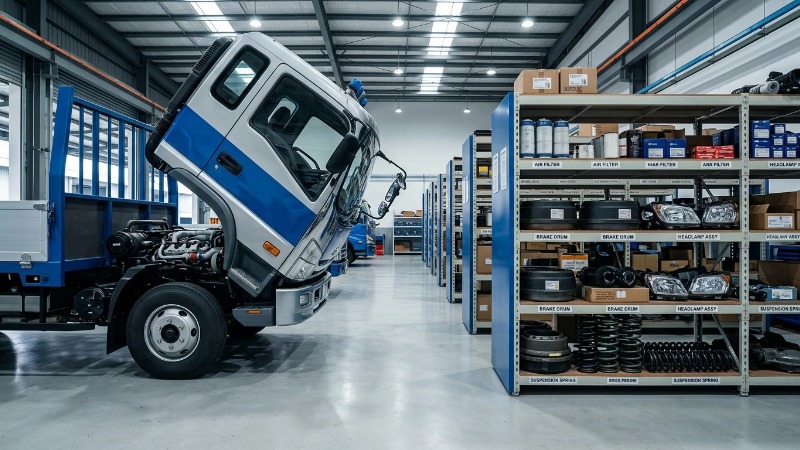
A short checklist before you transfer funds
- Match the beneficiary name on the bank details to the contracting company.
- Confirm the contract names the exact model code and specification.
- Verify that the inspection right is written into the payment terms.
- Check who holds title to the truck until the balance clears.
- Compare the documents promised, such as the invoice, packing list and certificate of origin, with what your customs broker needs.
Payment to a personal account, or to a company other than the contracting party, is the clearest warning sign in this trade. Stop there.
How Does Pre-Shipment Inspection Reduce Risk?
You ask: if the factory already tested the truck, why pay someone else to look at it? Because the factory’s quality check answers to the factory. A pre-shipment inspection (PSI) is an independent check of the finished goods against your purchase contract, carried out by a third-party inspection body such as SGS before the balance payment is released.
Its value is timing. A wrong engine rating, a missing option, a different axle brand or a body thickness below contract is cheap to correct while the truck is still in the yard. Once it is on a vessel, the same fault becomes a claim, a delay or a negotiation with a supplier who already holds most of your money.
Inspectors generally verify the chassis and engine numbers, the specification against the signed sheet, visible build quality, basic function of the tipping gear, lights and brakes, and the quantity and condition of loose items. Ask for photos and a written report, not a verbal “all good”.
Tip: Put the inspection into the contract before the deposit is paid. State who appoints the inspector, which specification sheet is the reference, and that the balance is released only against a clean report. Without that wording, a failed inspection gives you little leverage.
It is no guarantee of long-term reliability. It confirms what was built, not how it will wear.
How Does RoRo Shipping Compare with Container and Bulk Options for Trucks?
RoRo (roll-on/roll-off) vessels carry trucks that drive aboard under their own power. Containers take knock-down kits or smaller lots, and break-bulk or bulk carriers lift oversized units by crane. RoRo usually costs less per truck at volume and means little handling. Containers cost more per unit but reach more ports. Break-bulk is the fallback when neither fits.
Damage risk differs by method. RoRo exposes trucks to deck conditions and drivers moving them on and off, so inspect for scratches, flat batteries and fuel levels at discharge. Knock-down shipments move the risk to reassembly: missing parts and poor local assembly quality.
Port capability decides more than price. Not every port has a RoRo ramp or the yard space to hold dozens of trucks.
Scenarios
A dealer ordering twenty tippers for one market: RoRo is usually the first option to price, provided the destination port handles it.
A fleet taking two or three units to an inland site: containerised knock-down units may be easier, if you have the workshop to assemble them.
Oversized or non-driveable units: break-bulk, with a quote that includes lifting and lashing.
Where Do Wholesale Truck Purchases Usually Go Wrong?
The typical failure looks like this: the unit price was the lowest on the table, the contract was signed quickly, and six months later the trucks sit in a yard with the wrong emission calibration, no spare parts and a freight bill nobody budgeted. Most of these losses are visible at the quoting stage if you look for them.
Five errors account for the bulk of them. Buyers compare ex-works prices and ignore landed cost. They treat parts supply as an after-sales topic, then find that wear items such as brake linings and suspension bushes take weeks to arrive. They skip third-party inspection because the factory “already tested” the units. They order an engine built to one emission standard for a market that requires another. And they place a full-volume order before one test unit has worked a real duty cycle.
Myth: the cheapest quote is the best-priced truck
A low quote often reflects a thinner scope: fewer options, a lighter body plate, no tooling or spares. Compare scope line by line before you compare totals.
Myth: a pilot order wastes time
A single test unit usually costs less than correcting a mistake across a whole shipment. It exposes homologation gaps, driver complaints and parts-fitment problems while they are still cheap to fix.
When Does Bulk Truck Purchase Make Sense for Fleets and Dealers?
Order direct only when three things are already in place: enough volume to justify the order, someone who can handle compliance, and a parts plan that works. If one is missing, the lower unit price is usually spent on fixing it.
The rule holds because a distributor’s margin pays for work you would otherwise take on yourself: registration paperwork, freight booking, stock of wear parts and warranty handling. A fleet running dozens of identical tippers can spread that work across every unit. A buyer of five mixed units rarely can.
It breaks in two directions. A dealer with an exclusive territory and a signed after-sales agreement may do well on a modest first order. A large fleet with no in-house parts planning can still lose money on a big one, because downtime costs more than the saving.
When the gaps are real but the price gap is tempting, buy through an authorized distributor or place a pilot lot of one or two units first. Run it through the full chain: inspection, shipping, registration, first service. If it clears without surprises, scale up.
Which of the three, volume, compliance or parts, is the weakest link in your own operation right now?
FAQ
What is the minimum order size?
It varies by manufacturer and model, and it is negotiable. Many will quote a single unit or a small lot, but price tiers usually improve with volume, so ask for the break points in writing.
Who handles warranty and parts?
You usually do, unless the agreement says otherwise. Agree a parts package, claim procedure and response times before the first order ships.
What payment terms are typical?
A deposit at order and the balance against inspection or shipping documents is common. Letters of credit are another route, and financing terms differ by supplier.
Left-hand or right-hand drive?
Match the steering side to your market’s traffic rules, and state it in the contract. Changing it later is costly.
Should I buy used or new stock?
New suits fleets that need warranty and current emission compliance. Used lowers the entry price but raises inspection and registration risk, so check eligibility locally first.
The weakest link among volume, compliance and parts is where to start, and a single pilot unit is the cheapest way to test it. Which of the three would break first in your operation?
Buying from a truck manufacturer pays off when you treat price as only one part of the deal. Verify the supplier, lock the specification and Incoterm in writing, inspect before shipment, and plan parts and registration before the first unit leaves the factory. Ready to move? Request a written quote with break points, a sample inspection report and an after-sales agreement, then place a one- or two-unit pilot order before you commit to volume.