


Introduction
The engine is the heart of any truck. It decides pulling power, fuel bills, and how often the truck visits the workshop. For buyers importing Chinese trucks, the engine choice often comes down to two names: Weichai and Cummins.
Weichai is China’s largest diesel engine maker. It powers a huge share of domestic trucks, including many Sinotruk, Shacman, and other export models.
Cummins is the global giant. Its Chinese joint ventures build engines under the Cummins name for a wide range of trucks sold both at home and abroad.
Both engines are proven. Both move thousands of trucks every year. Yet they are not the same machine. Power delivery, fuel behavior, parts availability, and service needs all differ.
This guide compares the two honestly. You will learn what each engine does well, where it struggles, and how to choose for your route, load, and market. If you want to browse trucks with either engine, visit our truck product category page.
Who Makes Weichai Engines
Weichai Power is a Chinese manufacturer based in Weifang, Shandong Province. It is one of the largest engine producers in the world.
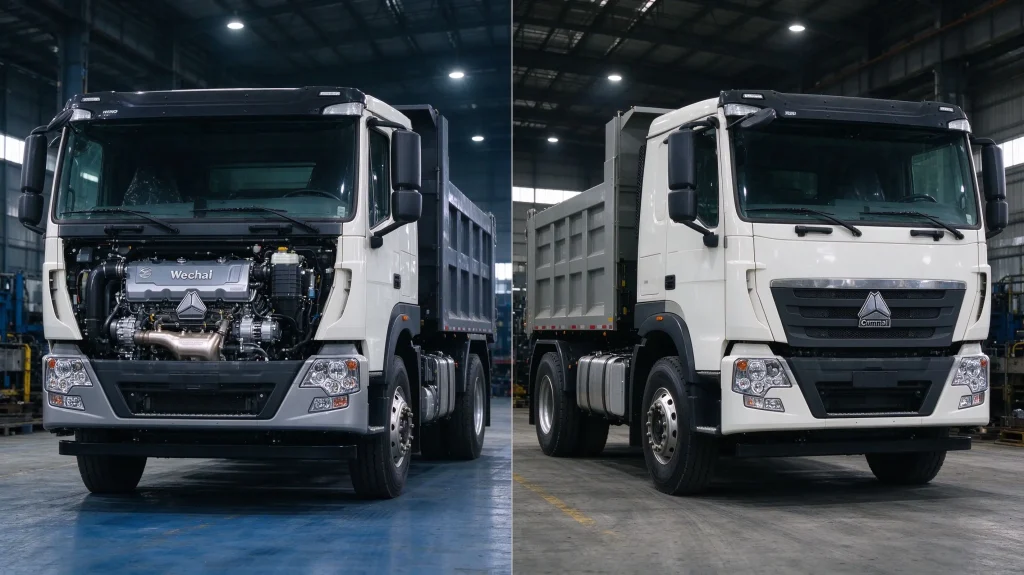
The company builds a full range of diesel engines for trucks, buses, construction machines, and marine applications. Its heavy-duty truck engines carry the WP series name.
Common models include the WP10, WP12, and WP13. These engines appear in many Sinotruk HOWO trucks, Shacman trucks, and other domestic brands.
Weichai also owns or partners with several truck makers. That integration means the engine and the chassis are often designed as one system.
For export buyers, Weichai offers a simple proposition: a high-torque engine built in large volumes, supported by an extensive domestic parts network.
Who Makes Cummins Engines
Cummins is an American company with a global reputation. It has operated in China for decades through joint ventures.
In China, Cummins engines are built by partnerships with local manufacturers. The most common heavy-duty model is the ISG and X12 series.
These engines power trucks from Foton, Dongfeng, and some export models. The Cummins name carries instant recognition in many markets.
Cummins also has a worldwide service network. That global reach is a major selling point for buyers in Africa, the Middle East, and Latin America.
For buyers who value brand recognition and global support, Cummins is often the safer-looking choice.
Weichai vs Cummins: The Core Differences
Both engines deliver serious power. The differences show up in how they work and how they are supported. Here is a quick comparison.
| Feature | Weichai Engine | Cummins Engine |
|---|---|---|
| Origin | China | USA / China joint venture |
| Common series | WP10, WP12, WP13 | ISG, X12 |
| Torque delivery | Strong low-end pull | Smooth, broad curve |
| Parts in China | Very easy | Easy |
| Parts overseas | Growing network | Wide global network |
| Brand recognition | Strong in China | Strong worldwide |
| Price | Generally lower | Generally higher |
| Service knowledge | Deep in China | Broad overseas |
As the table shows, the choice is not about which engine is better overall. It is about which one fits your market and your maintenance setup.
In the sections below, each difference gets a closer look.
Power and Torque
Power and torque decide how the truck feels with a full load. Both engines offer competitive numbers, but the delivery differs.
Weichai engines are known for strong low-end torque. They pull hard from low rpm, which helps when starting a loaded truck on a slope.
That character suits dump trucks, mixers, and mining vehicles. The engine does not need high revs to move heavy loads.
Cummins engines deliver a broad, smooth torque curve. They feel calm and progressive across the rpm range.
That character suits highway tractors and long-distance hauling. The engine cruises efficiently and responds predictably.
In practice, both engines meet the rated power. The feel behind the wheel is where they separate.
Fuel Consumption
Fuel is the biggest daily cost. Buyers compare engine fuel figures carefully before committing.
Weichai engines have improved fuel economy steadily over the years. Modern WP series engines match most rivals in normal operation.
Cummins engines carry a reputation for efficiency, especially at highway speeds. The X12 series is tuned for long-haul economy.
Real-world fuel use depends on load, route, driver, and maintenance. Two identical trucks with different engines can show similar numbers.
Drivers also matter. A smooth driver saves fuel on any engine. A heavy foot burns more on both.
As a rule, expect both engines to be within a few percent of each other on comparable work.
Reliability and Durability
Reliability is what keeps the truck earning. Both engines have long service lives when maintained properly.
Weichai engines are built for heavy work. Many mining and construction trucks run hundreds of thousands of kilometers on WP engines.
The design is robust and the components are proven. Local knowledge of these engines is deep because they are everywhere in China.
Cummins engines also have a strong durability record. Their global reputation comes from decades of service in tough conditions.
The X12 and ISG series are well engineered. Their electronics and sensors are generally reliable.
In short, both engines can last as long as the truck. The difference lies in how quickly problems get fixed when they appear.
Parts Availability in China
If the truck works in China or near Chinese export hubs, parts are easy to find for both engines.
Weichai parts are everywhere. The domestic network is dense, and prices are competitive. Any workshop in China knows these engines.
Cummins parts are also available in China through official channels. The joint venture ensures genuine parts for domestic trucks.
For trucks exported and then operated in other countries, the picture changes. Weichai parts are available through export channels, but the network is still growing.
Cummins has a more established overseas parts network. In many African and Middle Eastern markets, Cummins parts are stocked locally.
For buyers who plan to operate far from Chinese service centers, that global availability is a real advantage.
Service and Workshop Knowledge
An engine is only as good as the workshop that maintains it. Local mechanic familiarity decides downtime.
In China, Weichai service knowledge is universal. Most mechanics have worked on WP engines and know common fault patterns.
In many African and Asian markets, Chinese mechanics and trained technicians also handle Weichai engines well.
Cummins has formal training programs worldwide. Its authorized service centers follow standardized procedures.
In markets with a strong Cummins dealer presence, service is quick and well organized.
In markets without a dealer, local mechanics may know less about Cummins electronics than about simpler engines.
Before buying, check which engine your local workshops understand better. That single factor can decide your downtime.
Brand Recognition and Resale
Brand affects resale value. Buyers look for names they trust when purchasing used trucks.
Cummins is a globally recognized name. In many markets, a Cummins-powered truck sells faster and holds value better.
Weichai is less known internationally, but that is changing. As Chinese trucks spread, Weichai’s reputation grows with them.
In China and nearby markets, Weichai is a trusted brand. Buyers there do not see it as inferior.
Resale also depends on the truck brand, condition, and mileage. The engine is one factor among several.
For markets where brand perception drives sales, Cummins carries a slight edge today.
Price and Cost of Ownership
Initial price and long-term cost both matter. The gap between the two engines is real but not huge.
Weichai engines generally cost less than Cummins equivalents. That lower price shows in the truck’s purchase price.
Spare parts for Weichai are also cheaper in China and in markets served by Chinese exporters.
Cummins parts cost more, but the global network and standardized service can reduce other costs.
Total cost of ownership includes fuel, parts, labor, and downtime. No single number tells the whole story.
For budget-conscious buyers in price-sensitive markets, Weichai often wins on cost.
For buyers who value service consistency, Cummins may justify its premium.
Which Engine Fits Which Work
Matching the engine to the job matters more than brand loyalty. Each engine suits certain operations.
Weichai WP engines shine in construction, mining, and dump truck work. The low-end torque matches heavy, slow, loaded cycles.
Cummins engines suit highway and long-haul logistics. The smooth power curve supports sustained cruising.
For mixed fleets, some operators run both. They use Weichai trucks for site work and Cummins trucks for line haul.
For single-truck buyers, choose based on your dominant route. If you climb slopes loaded daily, favor low-end torque.
If you cover long flat distances, favor highway efficiency.
Engine Technology Comparison
Under the valve cover, the two engines use different approaches to reach their goals. Understanding the technology helps you compare honestly.
Weichai WP series engines use common rail fuel injection. This system delivers precise fuel pulses for clean combustion and steady power.
The engine block is built for strength. Heavy-duty versions use reinforced materials to handle sustained high torque.
Cummins X12 and ISG engines also use high-pressure common rail injection. Their electronics manage combustion across a wide operating range.
Cummins emphasizes lightweight design. The X12 uses composite materials and compact architecture to reduce weight.
Lighter weight helps fuel economy and payload. A lighter engine leaves more capacity for cargo.
Weichai favors slightly heavier, robust construction. That weight buys durability in harsh conditions.
Neither approach is wrong. They reflect different priorities: efficiency and weight versus strength and simplicity.
Low-End Torque vs Top-End Power
Torque and power are different numbers. Torque is the pulling force. Power is the work done over time.
Weichai engines concentrate torque at low rpm. The engine reaches strong pull early in the rev range.
That behavior helps trucks start loaded, climb slopes, and move through mud without revving hard.
Cummins engines spread torque across a wider band. They deliver consistent pull from low to high rpm.
This smooth curve suits highway cruising. The engine holds speed without constant gear changes.
For dump trucks and mixers, low-end torque wins. For tractors and long-haul trucks, broad power wins.
When comparing specifications, look at the torque curve, not just the peak number.
Engine Brake Performance
The engine brake is a safety feature on heavy trucks. It slows the truck without wearing the service brakes.
Weichai engines include an exhaust brake or compression brake depending on the model. The braking force is strong at low rpm.
That low-rpm braking suits downhill mining routes. The driver controls speed without overheating the brakes.
Cummins engines use a compression release brake. It provides strong retarding power at higher rpm.
High-rpm braking suits highway descents. The driver keeps engine speed up to maintain brake effect.
For mountain routes, the right engine brake matters as much as the engine itself.
Ask which brake system the specific model has and how it behaves on your typical terrain.
Cold Start and Hot Climate Behavior
Climate affects engine behavior. Both brands handle extremes, but the details differ.
Weichai engines start reliably in cold weather with proper glow plug or preheat systems. Export versions can include cold kits.
In hot climates, Weichai engines manage temperature well when the cooling system is correctly specified.
Cummins engines also start cleanly in cold conditions. Their electronic control manages fuel delivery during warm-up.
In high-temperature regions, Cummins cooling systems are well engineered. Overheating is rare with proper maintenance.
For dusty or sandy environments, both brands need upgraded air filtration.
When ordering for extreme climates, request the appropriate package for your destination.
Common Problems and Fixes
Every engine has known weak points. Knowing them helps you inspect and maintain.
Weichai WP engines occasionally face injector and sensor issues. Fuel quality matters, especially in remote regions.
Regular filter changes and clean fuel prevent most Weichai problems. The engine is otherwise robust.
Cummins engines can show sensor and wiring issues in dusty conditions. Electronics need protection from moisture and dirt.
Proper air filtration and regular checks keep Cummins engines healthy.
Neither engine is fragile. Both fail when maintenance is skipped and fuel is bad.
Emission Standards Compatibility
Both engine makers offer versions for different emission levels. This matters for export registration.
Weichai builds Euro 2 through Euro 6 and China 6 compliant engines. Export models match the destination standard.
Cummins builds equally broad emission coverage through its Chinese joint ventures.
When ordering, confirm the engine’s emission version matches your market’s requirement.
The wrong emission level blocks registration and causes customs delays.
Both brands handle this correctly when the order is specified properly.
Chinese Truck Brands and Their Engines
Real truck choices tie engines to brands. Here is how the two names appear across popular Chinese trucks.
Sinotruk HOWO trucks commonly use Weichai WP engines, especially in export markets. The combination is proven in construction work.
Some HOWO models also offer Cummins options for buyers who prefer the global brand.
Shacman trucks mostly run Weichai engines. The brand is strongly associated with Weichai power.
Foton trucks frequently use Cummins ISG engines. This pairing is well known in logistics fleets.
Dongfeng offers both, with Cummins appearing on many export models.
For buyers, the engine often comes with the truck brand. Choose the combination that fits your work and market.
Which Engine Do Export Buyers Prefer
Export demand shows a clear pattern. Understanding it helps you match your order to the local market.
In Africa, both engines sell. Weichai-powered trucks are common because they are cost-effective and supported by Chinese exporters.
In the Middle East, Cummins engines appear on many imported trucks. Brand recognition and service network drive that preference.
In Southeast Asia, Weichai engines are widely accepted, especially in construction fleets.
In Latin America, Cummins has a stronger historical presence. Buyers often ask for it.
The pattern follows parts and service availability more than raw performance.
For more market insight and export cases, visit our cooperative case page.
How to Inspect the Engine Before Buying
A used or new truck needs an engine check before you commit. The inspection takes time but saves money.
Start with a cold start. Listen for knocking, smoke, and hesitation. A healthy engine starts clean.
Check the oil. Dark, gritty oil signals poor maintenance. Low oil level is an immediate red flag.
Look at the exhaust. Black smoke under load suggests fuel or injector issues. Blue smoke hints at oil burning.
Listen for turbo whine or rattles. Unusual noises point to worn components.
Ask for the service history. Regular oil and filter changes are the best predictor of engine health.
For export trucks, request the engine certificate and emission documents as part of the handover.
Engine Maintenance Basics
Simple maintenance keeps either engine running for years. Most failures come from neglect, not design.
Change oil and filters on schedule. The interval depends on the engine and operating conditions.
Use the recommended oil grade. Cheap oil saves money now but costs engines later.
Keep the air filter clean. Dusty sites need more frequent replacement.
Use clean fuel from reliable sources. Bad fuel damages injectors and pumps on any engine.
Watch the coolant level and temperature. Overheating is the fastest way to kill a diesel engine.
For detailed maintenance guidance, visit our truck knowledge base.
Frequently Asked Questions
Buyers ask the same questions about Weichai and Cummins. Here are clear answers.
Which engine is more reliable? Both are reliable when maintained. Failure usually comes from neglect, not the brand.
Is Weichai cheaper than Cummins? Generally yes, in purchase price and parts cost.
Which engine is better for highway hauling? Cummins is often preferred for long-haul efficiency and smooth power.
Which engine is better for construction work? Weichai’s strong low-end torque suits heavy, slow, loaded work.
Are Cummins parts available in Africa? Yes, in many markets with an established Cummins dealer network.
Are Weichai parts available outside China? Increasingly yes, through Chinese export channels and growing local networks.
Can I get a HOWO truck with a Cummins engine? Some models offer Cummins options, but Weichai is the standard choice for most HOWO exports.
Which engine holds resale value better? Cummins often carries a premium in markets that recognize the brand.
Do Weichai engines use more fuel than Cummins? On comparable work, the difference is small. Load, route, and driving style matter more.
Can I repair a Weichai engine in my country? Usually yes, if the exporter provides parts and training. Ask about local support before ordering.
Which engine is better for cold climates? Both work with the proper cold-start package. Specify it when ordering.
How long do these engines last? With regular maintenance, both commonly exceed one million kilometers in heavy-duty service.
Is the Cummins badge worth the extra cost? It depends on your market. If Cummins support is strong locally, the premium can pay for itself.
Warranty and After-Sales Support
Warranty terms shape the risk you carry after purchase. Both brands offer factory support, but the terms differ by market.
Weichai engines carry a warranty through the truck manufacturer. The exporter coordinates claims for overseas buyers.
Cummins engines may offer warranty through the global dealer network. Claims can be processed closer to the operator.
The practical difference appears when something fails. A local Cummins dealer can approve a claim on site.
Weichai claims often require the exporter or a Chinese service partner to coordinate with the factory.
For fleets, warranty response time matters. Downtime during a claim is lost revenue.
Ask your supplier for the exact warranty scope, claim process, and expected response time before ordering.
Genuine Parts and Counterfeit Risks
Parts quality is a quiet danger in the truck trade. Counterfeit parts damage engines and void warranties.
Weichai genuine parts are stamped and packaged with anti-counterfeit labels. Buy from authorized channels.
Cummins parts carry authentication features too. The global dealer network makes genuine parts accessible.
In remote markets, counterfeit filters and injectors are common. Cheap parts destroy injectors and pumps.
Educate your drivers and mechanics to check part authenticity before installation.
Both brands suffer from the same counterfeit problem. The solution is buying through verified suppliers.
A small premium for genuine parts protects an expensive engine.
Fuel Quality Tolerance
Fuel quality varies by market. Some regions sell diesel with high sulfur or contamination.
Weichai engines tolerate moderate fuel quality when filters are maintained. High-sulfur fuel shortens oil life.
Cummins engines are designed for international fuel standards. Poor fuel triggers sensor and injector issues faster.
In markets with low-quality fuel, both engines need more frequent filter changes.
Some buyers install additional fuel filtration for protection.
Ask which engine handles your local fuel better. That answer matters more than any brochure claim.
Long-Haul vs Stop-Start Duty Cycles
The duty cycle changes how the engine wears. A highway engine and a site engine age differently.
Long-haul running keeps the engine warm and steady. Wear is even and predictable.
Stop-start work in construction stresses the engine with repeated cold cycles and heavy loads.
Weichai’s robust design handles stop-start duty well. The strong low-end torque reduces strain during frequent starts.
Cummins engines also handle stop-start, but they are optimized for steady running.
Match the engine to the duty cycle. A highway engine forced into site work wears faster.
Tell your supplier your real working pattern so they can recommend the right specification.
Engine Oil and Lubrication
Oil choice protects the engine. Each brand specifies its own oil requirements.
Weichai engines use conventional heavy-duty diesel oil in most versions. Standard grades are widely available.
Cummins engines may specify low-ash oil for models with particulate filters. That oil is more expensive.
Using the wrong oil damages the engine and the emissions system.
Check the oil specification in the manual and buy accordingly.
For fleets, standardizing oil grades across trucks simplifies stock management.
Weichai’s simpler oil requirement is a small but real cost advantage in remote markets.
How to Order the Right Engine
Ordering the wrong engine is a costly mistake. Follow this checklist when you place the order.
- State the exact engine model and rated power you need.
- Confirm the emission standard for your registration market.
- Specify the axle ratio that matches the engine’s power band.
- Request the engine brake type suitable for your terrain.
- Choose the climate package for your region.
- Confirm the oil and filter specifications in the manual.
- Ask for the engine certificate and emission documents.
Getting these details right at order time prevents expensive corrections later.
Real Fleet Examples
Real fleets show how the choice plays out. Here are typical scenarios.
A mining contractor in West Africa runs Weichai-powered HOWO dump trucks. The low-end torque handles the loaded climbs, and parts arrive through the exporter.
A logistics company in East Africa uses Cummins-powered tractors. The smooth power and local dealer support keep the fleet moving.
A construction firm in the Middle East runs both. Weichai trucks work on site, and Cummins trucks handle highway runs.
A fleet in Southeast Asia standardized on Weichai engines. Price and parts availability made the decision easy.
In each case, the choice followed the work and the local support network.
Decision Guide: Which Engine Should You Choose
Here is a practical path for most buyers.
- Define your main route. Highway hauling favors Cummins. Heavy site work favors Weichai.
- Check local parts availability for each engine.
- Ask local workshops which engine they can service best.
- Compare the total purchase price and running cost.
- Consider resale value in your market.
- Confirm the emission version matches your registration rules.
- Choose the brand combination that fits your work and support network.
Following this path prevents most engine-related regrets.
Turbocharger and Air System
The turbocharger feeds the engine with compressed air. Its health determines power and fuel economy.
Weichai engines use robust turbochargers sized for heavy work. In dusty conditions, the air filter must be maintained carefully.
Cummins engines use modern turbochargers with efficient air management. The system is precise but sensitive to dirty filters.
A worn turbo shows symptoms on both brands: black smoke, power loss, and unusual whistle.
Regular air filter checks prevent most turbo damage. Replace filters on schedule, especially in sandy regions.
Oil changes matter for the turbo too. It relies on clean oil pressure for lubrication.
Both engines protect the turbo when maintenance is disciplined. That is the real difference between long and short turbo life.
Conclusion
Weichai and Cummins both power Chinese trucks reliably. They are different tools for different jobs.
Weichai offers strong torque, lower cost, and deep support in China and many export markets. It is the natural choice for construction and mining work.
Cummins offers global recognition, a wide parts network, and smooth highway performance. It suits long-haul logistics and markets with strong dealer presence.
Match the engine to your route, your market, and your workshop. That matching matters more than the name on the valve cover.
If you want to compare trucks with either engine, start from our homepage. For a quotation tailored to your market, contact our sales team.
More engine and truck guides are available on our blog page.
To understand how we support exported trucks, visit our about us page and our customer service page.