


Learn how to export used trucks and buy wholesale from a truck exporter: spec, inspection, paperwork and landed cost for dealers and fleet buyers.
“I just need a good price on a batch of trucks” is how most enquiries start, and it is the last thing you should settle. Spec, destination rules, shipping method and paperwork decide whether a batch makes money, so this guide walks through each decision in order, from the first conversation with a truck exporter to delivery at your port.
What Does “Wholesale Trucks” Really Mean When You Buy From a Truck Exporter?
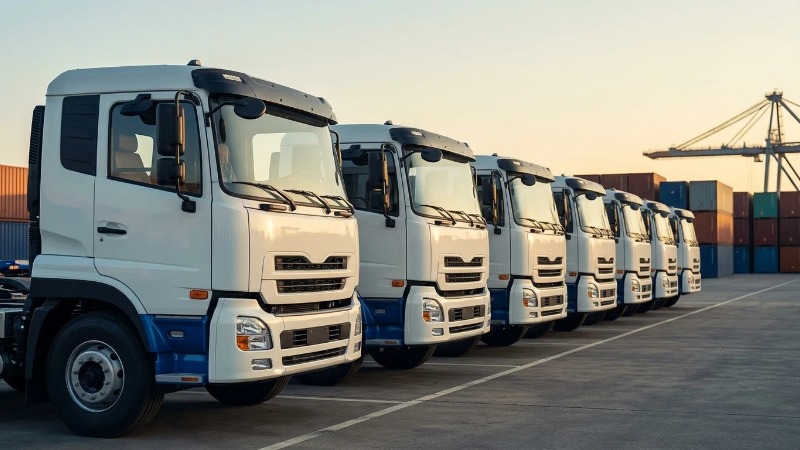
Retail pricing is one unit, one buyer, one transaction. A wholesale deal is different: a negotiated batch where specification, inspection scope, documents and delivery terms are agreed before money moves. The discount is a result of that structure, not the definition of it.
That distinction matters because a low headline price per unit can hide gaps. Units that differ from the agreed spec, missing export paperwork or an inspection nobody defined will cost more than the discount saved. A unit priced slightly higher but delivered with clean title, a documented condition report and a clear shipping basis is usually the cheaper truck in the end.
When the batch is for resale, uniformity helps you. Dealers generally move matched units faster than a mixed lot, because buyers can compare like with like. When the batch is for your own fleet, uniformity also simplifies spare parts stock and driver training.
What a Wholesale Agreement Should Fix in Writing
Before you compare prices, check that each offer states the same things. The usual points are:
- Make, model, year range and the specification for every unit in the batch
- Who inspects, what the inspection covers and what happens to units that fail
- Title, registration and export documents supplied per vehicle
- Trade terms, payment schedule and the point where risk passes to you
Offers that leave these open are not comparable, whatever the price says. Settle them first, then negotiate the number.
Who Is Choosing, and What Do You Need to Settle First?
Settle four things before you ask any supplier for a quote: destination, budget, units per batch and target spec. The rule holds because every other decision, from vehicle age to shipping method, depends on those four answers.
Your role changes how you weigh them. A dealer buying for resale cares about margin per unit and how quickly stock turns, so a truck that sits unsold for months erases a good purchase price. A fleet buying for its own use cares about uptime and a predictable cost per kilometre, which makes parts availability and service access more important than the cheapest unit.
The rule breaks when the destination is still undecided. If you are weighing two markets, the import age limit, emission requirement or steering-side rule in either one can rule out entire categories of stock. In that case, shortlist the markets first and run the steps below for each one separately.
- Name the destination country and port, and confirm its import rules for used and new commercial vehicles.
- Set a landed-cost budget that includes freight, insurance, duties, port charges and any conversion work, not just the purchase price.
- Decide the batch size, and check whether your chosen shipping method suits it.
- Write a target spec covering truck type, axle configuration, engine, emission level and steering side.
- Record your required documents, such as title, export deregistration and inspection report.
- Send the same written brief to every supplier so the offers can be compared line by line.
A written brief also filters suppliers quickly. Those who answer your questions on spec and paperwork are worth pricing; those who reply only with a number are not.
Decision 1: New, Nearly New or Used Stock?
New stock gives you the cleanest paperwork and the longest warranty, but it carries the highest unit cost and the slowest margin. Used stock reverses that: lower entry price, higher condition risk, and more exposure to import age limits. Nearly new units, usually a few years old with moderate mileage, sit between the two and often suit a first batch.
The deciding factor is rarely the price gap. It is whether the unit can legally enter and be registered at your destination. Some countries cap vehicle age at import, and others require a minimum emission level such as Euro 5. A cheap used batch that fails either test is not cheap.
New stock fits you when the destination has strict rules, when end customers expect a manufacturer warranty, or when you are financing fleet units over several years. Nearly new fits when you want lower depreciation exposure without a new-vehicle price. Used fits when the market tolerates age, buyers value low upfront cost, and you can inspect every unit before shipping.
Condition risk grows with age, so inspection cost should grow with it. On older units, budget for an independent check and for spare parts, since availability for older engine generations can be thin in some markets.
| Age band | Advantages | Limitations |
|---|---|---|
| New | Full warranty and clean documentation; easier emission compliance | Highest unit price; slower resale margin |
| Nearly new | Lower price than new; modern emission level likely; less wear | Warranty may be partial or expired; fewer units available per batch |
| Used | Lowest entry price; wide choice of makes and specs | Higher condition risk; may breach age or emission limits; parts supply varies |
Check your destination’s age and emission rules first, then pick the youngest band your budget supports.
Decision 2: Which Truck Types and Specs Fit Your Market?
Four criteria narrow the field faster than any catalogue: payload, axle configuration, engine and local road conditions. Work through them in that order, because each one rules out options before the next comes into play.
Payload and body type. Start with what the truck will carry. Tractor units pull semi-trailers for long-haul freight, rigid cargo trucks suit regional distribution, tippers serve construction and mining, and light-duty vans move parcels and small loads. Dealers tend to find the fastest turnover in the type that local operators already replace most often. Fleets should size payload to the real load with some headroom, not to the largest figure on the spec sheet.
Axle configuration. A 4×2 is lighter and cheaper to run on good roads. A 6×4 or 8×4 carries more and handles rough sites, but costs more in tyres and fuel. Check the axle-load limits at your destination, since a truck that is legal in the country of origin can be overweight on arrival.
Engine and drivetrain. Match engine output and emission level to the fuel quality available locally. Modern engines with exhaust aftertreatment often need low-sulphur diesel and, in many designs, a urea additive. Where fuel is poor or additive supply is patchy, an older, simpler engine can be the safer choice, provided import rules allow it. Manual gearboxes remain easier to repair in many markets than automated ones.
Local road and service conditions. Think about gradients, unpaved surfaces, climate and the nearest workshop. Parts availability for a given make often matters more than a small difference in purchase price.
Rule of thumb: choose the type and spec that local operators already buy and can repair, then look for the youngest, best-documented units in that spec.
Which Emission Standards, Steering Side and Import Rules Apply at Your Destination?
A batch of trucks arrives at port, and customs refuses to clear it. The trucks are too old for the market, or they fail the emission requirement, or they have the wrong steering side. At that point the purchase price no longer matters, because the units cannot be registered, and re-export or scrapping costs usually wipe out the margin.
Avoid this by checking three rule sets for your destination before you commit to any stock.
Emission level
Euro 5 is the European emission standard for heavy-duty engines that limits pollutants such as nitrogen oxides and particulate matter. Some countries require it for imports, others accept Euro 3 or Euro 4, and some tie the requirement to the vehicle’s registration date or manufacture date. Confirm which standard applies and how the authority proves it, since many ask for a compliance document or engine plate details.
Age limits on used vehicles
Several markets cap the age of imported used commercial vehicles, often counted from the manufacture year. Others ban used imports in certain categories altogether. Rules change, so ask a local customs broker or the vehicle registration authority for the current text rather than relying on a supplier’s summary.
Steering side
Many countries mandate left-hand or right-hand drive for registered vehicles. Where conversion is permitted, it adds cost and can complicate registration. Where it is not permitted, a wrong-side batch is simply unsellable.
The order of checks matters. Settle the destination rules first, then filter supplier stock by age, emission level and steering side. Get the answers in writing from the authority or your broker, and keep a copy with the purchase file.
How Do You Convert Left-Hand Drive and When Is It Worth It?
You ask: “Can’t I just convert the cab and sell into a right-hand drive market?” Sometimes, yes. But conversion is a repair-shop job on a safety-critical system, and it only pays when the market truly demands it and each unit’s value absorbs the cost.
Left-hand drive (LHD) conversion means moving the steering column, pedals, linkages and often the dashboard to the opposite side of the cab. On a truck this is far heavier work than on a passenger car. It can involve the steering box or rack, brake and clutch pedal assemblies, wiper and heater layout, and sometimes wiring looms. Labour hours and parts vary widely by make and model, so get a written quote per model rather than a flat estimate for the batch.
It tends to be worth it in three situations: the destination legally requires the opposite steering side, the units are high enough in value that the conversion cost is a small share of resale price, and a competent workshop can finish the job in volume. It is rarely worth it on older, low-value units, where the conversion bill can eat the margin you were buying for.
Then there is the paperwork. Some authorities want a conversion certificate or an engineering sign-off before registration. Manufacturers may also treat a steering conversion as an unapproved modification, which can void warranty on the affected systems. Ask the authority and the manufacturer, in writing, before you commit.
Note: Where a market allows both steering sides, buying units already built for that side is usually cleaner than converting. Compare the cost of sourcing correct-side stock against conversion plus certification before you decide.
Where to Buy Wholesale Commercial Trucks: Sources Compared
Buying direct from a manufacturer’s stock gets you the cleanest paperwork and predictable specs, but little room on price. Auctions reverse that: low entry prices, thin information. Fleet disposals and leasing returns sit between the two, and dealer networks trade a margin for convenience.
The table sets the five main sources side by side. Treat the ratings as general tendencies, not guarantees, since they shift by country and seller.
| Source | Price | Transparency | Volume per batch | Main trade-off |
|---|---|---|---|---|
| Manufacturer stock | Higher | High | Larger, uniform lots | Little negotiating room |
| Auctions | Lower | Low to medium | Mixed, often small lots | Condition risk, fees, short inspection windows |
| Fleet disposals | Moderate | Medium to high | Larger, similar units | Heavy use, so wear is high |
| Leasing returns | Moderate | High | Medium to large | Limited supply of preferred specs |
| Dealer networks | Moderate to higher | Medium | Flexible, mixed | Dealer margin built into the price |
The takeaway: lower price usually costs you information, so the cheaper the source, the more you should spend on independent checking.
Which source fits which situation
If you resell into a market with strict import rules, manufacturer stock or leasing returns make compliance easier to prove, thanks to complete service histories. If your margin depends on buying cheaply and you can inspect before bidding, auctions can work, though they reward experienced buyers. Fleets wanting identical units for easy maintenance should look first at fleet disposals and leasing returns, where matching lots are common.
Many buyers mix sources, using one for steady volume and another to fill gaps. Whichever you choose, ask for the same documents and inspection access every time.
How to Export Used Trucks: Steps From Purchase to Delivery
Exporting a used truck follows a fixed sequence, and each step depends on the one before it. Skip one and the whole batch can sit at port accruing storage charges.
- Verify title and ownership first. Check that the seller holds clear title, that chassis numbers match the registration papers, and that no finance lien or police flag is attached.
- Commission an inspection before payment. An independent report on condition, mileage and identification numbers gives you evidence if the delivered units differ from the description.
- Confirm the destination’s import documents. Ask your customs broker which papers the importing country requires, such as a bill of sale, a certificate of origin or a pre-shipment inspection certificate, and whether any must be legalised.
- Obtain the export deregistration and clearance. The exporting country typically requires the vehicle to be deregistered, and the exporter or a forwarder files the export declaration.
- Book shipping and prepare the units. Choose RoRo or container loading, then deal with fuel levels, batteries and loose items as the carrier requires.
- Collect the shipping documents. The bill of lading, commercial invoice and packing list must agree on every chassis number and description, because mismatches are a common reason for customs queries.
- Clear customs at destination. Your broker pays duties and taxes, presents the paperwork, and arranges registration or onward transport.
Order matters because several documents cannot be produced after the vehicle has sailed. Deregistration papers, for example, are far easier to obtain while the truck is still in the exporting country.
One practical habit: send your broker the draft document set before the units are loaded. A broker will often spot a missing certificate or a mismatched number while it can still be fixed cheaply.
RoRo or Container Shipping: Which Fits Your Batch?
A dealer has twenty running tractor units sitting at a port yard, and the shipping quote comes back with two options at very different prices. The cheaper one is not always the better one. The choice depends on what each unit is worth, how it will be handled, and what the destination port can actually receive.
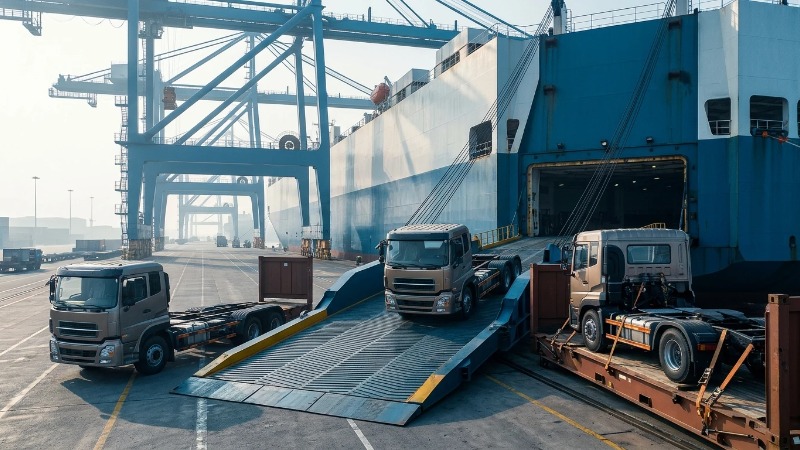
Roll-on/roll-off (RoRo) shipping is a method where vehicles are driven onto a specialised vessel and lashed on deck. Container shipping places vehicles inside 20- or 40-foot containers, usually braced and blocked inside. RoRo is typically cheaper per unit and quicker to load, but it requires units that start, steer and brake.
Scenario 1: Large running units, mixed ages
Tractor units and rigid cargo trucks in a working condition usually suit RoRo. Cost per unit is lower, and no one has to dismantle anything to fit a box. The trade-off is exposure: cargo travels on open decks, and personal items or loose parts left inside are easily lost.
Scenario 2: Higher-value or newer units
Where unit value is high, the extra container cost can be cheaper than a damage claim. A closed, sealed box limits weather exposure and pilferage. Large trucks may need cab or body parts removed to fit, which adds labour.
Scenario 3: Small batches, vans and non-runners
Light-duty vans and a few mixed units can often share a container, which lets you consolidate. Non-running vehicles generally cannot go RoRo at all. Check that the destination port can unload containers and has the yard space for a RoRo discharge before you book.
Which Incoterms and HS Code Should You Use?
For most truck batches, use FOB if you control your own freight and insurance, and CIF if you want the seller to arrange the voyage. Classify new and used goods vehicles for freight under HS code 8704, then confirm the exact subheading with your customs broker.
Free On Board (FOB) is an Incoterms rule under which the seller delivers the trucks onto the vessel at the named port of loading. From that point, freight, marine insurance and transit risk are yours. Cost, Insurance and Freight (CIF) makes the seller pay for the main carriage and a minimum level of insurance to the destination port, although risk still passes to you once the goods are loaded.
That last detail catches people out. Under CIF you pay for cover you do not control, and the default policy is usually minimal, so check what it actually covers for vehicles.
HS code 8704 covers motor vehicles for the transport of goods, including tippers, cargo trucks and many light vans built for cargo. Tractor units for semi-trailers usually sit under 8701 instead. Subheadings and duty rates differ by weight class, engine type and country, and some importers apply extra rules for used units.
Take a generic example. A dealer buying tipper trucks FOB can compare freight quotes from several forwarders and keep control over RoRo or container choice. The same dealer on CIF gets one price but has less say over carrier, routing and insurance terms.
What Should a Pre-Shipment Inspection Cover?
A pre-shipment inspection should confirm that the trucks you paid for are the trucks being loaded, and that they match the description in the contract. Three criteria matter most, and a checklist then turns them into something an inspector can sign off.
Identity and paperwork. The vehicle identification number (VIN) on the chassis plate and frame should match the title, export certificate and invoice. Mismatches stop clearance, and no repair fixes them.
Mechanical condition. Recorded mileage or engine hours should look plausible against wear on pedals, seats and the drivetrain. Engine, gearbox, axles and chassis need a cold start, a road or yard test and a visual check for cracks, weld repairs and leaks.
Independence. Where possible, hire an inspector who has no stake in the sale and who reports to you. A seller’s own report is useful, but it is not a second opinion.
- Match VIN, engine number and plate to every document.
- Record odometer and hour-meter readings with dated photos.
- Test cold start, brakes, steering and gear changes.
- Inspect the frame, suspension and axles for cracks or repairs.
- Check tyre depth, age and uneven wear.
- Look for oil, coolant and fuel leaks.
- Confirm the export documents are complete and unaltered.
Agree the report format and rejection criteria before the inspection, not after it.
Common Mistakes When Buying Trucks in Bulk
The common assumption is that a clean photo set and a low unit price mean a safe batch. Most costly errors come from the steps around the trucks, not the trucks themselves.
Skipping destination rules. Buying first and checking age limits, emission level or steering side afterwards can leave a batch that cannot be cleared. Confirm the rules in writing before you commit to stock.
Trusting photos alone. Images hide worn drivetrains, frame repairs and mismatched identification numbers. Make the sale conditional on an independent inspection against agreed rejection criteria.
Ignoring spare parts supply. A cheap model with no local parts channel stays off the road, and resale suffers. Ask which dealers or distributors cover your market and what the common wear parts cost.
Underestimating port costs. Loading charges, terminal handling, demurrage, duties, local taxes and inland haulage often sit outside the supplier’s quote. Build a landed-cost figure per unit before you compare offers.
Fleet Purchase or Leasing: Which Makes Sense for You?
Take a haulage operator who needs ten tractor units for a long-haul contract. Buying them ties up capital but leaves the operator with assets that run for many years. Fleet leasing, in which a lessor owns the vehicles and charges a periodic rental for an agreed term, keeps cash free but caps the upside.
The comparison only works over the holding period. For purchase, add the unit price, import costs, financing, maintenance and the expected resale value at exit. For leasing, add every rental, the maintenance terms, mileage limits and any end-of-term charges for wear.
In this example, high utilisation and a long holding period favour buying, since the unit cost is spread over many kilometres. If the contract is short, or the operator wants to renew vehicles on a schedule, leasing usually fits better because residual value risk sits with the lessor.
The lesson is that neither option wins on price alone. Ask which side carries the risk of resale value and downtime, then check that your destination allows leased vehicles to be imported and registered under the lessor’s name.
Frequently Asked Questions
What is the minimum batch size?
It varies by supplier and source, so ask for it in writing. Manufacturer stock and auctions often set lower thresholds than fleet disposals.
What payment terms are normal?
A deposit with the balance before release is common. Letters of credit suit larger batches, though terms are negotiable.
Which documents do you need?
Title or registration, commercial invoice, packing list and bill of lading, plus any export deregistration papers your destination requires.
Do used trucks carry a warranty?
Rarely, and only if the contract says so. Define coverage, duration and who pays for parts and labour.
How long does delivery take?
It depends on stock location, inspection, vessel schedules and customs. Ask for a timeline by stage rather than one date.
If you are still weighing a purchase against leasing, or unsure which emission rules apply, ask a question about your own case, for example whether Euro 5 tractor units can be registered in your destination country.
Buying from a truck exporter works best when you settle the basics first: your destination’s emission and steering rules, the right mix of new and used stock, and a clear Incoterm with the correct HS code. Add an independent pre-shipment inspection and a written contract, and most costly surprises can be avoided. When you are ready, send a shortlist of two or three suppliers the same specification sheet and request itemised quotes, then compare them on total landed cost rather than unit price alone.