


Chinese trucks for sale: see what drives reliability, how to judge heavy duty truck prices, import requirements and used-truck risks before you buy.
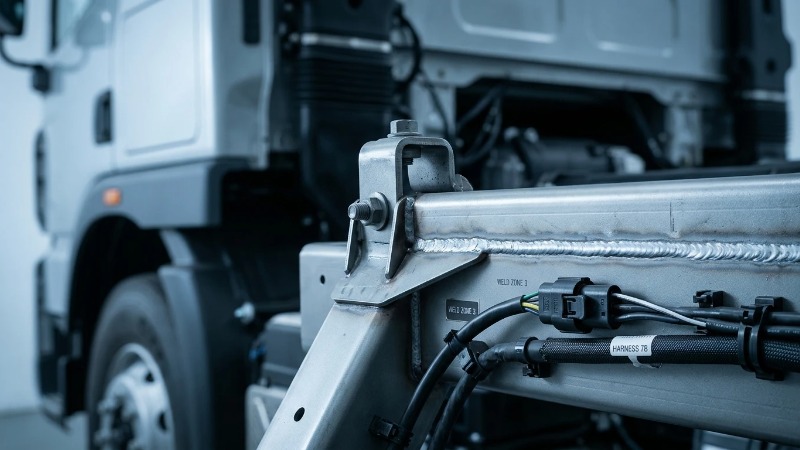
Look at the weld bead along a heavy-duty chassis rail, the finish where the cab mounts to the frame, and how firmly a wiring harness connector clicks home. Those small details decide whether a truck runs for years or spends them in the workshop, and they vary more between models than between countries. If you are weighing Chinese trucks for sale, that is the right level at which to judge them.
- Model over origin: reliability tracks the specific truck, not the flag.
- Powertrain matters: engine, gearbox and axles drive uptime.
- Support decides outcomes: parts access beats a lower quote.
Are Chinese Trucks Reliable, or Is That Reputation Outdated?
The common assumption is that Chinese trucks are cheap, disposable and fine only until the first hard season. That verdict was never entirely fair, and today it is too blunt to be useful. Reliability depends far more on the specific model, its powertrain and the dealer behind it than on where the badge was born.
Why the “cheap and disposable” belief formed
Early exports often paired low prices with thin parts support, inconsistent build quality and little service documentation. Buyers who ran overloaded trucks on poor roads with no local technicians saw failures, and those stories stuck. The belief still has some force at the bottom of the market: unbranded or heavily rebadged units, trucks with unproven components, and sellers who disappear after delivery.
What actually drives uptime
Drivetrain pedigree comes first. Trucks built around established engines from makers such as Weichai or Cummins, with proven gearboxes and axles, are easier to diagnose and repair than one-off combinations. Parts access is second: can you get filters, injectors, brake components and aftertreatment parts within days, not weeks?
Service network is third, and it is the one buyers underweight. A well-built truck with no nearby technician can be down longer than an average truck with a good workshop around the corner. Before you compare prices, ask who will fix it and how fast.
What Are the Real Myths About Buying Chinese Trucks?
Two buyers can look at the same pair of quotes and reach opposite conclusions. One reads the price line and stops. The other asks what each truck will cost to own, legally register and keep running. The second approach holds up; the first is where most expensive mistakes begin, and four assumptions come up again and again.
Myth: the lowest quote is the lowest cost
An ex-works figure is only the start of the bill. Freight, duties, local modifications, registration and any retrofit needed to pass inspection are added afterwards, and a cheap quote often leaves some of them out. Compare landed, road-ready cost, then add expected fuel and downtime.
Myth: all models share the same quality tier
Chinese manufacturers sell several grades under one badge. A flagship tractor with a well-known engine and a budget tipper from the same maker may differ in cab, axles, gearbox and build tolerance. Judge the exact configuration on the quote, not the brand name.
Myth: a Euro-spec badge means local compliance
A “Euro V” or “Euro VI” line on a spec sheet is a claim, not a certificate. Your authority decides what counts as compliant, usually through type approval or conformity documents and, in some markets, a local emissions test. Ask for the paperwork before you pay a deposit.
Myth: parts will be easy to find anywhere
Parts depend on the distributor, not the factory. Common wear items may be stocked locally, while body panels, sensors and aftertreatment components can take weeks to arrive. Ask what is held in stock nearby, who the authorised technicians are, and how a warranty claim is actually handled.
Each myth fails for the same reason: it treats the purchase price as the whole decision. Once ownership cost, legal use and uptime go into the comparison, the cheapest-looking option often stops being cheapest.
Which Chinese Truck Brands and Models Are Worth Shortlisting?
Four names come up in almost every comparison: Sinotruk HOWO, Shacman X3000, FAW Jiefang J7 and Dongfeng Tianlong. Sinotruk HOWO and Shacman are usually weighed against each other for tipper and construction work. FAW Jiefang J7 and Dongfeng Tianlong are more often the choice for tractor units and highway haulage. None of them is the right answer for every duty, so shortlist by application first and by badge second.
HOWO is the most widely distributed of the four in many markets, which tends to help with parts and used-unit resale. Shacman X3000 is commonly specified for heavy tipper, mining and construction hauling, where a stiff chassis and high-torque powertrain matter more than cab comfort. Jiefang J7 is positioned as a long-haul tractor with a focus on driver environment and fuel economy. Tianlong covers a broad range of tractor, rigid and special-body variants, with strong domestic dealer coverage in China.
| Model | Typical positioning | Commonly suited to | Check before shortlisting |
|---|---|---|---|
| Sinotruk HOWO | Broad range, widely exported | Tippers, mixers, general cargo | Local dealer and parts depth |
| Shacman X3000 | Heavy-duty, load-focused | Tippers, mining and construction hauling | Axle and chassis rating for your route |
| FAW Jiefang J7 | Comfort and efficiency-led tractor | Long-haul tractor units | Engine option and emission calibration |
| Dongfeng Tianlong | Versatile range | Tractors, rigid trucks, special bodies | Variant availability in your market |
The takeaway from the table: the model name tells you the intended duty, while the exact configuration, engine and local support decide whether it performs that duty well for you.
My recommendation is to shortlist two models per application, then compare them on the same engine class, axle setup and emission level. Comparing a basic-spec tipper against a fully optioned tractor says nothing useful. Ask each supplier for the same specification sheet and the nearest service point, then decide.
How Do Weichai and Cummins Engines Change the Ownership Picture?
Engine choice affects fuel use, parts availability and resale more than any other single option, so confirm the exact engine and emission calibration before you compare prices. Two trucks with the same cab and chassis can behave very differently over five years depending on what sits under the hood. Four criteria separate the options in practice.
Where the Weichai WP13 is commonly specified
The Weichai WP13 is a 13-litre six-cylinder diesel that is widely fitted to Chinese heavy-duty tractors and tippers, including models from several of the brands on a typical shortlist. Its main advantage is local depth: in markets where Chinese trucks are already common, Weichai parts and trained technicians are often easier to find than you would expect. Ask for the output rating and emission calibration of the exact unit quoted, because the same engine family is sold in several power and emission variants.
Cummins variants and the service-network trade-off
Cummins-equipped trucks usually cost more at purchase. What you pay for is a global dealer network and, in many markets, stronger used-truck resale. The trade-off is geographic. If the nearest Cummins service point is a day’s drive away, the brand name does little for uptime, and a well-supported Weichai may serve you better. Check the actual distance to an authorised workshop, not the map on a brochure.
Matching engine, gearbox and axle ratio to the duty cycle
A strong engine paired with the wrong axle ratio wastes fuel. Long-haul tractors generally suit higher-geared setups that hold low revs at cruising speed. Mining and construction hauling, with steep grades and heavy starts, calls for lower ratios and a gearbox with enough range to avoid constant slipping and overheating. Insist that the quote states engine output, gearbox model and rear axle ratio together, then check them against your route profile and gross combination weight.
A cheaper unit with a mismatched driveline often costs more in fuel and clutch wear than the price gap saved.
How Much Do Chinese Heavy Duty Trucks Cost?
There is no single price. Chinese heavy duty trucks price depends on configuration, emission level and what it costs to get the unit to your yard, so the number that matters is landed cost, not the ex-works figure on the quote.
What Moves the Headline Price
Engine output is the first lever. A higher-horsepower variant of the same engine family, say a stronger Weichai WP13 rating, costs more than the base rating, and the gap is usually larger than the fuel saving on light duty. Cab grade comes next: a sleeper with air suspension and a higher-spec interior sits well above a day cab.
Axle setup is the quieter driver. Axle ratio, single or double reduction hubs, and 6×4 versus 8×4 layouts all change the price, as does the gearbox choice. The emission package matters too, because a unit built to Euro VI carries more aftertreatment hardware than a Euro V one and usually costs noticeably more.
Costs Buyers Forget
Freight is the obvious omission. Whether the truck ships roll-on/roll-off or in a container, and how much dismantling that requires, changes the freight line considerably, and insurance sits on top of it.
Duties and taxes follow, and they vary by country and by vehicle category, so ask your customs broker for the exact classification before you compare quotes. Then come modifications: lighting, mirrors, speed limiters, a steering-side conversion, or a body fitted locally. Registration, inspection fees and any type-approval work finish the bill.
In practice, many importers build a simple landed-cost sheet with every line above, then compare quotes only on that total. A lower ex-works price can easily turn out to be the more expensive truck once the sheet is complete.
What Is the True Cost of Ownership Over Five Years?
Take two tractor units bought for the same long-haul route. One is quoted noticeably lower. Three years in, it has spent more days waiting for a part from another city, and its fuel use has crept above the other truck’s. The price gap that decided the purchase has been spent several times over.
That pattern is common, and it is why a five-year view matters. Fuel is usually the largest running cost on high-mileage work, so a small difference in consumption, driven by engine calibration, axle ratio and gearbox choice, compounds quickly. Downtime comes next: a truck that is off the road earns nothing, and the cost of a stranded load often exceeds the part itself. Tyres, brake wear and routine parts follow, then resale value at the end.
Cheaper trucks do save money in some places. Lower purchase prices reduce financing charges, and simpler specifications can mean cheaper routine repairs. On short-haul or low-mileage work, where fuel is a smaller share of the bill, the lower entry price can hold up. Where they tend not to save is on high-utilisation routes, in thin dealer networks, and at resale, where buyers discount models they cannot easily service.
| Advantages of a lower-priced truck | Limitations of a lower-priced truck |
|---|---|
| Smaller capital outlay and lower finance cost | Fuel use may be higher on high-mileage duty |
| Simpler specification can keep routine repairs cheap | Parts delays can multiply downtime days |
| Suited to low-mileage or seasonal work | Resale may be weaker where service support is thin |
| Frees budget for spares or a driver-training programme | Cost of a stranded load can exceed any purchase saving |
The table’s takeaway: the cheaper truck wins on low utilisation and loses as mileage and downtime costs rise, so run the comparison against your own duty cycle.
Which Specifications Matter: GVWR, Payload and Dimensions?
A rule of thumb that holds up well: the rated capacity on the brochure is only usable if it also fits the axle-load and size limits where the truck will run. A tipper rated for a heavy payload on paper can still be restricted to a lower legal load by the local authority.
Gross vehicle weight rating (GVWR) is the maximum total weight the manufacturer permits for the loaded vehicle, including chassis, body, fuel, driver and cargo. Payload is what remains once you subtract the truck’s own weight, so a heavier body, a larger cab or a hydraulic tail-lift quietly reduces it. Check the kerb weight of the exact configuration you are buying, not the base chassis figure.
Overloading is where the rule breaks down most expensively. Fines and impounding are the visible cost. Less visible is the risk that a manufacturer or dealer rejects a warranty claim on a cracked frame, a failed axle or worn brakes if the truck was run above its rated limits. Insurers can take a similar view after an accident.
GB 1589 and local rules
GB 1589 is the Chinese national standard that sets limits on vehicle dimensions, axle loads and gross mass for road vehicles. Trucks built for China are designed around it, so their length, width, height and axle configuration reflect Chinese limits. Your market may differ on any of these, and the gap is often largest on permitted axle load and overall length.
Before you commit, ask the supplier for the axle-load distribution and certified dimensions of the exact variant. Then compare them with your national regulations, not with the Chinese ones. If the numbers do not fit, you are looking at a different axle setup or body, or a lower legal payload than the one you priced the job around.
Euro V or Euro VI: Which Emission Standard Do You Actually Need?
Buy to the standard your market requires and your fuel can support. A Euro VI truck is not automatically the better purchase, and on the wrong diesel it can become the more expensive one. Four criteria settle the question.
Legal requirement. Start with what your registration authority accepts. Some markets mandate Euro VI for new registrations, others still accept Euro V or lower, and used-vehicle rules often differ from new-vehicle rules. Buying above the requirement adds cost without adding legal benefit; buying below it can make the truck unregistrable.
Fuel sulphur content. Euro VI relies on a diesel particulate filter and selective catalytic reduction (SCR), an aftertreatment system that injects urea solution to cut nitrogen oxides. These components are sensitive to high-sulphur diesel, which can clog filters and poison catalysts. If the fuel you can reliably buy along your route is not low-sulphur, a Euro V calibration is usually the safer choice.
AdBlue supply. AdBlue is the branded urea solution that SCR systems consume. Check whether it is sold at the depots and fuel stops your trucks will actually use. A truck that cannot get it will typically derate or limit speed, which stops a haul as effectively as a breakdown.
Proof of compliance. A line on a spec sheet saying “Euro VI” is a manufacturer claim, not a certificate. Ask for the type-approval or conformity documents for the exact engine and chassis variant, and confirm that the engine calibration on the unit matches them. Your national authority decides what it will accept, so verify before paying a deposit.
What Are the Chinese Truck Import Requirements?
The expensive mistake looks like this: a deposit goes out against a good quote, the truck arrives at port, and only then does the registration office reject it. The cause is usually an age limit, an emission rule or a drive-side requirement nobody checked first. Chinese truck import requirements differ sharply by country, and the national authority, not the seller, has the final word.
In most markets the rules fall into a few groups: type approval or a certificate of conformity for the exact model, emission compliance, a maximum vehicle age for used units, left-hand or right-hand drive rules, import duties and taxes, and a pre-registration inspection. Get the written position from your customs broker or registration authority before money moves.
Documents typically requested at customs and registration
Customs and registration offices commonly ask for the commercial invoice, bill of lading, packing list, certificate of origin, and the manufacturer’s certificate of conformity or type-approval papers. Used units usually also need a deregistration or export certificate and proof of manufacture date. Requirements vary, so treat this as a starting list, not a guarantee.
Modifications that trigger re-inspection
Changes made after arrival can reopen approval. Typical triggers are converting drive side, altering axle configuration, changing body length or overhang, swapping the engine or removing aftertreatment parts. Any of these can void the original conformity papers and require a fresh inspection.
- Confirm in writing that the exact model and variant can be registered in your country.
- Check the maximum vehicle age and emission level your authority accepts.
- Request the certificate of conformity or type-approval documents before paying a deposit.
- Verify the drive-side rule and any dimension or axle-load limits.
- Ask your customs broker to calculate duties and taxes on the landed value.
- Plan modifications before shipping, and confirm they will not trigger re-inspection.
What Should You Know About Buying Used Chinese Trucks?
A tipper has spent three years hauling aggregate on a quarry road. The paint looks fine and the cab is clean, yet the odometer reads lower than the wear on the pedals and seat suggests. Buying used Chinese trucks for mining and construction hauling can work, but records are often thin, so the inspection has to carry the weight that paperwork normally would.
Inspection points
Start with the frame. Check the rails near spring hangers, crossmember joints and the fifth-wheel or body mounting area for cracks, repair welds and fresh paint covering them. Then look at cab corrosion along sills, floor and mounts, since road salt and wet sites hit these areas first. Finally, test the turbocharger for shaft play and oil leaks, and read fault codes on the aftertreatment system, including the diesel particulate filter and SCR unit if fitted.
Red flags
Be cautious when the odometer reading does not match engine hours, service stamps or tyre wear. Missing maintenance records matter more on heavy-duty units than on light ones, because you cannot judge how hard the engine was worked. Uneven panel gaps, mismatched paint and new bolts on old brackets can point to undeclared accident repair.
If a seller resists an independent inspection, that tells you most of what you need to know. Pay for one before any deposit moves.
How Do You Buy Step by Step, From Specification to Handover?
Most avoidable losses come from skipping a stage, not from a bad truck. Work through the sequence in this order and don’t let a seller compress it.
- Define the duty cycle in writing: payload, route, terrain, annual distance and the axle-load limits where the truck will run.
- Shortlist two or three models and confirm the exact engine, gearbox, axle ratio and emission calibration for each.
- Check the registration authority’s rules for type approval, emissions, vehicle age and steering side before requesting final quotes.
- Verify the supplier: confirm its legal registration, ask for references from your market and check that the dealer or distributor can show real parts and service arrangements.
- Request quotes on the same basis, itemising freight, duties, modifications and registration so you can compare landed cost.
- Commission an independent inspection of the specific unit, and for used trucks include frame, cab, turbo and aftertreatment checks.
- Secure payment through staged terms tied to documents and inspection results, never a large unsecured deposit.
- Verify the paperwork and the truck on handover against the contract, including VIN, engine number and the compliance documents your registration office needs.
The order matters because each step narrows the next. A supplier check done before you know the legal requirements tends to be a polite conversation, and a payment plan set before inspection leaves you with little leverage if the unit disappoints.
What Do Experienced Fleet Operators Weigh Before Signing?
Ask a fleet manager who has run mixed-brand trucks what they check last, and the answer is usually the price. It comes after everything that decides whether the truck earns money. In this trade, the order of questions tends to be fairly consistent.
First comes parts supply. Operators generally want to know how many days a clutch, a turbocharger or an AdBlue sensor takes to arrive, and whether a local dealer holds stock or simply promises to order it. A truck waiting a week for a part loses more in lost trips than a modest discount saves.
Second, technicians. Experienced buyers ask who will actually do warranty work, whether that person has diagnostic software for the exact engine and emission calibration, and what happens at a remote site. A strong service network on paper means little if the nearest trained workshop is a day’s drive away.
Third, resale. Fleet people typically look at how readily a used unit of that model sells in their region, because a common model with known parts support holds its value better than an obscure one, whatever the original quote.
The practical takeaway: put these three questions to the supplier in writing, and treat vague answers as a cost you will pay later. Sticker price still matters. It just rarely settles the decision.
FAQ
Can you get a warranty on an imported Chinese truck?
Usually yes, but terms vary by supplier and market. Confirm in writing who honours claims locally, what the cover excludes, and whether the clock starts at shipment or registration.
Are right-hand-drive versions available?
Often, though not on every model or at the same price. Ask whether the factory builds them or a converter does, since conversions can trigger re-inspection.
How long does importing usually take?
It depends on build slot, shipping route and clearance. Approvals and registration often add more time than the voyage, so check them first.
Do spare parts ship quickly?
Only if a local stockist exists. Otherwise, wear parts can sit in transit for weeks while the truck is idle.
Is financing available for used units?
Sometimes. Lenders tend to ask for a clear service history and an independent inspection report, and they may limit age or terms.
If you are comparing options, send the supplier your duty cycle, a rough quantity range and the specification you need. That gives you quotes you can actually set side by side.
Buying a Chinese truck is no longer a gamble, but it does reward preparation. Define your duty cycle first, shortlist models with proven engines and local parts support, and compare total cost over several years rather than the headline quote. When you are ready, ask two or three suppliers to quote against the same written specification, and you will see quickly which ones are serious.