


Sticker price isn’t the full story. See what dealer fees, upfit, taxes and first-year costs add to new trucks for sale, and what a new truck really costs.
The sticker price on new trucks for sale is what the truck costs. It isn’t. That number covers the chassis as it leaves the factory, and a working truck almost always costs more once fees, body, compliance and the first year of running costs are added.
This guide breaks down those layers, then shows how they shift for delivery fleets, flatbed haulers, diesel owner-operators and small trade businesses.
How Much Does a New Truck Really Cost Once Everything Is Added?
The real cost of a new truck is the sticker price plus dealer charges, body or upfit, taxes and registration, compliance items and first-year operating costs. Each layer is smaller than the chassis price on its own, but together they can move the total well beyond what the window sticker suggests.
Here are the layers in the order you usually meet them.
1. Sticker price. This is the manufacturer’s suggested retail price (MSRP) for the cab-chassis or complete truck, before anything is negotiated or added.
2. Dealer charges. Documentation, destination or freight, and dealer preparation are common. Add-on packages, such as paint protection or extended coverage, are optional but often presented as standard.
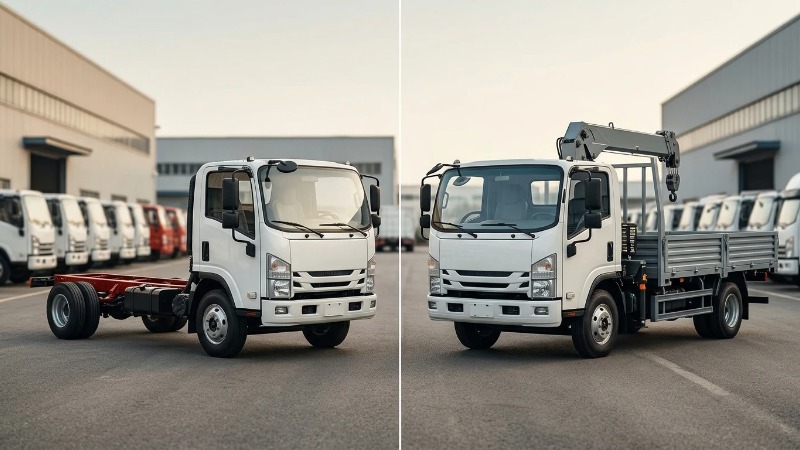
3. Body or upfit. A cab-chassis has no cargo area. A box, flatbed, service body or liftgate is a separate purchase and installation, and its cost depends heavily on specification.
4. Taxes and registration. Sales or use tax, title and plate fees vary by state and by vehicle weight class. Heavier trucks often carry higher registration and, in some jurisdictions, road-use charges.
5. Compliance items. Federal Motor Vehicle Safety Standards (FMVSS) equipment, emissions requirements under the Environmental Protection Agency (EPA), and any required DOT-related markings, inspections or permits can add cost before the truck earns revenue.
6. First-year operating costs. Commercial insurance, fuel, scheduled maintenance, financing interest and downtime all land in the first twelve months.
As a rule of thumb in this trade, upfit and operating costs are the layers buyers underestimate most. Price the finished, registered, insured truck, and treat the sticker as the starting point.
What Fees Are Added to the New Truck Price at the Dealership?
Dealer charges fall into two groups. Some are set by the manufacturer or the state and pass through unchanged. Others are set by the dealer and sit open to negotiation, and the second group is where a careful buyer saves money. The usual line items are documentation, destination or freight, dealer preparation, title and registration, and add-on packages.
Fixed charges versus negotiable charges
Destination charges come from the manufacturer and appear on the window sticker, so they rarely move. Title, registration and sales tax are government charges. Neither group is worth haggling over, though you should confirm the amounts match the state schedule.
Documentation fees and dealer preparation are different. Some states cap the doc fee, others leave it to the dealer, and the fee often stays the same however large the truck. Prep charges deserve a question, because a new truck is normally delivered ready to drive. Add-on packages, such as paint protection, nitrogen tires or etched VINs, are usually pure dealer margin.
| Line item | Who sets it | Negotiable? | What to ask |
|---|---|---|---|
| Destination or freight | Manufacturer | Rarely | Does it match the window sticker? |
| Documentation fee | Dealer, sometimes capped by state | Often indirectly, through the vehicle price | Is it the same for every customer? |
| Dealer preparation | Dealer | Yes | What work does it cover that the factory did not? |
| Title and registration | State | No | Does the quote match the official fee schedule? |
| Add-on packages | Dealer | Yes | Is each one optional, and can it be removed? |
The takeaway: question prep and add-on lines first, since they are the least tied to any outside rule.
Terms worth knowing: doc fee, destination charge, upfit, cab-chassis, GVWR
- Doc fee — a dealer charge for preparing the sales paperwork and processing the title.
- Destination charge — the manufacturer’s fee for moving the truck from the plant to the dealer.
- Upfit — a body or equipment installed on the chassis, such as a box, flatbed or service body.
- Cab-chassis — a truck sold with the cab and frame but no cargo body.
- GVWR — gross vehicle weight rating, the maximum loaded weight the manufacturer allows for the truck.
Last-Mile Delivery Fleet: Where Box Truck Costs Shift
A regional delivery operator prices a fleet of ten box trucks and compares two dealer quotes. One chassis is cheaper by a visible margin, so the decision looks easy. Then the body, liftgate and tracking hardware are added, and the gap between the quotes shrinks or reverses.
That pattern is common in last-mile delivery. A box truck is a cab-chassis with a cargo body mounted behind the cab, and in a delivery fleet the chassis is often the smaller part of what you are really buying. The dealer markup on the chassis matters less than the choices layered on top of it.
An illustrative fleet, not a real one
Take a hypothetical fleet running dense urban routes with many stops per day. The cost drivers shift in this order:
Body. Interior height, roll-up versus swing doors, shelving and floor type all change the price. A body sized for the wrong parcel mix wastes route capacity from day one.
Liftgate. A liftgate adds purchase cost and weight, and it has its own maintenance needs. Its weight also reduces payload capacity, so check the remaining margin under the GVWR before ordering.
Telematics. Hardware, installation and monthly service fees are recurring. Price them across the ownership period, not as a one-time line.
Downtime. A truck that sits in a shop misses its route. In a tight schedule, a few lost days a year can outweigh a modest saving on the purchase price.
The practical conclusion: ask each seller to quote the finished truck, with body, liftgate and telematics itemized, and ask what warranty covers the body and equipment separately from the chassis. Then compare the finished trucks, not the chassis alone.
Contractor or Hauler Running a Flatbed: Payload, GVWR and Upfit Costs
A cheaper chassis and a cheaper working truck are not the same thing, and on a flatbed the gap shows up in payload. Gross vehicle weight rating (GVWR) is the maximum loaded weight the manufacturer allows for the truck, including the chassis, body, fuel, driver and cargo. Payload capacity is what remains once everything permanently bolted on is subtracted.
The calculation is simple, and it is the one that gets skipped. Take the GVWR, subtract the curb weight of the chassis, then subtract the flatbed, headache rack, toolboxes, crane or hoist, and any extra fuel or ballast. What is left is the cargo you can legally carry. A heavy steel deck or a hydraulic crane can use a large share of that figure before the first pallet goes on.
Cheaper chassis versus higher rating
Consider two quotes for the same job. The lower-priced chassis carries a lower GVWR, so after the body and equipment are added, the usable payload may fall short of your typical load. The higher-priced chassis carries a higher rating, which usually means heavier axles, springs and brakes, and sometimes a different licensing or inspection category.
If your loads regularly sit near the limit, the higher rating is usually the better purchase. If you haul light, bulky material and rarely approach the limit, the lower rating can be sound, provided you have done the arithmetic with the actual body weight, not the brochure’s bare-chassis number. An aluminum deck in place of steel can recover payload, though it typically costs more up front.
Note: Rating upgrades cannot be added after the fact by swapping parts. GVWR is set by the manufacturer and shown on the certification label, so confirm the rating before the body is ordered. Overloading beyond it risks fines, out-of-service orders and insurance disputes.
Owner-Operator With a Diesel Engine: CDL Requirements, Emissions and Downtime
The expensive surprise on a diesel truck rarely shows up at signing. It shows up eight months later, when a warning light derates the engine on a loaded run and the truck sits in a shop bay while the freight goes elsewhere.
For an owner-operator, a diesel engine adds three costs that the sticker price does not show: licensing, emissions-system upkeep and out-of-service risk.
Licensing by weight class
A commercial driver’s license (CDL) is the license US states issue for operating heavy or specialized commercial vehicles. In general, a Class B CDL applies to a single vehicle with a GVWR of 26,001 pounds or more, and a Class A applies to combinations of 26,001 pounds or more where the towed unit exceeds 10,000 pounds. Many medium-duty diesel box trucks and flatbeds sit just under that line. Passenger or hazardous-materials work can trigger endorsements regardless of weight. Check your state’s rules, since details vary.
Emissions upkeep and inspection exposure
Modern diesels use aftertreatment: a diesel particulate filter, selective catalytic reduction and diesel exhaust fluid (DEF). DEF is a urea solution injected into the exhaust to cut nitrogen oxides. You buy it continuously, and a truck that runs short of it will typically be limited in power or speed. Filter regeneration, sensors and injectors are common repair items, and short, low-speed duty cycles tend to make them worse.
Roadside inspections add exposure. Under the Federal Motor Carrier Safety Administration’s (FMCSA) rules, an out-of-service order means no revenue until the defect is fixed.
Note: Price the warranty on the aftertreatment components, the dealer’s service network along your usual routes and your realistic downtime cost per day before you compare diesel against gasoline. A cheaper truck with a thin service network can cost more.
Small Business Buying a Light-Duty Truck or Cab-Chassis: Which Costs Surprise You?
A plumbing contractor picks a light-duty cab-chassis because the price is attractive, then books a service body from a separate supplier. Three weeks later the body shop says the frame length is wrong, the insurer wants a different classification, and the finished truck sits close to its weight limit before any tools go in.
That sequence is common among small trade businesses, and each step is a cost the sticker price never showed.
Insurance classes
A truck registered to a business and used for work is usually rated under commercial auto, not personal auto. Premiums typically rise with vehicle weight, radius of operation and the equipment carried. Ask for a quote on the exact configuration before you commit to the truck, because the answer can change which model makes sense.
Upfit incompatibility
A cab-chassis is a truck sold without a cargo body, leaving the frame exposed for a body to be mounted. Body makers specify the cab-to-axle length, frame rails and electrical connections they need. Check these against the chassis, since a mismatch means modification labor or a different body altogether.
Weight-rating limits
The gross vehicle weight rating (GVWR) is the maximum loaded weight the manufacturer allows. A steel service body with shelving, a crane or a compressor can use a large share of payload capacity before the first job. Crossing into a heavier class may bring a CDL question, so confirm the final rating before you order.
The practical rule: price the chassis, body, insurance and registered weight as one package. A lower-priced chassis that needs a different body or a heavier rating rarely stays the cheaper option.
What Costs Stay the Same Whatever the Truck or Use?
The rule of thumb: whatever the body, engine or route, five obligations come with every new commercial truck, and none of them is optional. They are taxes and registration, insurance, federal safety compliance, emissions compliance and inspection. Budget for them before you compare any two trucks.
Why it holds is simple. These items attach to the vehicle and the operator, not to the application. A flatbed hauler and a last-mile fleet pay the same kinds of charges, and only the amounts differ.
The obligations, by their public names
Sales or use tax and registration fees apply at purchase, and registration is usually tied to the declared gross weight. Rates and fee schedules vary by state and sometimes by county, so check the local rules.
Insurance is also constant. Commercial auto cover is usually priced by vehicle class, use and radius, and carriers differ.
New trucks must conform to the Federal Motor Vehicle Safety Standards (FMVSS), which the manufacturer certifies. Engines must meet U.S. Environmental Protection Agency (EPA) emissions requirements. Operation then falls under the Federal Motor Carrier Safety Regulations (FMCSRs) where they apply, including DOT inspection exposure for vehicles in interstate commerce. Some intrastate operations follow state equivalents.
Common practice is to put these five lines into every quote comparison first, then compare the differences between trucks. Buyers who do this tend to avoid the surprise of a cheaper truck that only looked cheaper because they left the fixed items out.
The rule breaks at the edges. Exemptions exist for some vehicle weights, some farm uses and some intrastate work, so confirm your own status rather than assuming it.
Financing, Depreciation and Insurance: Is Buying Better Than Leasing?
Buying means you carry the loan interest, the depreciation and the resale risk, but you keep the asset and the freedom to modify it. Leasing swaps that ownership risk for a fixed monthly payment and a set of contract limits. Neither is cheaper in every case, and the gap depends on how hard the truck works and how long you keep it.
Buying tends to suit long service lives and high mileage. A truck kept through most of its useful life spreads depreciation thinly, and you can bolt on a body or equipment without asking permission. Leasing tends to suit shorter replacement cycles and tight budget forecasting, because the payment is predictable and the lessor usually absorbs the residual value risk. The catch is that mileage caps, wear-and-tear charges and restrictions on upfit modifications can add cost that the monthly figure hides.
Insurance sits on both sides. Lenders and lessors typically require comprehensive and collision cover, and premiums depend on the vehicle class, the use and the operating radius, so get a quote before you choose a structure rather than after.
| Factor | Advantages of buying | Limitations of buying |
|---|---|---|
| Cost over time | Lower total cost on a long, high-use life | Larger down payment and interest |
| Modifications | Free to add a body or equipment | Upfit cost is yours to fund |
| Residual value | You keep any resale value | You absorb a weak used market |
| Budgeting | Payments end when the loan does | Repair costs rise as the truck ages |
| Tax treatment | Depreciation may be deductible | Rules vary, so confirm with your accountant |
The table’s takeaway: buying rewards patience and heavy use, while leasing rewards discipline about mileage and a shorter horizon. Run both quotes on the same out-the-door, fully upfitted basis, or the comparison will mislead you.
Which Hidden-Cost Mistakes Catch Buyers Out?
The most common assumption is that the cheapest sticker price wins. It doesn’t. The main error is comparing sticker prices when you should compare delivered, upfitted prices. Four related myths tend to travel with it.
Myth: “The dealer fee is fixed”
Destination charges are set by the manufacturer and rarely move. A documentation fee is the dealer’s own charge, and some states cap it while others don’t. Ask for it as a separate line and weigh it against the total, not in isolation.
Myth: “Payload is whatever the brochure says”
Brochure payload usually describes a bare chassis or a specific configuration. Once a body, liftgate, toolboxes and fuel are added, the usable figure drops. Subtract the real equipment weight from the GVWR minus curb weight before you accept a rating.
Myth: “The upfit is a small add-on”
On a box truck or service body, the body can be a large share of the delivered cost. It also affects lead time, since a truck waiting on its body earns nothing.
Myth: “A diesel engine costs more only at purchase”
Diesel trucks often carry the higher purchase price, then add emissions-system upkeep, such as diesel exhaust fluid (DEF), and downtime risk. Whether fuel economy offsets this depends on mileage and duty cycle.
Myth: “Compliance is the manufacturer’s problem”
The chassis may meet Federal Motor Vehicle Safety Standards (FMVSS) as built, but a body you add or a weight rating you exceed becomes your responsibility. Confirm in writing who certifies the finished vehicle.
How to Pick the Right Truck for Your Situation
Work through six decisions in this order, because each one narrows the next. Skipping ahead usually means paying twice.
- Define the job in loads and routes. Write down the heaviest regular load, daily distance and stops per day. The trade-off: a spec built for the worst-case load costs more every day, while one built for the average load fails on the heavy days.
- Calculate payload from the Gross Vehicle Weight Rating (GVWR). Subtract the chassis curb weight, the body, any liftgate or tools, and fuel and driver weight from the GVWR. A higher rating buys capacity but can move you into a different licensing and inspection class.
- Check licensing before the weight class. Confirm whether your drivers need a commercial driver’s license (CDL) at the chosen rating. Staying under the threshold widens your driver pool, though it caps what you can carry.
- Choose the body and powertrain together. A box, flatbed or service body changes weight and cost, and a diesel engine changes upkeep. Diesel tends to repay itself on high mileage and heavy loads, while gasoline often wins on short, stop-start routes.
- Add the dealer, upfit and compliance layers. Request one itemized, delivered price covering the chassis, body, fees and certification. The cheapest chassis quote rarely stays cheapest after this step.
- Model total cost over the years you will keep it. Include financing, insurance, fuel, maintenance and expected resale value. A longer horizon favors durability, and a shorter one favors a lower purchase price or a lease.
The rule of thumb: let payload and licensing set the truck, then let total cost choose between the trucks that qualify. Price should be the last filter, not the first.
What to Verify Before You Sign a New Truck Purchase
Five checks, done in writing and before any deposit, catch most of the problems that turn a fair quote into an expensive truck. Treat each as a condition of signing, not a courtesy request.
Itemized out-the-door quote. Ask for one document that lists the vehicle price, destination charge, documentation fee, dealer prep, add-on packages, taxes, title and registration. A bundled total hides the lines you could question. Get the same format from at least two sellers so the comparison is honest.
Weight ratings on the finished truck. Confirm the gross vehicle weight rating (GVWR), the front and rear axle ratings, and the payload left after the body and equipment are fitted. A brochure figure describes a bare chassis. Your load is carried by the upfitted truck.
Body compatibility. Check that the body maker approves the chassis, wheelbase and cab-to-axle dimension you chose. If the body comes from a separate supplier, ask who is responsible for fit, final certification and any rework.
Warranty terms. Read what the powertrain cover includes, how long it runs, and whether an upfit or a non-dealer installation affects it. Emissions-system coverage deserves its own question on a diesel.
Fees and promises in writing. Verbal assurances about delivery dates, included accessories or fee reductions carry no weight once you sign. Put them on the order form.
- Request the itemized quote and compare it line by line.
- Match the stated GVWR and payload to your heaviest regular load.
- Obtain written body-maker approval for the chassis.
- Read the warranty exclusions before the coverage summary.
- Confirm the delivery date and any penalty for delay.
- Strike or question every add-on you did not ask for.
If a seller resists putting any of this on paper, that tells you something about the deal.
Summary: Price the Whole Truck, Not the Chassis
Compare new trucks on out-the-door, fully equipped cost plus carrying costs, not on sticker price. A low chassis price tells you little until fees, body, compliance items, insurance and financing are added to it.
Before you commit, ask at least two sellers for itemized quotes built to the same specification, and compare them line by line.
FAQ
What is the difference between MSRP and the out-the-door price on a new truck?
MSRP is the manufacturer’s suggested price for the chassis as specified. The out-the-door price adds destination charges, dealer fees, body or upfit, taxes and registration. Always compare the second figure.
Are dealer documentation fees negotiable?
Often only indirectly. Some states cap doc fees, so the line itself may not move. You can usually negotiate the truck price or add-ons to offset it.
Do I need a CDL for a box truck?
It depends on GVWR. In the US, a CDL is generally required at 26,001 lb GVWR or more. Many lighter box trucks need only a standard license, but check your state’s rules.
How does GVWR affect what I can legally carry?
GVWR is the maximum loaded weight the chassis is rated for. Your legal payload is that figure minus the empty truck, body, equipment, fuel and crew.
Does a diesel engine cost more to run than a gasoline one?
Often yes in upkeep, though not always per mile. Diesel usually costs more for DEF and aftertreatment service, but it may return better fuel economy under heavy, high-mileage loads.
What inspections does a new commercial truck still need?
Yes, it still needs them. Expect registration checks and roadside DOT inspections. Interstate operators typically also need annual inspections and driver pre-trip checks, so confirm local requirements.
Ready to buy? Start by asking each seller for a written, itemized out-the-door quote that covers the same chassis, body, GVWR, and options. Add your own estimates for insurance, financing, and upkeep, then compare the total cost of ownership over the years you plan to keep the truck. The cheapest sticker is rarely the cheapest truck.