


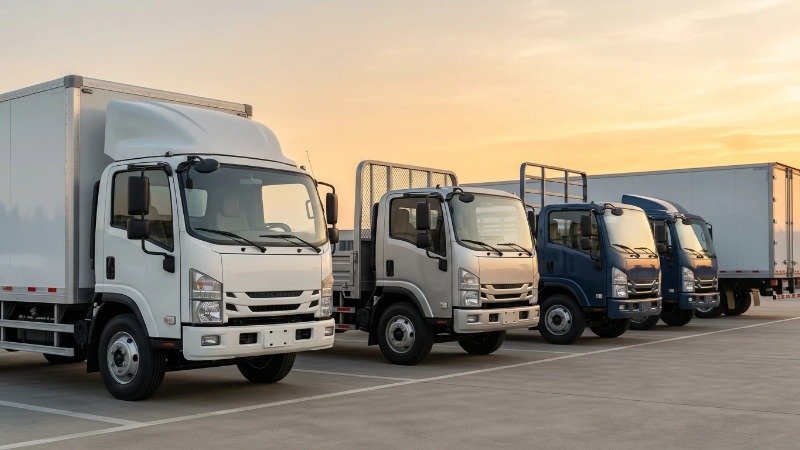
Learn how to choose a cargo truck, what it costs and which is best for hauling. Compare new and used cargo trucks for sale near me and avoid pricey mistakes.
This guide is for fleet managers, owner-operators, contractors and delivery businesses buying a first or next work truck; if you lease a full-service fleet or want a pickup for personal use, skip it.
What Counts as a Cargo Truck, and What Should You Settle Before Browsing Listings?
A cargo truck is a commercial vehicle defined by the work it must do: the weight it carries, the shape of the load and the route it runs. Settle those three before you compare make, model or price.
Browsing first is how buyers end up with a truck that looks right on a listing and fails on the job. A box truck, flatbed, stake body or dry van all qualify, but each suits different freight.
Load weight
Write down your heaviest realistic load, not your average one. That figure drives the GVWR (gross vehicle weight rating, the maximum loaded weight the manufacturer allows) and, indirectly, licensing, tires, brakes and engine choice.
Load shape
Dense, heavy freight runs out of payload before it runs out of space. Bulky, light freight does the opposite. Pallets, long pipe, loose building materials and boxed parcels each point toward a different body type and door or deck arrangement.
Route type
Dense urban stops, regional highway legs and mixed site work wear a truck differently. Stop count, daily distance and annual mileage affect engine choice, turning radius, fuel cost and how much downtime you can absorb.
With those three answers on paper, a listing becomes easy to screen. Most of them can be ruled out in under a minute, which is the point.
Five Beliefs About Buying a Cargo Truck That Quietly Cost Money
Most first-time buyers carry the same five assumptions into a dealer lot. Each sounds sensible, and each can cost you real money.
“A bigger truck is safer and more flexible”
Extra size brings extra GVWR, and with it licensing, inspection and insurance obligations you may not need. A larger truck also burns more fuel on every empty mile. Size the truck to your heaviest realistic load, not your worst imagined one.
“Low mileage means low risk”
Mileage measures distance, not abuse. A delivery truck with heavy stop-and-go use, long idling or overloaded runs can be worn out at modest mileage. Service records and the condition of brakes, suspension and frame tell you more than the odometer.
“A diesel engine always pays back”
Diesel rewards heavy loads and high annual mileage. On short urban routes, its higher purchase price and emissions-system upkeep can outweigh the fuel savings. Run the numbers against your own mileage first.
“The cheapest listing is the cheapest truck”
A low asking price often reflects deferred maintenance, a poor body or missing paperwork. Count the repairs, the downtime and the upfit you will have to add. The lowest sticker price and the lowest cost per year of use are rarely the same unit.
“Any dealer inspection report is enough”
A report from the seller is a starting point, not independent evidence. Scope and thoroughness vary, and the seller has an interest in the outcome. For any used unit, pay a mechanic you chose to look at it.
How Do You Choose a Cargo Truck? Start With GVWR and Payload Capacity
Choose a cargo truck by working backward from your heaviest realistic load. Then subtract everything that isn’t cargo to see what the truck can legally carry. Four checks do most of the work.
Criteria that decide the fit
Heaviest realistic load. Use the load you carry a few times a month, not the once-a-year outlier. Rent for the outlier.
Usable payload. Payload is the weight a truck may carry beyond itself. Start from the GVWR (gross vehicle weight rating, the maximum loaded weight the manufacturer allows) and subtract curb weight, which is the empty truck with fluids. Then subtract fuel, the driver, tools, straps and any liftgate or shelving added later. The remainder is what you can haul.
Axle ratings. A truck can sit under its GVWR and still overload one axle. Check the front and rear axle ratings on the compliance label, and think about where the weight sits on the body.
Volume versus weight. Parcels and furniture usually fill the box before they hit the weight limit, so cubic capacity matters more. Pipe, pallets of tile and machinery do the reverse, and payload decides.
A rule of thumb: leave a margin below the limit for everyday loads rather than loading to the number.
Terms to know
- GVWR — the maximum loaded weight of the truck as set by the manufacturer.
- Payload — the cargo weight the truck can carry, equal to GVWR minus curb weight and added loads.
- Curb weight — the weight of the empty truck with fluids but no driver or cargo.
- GCWR — the gross combined weight rating, the limit for the truck plus any trailer it tows.
- Tare — the weight of the empty vehicle or body, used as the starting point when calculating net load.
Box Truck, Flatbed, Stake Body or Dry Van: Which Body Fits Your Freight?
An enclosed body protects the load and the people handling it. An open body gives up that protection in exchange for fast, unrestricted loading. The choice usually comes down to whether your freight fears weather and theft, or whether it is long, heavy or awkward enough that walls would only get in the way.
A box truck is a cargo truck with an enclosed cargo box mounted behind the cab, usually loaded through rear doors, a roll-up door or side doors. A flatbed has a bare deck. A stake body adds removable or fixed side rails to that deck. A dry van is a fully enclosed, non-refrigerated trailer, typically pulled by a tractor, so it belongs to a different class of vehicle and licensing from the straight trucks above.
| Body type | Loading method | Security | Weather exposure | Upfit cost |
|---|---|---|---|---|
| Box truck | Rear or side doors; liftgate or ramp optional | High | Low | Moderate |
| Flatbed | Forklift, crane or hand loading from any side | Low; needs straps and tarps | High | Lower |
| Stake body | Open top; sides contain loose or palletized goods | Low to moderate | High | Lower to moderate |
| Dry van | Dock-height rear doors | High | Low | Trailer purchase plus tractor |
The takeaway: enclosed bodies buy security and weather protection, open bodies buy loading flexibility, and the price gap between them depends on the options you add.
Which to pick by situation
Parcels, furniture, appliances and anything that cannot get wet point to a box truck. Lumber, steel, pipe, pallets of block and machinery point to a flatbed, or a stake body if the load shifts without side rails. A dry van makes sense mainly when you already run tractors and dock-to-dock freight.
Weigh the body itself, too. A heavy box or a liftgate eats into payload, so check the finished weight against your GVWR before you commit.
What Is the Best Cargo Truck for Hauling Your Specific Load?
Picture a dispatcher with three jobs on the board: a parcel route with 120 stops, a landscaping supplier moving pallets of block, and a regional run of 400 highway miles. No single truck serves all three well. The best cargo truck is the one whose weight rating, body and duty cycle match the work, so the useful question is which operation you actually run.
Last-mile delivery with frequent stops
Last-mile delivery is short-haul distribution to many drop points, often in dense areas. Here the truck is opened and closed hundreds of times a day. Look for a box truck or cargo van with a low step-in height, a roll-up or side door, and a tight turning circle. Payload matters less than cubic volume, since parcels usually fill the space before they reach the weight limit. A gasoline engine often fits this stop-and-go pattern.
Building-materials hauling
Block, lumber, drywall and rebar are dense, long or both. A flatbed or stake body with a high payload rating and sturdy axles is the usual fit, often with a forklift or crane in the picture. Weight is the limit here, not volume. Check the finished payload after the body and any lift equipment are added, and expect rougher duty on frame and suspension.
Regional freight with long highway legs
Long legs reward efficiency and driver comfort. A larger box or dry van on a diesel chassis tends to suit steady highway miles, where fuel economy and engine life count most. Cab comfort, cruise control and service access along the route deserve real weight. Be aware that higher GVWR can bring CDL and inspection obligations.
Whichever profile is closest to yours, test the shortlist at your actual loaded weight on your actual route before you decide.
Diesel Engine or Gasoline: Where Each One Pays Off
A diesel engine costs more up front and rewards hard, steady work. A gasoline engine costs less up front and suits trucks that spend their day idling at curbs. Neither is the better engine in general; each is better for a specific duty cycle.
Diesel generally fits heavy loads, high annual mileage and long highway legs, where its torque and fuel economy accumulate real savings. Gasoline often fits short routes, light stop-and-go work and buyers who want a lower purchase price and simpler maintenance. The break-even depends on how many miles the truck actually runs, so estimate that before comparing sticker prices.
| Factor | Diesel | Gasoline |
|---|---|---|
| Purchase price | Typically higher | Typically lower |
| Fuel economy under load | Usually better | Usually lower |
| Emissions systems | More complex, with particulate filter and exhaust fluid on modern units | Simpler aftertreatment |
| Repair complexity | Higher cost per repair, longer intervals | Cheaper, widely serviceable |
| Resale | Often stronger on heavier trucks | Often weaker, but cheaper to buy in |
The table’s takeaway: diesel trades a higher entry cost for lower running cost at high mileage, and gasoline does the reverse.
Tip: Short urban routes with long idling can clog a diesel’s particulate filter, and that repair is expensive. If your truck rarely gets up to highway speed, price that risk before choosing diesel.
Do You Need a CDL, and What Does a DOT Inspection Require?
Check the GVWR on the door-jamb plate before you check anything else, because licensing follows that number, not the badge or the body style. In the US, a Class B commercial driver’s license (CDL) is generally required when a single vehicle has a GVWR of 26,001 lb or more. A CDL is a state-issued license that authorizes a driver to operate heavier commercial vehicles.
The rule holds for most straight trucks. It bends in a few places: some states set their own thresholds for intrastate work, and certain categories, such as hazardous materials or passenger transport, carry endorsements regardless of weight. Towing a heavy trailer can also change the class, since combination rating matters, not just the truck’s own.
The practical consequence is simple. A truck rated just under the line lets a wider pool of drivers run it without a CDL, which matters for hiring. A truck rated just over it adds licensing, testing and often drug and alcohol program obligations.
What DOT inspection means for your truck
The Federal Motor Carrier Safety Administration (FMCSA) regulates commercial motor vehicles operating in interstate commerce. Its rules include periodic inspection requirements under 49 CFR Part 396, which generally call for each vehicle to be inspected at least once every 12 months by a qualified inspector, with a record kept. Drivers are also expected to complete vehicle condition reports, and roadside inspections can happen at any time.
Applicability depends on weight and the type of operation. Some lighter or intrastate trucks fall outside the federal rules, though many states adopt similar ones. Confirm both the CDL class and the inspection regime with your state licensing authority before you sign, because a truck that needs an annual inspection and a CDL driver is a different purchase from one that needs neither.
How Much Does a Cargo Truck Cost Beyond the Purchase Price?
The purchase price is only the first bill. Prices swing widely by class, age, body type and engine, so any single number is misleading. Typically, a used light-duty cargo van or small box truck sits at the low end, a new medium-duty box truck costs several times that, and heavy-duty units run higher still.
Treat those categories as orientation, not quotes. Local listings and a written dealer quote tell you more than any published average.
What does total cost of ownership include?
Total cost of ownership (TCO) is the full amount a truck costs you over the years you keep it, not just what you pay on the day you buy it. Fuel is usually the largest recurring line, and it scales with mileage and load. Insurance varies with cargo type, radius and driver record, and it often differs sharply between a light truck and a heavier one.
Tires are a real budget item on any commercial truck, and replacement frequency climbs with heavy loads and long routes. Registration and heavy-vehicle fees generally rise with weight class. Maintenance needs a reserve, not a hope: older trucks and diesel emissions systems can produce repair bills that arrive without warning.
Then come the costs that never appear on a listing. Upfit, such as shelving, a liftgate or a reefer unit, can add meaningfully to the purchase. Downtime is the quietest cost of all, because a truck in the shop earns nothing while the payments and insurance continue.
A practical test: price two candidate trucks over your expected ownership period, using your own annual mileage. The cheaper sticker often loses.
Cargo Trucks for Sale: New, Dealer-Certified, Auction or Private Seller?
A new truck gives you a factory warranty and clean paperwork at the highest price. A dealer-certified used unit sits in the middle, with some reconditioning and limited coverage. Auctions and private sellers are usually cheapest, and the risk lands on you.

Which one fits depends on how much uncertainty your operation can absorb. If a day of downtime costs you contracts, pay for documentation and warranty. If you have a mechanic and a cash buffer, the cheaper channels open up.
| Channel | Warranty | Documentation | Price transparency | Risk |
|---|---|---|---|---|
| New from a dealer | Full manufacturer coverage | Complete | Moderate, with room to negotiate | Lowest |
| Dealer-certified used | Limited, varies by program | Usually good | Moderate | Low to moderate |
| Auction | Rarely any | Varies, often thin | High on final bids, low on condition | Highest |
| Private seller | None | Depends on the seller | Varies widely | Moderate to high |
The takeaway: the lower the price, the more verification you carry yourself.
Searching for used inventory near you
Start with a local search for used cargo trucks for sale near you, then widen the radius in steps. Filter by GVWR, body type and engine before you look at price, so you compare like with like. Ask every seller for the VIN and service records up front.
When travel is worth it
A longer trip pays off when the local pool is thin on your exact spec, or when a unit has full maintenance history and a price gap that exceeds travel and inspection costs. Never pay a deposit before someone you trust has inspected the truck in person.
How Do You Inspect a Used Cargo Truck Before You Pay?
Run the inspection in this order, because early findings often end the process before you spend on a mechanic.
- Verify the title, VIN and service records, and compare the odometer against maintenance and inspection history.
- Insist on a cold start, and watch for hard cranking, blue or white smoke, and warning lights that stay on.
- Examine the frame rails and crossmembers for cracks, weld repairs, rust perforation and bends.
- Check brake linings or pads, drums or rotors, air lines and tire wear patterns, since uneven wear points to alignment or axle problems.
- Inspect engine oil, coolant, transmission and hydraulic fluid for contamination, and look underneath for fresh leaks.
- Operate the doors, floor, tie-downs and liftgate through a full cycle, noting slow lifts or hydraulic drips.
- Drive it loaded, if the seller allows, and listen for driveline noise, brake fade and steering wander.
- Pay an independent mechanic for a written report before any deposit.
That report is your negotiating tool. Repair estimates on a written page move a price far more than a vague “it needs work.”
Tip: Bring a flashlight, a tire tread gauge and a printout of this list. Sellers who rush you through it are telling you something.
Title, Financing and Insurance: The Paperwork That Sinks Deals
A truck that passes every mechanical check can still be a bad buy. It happens when the seller’s paperwork doesn’t match the metal, and you find out at registration, at the lender, or after a claim.
Start with the title. A lien that hasn’t been released means a lender can still claim the truck, and a salvage or rebuilt brand cuts resale value and can limit which insurers will write the policy. Ask for the title before you negotiate, not after.
Then match the VIN. Compare the number on the title, the dash plate, the door-jamb label and the frame, and treat any mismatch as a reason to walk. Odometer readings deserve the same suspicion: compare the dash against service records, inspection stickers and any vehicle history report. A gap you can’t explain is a discrepancy, not a quirk.
Financing is where good trucks turn into bad deals. A loan term that runs past the useful life of the truck, or past the warranty, leaves you paying for a vehicle that’s costing you repairs. Check the rate, any prepayment penalty and whether the lender requires specific coverage.
Insurance is priced on what you haul and how far you go. Cargo type, operating radius, driver records and GVWR all move the premium, and a policy written for local deliveries may not cover a regional run. Get a quote on the specific unit before you commit.
Note: Never hand over a deposit until the title, VIN and lien status are confirmed in writing and an insurer has quoted the exact truck.
What Good Buying Practice Looks Like in a Real Purchase
Consider an illustrative buyer, a small contractor replacing an aging work truck. The buyer starts by writing down the heaviest realistic load, the route type and the expected annual mileage. Only then does the search begin.
Three units make the shortlist, each with a GVWR that fits the load without pushing into licensing the business doesn’t need. The buyer runs the inspection sequence on all three and asks for a loaded test drive. One has a frame repair that the listing never mentioned. Another passes, but the quoted insurance and a likely tire replacement push its full ownership cost above the third unit’s. The buyer budgets fuel, insurance, registration, maintenance reserves and downtime for each, not just the sticker price.
The third unit wins on total cost, though its seller won’t move on price. The buyer buys it anyway, because the numbers still work.
Practitioners in this trade commonly say the best deal is often the one you walk away from. A discount rarely repays a truck that doesn’t fit the job, and a seller who resists an independent inspection has already told you something.
The lesson is the order of operations: define the work, verify the truck, then price the ownership. Skip a step and the price will not protect you.
FAQ
Is a new or used cargo truck the better first purchase?
Used often suits a first purchase if you can verify condition and paperwork. New costs more but brings a warranty and a known history.
Can a diesel truck run on short urban routes?
Yes, but frequent short trips can strain emissions systems. Gasoline usually fits stop-and-go work better.
Is a liftgate worth adding?
Yes, if you regularly load heavy items without a dock. It adds weight and cost, so subtract it from payload.
How often should a cargo truck be inspected?
At least annually for interstate commercial vehicles under federal rules. Daily walkarounds and routine maintenance catch problems between inspections.
Bottom Line: Your Next Step
Fit comes first, ownership cost second, and price last. A truck that matches your load, route and licensing position will usually beat a cheaper one that doesn’t, because the mismatch shows up every month in fuel, repairs and downtime.
Start with three figures on one sheet of paper: your heaviest realistic load, your route type, and your annual mileage. Those numbers set the GVWR range, the body style, the engine choice and whether a CDL enters the picture at all.
Then shortlist two or three trucks against them. Check each one’s usable payload, run the inspection steps, and price the full cost of ownership before you talk about discounts. If a unit fails any of the three figures, drop it, however good the listing looks.
Which of your three figures are you least sure of today, and what would it take to measure it before you buy?