


Shopping for heavy trucks for sale? Learn how to choose a heavy duty truck: match class and GVWR to the job, compare new vs used, and budget total cost.
Buying a heavy truck comes down to five questions: the job, new or used, configuration, powertrain, and total cost including compliance.
Match the GVWR and axle setup to your heaviest realistic load, buy the newest spec you can verify and afford, and never skip the inspection.
- Job first: duty cycle sets class, GVWR and axles.
- Condition second: verify records before comparing prices.
- Cost last: add compliance, insurance and financing.
What Job Will the Truck Do, and Which Class and GVWR Follow From It?
The duty cycle decides the class, and the class decides the rest. Class 8 begins above 33,000 lb GVWR, which covers most tractors used for regional and long-haul freight.
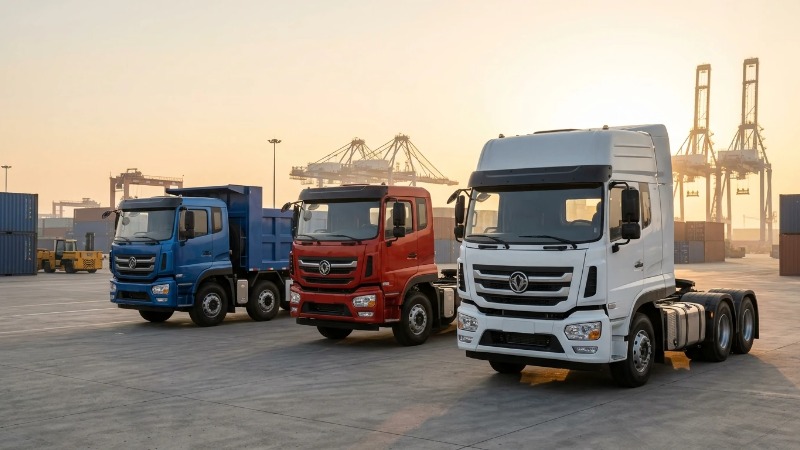
Gross vehicle weight rating (GVWR) is the maximum loaded weight of a single vehicle as set by its manufacturer. Gross combination weight rating (GCWR) is the maximum for a truck plus its trailer and load together. A commercial driver’s license (CDL) is the license a driver needs once weight ratings pass federal thresholds. The exact thresholds and endorsements are worth confirming with your state licensing agency.
Regional haul
Regional work usually means a tractor pulling a van or reefer trailer, with frequent returns to a home terminal. A day cab is a tractor with no sleeping berth, lighter and cheaper to run, and it suits routes where the driver sleeps at home. A sleeper is a tractor with a bunk behind the seat, needed when drivers spend nights on the road.
Vocational and local delivery
Vocational work, such as dump, mixer or utility bodies, tends to need heavier axles and frames but fewer road miles. Local delivery often fits a lower-rated straight truck, and many of these fall below Class 8. Stop-and-go use puts more stress on brakes and transmissions than highway miles do, so weight rating alone doesn’t tell you what will last.
Write the heaviest realistic load and typical route on one page before you look at any listing. That page becomes your filter.
New vs Used Heavy Duty Trucks: Where Does the Money Go?
A new truck charges you up front for certainty, while a used one charges you later for uncertainty. Neither is cheaper in every case. The better choice depends on how many hours the truck must run and how much downtime your operation can absorb.
New trucks buy a factory warranty, emissions hardware built to current requirements and a predictable maintenance schedule. Used trucks cut the purchase price, but the risk of wear, deferred service and failed emissions components moves to you. A truck with an unknown history can cost more over two years than a pricier one with clean records.
In this trade, depreciation is generally steepest in the first years of a truck’s life, which is why buyers of nearly new units often capture much of the value of a new spec. Experienced fleet managers also tend to say that unplanned downtime costs more than the repair itself, because a late load and an idle driver add to the bill.
| Option | Advantages | Limitations |
|---|---|---|
| New | Warranty coverage on major components | Highest purchase price and fastest early depreciation |
| New | Current emissions hardware and safety features | Delivery or build time can delay start of work |
| New | Predictable maintenance and uptime | Financing payments are larger |
| Used | Lower purchase price and slower depreciation | Wear and repair risk sit with you |
| Used | Immediate availability in many cases | Warranty is limited, transferred or absent |
| Used | Wider choice of older proven specs | Emissions systems may be costly to repair |
Choose new if the truck runs high annual mileage and your schedule cannot tolerate breakdowns. Choose used, ideally with verified records, if the work is seasonal, local or low-mileage.
Which Configuration Fits Your Freight: Tractor, Straight Truck, or Flatbed?
A Class 8 tractor pulls a separate trailer, so one power unit can serve many trailer types and be swapped between loads. A straight truck carries its body on the same frame, which means less flexibility but simpler handling and a shorter overall length. Flatbed and dump bodies sit on that straight-truck platform and are built for a specific kind of cargo.
Tractors fit trailer-based freight such as dry van, reefer and tanker work. Straight trucks with flatbed, dump or similar bodies fit single-unit vocational and local jobs, including construction supply, aggregates and urban delivery. If your loads change often, the tractor’s ability to drop one trailer and hook another is hard to match.
Day Cab vs Sleeper
Within tractors, the cab choice follows how far the driver runs before returning home. The table below compares the two in general terms.
| Attribute | Day cab | Sleeper |
|---|---|---|
| Typical route | Local and regional, home each night | Regional and long haul, multi-day trips |
| Weight and length | Lighter and shorter | Heavier and longer |
| Maneuverability | Better in tight yards and city streets | Reduced |
| Driver comfort on the road | No overnight accommodation | Bunk and living space |
| Resale audience | Local and regional fleets | Long-haul carriers and owner-operators |
The takeaway: buy a sleeper only if drivers will actually sleep in it, since you pay for the extra weight and length every mile.
How Do You Size Payload and Towing Capacity Honestly?
Payload is the weight a truck can legally carry once everything permanent is already on it. The rating plate gives you GVWR (gross vehicle weight rating, the maximum loaded weight of a single vehicle), and four checks turn that number into something you can plan around.
Empty weight. Start with the curb weight of the exact build, not the brochure model. Day cab or sleeper, engine size and axle count all change it, and the difference can decide whether a load fits.
Body, fuel and fittings. A flatbed, dump body, liftgate, toolboxes, a full tank and a driver all count against GVWR. Vocational bodies in particular can take a large share of the rating before any cargo goes on.
Towing and combination limits. For a tractor, the figure that matters is GCWR (gross combination weight rating), which covers tractor, trailer and cargo together. Check that the axles, tires and drivetrain are rated for it, not just the engine.
Margin. Size for your heaviest realistic load, then leave headroom for scale variation, uneven loading and future equipment. A truck that runs at its limit every trip wears faster and leaves no room for error at a weigh station.
Tip: Weigh the truck as it will actually run, with fuel, driver, body and tools aboard, at a public scale. Subtract that figure from GVWR, and use the result as your payload.
Rule of thumb: if the honest payload falls short of your typical load, change the spec rather than the habit.
What Should I Look for When Buying a Heavy Truck’s Engine and Drivetrain?
Rule of thumb: buy the powertrain for your hardest route, not your average one. A spec that suits flat interstate miles can struggle on grades, and the reverse costs you fuel every day.
Start with the Class 8 diesel engine itself. Note the make, model and displacement, then confirm that parts and service support are available where you operate. Check the emissions system as well, meaning the diesel particulate filter, selective catalytic reduction and exhaust gas recirculation hardware. Repeated regeneration faults or deferred repairs here are among the costlier surprises on a used unit.
Next, the transmission and axles. Automated manuals usually favor fuel economy and driver comfort, while manual or fully automatic units can suit severe vocational duty. Axle ratio sets the balance between pulling power and engine speed at cruise. Service records should show regular oil analysis, coolant care and clutch or driveline work.
Two General Cases
On a hilly regional haul, a higher-torque engine rating and a lower-numerical-ratio mismatch can mean constant downshifting, so a ratio that keeps the engine in its power band matters more than peak horsepower. In urban stop-and-go work, idle time and low-speed torque dominate, which makes transmission durability and emissions system health the first checks.
The exception: if your routes vary widely, favor the flexible middle spec and accept a small penalty on both.
How Do You Find Used Heavy Trucks for Sale Near Me Without Taking on Hidden Risk?
Work through the sourcing in order, and let paperwork, not photographs, decide who makes the shortlist.
- Write your spec first: GVWR, axle configuration, engine family, transmission and a mileage ceiling, so every listing is judged against the same sheet.
- Compare the three seller types. Dealers usually offer reconditioning, some form of warranty and financing, at a higher price. Auctions are fast and cheap but typically sell as-is with little time to inspect. Private sellers can price lower, yet you carry the title and condition risk alone.
- Request documents before you travel: the VIN, service records, title status and any emissions repair history.
- Reject listings that will not share records, or that show gaps in maintenance with no explanation.
- Limit your radius by cost of inspection, not by distance alone. A truck 500 miles away may still beat a local one if its records are complete.
- Shortlist two or three units, then inspect each in person or through an independent shop before negotiating.
Auctions deserve extra caution. If you cannot start the engine, read fault codes and check the frame, assume the worst and bid accordingly.
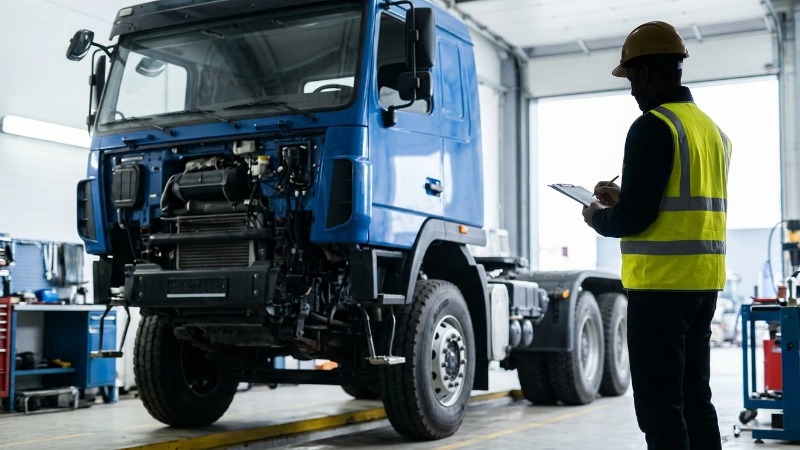
Photos show paint, not wear. A clean cab says little about the engine, the aftertreatment system or the state of the frame, which is why records and a hands-on check carry more weight.
What Should You Verify Before You Commit?
The costly pattern is a deposit paid on the strength of a clean walk-around, followed by a discovery weeks later: a salvage brand, a rolled-back odometer or an engine with a deferred rebuild. Once money moves, leverage moves with it. Do the checks first, and keep them independent of the seller.
Three checks carry the most weight. A VIN history report is a record that compiles title, accident, registration and reported mileage events tied to a vehicle identification number. An independent mechanical inspection means a shop you chose, not one the seller recommended, with diesel and aftertreatment experience. Maintenance records show whether service intervals were actually kept.
- Match the VIN on the cab, frame and title to the paperwork.
- Run a VIN history report and compare reported mileage with engine hours.
- Request the full service file, including major repairs and warranty claims.
- Book an independent inspection covering engine, transmission, axles, brakes, frame and emissions system.
- Confirm a clear title with no liens before any payment.
- Check that the truck can pass a DOT inspection as it stands.
- Get every promise from the seller in writing.
A seller who resists an outside inspection has told you something useful. Walk away.
Note: A history report only shows what was reported. Unreported repairs and cash-paid work never appear, so treat the report as a screen and the inspection as the verdict.
Which Rules and Financing Terms Shape the Final Cost?
Two buyers look at the same Class 8 tractor. One is an owner-operator who will drive it. The other runs a small fleet and will hand it to employed drivers. The sticker price is identical, yet their real costs diverge once licensing, inspection and loan terms are counted.
Owner-operator
You need a commercial driver’s license (CDL) in the right class, and a combination vehicle over the federal weight threshold generally calls for Class A. Registration, insurance and annual DOT inspection are yours alone to track. Because one truck carries all your income, a financing term that stretches payments past the engine’s likely service life is a real risk.
Small fleet
Each driver must hold the right CDL, and you carry the compliance paperwork: driver qualification files, inspection records and insurance across several units. Dealer financing can be structured per unit or as a package, and the terms are worth comparing against a bank or lender quote.
In both cases, read the annual percentage rate, down payment, term length, prepayment penalties and insurance requirements together. A lower monthly payment often just means a longer, costlier loan. Confirm current CDL, federal motor carrier and state registration rules with the relevant agencies before you sign.
Which Common Buying Mistakes Cost the Most?
The common assumption is that the cheapest listing is the smartest deal. It rarely is, because a low asking price often reflects deferred repairs, a heavy mileage history or missing paperwork that you inherit on delivery.
Myth: price is the best tiebreaker
Compare trucks on total cost over the period you plan to keep them: financing, expected repairs, downtime and resale. A truck priced modestly higher with full service records usually carries less risk than a bargain with gaps in its history.
Myth: the brochure payload is what you can haul
Payload is what remains after the body, fuel, fittings and driver are counted. Buyers who size a truck to the brochure figure often find they are over the GVWR on their first heavy load, which risks fines and out-of-service orders. Size to your real build, then keep a margin.
Myth: a clean walk-around is an inspection
Paint and a tidy cab say little about the engine, frame or emissions system. An independent mechanical inspection and a VIN history report cost little next to a rebuild, and they give you leverage in negotiation. Skip neither, however confident the seller sounds.
Short Wrap-Up: What to Settle First
Settle the duty cycle and weight rating first. Condition and total cost only make sense to compare once the job is fixed.
- Job and rating: Match GVWR and axle layout to your heaviest realistic load.
- Condition: Verify the VIN history, service records and an independent inspection.
- Total cost: Add financing, compliance, repairs and downtime to the price.
A truck that fits the job but fails inspection is still a bad buy. A cheap truck that fits the job poorly costs more over time.
Before you contact any seller, write a one-page spec sheet covering class, GVWR, configuration, engine and drivetrain, and your budget ceiling. Then ask each seller for inspection records and maintenance history, and shortlist only the trucks that come with them.
FAQ
Is a used heavy truck worth it?
Yes, if the documentation and inspection hold up. A used truck lowers the purchase price, but you take on the repair risk, so budget for deferred maintenance and compare total cost over your planned ownership period.
How much payload do I really need?
Enough to cover your heaviest realistic load plus a margin. Subtract the truck’s weighed empty weight, body and fuel from its GVWR, and size up if the result is tight.
Do I need a CDL to drive it?
Usually yes. In the US, a combination vehicle over the federal weight threshold generally calls for a Class A CDL, and a heavy straight truck typically needs Class B. Check your state’s rules and any endorsements your cargo requires.
What paperwork should a seller provide?
A clear title, a bill of sale, maintenance and service records, and a recent DOT inspection report where applicable. Run a VIN history report yourself rather than relying on the seller’s copy.
Start with the one-page spec sheet, then request those records from each seller before you spend on an independent inspection.