


Introduction: Evolving Chinese Truck Market in the Middle East (2026)
The Middle Eastern commercial vehicle landscape is undergoing significant transformation throughout 2026. Across Saudi Arabia, the UAE, Oman, Kuwait, Qatar and Bahrain, large-scale infrastructure expansion, sustainable city development and ongoing mining operations are reshaping heavy truck demand.
Unlike previous years where buyers prioritized low upfront costs, modern fleet owners now focus on long-term reliability, desert adaptability and streamlined after-sales support. This shift in purchasing mindset has greatly elevated the market share of Chinese heavy-duty trucks within GCC territories.
One of the most noticeable 2026 market shifts is the standardization of desert-specific factory configurations. No longer considered optional upgrades, heat-resistant and dust-proof features have become baseline requirements for trucks operating across arid Middle Eastern regions.
Working with GCC truck export specialists allows local fleet managers to access pre-configured, certification-ready vehicles that match 2026 regional import and operational standards.
In this in-depth industry guide, we cover exclusive 2026 market trends, regional demand variations, top-performing truck models, updated GCC certification rules and practical procurement strategies tailored for Middle East fleet operators.
Core Factors Boosting Chinese Truck Popularity in GCC (2026)
Multiple layered factors contribute to the continuous growth of Chinese truck adoption across the Middle East in 2026. This upward trend is not based on price advantages alone, but on comprehensive operational value improvements.
To begin with, regional fleet renewal cycles have peaked in 2026. A massive number of aging European and American heavy trucks have reached their service lifespan. Local contractors are actively seeking cost-effective, high-performance replacement solutions.
Furthermore, Chinese original equipment manufacturers have completed iterative upgrades for Middle East market-specific chassis, powertrain and cooling systems. Current export models are fully optimized for 45°C+ extreme heat, fine sand erosion and high-load continuous operation.
Additionally, regional spare part logistics networks have matured substantially. Major GCC port cities including Jeddah, Dubai and Dammam now maintain localized inventory warehouses, effectively resolving the after-sales lag issue that troubled early Chinese truck exports.
On the service side, formal one-stop export solutions have become mainstream in 2026. Qualified suppliers can independently complete configuration customization, official certification, commodity inspection and international shipping procedures, greatly lowering the threshold for cross-border procurement.
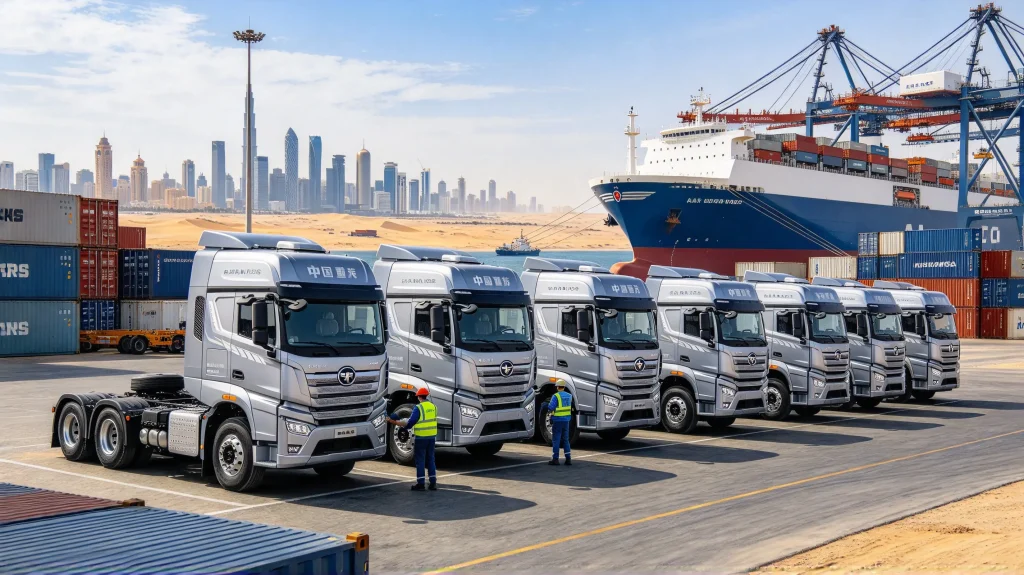
GCC Country-Specific Demand Differences in 2026 Truck Market
Although all GCC countries share desert climatic characteristics, project types, road conditions and vehicle usage scenarios vary greatly from nation to nation. Understanding these subtle differences helps fleet buyers select targeted truck configurations in 2026.
Saudi Arabia remains the dominant consumer of heavy-duty trucks in the Middle East. National Vision 2030-related mining expansion, road network upgrading and new urban construction generate stable high-volume demand. Most Saudi fleets prioritize ultra-durable dump trucks and long-haul tractor heads suitable for long-distance desert gravel roads.
The UAE market leans toward standardized logistics and municipal engineering vehicles. Dubai and Abu Dhabi’s port container transportation, urban infrastructure renovation and sanitation projects require trucks with stable daily performance and low maintenance frequency.
Oman and Kuwait feature more complex off-road working environments. Remote mountainous construction zones and scattered mining sites demand trucks with enhanced chassis rigidity and advanced dust filtration systems to adapt to harsh no-road conditions.
Qatar and Bahrain focus on small-scale municipal projects and landscape engineering. Truck orders in these regions are mostly medium-duty models used for short-distance material transportation and on-site auxiliary operations.
Regardless of regional differences, all Middle East truck fleets in 2026 must adapt to high-temperature, high-dust environments. Targeted factory customization is no longer an optional add-on but a necessary condition for stable operation.
Top Performing Chinese Truck Brands for Middle East Projects (2026)
Four mainstream Chinese heavy truck brands occupy the core export market share of GCC countries in 2026. Each brand has formed differentiated product positioning for segmented Middle East application scenarios.
HOWO Trucks: Balanced Choice for Mixed GCC Operations
HOWO maintains the largest market stock in the Middle East thanks to its highly balanced comprehensive performance. Local after-sales recognition and spare part compatibility far exceed many competing brands.
The 2026 upgraded GCC version optimizes chassis bearing capacity and engine heat dissipation efficiency. 8×4 dump trucks and 6×4 tractor heads still dominate bulk fleet orders, perfectly adapting to mixed scenarios of construction earthwork and highway logistics.
For fleet buyers pursuing stable comprehensive performance and low overall operating costs, HOWO remains the most cost-effective mainstream option in 2026.
Shacman Trucks: Professional Grade for Mining & Off-Road Scenarios
Shacman has further expanded its GCC mining market share in 2026. Relying on super-heavy-duty reinforced chassis design, it effectively resists torsion impact and structural deformation under extreme off-road conditions.
The 2026 desert exclusive configuration is equipped with oversized high-flow radiators and three-stage composite air filtration devices. It can continuously operate in high-temperature sandy environments for a long time without power attenuation or engine sand ingestion failure.
For remote mine development and long-distance desert heavy haulage projects, Shacman has become the preferred professional model for large Middle East engineering fleets.
FAW Trucks: High-Efficiency Solution for Long-Haul Logistics
FAW’s 2026 export models focus on fuel economy and driving comfort optimization. The precisely calibrated powertrain delivers stable output under full load conditions, effectively reducing long-distance transportation fuel consumption.
The fully sealed heat-insulated cabin design isolates external high temperature and floating sand, significantly improving driver comfort during ultra-long shifts. It is widely favored by GCC cross-border logistics fleets.
Foton Trucks: Flexible Option for Municipal & Medium-Duty Tasks
Foton targets medium-heavy duty segmented markets in 2026. Its flexible vehicle configuration and simple maintenance structure perfectly match municipal sanitation, urban construction and short-distance material transportation needs.
With low daily operating costs and strong scenario adaptability, Foton has become the mainstream choice for small and medium-sized engineering teams and municipal management departments across GCC.
Buyers can filter desert-ready and GCC-certified vehicles through the full catalog of export truck models to match different project scenarios.
Best-Selling Chinese Truck Models for 2026 Middle East Fleet Renewal
In 2026, Middle East fleet procurement shows obvious model concentration characteristics. Several classic heavy-duty models with verified desert adaptability occupy the majority of export orders.
6×4 Tractor Heads: Core Force for GCC Highway Logistics
Long-distance container transportation and bulk cargo transit across GCC countries rely heavily on high-performance tractor heads. The 2026 upgraded 6×4 tractor series strengthens heat dissipation and dust prevention for desert highway driving.
Fleet managers focused on cross-border freight can select 6×4 tractor heads for GCC highway haulage configured for continuous high-temperature operation and long-distance heavy load scenarios.
6×4 / 8×4 Dump Trucks: Essential for Earthwork & Mining
Mining exploitation, foundation earthwork and construction waste transportation are the most rigid demand scenarios for dump trucks in the Middle East. The 2026 new generation models thicken cargo box steel plates and upgrade hydraulic lifting systems.
For large-scale mining and large-volume earthmoving projects, 8×4 GCC dump trucks for desert mining provide larger single-vehicle payloads and higher construction efficiency.
By comparison, 6×4 dump trucks feature flexible steering and strong passability, suitable for narrow construction sites and complex desert branch roads.
Water Tanker Trucks: On-Site Support for Desert Construction
Water tanker trucks are indispensable auxiliary equipment for Middle East desert projects. They undertake core tasks such as construction dust reduction, road surface cooling and remote site water supply.
The 2026 export version adopts overall anti-corrosion spraying and sealed tank body design, adapting to long-term outdoor high-temperature exposure and seawater transpiration during shipping.
Flatbed Trucks: Professional Equipment Transportation Solution
Large mechanical equipment, generator sets and engineering accessories in GCC projects all require professional flatbed truck transportation. Reinforced bearing platforms and multi-point binding structures ensure cargo stability on bumpy desert roads.
To meet specialized transportation needs, professional heavy-duty flatbed truck options provide customized length, load-bearing and structural configurations for Middle East customers.
2026 Updated GCC Certification Standards for Imported Trucks
GCC unified certification standards have been partially optimized in 2026. The overall review process is more standardized, while the threshold for qualified exported vehicles is further improved.
All heavy trucks entering GCC member states must pass GSO unified testing covering active safety, braking performance, lighting standards and emission indicators. Uncertified vehicles will face customs detention and return risks.
It is worth noting that Saudi Arabia, UAE and Oman have added localized document verification links in 2026. Buyers must confirm the latest local policy requirements with suppliers before mass production to avoid specification mismatch.
Formal export suppliers will synchronously complete certification application, document sorting and data alignment work to ensure one-time customs clearance of vehicles after arriving at the port.
2026 Exclusive Desert Customization Upgrades for Chinese Trucks
Standard domestic Chinese trucks cannot adapt to Middle East extreme desert environments. In 2026, factory customization technology is further upgraded, forming a complete set of mature desert adaptation solutions.
High-Efficiency Enhanced Cooling System
Summer road surface temperatures in the Middle East often exceed 60°C. Ordinary radiators are prone to high-temperature alarms and power drop under continuous full-load operation.
The 2026 upgraded cooling system uses thickened oversized radiators and high-power independent heat dissipation fans, which can maintain stable engine temperature output under extreme high-temperature working conditions.
Three-Stage Progressive Dust Filtration System
Floating fine sand in desert areas is the main cause of engine cylinder wear and air intake blockage. Traditional single-stage filter elements cannot intercept ultra-fine sand particles effectively.
The new three-stage filtration structure in 2026 realizes layered interception of coarse and fine dust, greatly extending the service life of engine components and reducing frequent maintenance costs for fleets.
Reinforced Chassis & Heat-Resistant Tire Matching
Unpaved desert roads cause frequent chassis torsion and impact. The 2026 export models strengthen the main beam structure and welding process to improve overall structural toughness.
Matched with high-temperature resistant rubber tires, it effectively reduces the risk of tire burst and rapid wear during long-distance high-temperature driving.
Full Sealed Heat-Insulated Cabin
The upgraded cabin sealing structure in 2026 completely isolates external floating sand and hot air. While improving driver comfort, it also avoids dust accumulation and short circuit failure of internal electrical circuits.
Overall Anti-Corrosion & Anti-Rust Treatment
Coastal humidity and sea fog corrosion in GCC areas seriously affect the service life of truck undercarriage. The 2026 full-body anti-rust spraying process comprehensively protects chassis and metal accessories.
How to Choose Reliable Chinese Truck Exporters for 2026 GCC Orders
Supplier qualification directly determines vehicle configuration accuracy, certification completeness and after-sales service quality. In 2026, many small intermediaries still rely on template services, bringing hidden risks to fleet procurement.
Professional and stable export manufacturers have independent factory cooperation channels, standardized QC inspection processes and complete after-sales systems. They can truly realize one-stop customized export services.
Before signing a 2026 bulk order, buyers can verify supplier strength through multiple dimensions.
You can check company export background and project records to confirm the supplier’s long-term service experience in the Middle East market and formal enterprise qualifications.
Practical Supplier Screening Standards
First, confirm that the supplier has long-term stable cooperative relationships with mainstream OEMs to ensure the authenticity and standardization of customized configurations.
Second, verify the pre-shipment inspection process. Each vehicle must pass full-item detection of power, braking, electrical and appearance before shipment.
Third, confirm the long-term spare parts supply capacity to ensure continuous operation of the fleet after delivery.
Fourth, all customized terms, certification obligations and after-sales commitments must be implemented in formal contracts to avoid verbal promise risks.
Standardized 2026 Procurement Process for Middle East Truck Buyers
Scientific procurement steps can effectively avoid configuration errors, document missing and delivery delays. The 2026 standardized export process is more streamlined and efficient.
Step 1: On-Site Demand Sorting
Clarify project attributes, working environment, load requirements and local import policies. Provide accurate demand indicators for suppliers to match the most suitable truck models and upgrade schemes.
Step 2: Configuration & Certification Locking
Confirm desert upgrade items, driving direction, lighting standards and GCC certification scope. All details are locked in the contract to prevent random changes during production.
Step 3: Production Progress Supervision
During vehicle production, suppliers provide real-time factory photos and video materials. Buyers can remotely supervise production progress and customized installation details.
Step 4: Strict Pre-Shipment Inspection
After production is completed, the QC team conducts full vehicle inspection. Only qualified vehicles can enter the shipping preparation link.
Step 5: Complete Export Document Preparation
Sort out GCC certification documents, commercial invoices, packing lists and certificates of origin to ensure consistent data and smooth customs clearance.
Step 6: Marine Transportation & Cargo Tracking
Arrange ro-ro ship or container transportation according to order volume, and provide real-time vessel tracking services to ensure accurate arrival time prediction.
Step 7: Post-Delivery Technical Service
After vehicle arrival, professional technical guidance and maintenance suggestions are provided. For long-term fleet operation problems, buyers can consult the professional aftersales and technical support team at any time.
Typical Procurement Risks & Avoidance Skills for 2026
Many Middle East buyers still encounter various problems in 2026 truck procurement. Most risks come from non-standard customization, incomplete documents and unclear contract terms.
The first common risk is blindly choosing standard-configured vehicles. Without desert adaptation upgrades, trucks will have frequent failures in high-temperature and sandy environments, seriously affecting construction progress.
The second risk is inconsistent certification document data. Minor information errors will lead to customs detention and high demurrage fees.
The third risk is unclear after-sales clauses. Many intermediaries do not provide long-term spare parts support, resulting in difficult fleet maintenance in the later stage.
To avoid repetitive industry mistakes, you can refer to real GCC fleet delivery projects and summarize mature procurement experience and risk avoidance strategies.
2026–2027 Medium & Long-Term Market Outlook
From the perspective of medium and long-term development, the Middle East Chinese truck market will maintain steady growth from 2026 to 2027. Large-scale national projects in various GCC countries will continue to generate stable fleet renewal demand.
With the continuous improvement of Chinese truck brand recognition and localized after-sales networks, the replacement speed of European and American old fleets will further accelerate.
At the same time, standardized certification processes and one-stop export services will continue to reduce the procurement threshold for Middle East buyers, making cross-border truck procurement more efficient and transparent.
In the future, more intelligent desert adaptation configurations will be popularized in GCC export models, further improving fleet operating efficiency and safety.
FAQs for 2026 Chinese Truck Trends in the Middle East
Are Chinese trucks reliable for year-round desert operation in 2026?
Yes. The 2026 latest desert customized models have completed systematic upgrades in heat dissipation, dust prevention, anti-corrosion and chassis reinforcement, fully meeting the year-round continuous operation needs of GCC desert environments.
Which truck brand is most suitable for Saudi mining projects in 2026?
Shacman is the first choice for heavy mining scenarios due to its super-reinforced chassis and strong desert adaptability. HOWO is more suitable for mixed construction and logistics scenarios, while FAW is better for long-haul highway transportation.
What core certifications are mandatory for 2026 GCC truck imports?
GCC GSO unified certification is mandatory. Meanwhile, complete commercial invoices, packing lists and certificates of origin must be provided. Individual countries require additional localized safety inspection documents.
Can suppliers adjust truck configurations to adapt to different GCC traffic rules?
Absolutely. 2026 export models support flexible customization of left/right-hand drive, regional standard lights and dashboard languages to meet the traffic regulations of different Middle Eastern countries.
How long is the overall cycle of 2026 truck customization and export?
The production cycle depends on the customization scope, and the sea freight cycle from China to Middle East ports is stably maintained at 18–28 days. The whole process can be accurately assessed before ordering.
Is small-batch trial order supported in 2026?
Yes. Formal export suppliers support single-vehicle trial orders and bulk fleet orders with the same standardized production, inspection and document standards.
Conclusion
2026 is a key year for the iterative upgrading and market expansion of Chinese trucks in the Middle East. With optimized desert-specific configurations, standardized GCC certification processes and improved localized after-sales systems, Chinese heavy-duty vehicles have achieved comprehensive value upgrading.
For Middle East fleet operators, grasping the 2026 new trends and selecting targeted customized models can effectively reduce long-term operating costs and improve fleet stability.
In future market competition, Chinese trucks will rely on differentiated scenario adaptation and perfect export services to further consolidate their leading position in the GCC commercial vehicle market.
Scientific model selection, standardized procurement and professional after-sales matching will become the three core elements of Middle East fleet renewal in 2026 and beyond.