


Overview of Chinese Heavy Trucks for Sale in the Middle East
The Middle East continues to expand its infrastructure, mining projects, urban development and cross-border freight routes. These ongoing projects create steady demand for durable heavy-duty trucks that can survive harsh desert working conditions.
Many fleet managers and construction contractors across GCC nations now look toward Chinese heavy trucks as a practical option. These vehicles are built to handle high temperatures, sandy air and rough unpaved roads common in Saudi Arabia, UAE, Oman, Kuwait and Qatar.
Unlike standard trucks built for temperate climates, Middle East ready heavy trucks go through targeted factory upgrades. These upgrades focus on heat dissipation, dust filtration, cabin sealing and anti-corrosion treatment for coastal salt fog.
If you are sourcing new heavy trucks for your fleet, it is important to understand available models, required GCC compliance, customization choices and how to work with trusted export suppliers. Mettlead Truck supplies fully adapted Chinese heavy trucks for Middle East construction and logistics fleets.
This guide breaks down everything you need to know before placing your truck order. It covers popular brands, common vehicle types, mandatory certification, desert modification, procurement steps and risk avoidance tips for Middle East buyers.
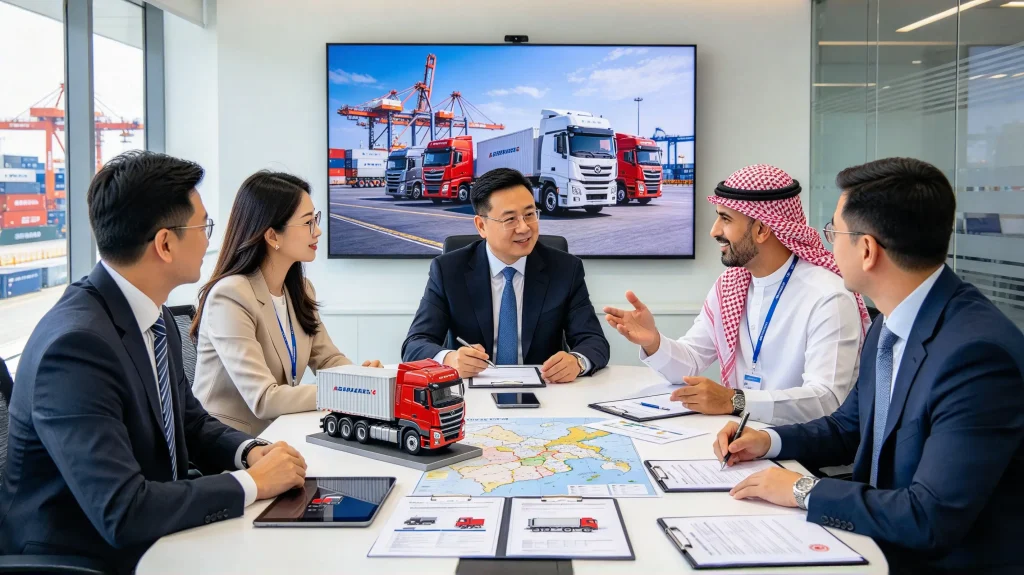
Why Chinese Heavy Trucks Are Popular Across GCC Countries
Chinese heavy trucks have grown their market share in the Middle East for several practical reasons. It is not only about competitive procurement terms. The real advantage lies in vehicle durability, flexible customization and accessible spare parts networks.
First, Chinese heavy truck OEMs have spent years refining their chassis and power systems for desert environments. They test vehicles under high heat and heavy-load cycles to reduce breakdown risks on remote construction and mine sites.
Second, local spare parts stock points have expanded in major Middle East ports. Dubai, Jeddah and Dammam host warehouses for common Chinese truck spare parts. This cuts waiting time for maintenance and reduces fleet downtime.
Third, suppliers can adjust configurations to meet each GCC country’s import rules. Steering side, lamp standards, emission levels and certification packages can all be tailored to match local traffic and customs requirements.
In addition, export suppliers provide full document support. This helps buyers avoid delays when clearing trucks through local customs, which is a major concern for fleet procurement teams.
Market Demand Differences Between GCC Nations
Each GCC country has unique project types and truck usage patterns. Understanding these differences helps you pick the correct vehicle type and configuration before purchase.
Saudi Arabia represents the largest market. Large-scale mining, road expansion and new city projects create strong demand for dump trucks and tractor heads. Most of these trucks run long hours on desert gravel roads.
The UAE focuses more on port container logistics, municipal construction and urban site work. Buyers here often prioritize stable operation and easy maintenance for daily scheduled fleets.
Oman and Kuwait require trucks that can handle remote off-road sites. Many construction zones sit far from city centers, so chassis strength and dust protection become critical selection factors.
Qatar and Bahrain have smaller overall demand. Their orders usually center on municipal work, landscaping and short-distance material transport for building projects.
Even with these differences, the core requirement remains the same. Any heavy truck operating in the region must be prepared for extreme heat and fine sand exposure.
Top Chinese Heavy Truck Brands Sold in the Middle East
Four major Chinese heavy truck brands dominate the Middle East export market. Each brand carries distinct strengths suited to different working scenarios.
HOWO Heavy Trucks
HOWO holds the largest installed base across GCC markets. It is widely recognized by local contractors and logistics operators for balanced performance and broad spare parts availability.
HOWO Middle East edition trucks feature reinforced chassis and upgraded cooling systems. 6×4 tractor heads and 8×4 dump trucks are the most requested models for large fleet orders.
These trucks work well for mixed-use projects. Whether you manage highway container transport or earthmoving at construction sites, HOWO offers reliable performance for everyday heavy-duty tasks.
Shacman Heavy Trucks
Shacman heavy trucks are preferred for heavy mining and rugged off-road environments. The chassis uses heavy-duty reinforced structures to resist torsion and impact on rough terrain.
Shacman desert customized units come with oversized radiators and multi-stage air filtration. This design protects engine components from sand damage during continuous high-temperature operation.
If your fleet works in remote mine zones or long-distance desert hauling, Shacman is one of the strongest options for heavy payload transport.
FAW Heavy Trucks
FAW heavy trucks focus on fuel efficiency and cabin comfort. They are commonly selected for highway logistics and urban construction fleets that run long scheduled driving hours.
The powertrain is carefully calibrated for stable output. Sealed cabin insulation also helps keep heat and dust out, improving driver comfort during long shifts.
Foton Heavy Trucks
Foton covers medium-heavy and heavy-duty segments. It works well for municipal fleets, sanitation work and smaller construction teams with mixed vehicle needs.
Foton trucks are simpler to maintain and carry lower operating costs. They fit buyers looking for flexible vehicles for short-to-medium haul material transport.
You can view our full lineup of export-ready heavy trucks by visiting our all truck categories page and filter for Middle East configurations.
Popular Heavy Truck Models for Middle East Fleets
Buyers shopping for Chinese heavy trucks in the Middle East usually select one of these core vehicle types. Each model serves a clear project purpose.
6×4 Tractor Heads
Tractor heads are the backbone of container logistics and bulk cargo transport across GCC highway networks. They connect with flatbed, tank or container trailers for cross-border freight runs.
Middle East spec tractor heads include upgraded heat dissipation and heavy-duty dust filters. This keeps power consistent during summer high-temperature driving cycles.
6×4 and 8×4 Dump Trucks
Dump trucks are essential for mining, earthwork and construction waste removal. Thickened cargo boxes and reinforced hydraulic lifting systems handle repeated heavy loading and impact.
8×4 dump trucks carry larger payloads and are popular for large-scale earthmoving projects. 6×4 versions offer better mobility for narrow desert site roads.
Water Tanker Trucks
Water tankers are widely used for site dust suppression, road cooling and water supply at remote construction zones. Anti-corrosion tank materials protect against harsh weather and long-term storage.
Flatbed Heavy Trucks
Flatbed heavy trucks haul construction machinery, generators and large site equipment. Reinforced platform structures and secure lashing points keep cargo stable on bumpy desert roads.
To check detailed specs and export-ready configurations, visit our dedicated flatbed truck product page.
Mandatory GCC Certification for Heavy Trucks Sold in the Middle East
GCC certification is a key requirement for importing heavy trucks into GCC member countries. Without valid certification, your shipment may face customs hold, extra demurrage fees or rejection at the port.
GSO standards cover vehicle safety, lighting, braking and emissions. Every truck must pass testing and carry matching documentation before export shipment.
Different countries add minor extra requirements. Saudi Arabia, UAE and Oman each have their own customs document checks, so you should confirm requirements with your supplier before production begins.
Reputable export suppliers will prepare the full certification package together with commercial invoice, packing list and certificate of origin. All document data must align perfectly for smooth customs clearance.
Necessary Desert Customization for Heavy Trucks in Middle East Service
Standard Chinese domestic trucks cannot operate reliably in Middle East desert conditions. Custom upgrades are required to extend vehicle service life and reduce unexpected breakdowns.
Enhanced Cooling System
Summer ambient temperatures often climb above 45°C, and road surface temperatures can rise much higher. Standard radiators struggle during continuous full-load operation.
Desert-spec trucks use oversized thick radiators and high-capacity cooling fans. This upgrade prevents engine overheating and temperature alarms during long work cycles.
Multi-Stage Dust Filtration
Fine airborne sand quickly clogs standard air filters. Over time, sand enters the engine and causes accelerated wear and power loss.
Three-stage filtration systems trap nearly all fine dust particles. This protects engine cylinders and reduces maintenance frequency for fleets operating in sandy zones.
Reinforced Chassis and Heat-Resistant Tires
Unpaved desert roads create constant twisting and impact loads on the chassis. Reinforced main beams improve structural strength and resist deformation under heavy payloads.
Heat-resistant tire compounds reduce blowout risk when tires run continuously on hot desert pavement.
Sealed and Insulated Cabin
Enhanced sealing strips and thermal insulation inside the cabin block outside heat and sand. This protects the truck’s electrical wiring from dust intrusion while improving driver comfort.
Full Anti-Rust and Anti-Corrosion Treatment
Coastal GCC cities carry high salt humidity. Sea transit and outdoor parking can lead to rust on unpainted metal surfaces.
Full anti-rust coating protects chassis, brackets and underbody parts from salt fog corrosion over the vehicle service life.
How to Select a Trusted Supplier for Chinese Heavy Trucks in the Middle East
Choosing your supplier matters as much as selecting the truck model. A reliable supplier ensures correct configuration, complete certification, pre-shipment inspection and proper export paperwork.
Many small brokers lack factory access and in-house QC teams. They may promise custom upgrades that never get applied, or deliver incomplete documents that block customs clearance.
You can use these criteria to screen potential export partners.
Supplier Qualification Checklist
First, confirm the supplier has stable factory cooperation channels and export experience with GCC markets. They must understand GCC certification rules.
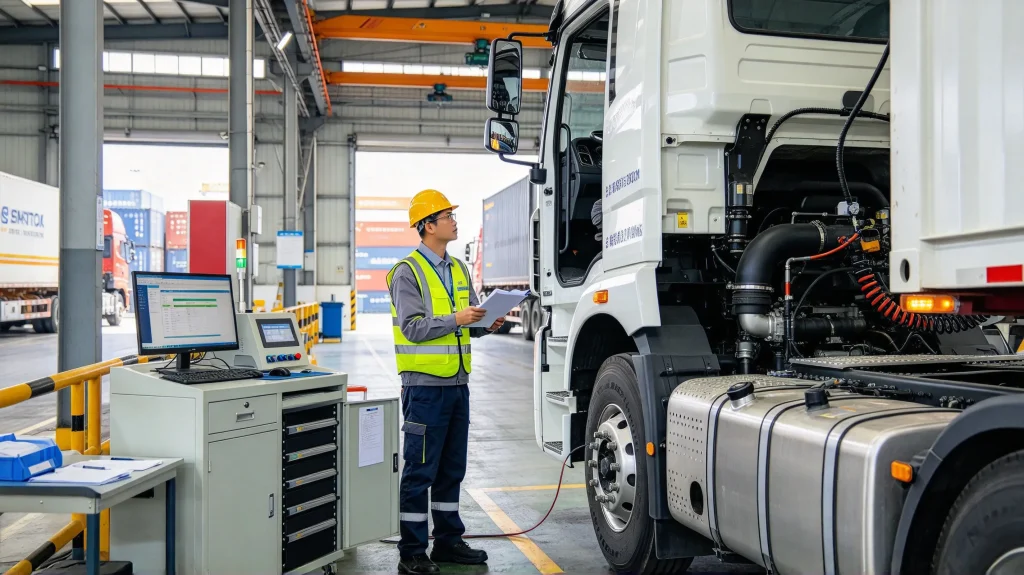
Second, verify they perform full pre-shipment inspection. Each truck should go through engine, brake, electrical and visual checks before loading onto the vessel.
Third, confirm they can provide after-sales support and spare parts supply for your fleet after delivery.
Fourth, confirm all custom modifications and certification obligations are written clearly in your sales contract. Avoid verbal agreements on vehicle specs.
Read more about our company’s export standards and project experience on our About Us page.
Complete Procurement Workflow for Buying Chinese Heavy Trucks for the Middle East
The procurement process follows a clear sequence. Following these steps helps you avoid costly mistakes and delivery delays.
Project Requirement Confirmation
Start by defining your working environment, payload needs, preferred axle configuration and target country. Your supplier uses this information to recommend suitable truck models and custom upgrade packages.
Configuration and Certification Confirmation
Once the model is selected, confirm desert upgrades, steering position, lighting standards and GCC certification. All items must be locked in writing before production starts.
Production Progress Tracking
During manufacturing, reputable suppliers share photos and short videos from the factory. This lets you remotely monitor production and verify your custom upgrades are installed correctly.
Pre-Shipment Quality Inspection
When production finishes, the QC team runs a full vehicle inspection. Only trucks that pass all tests move forward to shipping preparation.
Export Document Preparation
The document team prepares GCC certificates, commercial invoice, packing list and certificate of origin. All data must match for smooth customs clearance.
Ocean Shipping and Cargo Tracking
Depending on your order size, the supplier arranges ro-ro vessel or container shipping. You can track vessel location in real time while the trucks sail toward Middle Eastern ports.
After-Delivery Technical Support and Spare Parts Supply
After your trucks arrive at the destination port, your supplier provides operation guidance and maintenance advice. Long-term spare parts supply keeps your fleet running continuously.
For after-sales support and technical inquiries, reach out to our customer service team.
Common Procurement Risks and How to Avoid Them
Many first-time buyers run into predictable problems when importing heavy trucks to the Middle East. Awareness helps you reduce risk before you sign a contract.
One common risk is skipping desert customization. Standard trucks without heat and dust upgrades will suffer frequent breakdowns in desert conditions.
A second risk is incomplete or mismatched certification paperwork. This can lead to port detention and expensive demurrage charges.
A third risk is unclear contract terms. Any custom upgrades, spare parts inclusion and document obligations should be written into formal contracts.
A fourth risk is poor spare parts planning. Prepare a stock of commonly worn parts at your local yard to minimize fleet downtime.
Review our past fleet export projects at cooperative cases to learn from real-world Middle East truck procurement cases.
2026 Market Outlook for Chinese Heavy Trucks in the Middle East
In 2026, demand for Chinese heavy trucks across GCC remains steady. Large national infrastructure projects, mine expansion and fleet renewal programs keep generating new orders.
Local fleets continue to phase out older European heavy trucks. Many fleet managers turn to Chinese heavy trucks because of flexible customization and dependable after-sales networks.
At the same time, certification processes become more streamlined for qualified export vehicles. This lowers administrative friction for cross-border buyers.
One-stop export services are now widely adopted. This simplifies the whole buying process for fleet operators who do not maintain large in-house import teams.
FAQs About Chinese Heavy Trucks for Sale in the Middle East
Are Chinese heavy trucks suitable for desert operation in GCC countries?
Yes. When equipped with desert upgrades including enhanced cooling, multi-stage dust filtration and anti-corrosion coating, Chinese heavy trucks can operate reliably in high-temperature sandy environments.
Which truck brand works best for Middle East mining projects?
Shacman is widely chosen for heavy mining work. HOWO is a balanced choice for mixed construction and logistics fleets. FAW suits highway long-haul transport.
What certification do I need to import heavy trucks into GCC nations?
GCC GSO certification is mandatory. You also need commercial invoice, packing list and certificate of origin. Some countries require additional test documentation.
Can I adjust steering side and lamp standards for local traffic rules?
Yes. Export suppliers can configure left-hand drive or right-hand drive, plus lighting and dashboard adjustments to meet your destination country’s traffic regulations.
How long does it take to ship heavy trucks from China to Middle East ports?
Shipping time generally ranges from 18 to 28 days, depending on vessel schedules and port congestion. Production lead time adds extra time based on customization scope.
Can I place a small trial order before bulk fleet purchase?
Yes. Most professional export suppliers accept single-unit trial orders, with the same inspection and document standards applied to large bulk fleet purchases.
Conclusion
Chinese heavy trucks have become a trusted option for construction, mining and logistics fleets across the Middle East.
With proper desert customization and GCC certification, these trucks can handle the extreme heat and sandy conditions found throughout GCC territory.
Success depends on selecting the correct model, locking in your custom upgrades in writing, working with a verified export supplier and preparing your certification documents early.
When all these steps are handled properly, importing Chinese heavy trucks becomes a practical way to expand or renew your fleet for Middle East projects.