




Concrete mixer trucks serve as the core workhorse for all modern construction projects. Unlike regular cargo trucks, these specialized vehicles integrate stirring, storage, and transportation functions in one unit. They ensure fresh, uniform concrete delivery from batching plants to job sites without quality degradation.
For overseas project contractors, fleet managers, and engineering companies, selecting a suitable concrete mixer truck directly improves construction efficiency. It also cuts long-term operating and maintenance costs. However, most new buyers struggle to tell the difference between mainstream 6×4 and 8×4 models. Many also fail to match drum capacity and configurations to local road rules.
This in-depth buying guide covers every detail you need before placing an order. It elaborates on model classification, core configurations, export standards, real market prices, and common purchase pitfalls. For reliable export-grade construction trucks, you can source verified units from Mettlead Truck official site.
Why Choose Chinese Concrete Mixer Trucks for Export
In recent years, Chinese concrete mixer trucks have dominated the global engineering vehicle market. They stand out for their balanced advantages of stable performance, flexible customization, and cost-effective pricing. Compared with European and American brands, Chinese models offer lower overall investment costs without sacrificing core working quality.
Furthermore, China boasts a complete industrial chain for special engineering vehicles. All core parts, including chassis, mixing drums, hydraulic systems, and reduction gears, support mass production and standardized testing. This mature supply chain guarantees stable product quality and fast delivery cycles for bulk orders.
In addition to standard models, formal Chinese manufacturers provide targeted export upgrades. These adaptive modifications help trucks adapt to different national climates, road conditions, and vehicle registration policies. Therefore, Chinese cement mixer trucks have become the preferred choice for medium and large-scale overseas construction fleet procurement.
Full Range of Model Coverage for Diverse Projects
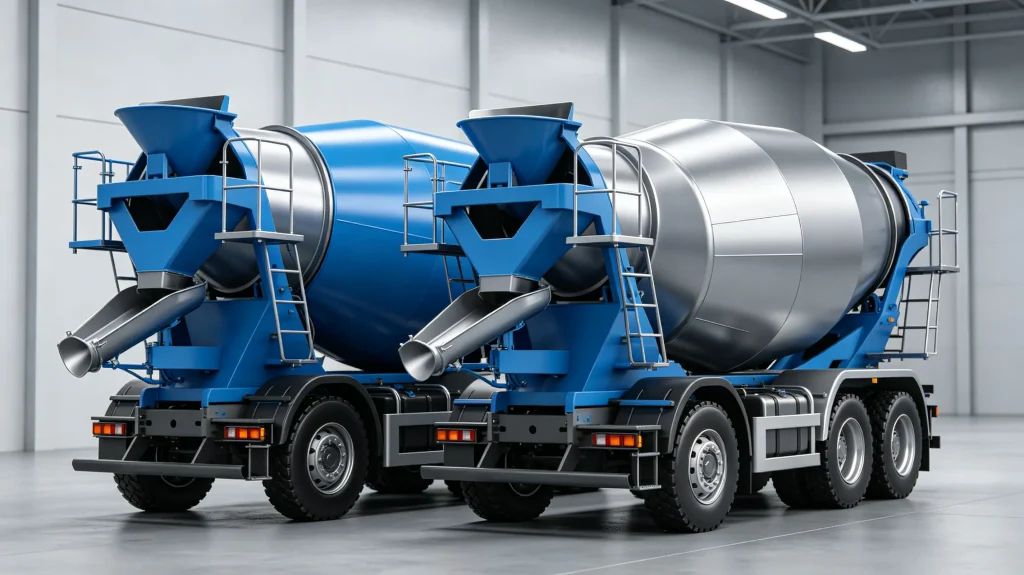
Chinese manufacturers cover a complete lineup of concrete mixer truck specifications. The product range includes small 4×2 light-duty models, mainstream 6×4 medium-duty trucks, heavy-duty 8×4 units, and super-large semi-trailer mixers. This full-size coverage meets the needs of small urban renovation and large infrastructure projects alike.
Whether you need narrow-road urban concrete transportation or heavy-load mining site operation, you can find a matching model. You can view the full range of engineering special vehicles at the all-categories product page to enrich your fleet configuration.
Lower Total Operating Costs
One of the biggest advantages of Chinese concrete mixer trucks is their low total cost of ownership. Beyond affordable upfront purchase prices, these vehicles feature simple mechanical structures and convenient daily maintenance.
Most core components adopt mainstream universal designs. Spare parts are widely available in global markets at low prices. This effectively reduces vehicle downtime and maintenance expenses during long-term fleet operation. For engineering companies with tight project budgets, this advantage greatly improves capital utilization efficiency.
Customizable Export-Oriented Configurations
To adapt to different overseas market standards, Chinese factories support personalized customization for export orders. Buyers can adjust driving mode, emission standards, drum volume, hydraulic brands, and vehicle appearance according to local requirements.
Moreover, manufacturers can strengthen anti-corrosion treatment, waterproof circuit design, and high-temperature resistance for coastal, tropical, and high-altitude regions. These targeted upgrades ensure the trucks maintain stable working performance in complex overseas environments.
Mainstream Concrete Mixer Truck Axle Configurations
Concrete mixer trucks are primarily classified by axle structure and driving mode. For international export markets, 6×4 and 8×4 layouts are the most mainstream and practical configurations. Each model has unique advantages in load capacity, maneuverability, and application scenarios.
Choosing the correct axle configuration is the premise of legal operation and efficient construction. Many buyers blindly pursue large capacity, resulting in unregistered vehicles or frequent overload failures. Thus, it is necessary to fully understand the characteristics of each model before purchasing.
6×4 Concrete Mixer Truck
The 6×4 concrete mixer truck is equipped with three axles, including two rear drive axles. This configuration is the most classic and mature design for medium-duty concrete transportation. It features a reasonable wheelbase, flexible steering, and strong road adaptability.
This model is suitable for flat urban roads, suburban highways, and ordinary construction sites. It balances transportation capacity and driving flexibility perfectly. Meanwhile, the 6×4 chassis has low fuel consumption and stable operating performance, making it ideal for long-duration daily operations.
Due to its high cost performance and low failure rate, the 6×4 mixer truck has always been the best-selling model in overseas small and medium-sized fleet procurement. It can fully meet the concrete supply demand of residential buildings, road renovation, and municipal engineering projects.
8×4 Concrete Mixer Truck
The 8×4 concrete mixer truck adopts a four-axle design with three rear load-bearing axles. The multi-axle structure disperses the overall vehicle weight and concrete load, effectively improving single-vehicle transportation capacity.
Compared with 6×4 models, 8×4 mixer trucks support larger drum volumes and higher legal payloads. They are mainly used for large-scale infrastructure projects, high-rise building construction, and large ready-mix concrete batching plant supporting transportation.
It is worth noting that the 8×4 model has a longer body and larger turning radius. Its flexibility on narrow rural roads and urban branch roads is slightly inferior. However, in open large construction sites, its high single-transport efficiency can greatly shorten the project cycle.
Other Common Mixer Truck Types
In addition to the two mainstream models, there are also 4×2 small mixer trucks and semi-trailer concrete mixers. 4×2 light-duty models are suitable for narrow road sections and small indoor construction projects. Semi-trailer mixers are dedicated to ultra-large-volume long-distance concrete transfer.
6×4 vs 8×4 Mixer Truck: How to Choose the Right Model
Many overseas buyers face confusion when choosing between 6×4 and 8×4 concrete mixer trucks. In fact, there is no absolute better model. The most suitable option depends on local road regulations, project scale, road conditions, and daily transportation volume.
Drum Volume Matching
6×4 concrete mixer trucks are mainly matched with medium-capacity drums. The mainstream export volume ranges from 6m³ to 10m³. Among them, 8m³ and 9m³ specifications are the most popular, which perfectly match the chassis load limit.
On the other hand, 8×4 models support larger drum capacities. The conventional volume ranges from 8m³ to 14m³. For large engineering projects with high concrete demand, 10m³ to 12m³ configurations can maximize construction efficiency.
Applicable Road Conditions
6×4 mixer trucks have a compact body and flexible steering performance. They can easily pass through urban traffic roads, community construction sections, and narrow suburban roads. They adapt to most conventional working scenarios.
In contrast, 8×4 heavy-duty mixer trucks are more suitable for wide and flat main roads and large open construction sites. Their super load-bearing capacity can cope with long-distance continuous transportation. But they are not recommended for complex road sections with narrow passages and many turns.
Project Scale and Work Efficiency
For small and medium-sized projects with low daily concrete demand, 6×4 models are sufficient. They avoid equipment waste and reduce daily fuel consumption costs. For large-scale infrastructure, bridge, and airport projects with continuous high demand, 8×4 high-capacity models can significantly improve single-vehicle output and speed up project progress.
Local Legal Load Standards
Different countries have strict regulations on vehicle total weight, axle load, and body size. Some regions have low load limits and prohibit super-large mixer trucks from being registered. Before purchasing, you must confirm local traffic rules to avoid purchasing models that cannot be legally operated.
Detailed Capacity Parameters of Export Mixer Trucks
Drum capacity is the core parameter that determines the working efficiency of concrete mixer trucks. However, many buyers only focus on the nominal volume while ignoring the actual effective loading capacity. This often leads to insufficient concrete supply or illegal overload.
6×4 Mixer Truck Mainstream Capacities
The 6×4 chassis supports multiple volume options, including 6m³, 7m³, 8m³, 9m³, and 10m³. For most overseas municipal and small engineering projects, the 8 cubic meter model is the most cost-effective choice. It balances load capacity, chassis stability, and purchase price.
The 9m³ and 10m³ enhanced versions are suitable for medium-sized projects with slightly increased demand. They adopt reinforced chassis and upgraded hydraulic systems to ensure stable operation under full-load conditions.
8×4 Mixer Truck Mainstream Capacities
The 8×4 four-axle chassis supports 8m³ to 14m³ large-capacity drums. The 10m³ and 12m³ specifications are the mainstream export models, which are widely recognized by large construction fleets.
The 14m³ ultra-large capacity model is customized for super-large projects. It can complete high-volume concrete transportation tasks in one trip, greatly reducing the number of vehicle trips and saving labor and time costs.
Effective Load Reminders
It is important to note that the density of ready-mix concrete is extremely high. The nominal drum volume is not equal to the actual load. Excessively pursuing large volume will cause chassis overload, tire wear, and hydraulic system damage. It may also trigger traffic penalties and affect project progress.
Core Components That Determine Truck Quality
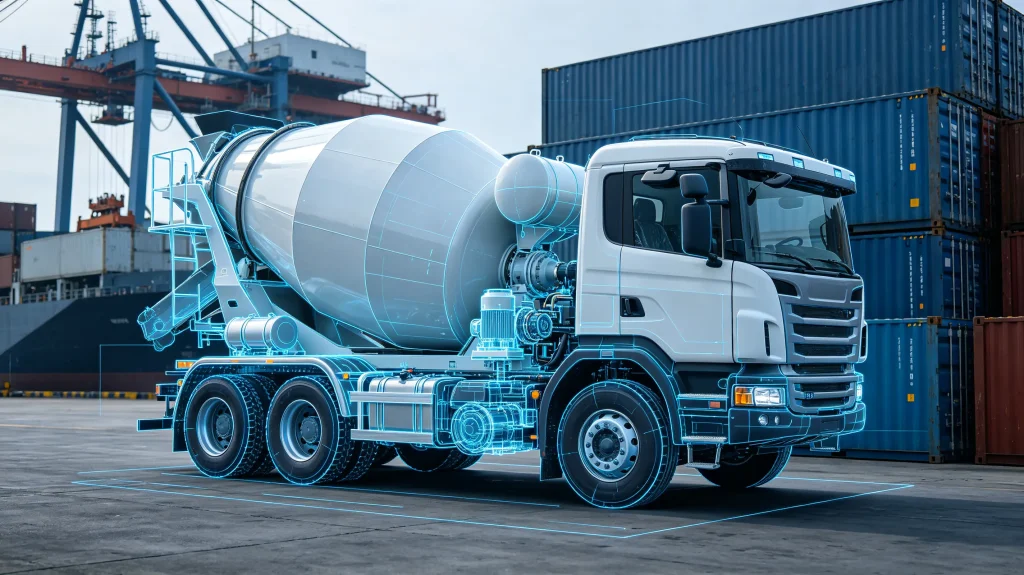
A high-quality export concrete mixer truck relies on multiple core components rather than a simple chassis and drum combination. The quality of drums, hydraulic systems, reduction gears, and supporting structures directly determines the vehicle’s service life and failure rate.
Wear-Resistant Mixer Drum
The mixing drum is the most easily worn part of the whole vehicle. Long-term friction with abrasive concrete will cause gradual wear of the inner wall. Therefore, export-grade mixer drums are made of high-strength wear-resistant steel plates.
The inner spiral blade adopts an optimized curved design. It ensures uniform stirring during transportation and avoids concrete segregation and solidification. At the same time, the overall welding process is used to prevent slurry leakage during bumpy transportation. You can check more professional structural designs on the about-us page.
Stable Hydraulic System
The hydraulic system is the power core of drum rotation. High-quality export trucks are equipped with international mainstream brand hydraulic pumps, motors, and control valves. This configuration ensures stable rotation speed, no jitter, and no stalling during loading, transportation, and unloading.
A good hydraulic system can adapt to long-hour continuous operation. It effectively reduces the failure rate caused by unstable power supply and avoids construction shutdown losses.
High-Torque Reduction Gear
The reduction gear undertakes the task of torque transmission between the hydraulic motor and the mixing drum. Export-grade reduction gears have high torque resistance and wear resistance. They can cope with heavy-load starting and long-distance stirring work.
Complete Water Cleaning System
Standard export concrete mixer trucks are equipped with high-pressure water supply and cleaning systems. The water tank has a large capacity to meet the cleaning needs of drums, hoppers, and discharge chutes after daily work.
Timely cleaning can prevent concrete residue from solidifying and blocking the drum. It effectively reduces later maintenance difficulty and extends the service life of the mixing equipment.
Reinforced Chassis Frame
Concrete mixer trucks bear long-term heavy loads. Export models adopt reinforced thickened frames and high-strength crossbeam structures. This design improves the overall torsional resistance and ensures the chassis does not deform after long-term heavy-load operation.
Key Export Specifications for Overseas Buyers
Different from domestic conventional models, export concrete mixer trucks need to meet the access standards of different countries. Before ordering, buyers must confirm all customized parameters to ensure smooth customs clearance and legal registration.
Driving Mode Adaptation
Left-hand drive and right-hand drive configurations can be customized freely. Manufacturers will adjust the steering system, instrument layout, and operating buttons according to the buyer’s local traffic rules to meet local driving habits.
Emission Standard Matching
To adapt to different national environmental protection policies, export models support Euro 2, Euro 3, Euro 4, and Euro 5 emission standards. Buyers can select the corresponding emission configuration according to local inspection standards to ensure legal road operation.
Drum Thickness and Anti-Corrosion Treatment
Export drums adopt thickened steel plates. For coastal high-salt and high-humidity areas, the whole vehicle is sprayed with multi-layer anti-corrosion paint. The internal and external anti-rust treatment can effectively resist atmospheric corrosion and extend the service life of the equipment.
Waterproof and Dustproof Circuit Design
Considering the long-term sea freight and complex overseas working environment, export vehicles adopt fully waterproof and dustproof electrical components. The circuit layout is optimized and fixed to avoid short circuit and aging caused by humidity and vibration.
Complete Export Certification Documents
Formal export manufacturers can provide a full set of customs clearance documents, including factory qualification certificates, vehicle inspection reports, and customs declaration materials. Complete documents are the key to smooth customs clearance and local vehicle registration. For document support details, refer to the customer-service page.
Concrete Mixer Truck Real Export Prices
The price of concrete mixer trucks is not fixed. It fluctuates according to chassis brand, drum volume, hydraulic configuration, emission standards, and customization requirements. Understanding the price composition can help buyers avoid high-price traps and low-quality shoddy products.
6×4 Mixer Truck Price Range
6×4 medium-duty mixer trucks have a moderate overall configuration and affordable price. The price of 6m³ to 8m³ conventional models is the most cost-effective, suitable for budget-limited small and medium fleets.
The price will increase accordingly with the upgrade of drum volume, hydraulic brand, and chassis horsepower. Enhanced models with high-end configurations are more expensive but have lower failure rates and higher operating efficiency.
8×4 Mixer Truck Price Range
Due to the increased axle number, reinforced chassis, and larger drum configuration, the overall cost of 8×4 heavy-duty mixer trucks is higher than 6×4 models. The price of 10m³ to 12m³ mainstream models is the most popular in the export market.
Although the initial purchase cost is higher, the single-vehicle transportation efficiency is greatly improved. It can create higher economic benefits for large-scale projects in the long run.
Price Inclusion Reminder
When comparing quotations, buyers must confirm the included items in the price. Regular quotations include chassis, mixing drum, hydraulic system, water cleaning device, vehicle painting, and basic warranty. Some low-price quotations may exclude export customization fees, document fees, and anti-corrosion treatment fees, resulting in hidden costs in the later stage.
Common Purchase Mistakes to Avoid
Most overseas buyers encounter problems such as inconsistent configuration, unqualified vehicles, and high maintenance costs after purchasing mixer trucks. Most of these problems are caused by incorrect selection and insufficient pre-purchase investigation.
Blindly Pursuing Large Drum Volume
Many buyers think that the larger the drum volume, the higher the efficiency. In fact, the drum volume must match the chassis load capacity. Excessively large drums will cause long-term overload operation, damage the chassis and hydraulic system, and even fail local traffic inspection.
Ignoring Hydraulic System Quality
The hydraulic system is a hidden core component. Many low-priced vehicles are equipped with inferior hydraulic parts. Although the appearance is no different, frequent failures such as weak rotation and oil leakage will occur during use, seriously affecting construction progress.
Only Comparing Unit Price Without Configuration
When purchasing mixer trucks, you cannot simply compare prices. Two vehicles with the same drum volume may have great differences in chassis brand, steel plate thickness, hydraulic brand, and welding process. Slightly higher-priced formal vehicles have far better stability and durability than low-priced shoddy products.
Ignoring Export Document Completeness
Some informal suppliers cannot provide complete export certification documents. After the goods arrive at the port, buyers will face the risk of customs clearance failure and inability to register. Therefore, confirming document qualification is a necessary step before payment.
How to Match the Best Model for Your Project
Scientific model selection can maximize vehicle utilization and reduce operating costs. Buyers can make targeted selection according to their actual project conditions.
Judging by Daily Concrete Demand
If the daily concrete supply demand is below 500 cubic meters, a 6×4 medium-capacity mixer truck can fully meet the demand. If the daily demand exceeds 800 cubic meters and requires continuous construction, it is recommended to choose an 8×4 high-efficiency heavy-duty model.
Judging by Transportation Distance
For short-distance transportation within 10 kilometers in urban areas, flexible 6×4 models are more suitable. For long-distance transportation over 20 kilometers in suburban and open areas, 8×4 models with higher stability and larger capacity are more advantageous.
Judging by On-Site Road Conditions
Urban flat roads and well-paved construction sites are suitable for all models. For rural roads, mountain roads, and narrow construction sections, prioritize flexible 6×4 mixer trucks. For wide and open large industrial sites, choose high-efficiency 8×4 models.
Judging by Local Regulatory Standards
Always take local vehicle weight limits, height limits, and length limits as the primary selection standard. Only models that meet local regulations can be legally operated for a long time.
After-Sales Service and Spare Parts Guarantee
Engineering vehicles have high operating intensity, and after-sales support is crucial to fleet operation. Perfect after-sales service can effectively reduce vehicle downtime and ensure continuous project construction.
Common Wearing Spare Parts
The main wearing parts of concrete mixer trucks include hydraulic seals, filter elements, water pump accessories, reducer gears, and drum wear plates. Formal suppliers can provide long-term spare parts supply support to solve the problem of difficult parts replacement overseas.
Professional Warranty Service
Regular export vehicles enjoy standardized warranty policies. The chassis and upper equipment have independent warranty periods. During the warranty period, quality problems can enjoy free maintenance and parts replacement services.
Remote Technical Guidance
For daily operation faults and maintenance problems, professional teams provide 24-hour remote technical guidance. It helps overseas workers quickly eliminate faults and avoid long-term shutdown losses. For customized after-sales cooperation, contact the official team via the contact-us page.
Final Summary
Concrete mixer trucks are essential equipment for construction engineering. 6×4 and 8×4 are the two most mainstream export models with their own unique advantages. The 6×4 model is flexible, cost-effective, and suitable for medium and small urban projects. The 8×4 model has large capacity and high efficiency, ideal for large-scale infrastructure heavy-load operations.
When purchasing, buyers should comprehensively consider project demand, road conditions, local laws, and budget. Do not blindly pursue low prices or excessive capacity. Choosing formal export-grade vehicles and complete supporting services can maximize the return on fleet investment.
If you need professional model recommendation, detailed parameter sheets, and exclusive export quotations, you can consult the official team for one-on-one customized procurement solutions.