





In the global commercial logistics and construction transportation industry, 6×4 and 8×4 heavy cargo trucks occupy an absolute mainstream position. For cross-border freight fleet operators, engineering contractors and bulk material transportation companies, choosing between 6×4 and 8×4 configurations directly affects daily transport efficiency, legal payload compliance, fuel cost control and long-term fleet profitability.
Many overseas buyers face confusion during truck procurement. They cannot accurately distinguish the applicable scenarios, parameter gaps and cost differences between 6×4 and 8×4 heavy trucks. Blind selection often leads to insufficient load capacity for heavy haulage or excessive vehicle configuration causing idle cost waste.
Therefore, this professional guide focuses on 6×4 and 8×4 heavy cargo trucks. It systematically sorts out core technical specs, structural advantages, applicable working conditions, market positioning and purchasing suggestions. Meanwhile, it eliminates overly academic and machine-written tones, adopting plain industry language that conforms to Google reading habits. For authentic export-grade heavy truck resources, you can browse the official platform of Mettlead Truck.
Basic Overview of 6×4 and 8×4 Heavy Cargo Trucks
Before analyzing detailed parameters and application scenarios, it is necessary to clarify the basic structural definitions of 6×4 and 8×4 heavy cargo trucks. The axle configuration code is the core standard for classifying heavy-duty commercial trucks, and it determines the fundamental performance boundary of the vehicle.
In short, the first digit of the configuration represents the total number of vehicle axles, and the second digit represents the number of driving axles. This simple rule helps buyers quickly judge the traction and load-bearing level of different truck models.
On the global used and new heavy truck market, 6×4 and 8×4 layouts cover almost all medium and heavy-duty bulk transportation demands. Lighter 4×2 trucks are only suitable for light cargo distribution, while ultra-heavy multi-axle trucks are limited to special oversize transportation. Thus, 6×4 and 8×4 are the most cost-effective choices for conventional commercial operation.

What Is a 6×4 Heavy Cargo Truck
A 6×4 heavy cargo truck is equipped with three total axles, including two driving axles and one steering axle. The steering axle is arranged at the front of the vehicle, undertaking vehicle steering and partial load-bearing work. The two rear axles are responsible for power output and main cargo load bearing.
This configuration is the most mature and widely used layout in the global heavy truck industry. It balances traction performance, driving flexibility and daily fuel economy perfectly. Most standard long-haul logistics trucks and general engineering cargo trucks adopt 6×4 design.
Thanks to the reasonable axle distribution, 6×4 trucks have low tire wear and stable driving performance on flat and slightly undulating roads. The after-sales parts supply chain of this model is extremely complete in most overseas regions, which greatly reduces fleet maintenance difficulty.
What Is an 8×4 Heavy Cargo Truck
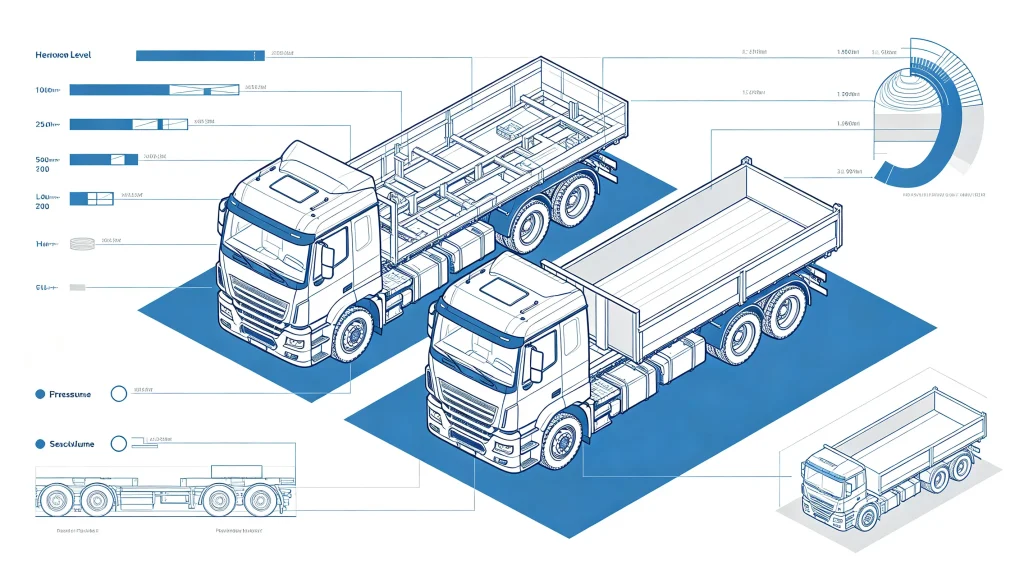
An 8×4 heavy cargo truck adopts a four-axle overall layout, with two front steering axles and two rear driving axles. Compared with the 6×4 structure, it adds one independent steering axle, which significantly optimizes the vehicle’s load distribution effect.
The core design purpose of 8×4 trucks is to increase legal payload without violating road axle load limit regulations. Many countries and regions have clear restrictions on single-axle load weight. Extra axles can disperse vehicle gravity and help obtain higher legal loading capacity.
For this reason, 8×4 heavy cargo trucks are mostly positioned in heavy-load and super-heavy-load transportation scenarios. They are common in mining transportation, large construction material haulage and bulk commodity short-cycle transportation fields.
Core Structural and Parameter Differences
The essential gap between 6×4 and 8×4 heavy cargo trucks comes from structural design, which further derives differences in gross vehicle weight, payload, chassis performance and operating cost. Understanding these parameter differences is the premise for accurate model selection.
In actual procurement, many buyers only pay attention to the superficial payload data but ignore the matching degree of chassis structure, axle load and power system. This will lead to vehicle overload damage or performance waste in subsequent operation.
Total Axle and Load Distribution Structure
The 6×4 three-axle structure concentrates the main load on the two rear driving axles. The front single steering axle bears lighter weight, which ensures flexible steering and sensitive vehicle control. This structure is very friendly for long-distance continuous driving.
In contrast, the 8×4 four-axle structure disperses the front load through double steering axles. The whole vehicle has more uniform stress, stronger overall stability and smaller single-axle bearing pressure. Even under full-load heavy cargo conditions, the chassis is not prone to torsional deformation.
From the perspective of structural durability, 8×4 trucks have longer service life in high-frequency heavy-load working conditions. However, the multi-axle design increases vehicle body weight, which causes a slight increase in no-load fuel consumption. You can check more chassis structure introduction of heavy trucks through all-categories product page.
GVW and Legal Payload Range
Gross Vehicle Weight is the core indicator that determines vehicle transportation capacity and compliance. The maximum GVW of mainstream 6×4 heavy cargo trucks is usually between 25 tons and 31 tons. After deducting the vehicle’s own weight, the legal usable payload is stably maintained at 18 tons to 28 tons.
This payload range fully covers most cross-border highway logistics businesses. It is suitable for container transportation, industrial finished product transportation and grain and commodity bulk transportation, which are the mainstream demands of modern logistics fleets.
The maximum GVW of standard 8×4 heavy cargo trucks can reach 35 tons to 40 tons. The legal payload can stably exceed 30 tons, and some enhanced engineering models can achieve higher load-bearing capacity. This is the core advantage of 8×4 trucks in heavy-load scenarios.
It is worth emphasizing that the high payload of 8×4 trucks is legal and compliant. Relying on multi-axle load dispersion, it avoids the traffic penalty risk caused by single-axle overload, which is very important for fleet standardized operation.
Power and Transmission Matching
In terms of power configuration, 6×4 heavy cargo trucks are mainly equipped with 380HP to 460HP engines. The torque output is focused on medium and low-speed stable traction, which adapts to long-distance highway constant-speed driving. The power matching pursues balance and fuel economy.
The gearbox of 6×4 models is mostly 12-speed or 16-speed manual transmission. The gear ratio setting is reasonable, which can realize smooth gear shifting and effectively reduce fuel consumption during long-distance transportation.
8×4 heavy cargo trucks are equipped with higher-power engines as standard, with horsepower ranging from 430HP to 520HP. The low-speed torque reserve is more sufficient, which can cope with frequent start-stop and climbing operations under full-load heavy cargo conditions.
At the same time, 8×4 models are equipped with enhanced heavy-duty gearboxes and reinforced clutch assemblies. The transmission system has stronger impact resistance and can adapt to harsh working conditions such as construction sites and mine roads.
Chassis and Suspension Configuration
The chassis frame of 6×4 trucks adopts standard high-strength steel. The thickness of the frame meets the needs of highway logistics and conventional engineering transportation. The suspension system uses multi-piece leaf springs, which is stable in performance and convenient for later maintenance.
The chassis design of 6×4 trucks focuses on lightweight optimization. While ensuring structural safety, it reduces the vehicle’s own weight and indirectly increases the actual cargo capacity, which is more in line with the profit demand of long-haul logistics.
8×4 heavy trucks adopt thickened and widened reinforced chassis. The anti-torsion and anti-deformation ability of the whole vehicle are significantly improved. The suspension system is upgraded with reinforced leaf springs and shock-absorbing structures to resist vibration and impact from rough road surfaces.
This enhanced chassis structure enables 8×4 trucks to operate stably for a long time in complex road conditions. It greatly reduces the failure rate of chassis parts and lowers the fleet’s long-term maintenance cost.
Brake and Tire Specification
6×4 heavy cargo trucks are equipped with standard air brake systems, which have sensitive braking response and stable heat dissipation. The tire specification is mostly 12R22.5 vacuum tires, with moderate load index, suitable for long-distance high-speed driving.
The number of tires of 6×4 trucks is small, and the later tire replacement cost is low. The tire wear is uniform during driving, which will not cause excessive loss of single tire, and the comprehensive operating cost is well controlled.
8×4 trucks are equipped with enhanced large-capacity brake chambers and heat-dissipating brake drums. The braking performance is more reliable, which can cope with long downhill and full-load braking scenarios. The tire load grade is higher to match super-heavy cargo transportation.
Due to the increase in the number of axles, 8×4 trucks have more tires and larger ground contact area. The vehicle has stronger grip and better driving stability on muddy, gravel and slippery roads.
Typical Application Scenarios
Different structural parameters determine the exclusive application fields of 6×4 and 8×4 heavy cargo trucks. Accurate matching of vehicle models and working conditions is the key to improving fleet operation efficiency and reducing comprehensive costs.
Many fleet operators have the problem of wrong model matching. Using 6×4 trucks for super-heavy transportation will cause frequent vehicle failures, while using 8×4 trucks for light logistics will lead to serious cost waste.
Main Application Scenarios of 6×4 Heavy Cargo Trucks
Long-haul cross-border highway logistics is the core applicable scenario of 6×4 heavy trucks. Relying on fuel-saving power matching and flexible driving performance, it can efficiently complete long-distance container transportation, commodity distribution and industrial material transportation tasks.
For highway fleets that take long-time and long-distance continuous operation as the main mode, 6×4 trucks have obvious advantages in tire wear, fuel consumption and driver driving comfort. The mature market accessories system also ensures low downtime rate.
Medium-duty engineering transportation is also a common scenario for 6×4 trucks. It can undertake the transportation of conventional construction materials such as sand, gravel and cement, and can also complete the transfer of mechanical equipment and engineering supplies.
In addition, 6×4 chassis is widely used for special vehicle modification. It can be transformed into bulk cement trucks, powder material transport vehicles and general cargo box trucks, with strong versatility in the commercial market. To learn more about modified truck solutions, visit cooperative-case page.
Main Application Scenarios of 8×4 Heavy Cargo Trucks
Mining and quarry bulk transportation is the dominant scenario of 8×4 heavy trucks. Mines and quarries have heavy cargo weight, complex road conditions and high operation intensity, which put forward high requirements on vehicle load capacity and structural durability.
The super-high legal payload and reinforced chassis of 8×4 trucks can fully adapt to the short-cycle and high-frequency heavy-load transportation of mineral materials, stone and gravel. It can maximize single-vehicle transportation volume and improve fleet operation efficiency.
Large-scale infrastructure construction material transportation also relies heavily on 8×4 heavy trucks. In highway construction, bridge engineering and urban large-scale construction projects, a large amount of heavy building materials need to be transported efficiently.
At the same time, 8×4 trucks are also suitable for port and terminal bulk cargo centralized transportation. Facing the intensive loading and unloading environment of ports, its stable structure and large load capacity can create higher economic benefits.
Advantages and Disadvantages Analysis
Each axle configuration has its own unique advantages and inherent limitations. There is no absolute good or bad between 6×4 and 8×4 heavy trucks. The core of selection is to match the actual business scenarios and budget conditions of the buyer.
Pros and Cons of 6×4 Heavy Cargo Trucks
The biggest advantage of 6×4 heavy cargo trucks is the excellent comprehensive cost performance. The vehicle purchase cost is moderate, the fuel consumption per kilometer is low, and the later maintenance and parts replacement costs are controllable. It is very suitable for small and medium-sized fleets and long-haul logistics companies.
In terms of driving performance, 6×4 trucks have a small turning radius and flexible operation. They can not only drive stably on highways, but also pass smoothly in urban freight terminals and ordinary rural roads.
In terms of market maturity, 6×4 heavy trucks have the largest number of users and the most complete after-sales system in the global market. The technical faults are few, and the vehicle stability is extremely high.
The main disadvantage of 6×4 trucks is the limited legal payload. It cannot meet the super-heavy load transportation demand, and it is easy to overload and damage the vehicle when facing ultra-heavy materials. In addition, the chassis stability is slightly insufficient on extremely rough road surfaces.
Pros and Cons of 8×4 Heavy Cargo Trucks
The core advantage of 8×4 heavy cargo trucks is the ultra-high legal payload and excellent structural stability. Relying on multi-axle load dispersion design, it can safely and compliantly complete heavy-load transportation tasks, with strong adaptability to harsh working conditions.
The reinforced chassis and enhanced power system make 8×4 trucks have strong durability. The vehicle failure rate is low in long-term high-intensity operation, and the service life of the whole vehicle is longer than that of ordinary heavy trucks.
The disadvantage of 8×4 trucks is the higher comprehensive operating cost. The initial purchase budget is higher, the vehicle self-weight is larger, and the fuel consumption of no-load and light-load driving is higher. The number of tires and parts is large, and the daily maintenance cost is relatively high.
In addition, the body of 8×4 trucks is longer and the turning radius is larger, so the flexibility of driving in narrow roads and urban complex road sections is slightly insufficient.
Market Positioning and Crowd Matching
Clarifying the market positioning and applicable purchasing groups of the two models can help overseas buyers quickly lock the target models and avoid decision-making errors caused by information asymmetry.
6×4 Truck Target Users and Market Positioning
6×4 heavy cargo trucks are positioned as universal mainstream heavy-duty transportation tools, focusing on medium-load and long-distance standardized logistics scenarios. It is the preferred model for most conventional commercial transportation fleets.
The main purchasing groups include cross-border logistics companies, highway freight fleets, commodity distribution enterprises and medium-sized engineering construction teams. These users pay more attention to fuel economy, stability and cost performance.
For buyers who take long-distance highway transportation as the main business and have no long-term super-heavy load demand, 6×4 trucks can completely meet the business needs and maximize fleet profits.
8×4 Truck Target Users and Market Positioning
8×4 heavy cargo trucks are positioned as professional heavy-load engineering transportation tools, focusing on short-distance, high-frequency and super-heavy load complex working conditions. It is a special model for bulk material and heavy engineering transportation.
The main purchasing groups include mining enterprises, quarry operators, large-scale infrastructure engineering companies and port bulk cargo transportation teams. These users take single-vehicle large-volume transportation as the core profit point.
For buyers who pursue high single-vehicle transportation efficiency and often undertake heavy-load tasks, the high configuration of 8×4 trucks can effectively avoid vehicle overload damage and compliance risks.
Export Standard Configuration Difference
For global importers, the configuration difference between domestic and export versions of 6×4 and 8×4 heavy trucks is very critical. Export-spec trucks have targeted upgrades for overseas climate, road conditions and regulatory policies.
Emission Standard Adaptation
Export 6×4 and 8×4 heavy trucks support multi-level emission calibration including Euro 2, Euro 3 and Euro 5. Buyers can freely match the emission standards according to the local environmental protection policies and vehicle registration requirements.
Different from domestic conventional models, export-spec emission systems have stronger environmental adaptability, can operate stably in high-temperature, high-humidity and high-altitude areas, and are not prone to emission system failures.
Environmental Adaptation Upgrade
Export heavy trucks are equipped with enhanced anti-corrosion paint and waterproof electrical systems. For coastal areas with heavy salt fog and rainy areas with humid climate, it can effectively prevent chassis rust and circuit aging.
At the same time, cold-region configuration and high-temperature heat dissipation configuration can be customized according to regional characteristics to ensure that the vehicle can work normally in extreme weather. You can consult professional export configuration schemes through about-us page.
Driving Mode Customization
Both 6×4 and 8×4 export trucks support left-hand drive and right-hand drive customization, covering the road traffic rules of all countries and regions in the world. The factory is calibrated according to export standards to ensure that the vehicle meets local registration conditions.
Cost and Budget Reference
Vehicle comprehensive cost includes initial purchase cost and later operation and maintenance cost. Scientific budget planning must take full-cycle cost into account, rather than only focusing on the naked car price.
Initial Purchase Cost Gap
Under the same brand and same configuration level, the factory price of 8×4 heavy cargo trucks is significantly higher than that of 6×4 models. The multi-axle structure, reinforced chassis and high-power power assembly increase the manufacturing cost.
For buyers with limited initial budget and medium-load demand, 6×4 trucks have obvious cost advantages. For users with long-term heavy-load demand, the higher initial investment of 8×4 trucks can be recovered through high-efficiency transportation.
Later Operation Cost Difference
6×4 trucks have lower fuel consumption per hundred kilometers, fewer wearing parts and lower daily maintenance cost. The long-term operation cost is economical, which is very suitable for long-distance continuous operation.
8×4 trucks have higher fuel consumption and maintenance cost, but their single-vehicle transportation capacity is stronger. In heavy-load scenarios, the number of vehicles required for the same cargo volume is less, which can save labor costs and fleet management costs.
Common Purchasing Mistakes to Avoid
In the process of purchasing 6×4 and 8×4 heavy cargo trucks, many overseas importers are prone to stereotyped cognition, which leads to unreasonable model selection and affects fleet operation benefits.
Blindly Pursuing High Payload
Many buyers think that the higher the payload, the better the vehicle performance. In fact, if the business demand is medium-load logistics, blindly choosing 8×4 heavy trucks will cause serious performance waste and greatly increase daily operating costs.
Ignoring Local Axle Load Regulations
Different countries have strict limits on single-axle load and total vehicle weight. Using 6×4 trucks to overload transportation in order to save costs will face high fines and vehicle detention risks, which is not conducive to long-term standardized operation.
Confusing Domestic and Export Versions
Domestic conventional trucks do not have export adaptive configuration. Purchasing domestic models for overseas operation will easily lead to unqualified registration and accelerated vehicle aging. It is necessary to give priority to formal export-spec trucks.
After-sales and Spare Parts Support
Complete after-sales service and spare parts supply system is the guarantee of stable fleet operation. When purchasing 6×4 and 8×4 export heavy trucks, buyers need to pay attention to the supplier’s global service capacity.
Formal export manufacturers can provide complete export documents, remote technical guidance and global spare parts delivery services. They can solve vehicle failure problems for overseas users in a timely manner. For after-sales policy details, refer to customer-service page.
It is recommended that buyers reserve conventional wearing parts such as brake pads, filters and clutch kits in advance after vehicle procurement to avoid long-term vehicle shutdown caused by parts shortage.