





In today’s global logistics industry, reliable cargo trucks form the backbone of all land-based freight operations. No matter you run a small local delivery team or manage a large cross-border fleet, the quality of your cargo trucks directly affects daily productivity, operational costs, and long-term business profitability.
In recent years, an increasing number of international buyers have turned to Chinese cargo trucks for fleet renewal and expansion. This growing trend is not accidental. Instead, it comes from stable build quality, comprehensive model coverage, and cost-effective overall investment that Chinese commercial vehicle manufacturers can offer.
If you are new to sourcing trucks from China, you may feel confused about model classification, export standards, configuration matching, and cross-border shipping processes. To help you avoid common purchasing mistakes, this detailed export guide covers every key step for global buyers.
Whether you plan to purchase light-duty urban delivery trucks or heavy-duty long-haul cargo vehicles, this guide will help you make informed and cost-efficient decisions. For ready-made export truck solutions, you can explore professional options through export-grade cargo truck series designed specifically for overseas markets.
1. Why Global Fleet Buyers Prefer Chinese Export Cargo Trucks
Before diving into specific model parameters and purchasing steps, it is necessary to understand why Chinese cargo trucks have gained huge popularity across global markets. In fact, many experienced fleet managers regard Chinese trucks as the most cost-balanced option in the current commercial vehicle industry.
First of all, Chinese truck manufacturers have mature mass production systems. After decades of technical upgrading and industrial iteration, domestic production lines can guarantee stable quality while maintaining flexible pricing advantages. Compared with Western and Japanese brands, China-made trucks deliver similar load capacity and durability with lower overall investment pressure.
In addition, export-version cargo trucks undergo independent technical calibration. Different from ordinary domestic trucks, export models adjust engine performance, chassis toughness, and electrical systems according to overseas road conditions and climate features. This means these trucks can adapt to tropical high temperatures, high-altitude cold environments, and rough rural road networks.
Furthermore, the after-sales supply chain for Chinese commercial vehicles has become increasingly complete worldwide. Spare parts supply channels are gradually improved in Southeast Asia, Africa, the Middle East, and Latin America. This greatly reduces the downtime risk for fleet operation caused by difficult maintenance.
Finally, Chinese manufacturers support highly customized export services. Buyers can adjust cabin configurations, cargo box sizes, driving modes, and functional accessories according to local traffic rules and business needs. Such high flexibility is very suitable for targeted fleet construction in different regional markets.
2. Core Differences Between Domestic Trucks and Export-Grade Cargo Trucks
Many first-time buyers easily fall into a misunderstanding: they think all Chinese cargo trucks meet export standards. In reality, domestic sales trucks and export-grade trucks are two completely different product sets in terms of production standards and quality control.
To begin with, emission standards are different. Export trucks strictly follow international emission regulations to ensure smooth customs clearance and local road legal driving. Domestic trucks are calibrated according to local Chinese policies, which may not be compatible with overseas environmental inspection standards.
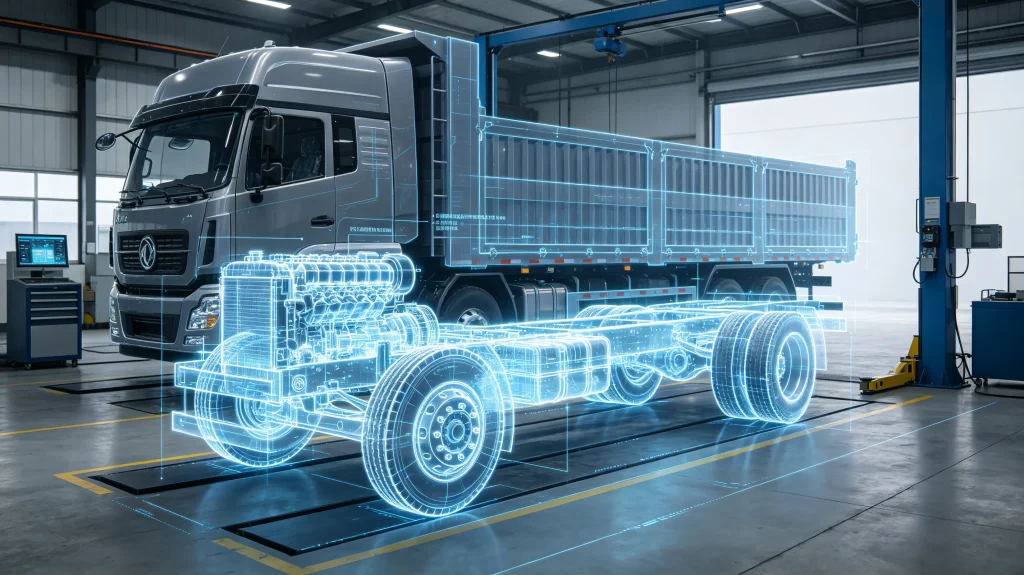
Besides, structural reinforcement standards vary greatly. Export cargo trucks adopt reinforced chassis beams, thickened cargo box plates, and upgraded suspension systems. These improvements aim to cope with long-term full-load operation and complex road conditions in overseas logistics scenarios.
Corrosion protection treatment is another key difference. During ocean transportation, trucks will face humid and salty sea air. Therefore, export vehicles undergo multi-layer anti-rust painting and chassis anti-corrosion spraying. Domestic trucks usually do not have such enhanced protection procedures.
Most importantly, export trucks come with complete official documents. This includes factory qualification certificates, commodity inspection reports, origin certificates, and export declaration files. Complete documentation is the core premise for smooth customs clearance and local vehicle registration.
If you want to verify formal factory qualifications and export standards, you can check detailed information on factory strength and export certification to ensure your purchasing source is compliant and reliable.
3. Complete Classification of Export Chinese Cargo Truck Models
Chinese export cargo trucks form a complete and systematic product matrix. According to load capacity, chassis structure, and actual usage scenarios, they can be divided into three core categories: light-duty, medium-duty, and heavy-duty cargo trucks. Each category has clear applicable customer groups and transportation scenarios.
3.1 Light-Duty Cargo Trucks for Urban Logistics
Light-duty cargo trucks are the most widely used vehicles in urban distribution scenarios. Generally, their load capacity ranges from 2 tons to 8 tons. They feature flexible driving, small turning radius, and low daily fuel consumption.
This type of truck is mainly suitable for city commodity distribution, supermarket supply chain transportation, express delivery trunk transfer, and small-scale industrial material handling. For fleet buyers focused on urban last-mile logistics, light trucks are the most basic and essential vehicle type.
Export light trucks support diversified cargo box customization, including flatbed boxes, enclosed boxes, refrigerated boxes, and wing-span boxes. Buyers can match different cargo box structures according to transported goods attributes.
3.2 Medium-Duty Cargo Trucks for Intercity Freight
Medium-duty cargo trucks belong to mid-size commercial vehicles with a load range of 10 tons to 20 tons. They balance flexibility and load capacity perfectly, making them ideal for intercity and provincial trunk logistics.
Compared with light trucks, medium-duty models have stronger chassis bearing capacity and better long-distance driving stability. Meanwhile, they are more cost-effective and flexible than heavy-duty trucks for medium and short-distance transportation.
In global logistics markets, medium-duty cargo trucks are very popular for regional cross-border transportation, bulk commodity distribution, and engineering material transfer. It is one of the most cost-efficient models for medium-scale fleet investment.
3.3 Heavy-Duty Cargo Trucks for Long-Haul Transportation
Heavy-duty cargo trucks are core equipment for long-distance cross-country freight. Their load capacity usually exceeds 25 tons, and they are equipped with high-power engines, reinforced axles, and large-capacity fuel tanks.
These trucks are mainly used for international long-haul logistics, large-scale bulk cargo transportation, and high-frequency cross-border freight tasks. For large logistics companies and professional freight fleets, heavy-duty cargo trucks are the main force of revenue creation.
Export heavy trucks support multi-axle configurations and can adapt to super-long working hours and full-load continuous operation. At the same time, the cabin is optimized for long-distance driving comfort to reduce driver fatigue.
To view real vehicle application effects in global fleet projects, you can refer to international fleet cooperation cases to help you select the most matching model configuration.
4. Key Parameters to Check Before Buying Chinese Cargo Trucks
Many overseas buyers only focus on the overall appearance and load capacity when purchasing trucks. In fact, several core parameters determine the long-term operating stability and service life of the vehicle. Therefore, parameter checking is an indispensable step before placing an order.
First, confirm engine configuration. The engine is the core power component of the truck. You need to check engine brand, power displacement, torque parameters, and emission standards. Reasonable power matching can ensure sufficient power reserve while avoiding excessive fuel consumption.
Second, verify chassis and axle parameters. The number of axles, axle load limit, and chassis beam thickness directly determine the bearing capacity and anti-torsion performance of the truck. For users who often transport heavy goods, reinforced axles and thickened chassis are essential configurations.
Third, confirm cargo box size and production process. Different countries have different road limit width and height standards. You must customize the cargo box size according to local regulations to avoid failure in road inspection.
Fourth, check driving mode configuration. Export trucks support left-hand drive and right-hand drive switching. You must select the correct driving mode according to local traffic rules to ensure legal road use after delivery.
Finally, confirm supporting functional configurations, including ABS anti-lock system, air conditioning system, tire specifications, and braking system. These details affect driving safety and daily operation comfort.
5. How to Choose the Right Cargo Truck Model for Your Business
Different fleet businesses correspond to completely different truck selection logic. Blindly pursuing large load capacity or low price will easily cause resource waste or insufficient operational capacity. Therefore, targeted model matching is very important.
If your business focuses on urban distribution, supermarket logistics, and last-mile delivery, light-duty enclosed cargo trucks are the best choice. They have flexible mobility and low operating costs, which fully meet the needs of frequent urban start-stop driving.
If you are engaged in intercity trunk freight and regional cross-border transportation, medium-duty cargo trucks can maximize fleet profits. They take into account both transportation volume and transportation flexibility, with low comprehensive loss rate.
For long-haul cross-border logistics and large-batch bulk cargo transportation, heavy-duty cargo trucks are the most suitable option. High load capacity and long-distance endurance can effectively improve single-transport revenue and reduce unit transportation costs.
In addition, you need to match models according to local road conditions. For mountainous areas, rainy and humid areas, and complex road sections, it is recommended to choose models with enhanced chassis and better power performance. For flat urban road networks, conventional standard configurations can fully meet demand.
6. Standard Export Process for Chinese Cargo Trucks
The export process of cargo trucks is standardized and mature, but first-time buyers are often unfamiliar with the overall process, resulting in delayed delivery and prolonged cycle. The following is the complete and streamlined export procedure for your reference.
Step 1: Model confirmation and configuration docking. Communicate with the supplier to confirm truck model, parameters, cargo box type, driving mode, and customized requirements. After full confirmation, sign a formal export contract.
Step 2: Factory production and quality inspection. After receiving the order, the factory arranges targeted production. Before delivery, professional quality inspection will be carried out on the whole vehicle, including power system, braking system, appearance anti-corrosion, and overall assembly quality.
Step 3: Document application and sorting. The supplier applies for export qualification documents, inspection reports, and origin certificates to ensure complete customs clearance materials.
Step 4: Container loading and sea shipment. According to the delivery cycle, arrange vehicle loading, fix the vehicle professionally, and complete container sealing and shipping declaration.
Step 5: Ocean transportation and logistics tracking. During sea transportation, you can track the shipping progress in real time until the goods arrive at the destination port.
Step 6: Destination customs clearance and pickup. With complete export documents, complete local customs clearance procedures and pick up the trucks for subsequent fleet deployment.
7. Common Buying Mistakes for First-Time Overseas Truck Buyers
In the process of purchasing Chinese cargo trucks, many overseas buyers will encounter various problems due to insufficient industry information. Summarized below are the most common mistakes to help you avoid unnecessary losses.
The first mistake is confusing domestic trucks with export trucks. Many buyers choose low-price domestic trucks to save costs. However, domestic trucks cannot pass overseas environmental inspections and road registration, resulting in vehicles unable to be put into use.
The second mistake is ignoring document integrity. In truck export business, documents are more important than vehicle appearance. Missing certificates will lead to detained goods and huge port demurrage charges.
The third mistake is unreasonable configuration matching. Excessively high configuration increases purchase cost, while insufficient configuration cannot adapt to local operating conditions, affecting service life and driving safety.
The fourth mistake is ignoring after-sales support. When purchasing commercial vehicles, you need to confirm spare parts supply channels and after-sales technical support to avoid difficult maintenance in the later stage of fleet operation.
8. After-Sales Support and Global Spare Parts Supply System
For fleet operators, after-sales service capacity directly determines the long-term stable operation of the fleet. A good after-sales system can greatly reduce vehicle failure downtime and maintenance costs.
At present, mature Chinese truck export manufacturers have built global spare parts warehouses and after-sales service outlets. They can provide fast spare parts delivery and remote technical guidance for overseas users.
Whether it is engine wearing parts, chassis accessories, electrical components, or cargo box accessories, standardized supply channels can ensure timely replenishment. This effectively solves the after-sales worries of overseas fleet users.
If you need to know more about after-sales service policies and global support systems, you can consult through official channels to obtain targeted service solutions.
9. Long-Term Fleet Operation Suggestions for Imported Chinese Trucks
Purchasing trucks is only the first step of fleet construction. Scientific daily operation and maintenance can maximize vehicle service life and reduce comprehensive operating costs.
First, develop a regular maintenance plan. Regularly replace engine oil, filter elements, and brake parts according to vehicle operating hours to avoid minor faults evolving into major failures.
Second, standardize driving habits. Long-term overload, violent start and stop, and high-speed driving will accelerate vehicle wear and tear. Standardized operation can effectively extend the service cycle of core components.
Third, reasonably match transportation tasks. Arrange different models according to cargo weight and transportation distance to avoid long-term overload operation of light trucks and resource waste of heavy trucks.
Fourth, regularly check anti-corrosion status. For vehicles operating in coastal and humid areas, regularly check chassis anti-rust performance and do supplementary protection to delay vehicle aging.
10. FAQ About Buying Chinese Export Cargo Trucks
Q1: Are Chinese cargo trucks suitable for African, Southeast Asian and Middle Eastern road conditions?
Yes. Export-grade cargo trucks are specially optimized for complex road conditions and high-temperature and humid climates. The chassis reinforcement and power calibration can fully adapt to most regional road environments worldwide.
Q2: How long is the whole export cycle from order to delivery?
Under normal circumstances, the production cycle is 15 to 25 working days, plus ocean transportation time. The specific cycle depends on the destination port and shipping schedule.
Q3: Can the truck configuration be customized according to local policies?
Fully customizable. Including driving mode, cargo box style, functional configuration, emission standards, and appearance details can be adjusted according to local regulatory requirements.
Q4: Is the after-sales spare parts supply convenient?
At present, global spare parts warehouses cover mainstream overseas markets. Spare parts can be delivered quickly to meet daily maintenance needs of the fleet.
Q5: Are export truck documents guaranteed to be complete?
Formal export manufacturers provide full set of legal export documents, which can support smooth customs clearance and vehicle registration in destination countries.
Final Words
Chinese export cargo trucks have become an important choice for global fleet renewal and expansion by virtue of reliable quality, flexible customization, and cost-effective advantages. For overseas buyers who pursue stable operation and controlled investment, sourcing cargo trucks from China is a mature and efficient procurement mode.
By selecting appropriate models according to business scenarios, standardizing procurement processes, and cooperating with formal export manufacturers, you can completely avoid purchasing risks and build a high-quality, low-cost commercial vehicle fleet.
For more customized export truck solutions and real-time product parameters, you can always browse Mettlead Truck Official Site to obtain the latest industry information and professional procurement guidance.