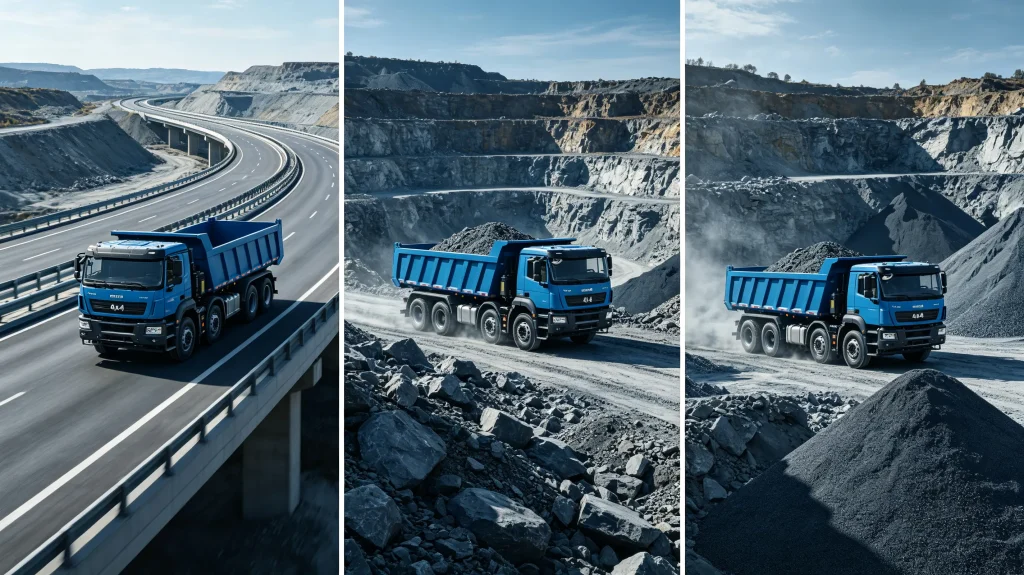
Introduction: Why 8×4 Dump Trucks Dominate Heavy-Duty Global Projects
When it comes to large-scale earthmoving, mining quarry operations and national infrastructure construction, ordinary medium-duty trucks cannot meet high-intensity transport demands. In this case, the 8×4 dump truck becomes the core equipment for global heavy-duty engineering projects.
Compared with common 4×2 and 6×4 dump trucks, the 8×4 model adopts a four-axle structural design. This unique layout brings larger load capacity, stronger road stability and higher single-shift transport efficiency. For project owners and fleet operators, it effectively shortens construction cycles and reduces long-term fleet operating costs.
In fact, the 8×4 dump truck is not a simple enlarged version of ordinary tipper trucks. Every specification and configuration is professionally optimized for heavy-load, long-cycle and harsh working conditions. From chassis structure to engine power, every detail targets mining sites, large road projects and bulk material transportation scenarios.
Even so, many overseas buyers still lack systematic understanding of 8×4 dump truck parameters. Most people only focus on superficial data like horsepower and cargo box size. They easily ignore core indicators including actual payload, chassis strength and adaptive configurations, which leads to inappropriate vehicle selection.
Therefore, this comprehensive guide fully explains all key specifications of export-grade 8×4 dump trucks. Meanwhile, it matches targeted configuration solutions for different working scenarios. To view more professional heavy-duty engineering vehicle resources, you can check Mettleadtruck Official Homepage.
In addition, you can refer to real overseas project deployment effects through Global Mining & Construction Truck Cases, so as to intuitively understand the practical performance of 8×4 dump trucks in different regions.
What Is an 8×4 Dump Truck? Complete Axle Layout & Structural Advantages
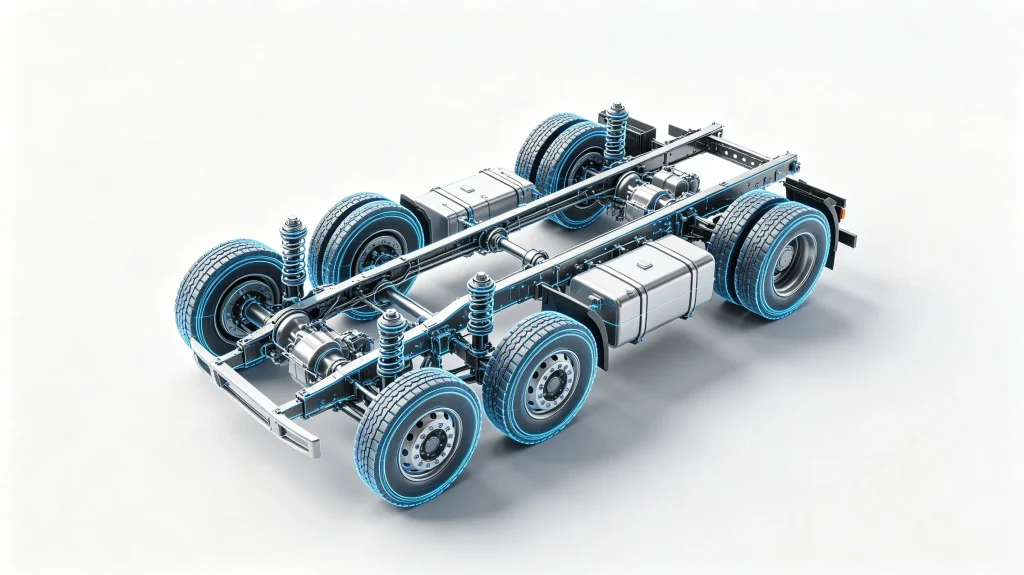
To accurately grasp the specifications of 8×4 dump trucks, we first need to clarify the definition of its axle layout. In professional truck terminology, 8×4 represents the total wheel positions and driving axle quantity of the whole vehicle.
Specifically, the number “8” means the vehicle has 8 sets of wheel positions in total. The number “4” indicates 4 driving wheels distributed on two rear drive axles. Simply put, the 8×4 dump truck is equipped with two front steering axles and two rear drive axles.
This four-axle layout is the biggest difference between 8×4 models and 6×4 three-axle dump trucks. Naturally, structural advantages and performance gaps are derived from this core design difference.
First of all, the four-axle design greatly disperses the overall vehicle weight and cargo load. For heavy-load transportation, the load borne by each tire and axle is significantly reduced. This effectively avoids chassis deformation, tire overload and axle damage caused by long-term heavy loading.
Secondly, dual front steering axles improve vehicle flexibility and driving stability. Even with an ultra-large cargo box and full load, the 8×4 dump truck can complete steering operations smoothly on narrow construction roads. It also maintains stable driving status on uneven mountain roads and muddy mining roads.
Furthermore, the double rear drive axles provide stronger traction output. When climbing steep slopes with full load or driving on slippery unpaved roads, the vehicle is not prone to wheel slipping and power insufficiency. This ensures continuous and efficient operation of engineering projects.
It is worth mentioning that the 8×4 structure also has obvious advantages in legal road driving. Many countries have strict single-axle load limit regulations. The multi-axle design makes the vehicle fully compliant with local road transport laws while ensuring large load capacity.
Of course, the 8×4 model also has minor limitations. Its own curb weight is larger than 6×4 models, and the body size is wider and longer. Thus, it is not suitable for ultra-narrow urban community construction and short-distance light-load transportation. You can compare the parameters and applicable scenarios of all models in All Heavy-Duty Truck Categories.
8×4 Dump Truck Payload Specifications: Rated vs. Actual Practical Payload
Payload capacity is the most concerned core indicator for fleet buyers and project contractors. It directly determines the single-vehicle transport volume and overall project construction efficiency. However, many buyers easily confuse rated GVW and actual usable payload.
First, let’s clarify two professional concepts. GVW (Gross Vehicle Weight) refers to the total allowable weight of the whole vehicle, including empty vehicle weight, driver weight, fuel weight and cargo weight. Practical payload refers to the maximum cargo weight that can be actually loaded, calculated by subtracting the empty vehicle curb weight from GVW.
Export-grade standard 8×4 dump trucks have a GVW range of 31 tons to 40 tons, which is far higher than that of ordinary 6×4 dump trucks. Such a large load limit is the core foundation for its heavy-duty transport capability.
In terms of actual usable payload, the standard factory configuration of 8×4 dump trucks can reach 25 tons to 32 tons. This data is based on the standard manganese steel cargo box and basic vehicle configuration.
It is crucial to note that different customized configurations will change the actual payload value. For example, if you upgrade to super wear-resistant thickened steel cargo box, the empty vehicle weight will increase accordingly. As a result, the actual cargo payload will decrease slightly, even if the GVW remains unchanged.
In addition, local road regulatory policies will also affect the actual loading capacity. Many countries have clear restrictions on highway single-axle load and total vehicle weight. Even if the vehicle hardware supports higher payload, it must be loaded in accordance with local legal standards to avoid penalties and customs clearance problems.
For mining project customers, the density of transported materials also needs to be considered. High-density materials such as iron ore, stone and mineral slag will reach the vehicle weight limit quickly. In this case, there is no need to pursue an oversized cargo box. On the contrary, low-density materials such as soil and gravel can match a larger box volume to maximize transport efficiency.
If you are confused about payload matching for your local projects, you can consult professional technical teams to obtain targeted configuration schemes through Get Custom Truck Configuration Advice.
8×4 Dump Truck Engine Specifications: Horsepower, Torque & Scenario Matching
The engine is the power core of the 8×4 dump truck, and it is also the key to determine the vehicle’s climbing performance, load-bearing capacity and long-term operational stability. Different working scenarios require matching power parameters, not simply pursuing high horsepower.
Export-grade 8×4 dump trucks are equipped with heavy-duty inline six-cylinder diesel engines. This type of engine is specially developed for high-intensity engineering operations. It features low-speed high torque, strong power reserve and durable wear resistance, fully adapting to frequent start-stop and full-load climbing working modes.
At present, the mainstream engine power configurations for global export 8×4 dump trucks cover multiple horsepower segments, including 400HP, 430HP, 460HP and 480HP. Each power segment has its exclusive applicable scenarios.
The 400HP power configuration is the basic universal version. It is suitable for flat terrain large-scale earthmoving, highway construction and conventional bulk material transportation. The power output is stable, and the fuel economy is excellent, which is very suitable for medium-intensity daily operation.
The 430HP model is the most popular mainstream configuration for global export. It balances power performance and operating costs perfectly. It can adapt to mixed terrains such as flat roads, gentle slopes and rugged construction roads. It is the preferred choice for most infrastructure projects and quarry operations.
The 460HP high-power configuration is oriented to medium and large mining projects. Facing steep mountain roads, long-distance slope climbing and full-load heavy ore transportation, this power segment can provide sufficient torque output. It avoids power shortage and vehicle stalling, ensuring continuous operation of mining fleets.
The 480HP ultra-high-power version is customized for ultra-heavy mining and high-altitude harsh environments. In high-altitude low-pressure, low-temperature and heavy-load working conditions, it still maintains stable power output. It greatly reduces the failure rate caused by insufficient power in extreme environments.
In addition to horsepower, peak torque is a more critical indicator for engineering vehicles. The engines of export-grade 8×4 dump trucks can output ultra-high torque at low speeds. This design enables the vehicle to generate strong driving force at low speeds, which is very suitable for heavy-load startup and slope climbing.
Emission standards are also an indispensable part of engine specifications. To meet the import policies of different countries, 8×4 dump truck engines support multiple emission configurations including Euro 2, Euro 3, Euro 4 and Euro 5. Buyers must select the emission standard in strict accordance with local import regulations to avoid customs clearance failure and vehicle registration failure.
For high-temperature tropical regions and high-cold high-altitude regions, we also support targeted engine system upgrades, including enhanced heat dissipation systems and low-temperature startup systems. You can learn more professional engine matching knowledge in Heavy Truck Import & Spec Knowledge Base.
Transmission & Clutch System Full Configuration Parameters
Engine power needs to be transmitted to the driving axle through the transmission system. Therefore, the performance of gearbox and clutch directly determines the driving experience and operational reliability of 8×4 dump trucks under heavy-load conditions.
All export-grade 8×4 heavy-duty dump trucks are equipped with professional heavy-duty manual gearboxes. The mainstream configurations include 12-speed and 16-speed gearboxes, which are completely different from light-duty truck gearboxes.
The multi-speed gear design realizes reasonable gear ratio matching. Low gears provide ultra-large torque for heavy-load startup and steep slope climbing. High gears reduce engine speed during empty-load return and flat-road driving, effectively optimizing fuel economy.
Some upgraded models are equipped with crawler low gears. This special gear mode allows the vehicle to run at a constant low speed and high torque. It is very suitable for complex mining road conditions and ultra-steep slope sections, greatly improving driving safety.
The clutch assembly adopts heavy-duty reinforced clutch discs and high-strength pressure plates. Aiming at the frequent start-stop and impact load of engineering vehicles, it effectively resists friction loss and pressure impact. It avoids clutch ablation and power disconnection faults caused by long-term heavy-load operation.
In addition, optional hydraulic retarder auxiliary braking configuration is available for 8×4 dump trucks. For fleets that often drive on long downhill mountain roads, this configuration can assist braking, reduce the wear of main brake pads, extend the service life of the braking system, and improve driving safety in mountainous areas.
All transmission system configurations are completed in the original factory assembly line, with stable matching and reliable quality. No secondary modification is required, which fully meets global export inspection and local registration standards.
Chassis, Axle & Suspension System Core Specifications
The chassis is the bearing skeleton of the whole vehicle, which carries all the weight of the cab, power system and cargo box. The structural strength of the chassis determines the service life and anti-deformation ability of the 8×4 dump truck in harsh working conditions.Export-grade 8×4 dump trucks adopt high-strength alloy steel integral frame. The multi-layer riveted and bolted composite structure improves the overall rigidity of the frame. It can resist long-term heavy-load impact and uneven road torsion, and is not easy to bend and deform.In terms of axle configuration, two front steering axles and two rear heavy-duty drive axles are matched. The front steering axles are optimized for steering flexibility, ensuring flexible turning of ultra-long vehicles. The rear drive axles adopt reinforced reduction gear axles, with strong load-bearing capacity and impact resistance.The suspension system uses thickened multi-leaf spring suspension, which is a classic reliable configuration for heavy-duty engineering vehicles. Different from the air suspension of highway logistics vehicles, the leaf spring suspension has stronger anti-impact ability.It can effectively buffer the vibration and impact from rugged mining roads and construction sites. It protects the chassis and axle components from damage, and adapts to long-term high-intensity off-road operation.In terms of tire matching, the standard configuration is 12.00R20 heavy-duty engineering tires. For mining sites with many sharp stones, you can upgrade to puncture-resistant mine-specific tires. The thickened tread enhances wear resistance and anti-puncture ability, reducing tire failure rate.It is important to emphasize that all chassis reinforcement and axle matching upgrades are original factory configurations. Post-purchase local welding and modification will damage the structural stability of the vehicle and fail to pass export inspection and local road safety inspection. You can learn about factory professional production standards at Professional Export Factory & Qualifications.
Cargo Box Specifications: Size, Material & Structural Design
The cargo box is the direct carrier of engineering materials, and its size, material and structural design directly affect the loading volume, wear resistance and service life of the 8×4 dump truck.
The cargo box size of export-grade 8×4 dump trucks is larger than that of 6×4 models. The standard internal length ranges from 7.6 meters to 8.6 meters, the internal width is 2.35 meters to 2.45 meters, and the side plate height can be customized according to material density and local regulations.
For lightweight materials such as soil, sand and gravel, properly increasing the side plate height can maximize the single loading volume. For high-density heavy materials such as ore and stone, reducing the side plate height can avoid overloading and ensure driving safety.
In terms of materials, there are two mainstream options: standard manganese steel and super wear-resistant alloy steel. Standard manganese steel is suitable for conventional earthmoving and construction waste transportation, with cost-effective and stable performance.
Super wear-resistant steel is customized for mining working conditions. The thickened plate body resists the impact and friction of sharp ore and hard stone. It greatly reduces the wear and deformation of the cargo box and extends the service life of the carriage.
Structurally, 8×4 dump truck cargo boxes are divided into straight type and rock reinforcement type. The straight type is simple and practical, suitable for general engineering projects. The rock type adds thickened anti-collision plates at the bottom and front of the carriage, which is specially used for heavy ore transportation.
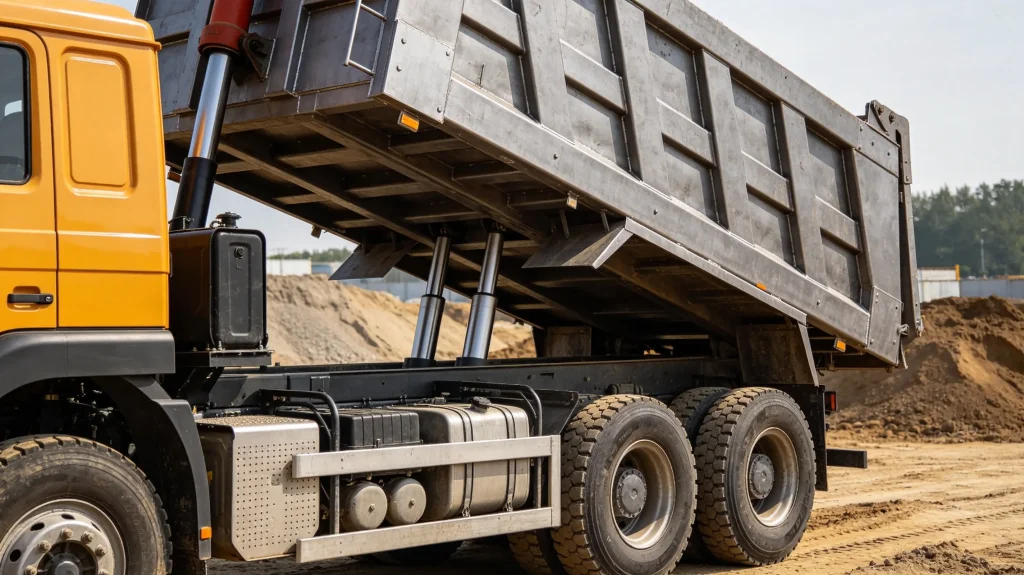
The supporting hydraulic lifting system adopts multi-stage telescopic high-pressure oil cylinders. The lifting process is stable and smooth, without jitter and stuck. The built-in buffer device can realize slow falling of the cargo box, avoiding violent impact on the chassis caused by rapid falling.
In addition, we support customized anti-leakage structure, sealed side seams and reinforced bottom plate according to regional requirements. All cargo box configurations are independently customized according to customer working conditions to ensure the best matching effect.
Cab Configuration, Safety & Comfort Settings
Engineering drivers need to work continuously for a long time every day. A reasonable cab configuration can effectively reduce driving fatigue and improve operational safety and comfort.
The export-grade 8×4 dump truck adopts a reinforced safety cab structure. The high-rigidity carriage frame can effectively protect the safety of drivers and passengers in case of vehicle rollover and collision accidents on complex construction sites.
In terms of seat configuration, mechanical suspension seats are standard, and air suspension seats are optional. The air suspension design can filter most road vibration, bringing a more comfortable driving experience for long-hour operation.
The instrument panel is equipped with a full set of real-time monitoring instruments, including engine speed, water temperature, oil pressure, braking air pressure and hydraulic system status. Drivers can quickly grasp the vehicle operation status and find potential faults in time.
In terms of intelligent comfort configuration, factory air conditioning is standard. According to different regional climates, we can upgrade high-power cooling air conditioners for tropical areas and auxiliary heating systems for cold high-altitude areas.
Optional safety configurations include ABS anti-lock braking system, 360-degree panoramic camera, tire pressure monitoring system and remote fault diagnosis system. These configurations greatly improve the safety of vehicle operation and facilitate fleet management.
LHD & RHD Factory Original Steering Configuration
Different countries and regions adopt left-hand traffic or right-hand traffic rules. The steering mode is a key configuration that cannot be wrong in cross-border procurement.
All export-grade 8×4 dump trucks support factory original LHD (left-hand drive) and RHD (right-hand drive) production. Different from post-modified steering vehicles, factory original configuration has complete matching of steering system, wiring harness, brake system and instrument layout.
Post-modified RHD vehicles often have problems such as unstable steering, mismatched circuits and unqualified safety inspection. They cannot pass local vehicle registration and road legal inspection, bringing great hidden dangers to fleet operation.
Our factory completes all steering mode adjustments in the assembly line stage. The whole vehicle is calibrated uniformly, with stable performance and full compliance with local traffic laws and regulations. Buyers only need to confirm the local traffic rules in advance to complete accurate customization.
Scenario-Based Configuration Matching Guide for 8×4 Dump Trucks
Different working scenarios have completely different requirements for 8×4 dump truck specifications. Reasonable configuration matching can maximize vehicle efficiency and reduce long-term operating costs.
10.1 Large-scale Highway & Infrastructure Projects
This type of project features large earthmoving volume, long construction cycle and mixed flat and slope road conditions. It requires vehicles with stable power and high continuous operation capacity.
It is recommended to choose 430HP mainstream power configuration, standard manganese steel cargo box and 12-speed gearbox. The overall configuration is balanced, with low failure rate and excellent cost performance, suitable for high-frequency cyclic operation.
Cross-Border Procurement Key Points for Export-Grade 8×4 Dump Trucks
Daily Maintenance & Inspection Guidelines to Extend Service Life
Common Specification Misunderstandings of 8×4 Dump Trucks
How to Get Custom 8×4 Dump Truck Configuration Solutions