





Introduction to 6×4 Dump Truck
Among all heavy‑duty tipper vehicles for global construction and mining work, the 6×4 dump truck remains the most widely selected option across different regions. Many fleet managers and project contractors prefer this three‑axle layout because it creates a balanced performance between load‑bearing capacity and road adaptability.
Unlike 4×2 models with limited payload or 8×4 units that bring higher operating weight and road restriction risks, the 6×4 design places two drive axles at the rear section. This structural layout distributes heavy cargo weight evenly across multiple wheel groups. As a result, it reduces excessive stress on single tires and frame components during repeated hauling cycles.
Even so, many overseas buyers still feel confused when reviewing technical sheets. Specifications such as real usable payload, engine matching rules, chassis reinforcement levels and body box material grades can vary greatly between factory batches. Some export‑modified units may not fully fit local road laws or site working conditions.
For this reason, this guide breaks down every core specification point of export‑grade 6×4 dump trucks. Apart from basic parameter tables, it covers real‑world performance differences, configuration selection logic, site‑matching suggestions and cross‑border procurement notes. You can refer to Mettleadtruck Official Homepage to view more heavy‑duty vehicle resources for global buyers.
A large number of real‑world application records can be found within Cooperative Case, which displays 6×4 dump‑truck deployment results for infrastructure, quarry and earth‑moving projects in multiple overseas territories.
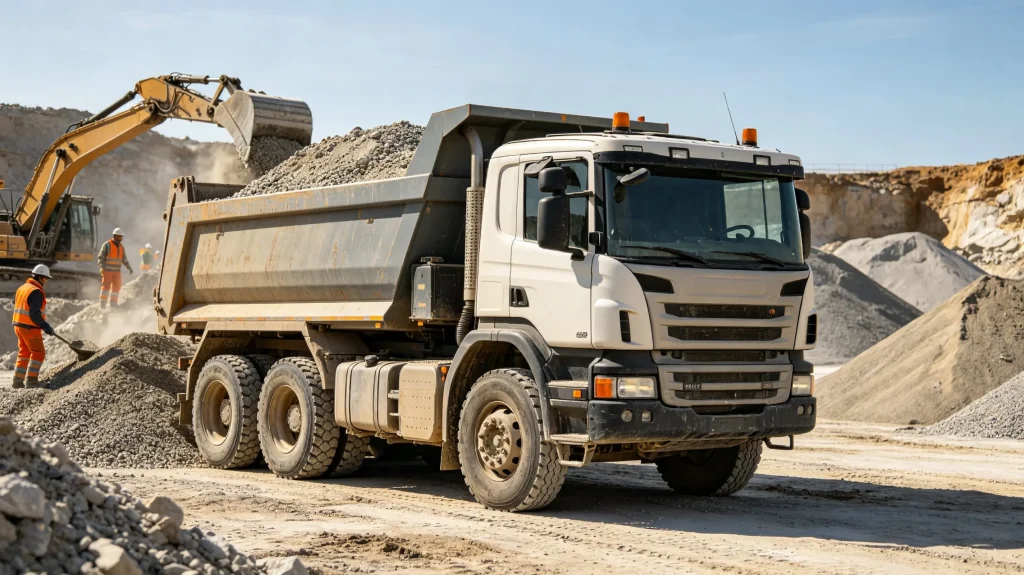
Understand 6×4 Axle Layout: How 3‑Axle Structure Works
Before diving into payload and engine parameters, it helps to understand exactly what “6×4” stands for in truck technical terminology. The first digit refers to the total wheel positions on the whole vehicle, while the second digit counts powered drive axles.
For a standard 6×4 dump truck, you get one steering front axle plus two rear driven axles. The front axle takes charge of directional control when turning on narrow construction access roads. Meanwhile, double rear drive axles deliver tractive force when climbing gradient slopes under fully loaded status.
This layout brings several practical advantages for tough job‑site environments. First, dual rear axles spread heavy cargo weight over more contact points against ground surfaces. This lowers the chance of chassis bending when running over uneven, potholed or muddy ground.
Second, double‑drive‑axle setup improves grip performance. When transporting wet soil, crushed rock or mineral ore, wheels are far less likely to spin idle on slippery unpaved surfaces. Many project teams notice obvious productivity gains during rainy seasons because of this feature.
On the other hand, buyers should also keep minor drawbacks in mind. Compared with 4×2 dump trucks, 6×4 units carry higher empty curb weight. They also consume slightly more fuel during empty‑vehicle return trips. For short‑distance light‑load municipal assignments, other chassis forms may deliver better economy. You can compare different chassis options inside All Heavy‑Duty Truck Categories.
Payload Capacity of Export‑Grade 6×4 Dump Truck
Payload represents the maximum weight of cargo that a dump truck can safely carry. This index directly decides how many material transport cycles you can finish within each working shift. However, many overseas purchasers mix up gross vehicle weight rating and real practical payload when reviewing quotation documents.
Gross Vehicle Weight (GVW) includes truck curb weight, driver weight, fuel weight plus loaded goods weight. Practical usable payload equals GVW minus empty vehicle weight. Different factory‑built configurations create distinct empty‑vehicle mass, so two 6×4 dump‑truck units with identical GVW rating can still deliver different real payload numbers.
Standard export‑spec 6×4 dump trucks commonly have GVW ranging from 25 tons up to 31 tons. After deducting chassis, cab, cargo box and accessory weight, typical practical payload falls between 18 tons and 24 tons. It is worth noting that payload figures printed on brochures are calculated under factory‑standard cargo‑box setup.
If you choose extra‑thick wear‑resistant steel for tipper box upgrade, curb weight rises accordingly. This will shrink actual available payload value even though GVW limit stays unchanged. Many mining‑focus clients overlook this point and face unexpected reduction of loading volume after receiving vehicles.
Local road regulation is another non‑ignorable factor. Quite a few countries set strict legal axle‑load limits for highway travel. Even if the truck hardware supports higher loading capacity, you cannot fill cargo to full mechanical payload when driving on public paved roads. You need to balance mechanical capability and local traffic law during configuration confirmation phase.
When you want to clarify payload‑related questions for your target market, submit your local policy background via Contact Us. Our technical team can explain how different body‑box choices influence your real‑world loading performance.
Engine Options for 6×4 Dump Truck: Power, Torque and Working‑Condition Matching
Engine forms the power heart of every 6×4 tipper truck. Horsepower and peak torque jointly determine climbing performance, acceleration under full‑load condition and long‑term reliability. Nevertheless, higher horsepower number does not always equal better site adaptability. Matching engine output to your actual work scenarios matters far more.
Export‑oriented 6×4 dump‑truck units mainly adopt inline six‑cylinder heavy‑duty diesel engines. These power units are built for continuous high‑load operation instead of short‑term high‑speed driving. Peak torque output usually appears at relatively low rotation speed. Such characteristic suits frequent start‑stop cycles typical at quarry and building sites.
Popular horsepower bands for global export‑spec 6×4 dump trucks cover 340 HP, 375 HP, 400 HP, 430 HP and 460 HP variants. Each power rating targets specific operating contexts.
340 HP‑375 HP engine combinations fit urban municipal construction, ordinary highway earthwork and flat‑terrain material hauling. If most of your routes contain gentle gradients and short‑to‑medium transport distance, these power levels offer stable output with reasonable fuel consumption level.
400 HP‑430 HP configurations represent mainstream universal choices. They handle mixed road conditions, frequent slope climbing and medium‑scale quarry assignments well. Most cross‑border bulk procurement orders select this power interval because it balances performance and component service lifespan.
460 HP and above engine setups serve heavy‑mining sites with steep mountain paths, full‑load long‑distance slope climbing and high‑frequency daily operation. Strong torque output prevents power shortage under heavy cargo status. At the same time, you should anticipate higher fuel expenditure for these high‑power variants.
Besides horsepower and torque figures, emission standard acts as a critical filter for cross‑border purchase. Export‑grade 6×4 dump‑truck engines support Euro 2, Euro 3, Euro 4 and Euro 5 configurations. Every destination country enforces different import emission requirements. Wrong emission option will result in customs clearance blockage or local vehicle‑registration failure.
Cooling system also belongs to engine‑related core configuration. For high‑temperature tropical zones, enhanced radiator and enlarged fan assembly become necessary upgrades. Otherwise, overheating faults may happen during daytime continuous heavy‑duty running. You can collect more engine‑selection knowledge inside Knowledge Base.
Transmission and Clutch System Configuration
Engine power cannot be delivered to rear drive axles without reliable transmission assemblies. For 6×4 dump trucks working on construction sites, gearbox durability weighs more than ultra‑quick shifting experience.
Most factory‑export 6×4 tipper trucks deploy manual heavy‑duty gearboxes. Common gear layouts include 10‑speed, 12‑speed and 16‑speed versions. Multiple low‑range gear ratios generate large output torque when starting with full‑loaded cargo or climbing sharp slopes. Meanwhile, high‑speed gears reduce engine rotation speed during long‑haul empty‑vehicle return travel.
For sites with countless slope sections, gearboxes with additional crawler low gear deliver obvious advantages. This special gear setting keeps engine running within stable torque zone while vehicle creeps up steep incline, lowering risk of clutch burning or engine stall.
Clutch assembly transfers power between engine and gearbox. Heavy‑duty reinforced clutch discs are standard for export‑spec 6×4 dump trucks. Under repeated impact from frequent loading‑unloading cycles, ordinary light‑duty clutch parts will suffer premature wear and create unexpected downtime.
Some optional configurations include hydraulic retarder auxiliary braking. This device greatly eases brake‑pad consumption when descending long mountain roads under full‑load state. If you operate in mountainous mining zones, this optional component effectively lifts driving safety and cuts maintenance expenses over long‑term usage.
Chassis, Axle and Suspension Technical Specs
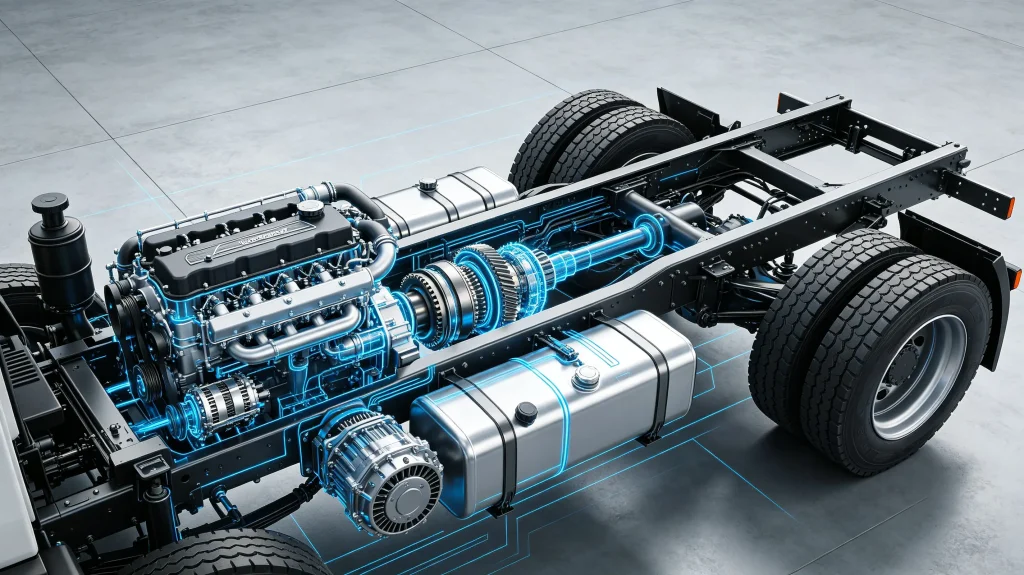
Chassis frame forms the load‑bearing skeleton of 6×4 dump truck. All cab, power‑train components and cargo‑box assemblies are mounted onto this steel framework. Export‑qualified vehicles adopt high‑strength alloy steel frame beams. Multi‑layer riveted‑and‑bolted connection methods enhance structural anti‑deformation capability.
Front steering axle bears steering function plus partial static weight. Its load rating must coordinate with whole‑vehicle GVW index. Two rear drive axles undertake most cargo weight and output driving force. Heavy‑duty reduction‑gear rear axles are widely used for export‑spec 6×4 dump trucks. They stand up to continuous heavy‑load impact in mining scenarios.
Suspension system absorbs vibration transmitted from uneven ground. Standard export‑grade 6×4 dump trucks apply multi‑leaf‑spring suspension setup. Thickened leaf‑spring groups resist deflection under cyclic heavy‑load shocks. Compared with air‑suspension units more common on highway tractor‑trucks, leaf‑spring structures hold better anti‑impact performance for rough off‑road construction sites.
Wheel‑hub and tire specifications deserve careful checking as well. Common tire dimension for 6×4 dump‑truck export falls on 11.00R20 or 12.00R20. For mining‑area usage, customers can choose reinforced mine‑pattern tires with thicker tread layers. These special tires improve puncture‑resistance performance against sharp crushed‑rock fragments.
It should be pointed out that chassis‑related reinforcement modifications must be finished inside original factory production lines. Post‑sale local welding or refitting will damage factory structural strength and invalidate relevant export inspection certification. You can learn more about factory‑original modification standards on About Us page.
Cargo Tipper Box Specifications and Material Options
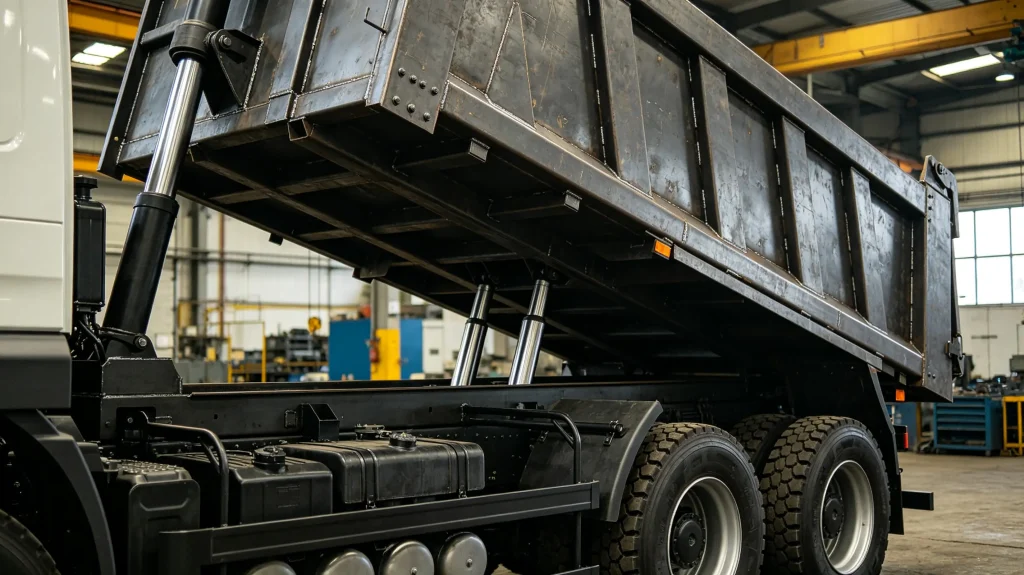
Cargo box is where all bulk construction or mineral materials are held. Box dimension, plate thickness and steel material grade produce huge influence over service life and practical loading volume of your 6×4 dump truck.
Factory‑standard export 6×4 dump‑truck cargo‑box internal length ranges roughly from 5.4 meters to 7.8 meters. Internal width normally stays around 2.3‑2.4 meters. Side‑board height can be adjusted according to local transport rules and material density. Dense heavy ore needs relatively low side height, while lightweight soil or gravel can adopt higher side‑board design.
Material selection contains ordinary manganese steel and super‑wear‑resistant steel grades. Standard manganese steel satisfies most general construction earth‑moving assignments. If you frequently haul sharp hard rock, mine slag or abrasive mineral materials, upgrading to high‑strength wear‑resistant steel plate becomes a wise investment.
Please keep in mind that wear‑resistant steel plates add extra self‑weight to tipper box. As mentioned in earlier payload chapters, heavier box reduces your usable cargo payload. You have to strike balance between box durability and actual loading capacity during configuration selection procedure.
Tipper‑box structural styles also come in multiple variants. Straight‑type boxes suit general earth‑moving work. Rock‑type reinforced boxes add thickened protection for front‑plate and bottom‑plate sections for mining material transport. Some regional markets require anti‑leakage side‑seam treatment to avoid fine‑particle material spillage while traveling on public roads.
Hydraulic lifting system powers the whole unloading movement of tipper box. Export‑grade 6×4 dump trucks usually deploy multi‑stage telescopic hydraulic cylinders installed underneath cargo box. System working pressure, cylinder quantity and sealing‑kit quality decide unloading smoothness and anti‑leak performance under long‑term vibration.
Slow‑fall buffer function belongs to a valuable practical feature. It prevents tipper box from slamming down violently after finishing unloading process, protecting frame and hydraulic components against strong impact damage.
Cab Configuration, Comfort and Safety‑Related Settings
Cab serves as long‑time working space for drivers. Even though 6×4 dump trucks focus primarily on site‑operation performance, reasonable cab configuration helps lower driver fatigue during long shift hours.
Export‑spec 6×4 dump‑truck cabs adopt reinforced safety‑cell structure. In case of roll‑over accidents on uneven job sites, the framework maintains survival space for people sitting inside. Seat options include ordinary mechanical‑suspension seats or optional air‑suspension driver seats to absorb continuous road vibration.
Instrument panel provides real‑time data feedback including engine rotation speed, water temperature, oil pressure, air‑pressure status for braking system and hydraulic‑system pressure warning signals. Clear instrument readouts help operators discover potential abnormal conditions at early stage.
Climate‑control configurations can be selected based on local ambient climate. For high‑temperature equatorial regions, factory‑installed high‑capacity air‑conditioning systems improve working comfort greatly. For cold high‑altitude territories, auxiliary cab‑heating setups become available as factory‑installed options.
On top of basic cab functions, multiple optional safety‑focus assemblies can be added. Anti‑lock braking system prevents wheel lock‑up risk during emergency braking on slippery ground. Tire‑pressure monitoring lets fleet supervisors notice abnormal tire pressure before blow‑out accidents happen. 360‑degree surround‑view camera assists drivers when operating within crowded narrow construction zones.
Steering Mode: LHD and RHD Factory‑Original Configuration
Different countries apply left‑hand‑traffic or right‑hand‑traffic road rules. Steering position represents one item you cannot afford to make mistakes during 6×4 dump‑truck procurement.
Only factory‑original LHD or RHD production guarantees complete matching of steering mechanism, wiring harness, dashboard layout and braking‑system calibration. Many cross‑border purchasers run into registration troubles after buying second‑hand locally converted right‑hand‑drive vehicles. Non‑factory refitting often fails official road‑safety inspection in target import countries.
When you submit your procurement requirement, clearly specify whether you need left‑hand drive or right‑hand drive. All steering‑related adjustments will be finished on assembly‑line before vehicle shipment. This way your newly imported 6×4 dump truck meets local traffic‑registration standards smoothly.
Working‑Scenario‑Based 6×4 Dump‑Truck Configuration Matching Guide
Reading through long specification tables is not enough. You need to map parameter items against your real‑world working scenarios. Below we sort typical application contexts and corresponding recommended configuration combinations for export‑grade 6×4 dump trucks.
Scenario One: Urban municipal and residential‑area construction projects
This type of work includes city road reconstruction, community foundation excavation and construction‑waste removal. Roads may contain narrow passages inside downtown zones. Working routes are mostly flat or contain only small gradients.
Under such conditions, 340‑375 HP engine power band is sufficient. Standard manganese‑steel cargo box meets material hauling demand. You may prioritize cab comfort features because drivers spend long hours driving on city streets. Pay attention to local vehicle‑width limitation for inner‑city traffic access.
Scenario Two: Large‑scale highway, dam and infrastructure projects
These projects involve massive earth‑moving volume. Transport routes mix flat road sections and continuous slope segments. Vehicle units undertake high‑frequency loading‑unloading cycles every single workday.
400‑430 HP engine becomes the preferred option here. Reinforced leaf‑spring suspension and heavy‑duty rear axles cope with repeated heavy‑load impact. Rock‑style cargo‑box structure can be selected if you frequently move crushed stone materials.
Scenario Three: Medium‑sized open‑pit quarry and mineral‑mine operations
Mining‑site conditions bring multiple challenges: sharp rock fragments, dusty atmosphere, steep access ramps and non‑paved rugged ground. Component wear rate goes far higher than ordinary construction environments.
Choose 430‑460 HP power output to handle slope climbing under full‑mineral‑cargo weight. Upgrade cargo box to super‑wear‑resistant steel plate. Pick mine‑pattern puncture‑resistant tires. Auxiliary retarder braking system is strongly suggested for long downhill mine‑road travel. Regular maintenance cycles should be shortened compared with general‑purpose usage.
You can look over real‑project deployment examples in Cooperative Case to observe how 6×4 dump‑truck specifications adapt to different site surroundings.