




Compare construction dump truck prices, specs & capacity by model. Find the best dump truck for your worksite with our heavy-duty & ADT buying guide.
Choosing a construction dump truck is rarely about picking the cheapest machine on the lot. It is about matching payload, terrain, fuel burn, and parts support to the reality of your worksite — then calculating what that truck will actually cost you over five to ten thousand operating hours.
This guide walks through every category of off-highway and heavy-duty hauler, from road-legal tippers to ultra-class mining trucks. You will learn what drives price, how to read a spec sheet like a seasoned fleet buyer, and how to compare a delivered (CIF) quote against an ex-works figure that looks tempting but hides real cost.
Whether you run a small earthmoving crew or manage a mine’s haul fleet, the goal is the same: buy the truck that lowers your cost per tonne moved, not just the one with the lowest sticker.
Key Takeaways
- Price scales with payload and duty class. A road-legal tipper, an articulated dump truck (ADT), and an ultra-class mining hauler can differ in price by an order of magnitude — because they solve very different problems.
- Three core categories dominate construction: rigid off-highway trucks, articulated dump trucks for rough terrain, and highway tippers for public-road hauling.
- Total cost of ownership beats sticker price. Fuel, tires, and maintenance usually dwarf the purchase figure over the machine’s life.
- Match the truck to your loader and haul road — the single most important decision factor. An oversized truck your excavator can’t fill efficiently wastes money every cycle.
- Compare delivered (CIF) price, not ex-works. Freight, duties, and lead time can change the ranking of two otherwise similar quotes.
What Determines a Construction Dump Truck’s Price?
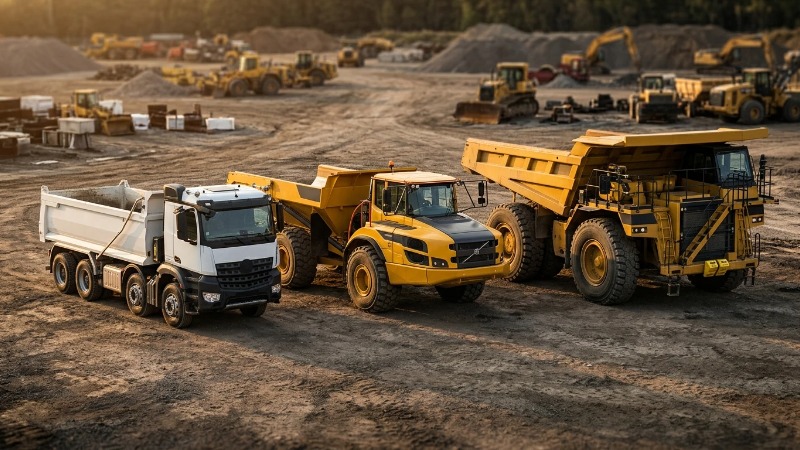
The dominant question buyers ask is simple: how much does it cost? The honest answer is that “construction dump truck” covers a price spectrum so wide it spans everything from a compact site tipper to a machine taller than a two-storey building.
Price is driven primarily by payload capacity, drivetrain and engine horsepower, build quality and materials, and the manufacturer’s brand and dealer network. Add emissions compliance, tire class, and delivery terms, and you have the full picture.
A useful mental model: the more material a truck moves per hour and the tougher the terrain it survives, the more it costs to buy — and the more it can earn back. That is why prices vary by such a large margin across the category.
The Three Core Price Categories at a Glance
Before drilling into individual models, it helps to see the whole landscape. The table below groups every construction hauler into three practical buying categories.
| Category | Typical Payload Range | Primary Use | Indicative Price Band |
|---|---|---|---|
| On-road / highway tipper | 10–30 tonnes | Road-legal haul between sites, aggregate, sand | Lowest 【数据待核实】 |
| Articulated dump truck (ADT) | 25–45 tonnes | Soft, rough or wet off-road terrain | Mid 【数据待核实】 |
| Rigid / mining haul truck | 40–400+ tonnes | Large-scale earthmoving, quarrying, mining | Highest 【数据待核实】 |
Notice the deliberate use of qualitative bands. Real quotes swing with steel prices, spec choices, and region, so treat these as directional rather than fixed. For live figures matched to your project, it is worth requesting a tailored comparison through a sourcing specialist.
Why This Matters for Buyers Right Now
Procurement conditions have shifted. Emissions-tier transitions across Europe, North America, and parts of Asia mean the engine spec you buy today affects where the truck can legally work — and its future resale.
Financing costs also weigh heavier than they did a few years ago, so the lifetime cost math has tightened. Meanwhile, infrastructure spending and mining demand keep pressure on lead times for popular classes.
The practical takeaway: buyers who plan around delivery timing, compliance, and total cost — not just headline price — consistently make better decisions.
Dump Truck Types Explained: Rigid vs. Articulated vs. Highway Tipper
Getting the terminology right prevents expensive mismatches. These three families are built for genuinely different jobs, and confusing them is one of the most common — and costly — buyer errors.
Rigid Dump Truck Specifications
A rigid dump truck uses a single, one-piece frame with the cab and dump body mounted on a fixed chassis. There is no articulation joint; the whole machine turns as one unit.
This design maximizes payload and structural strength, which is why rigid trucks dominate mining and large quarry operations. Rigid dump truck specifications typically emphasize high payload, robust frame steel, and powerful diesel engines built for continuous heavy cycles.
Mining haul truck payload capacity climbs in clear tiers — roughly 40–60 tonnes at the entry off-highway level, scaling through 90, 150, 220 tonnes, and beyond into the ultra-class above 300 tonnes. The trade-off is that rigid trucks need well-maintained, relatively firm haul roads to perform.
Articulated Dump Truck (ADT) Cost & Use Case
An articulated dump truck splits the machine into a tractor unit and a trailer connected by an articulation joint, usually paired with all-wheel drive. This lets the truck flex and steer around the joint while keeping all wheels driving.
That flexibility is the ADT’s superpower on soft, muddy, or uneven ground where a rigid truck would bog down. Typical ADTs sit in the 25–45 tonne class and thrive in earthmoving, site development, and wet-weather work.
On articulated dump truck cost: an ADT usually sits above a comparable highway tipper but below a rigid mining truck of similar payload. You pay for the all-terrain drivetrain, and in return you gain productivity in conditions that would strand cheaper machines.
Highway / On-Road Construction Tipper
Highway tippers are chassis-based trucks with a dump body, built to travel legally on public roads. They shine when material must move between locations rather than around a single site.
Because they are road-legal, they carry registration, lighting, and axle-load constraints that off-highway trucks ignore. In a mixed fleet they handle aggregate delivery, spoil removal, and shuttle runs — the connective tissue between quarry, plant, and jobsite.
For buyers building a complete fleet, browsing a structured truck category catalog helps clarify where each body style fits.
Comparison Table: Rigid vs. Articulated
| Factor | Rigid Dump Truck | Articulated Dump Truck |
|---|---|---|
| Terrain suitability | Firm, prepared haul roads | Soft, wet, rough, uneven ground |
| Payload | Higher (40–400+ t) | Moderate (25–45 t) |
| Purchase price band | Higher | Mid-range |
| Operating cost per tonne | Lower at scale on good roads | Efficient in poor ground conditions |
| Resale liquidity | Strong in mining regions | Broad across construction markets |
Construction Dump Truck Price List by Model & Class
Rather than organizing by brand — which dates quickly — this section groups trucks by capacity class. That approach stays evergreen and maps directly to how buyers actually shortlist machines.
Light-Duty Tippers (≤20 tonnes)
Light-duty tippers cover the smaller end: urban construction, landscaping, small aggregate runs, and confined sites. They are the most affordable entry point and the easiest to operate and maintain.
Engines here are modest by heavy-duty standards, and the chassis is often shared with general commercial truck platforms. Indicative pricing sits at the bottom of the range, though spec choices like body material and hydraulics move the number.
For contractors moving mostly soil and sand over short distances, this class often delivers the best return without over-investing in capacity you never use.
Mid-Range Off-Highway Trucks (20–60 tonnes)
This is the construction sweet spot — the class most earthmoving and quarry operations gravitate toward. It balances meaningful payload against manageable purchase and running costs.
Heavy-duty dump truck engine horsepower in this band typically runs from roughly 300 to 700+ HP depending on payload and gradeability targets. Drivetrains lean toward rugged, high-torque diesels matched to automatic or powershift transmissions.
Both capable ADTs and entry rigid trucks live here, so buyers in this range face the most genuinely competitive shortlists. Getting the loader match right (covered below) matters most in this class.
Heavy & Ultra-Class Mining Haul Trucks (60–400+ tonnes)
At the top sit off-highway rigid dump truck models built for mine-scale production. Payloads here are measured in the hundreds of tonnes, and everything scales accordingly — engine output, tire size, frame steel, and price.
Ultra-class trucks are effectively industrial infrastructure. Their price scaling is steep, and they demand serious haul-road engineering, dedicated maintenance, and skilled operators to justify the investment.
Buyers at this level rarely make impulse decisions; they run detailed cost-per-tonne modeling before committing. Technical background on these machines is worth studying — resources like a dedicated knowledge base help ground those decisions.
Master Price & Specification Comparison Table
| Class | Payload | Engine HP Range | Body Volume (approx.) | Indicative Price Band | Typical Buyer |
|---|---|---|---|---|---|
| Light-duty tipper | ≤20 t | 200–400 HP | 8–14 m³ | Lowest | Urban contractors, small crews |
| Mid-range off-highway | 20–60 t | 300–700+ HP | 14–35 m³ | Moderate | Earthmoving, quarry operators |
| Heavy rigid | 60–150 t | 700–1,500 HP | 35–90 m³ | High | Large mines, major projects |
| Ultra-class | 150–400+ t | 1,500–4,000+ HP | 90–250+ m³ | Highest | Major mining operations |
Use this table as a shortlisting starting point. Once you know your class, the spec-comparison discipline below turns a broad list into a defensible decision.
Key Specifications Buyers Should Compare
Reading a spec sheet well separates buyers who overpay from those who buy exactly the machine they need. Here is how experienced fleet managers approach it.
Payload Capacity & Body Volume
Two numbers matter: struck capacity (material level with the body rim) and heaped capacity (the realistic loaded volume with a heaped angle). Manufacturers often headline the heaped figure, so compare like-for-like.
Crucially, volume must be matched to material density. A body sized for light overburden will overload dangerously if filled with dense rock, while a rock-rated body hauling loose soil wastes capacity.
Match dump truck capacity by model to the density of what you actually move — not the material you occasionally move. This single check prevents chronic overloading or persistent underutilization.
Engine Horsepower, Torque & Drivetrain
Horsepower headlines, but torque and gradeability do the real work. A truck’s ability to climb a loaded ramp at a workable speed determines cycle times far more than peak HP.
Check the manufacturer’s rimpull and gradeability curves against your steepest loaded haul-road grade. Heavy-duty dump truck engine horsepower should be read alongside gross vehicle weight, not in isolation.
Transmission type matters too — powershift and automatic drivetrains reduce operator fatigue and protect the driveline on repetitive cycles.
Emissions Standards & Fuel Type
Emissions compliance is now a purchase constraint, not an afterthought. Tier 4 / Stage V (and their regional equivalents) dictate where a truck can legally operate and how it will hold value.
Diesel remains dominant for heavy haulers, but electric and hybrid models are emerging in the construction and light-mining space. Certification differs by region, so verify that the emissions spec matches your destination market before buying.
According to common industry procurement practice, buyers who ignore destination-market emissions certification frequently face costly retrofits or resale write-downs — a mistake seasoned fleet managers rarely repeat.
Tire, Suspension & Chassis Considerations
Tires are among the largest recurring consumables on a heavy hauler, and off-the-road (OTR) tire class scales sharply with payload. Underestimating tire cost is a classic budgeting error.
Suspension type should match terrain: rugged struts and robust frames for rocky mine floors, more compliant systems for uneven soft ground. The chassis is the machine’s backbone — frame steel quality quietly determines long-term durability and resale.
Total Cost of Ownership Beyond the Sticker Price
The purchase figure is the beginning of the story, not the end. Practitioners think in cost per operating hour and cost per tonne moved — and that reframing changes which truck “wins.”
Fuel, Tires & Maintenance
Over a working life, fuel, tires, and maintenance typically dwarf the purchase price. These are the recurring cost centers that quietly decide profitability.
A fuel-efficient drivetrain and a body sized correctly for your material can shave meaningful cost per tonne across thousands of cycles. It is worth modeling these numbers before signing anything — a good customer service team can supply the consumption and service-interval data you need.
Depreciation & Resale Value
Not all trucks age equally. Type, brand reputation, hour meter, and maintenance history all shape residual value.
Rigid mining trucks hold value well in active mining regions; ADTs enjoy broad demand across construction markets. Well-documented service records consistently lift resale — buyers pay for confidence.
Financing, Import Duties & Logistics
For cross-border purchases, the CIF (Cost, Insurance, and Freight) price for mining haul trucks from China often differs substantially from the ex-works figure. Freight, insurance, port handling, and destination duties all stack on top.
Region matters: shipping a heavy-duty mining truck for export to Africa carries different logistics and duty math than delivery within Asia or to South America. Always compare the fully delivered number, since a lower ex-works price can lose its edge once freight and duty are added.
Chinese vs. Western Manufacturers: Price & Value Comparison
Sourcing decisions increasingly weigh Chinese manufacturers against established Western and Japanese brands. Both routes are legitimate; the right one depends on your priorities.
Chinese Mining Dump Truck Manufacturers
Chinese mining dump truck manufacturers have expanded rapidly in capability and export reach. They typically position on value, offering competitive delivered pricing across a wide payload range.
Their export presence has grown notably in emerging markets, including heavy-duty mining truck export to Africa, where competitive delivered cost and flexible sourcing matter greatly. Buyers report that build quality has improved substantially in recent years, though parts logistics still deserve careful planning.
Established Western/Japanese Brands
Legacy Western and Japanese brands carry premium positioning backed by deep dealer and parts networks. For operations where uptime is everything, that support infrastructure is a genuine asset.
The trade-off is higher purchase price and, sometimes, longer or costlier parts pipelines in remote regions. Strong resale value can partly offset the initial premium.
Pros & Cons Comparison Table
| Factor | Chinese Manufacturers | Western / Japanese Brands |
|---|---|---|
| Purchase price | Generally lower | Premium |
| Parts availability | Improving; plan logistics | Extensive dealer network |
| Warranty & support | Varies by supplier | Well-established |
| Resale value | Solid and rising | Traditionally strong |
| Lead time | Often competitive | Can be longer for custom specs |
| Delivered (CIF) value | Frequently attractive | Depends on region |
The honest verdict: there is no universally “better” option. A remote mine 500 km from the nearest dealer weighs support differently than a well-connected urban contractor. To understand one supplier’s approach and track record, reviewing an about-us profile is a sensible first step.
How to Choose the Right Dump Truck for Your Project
With the fundamentals covered, here is the practitioner’s checklist for turning research into a confident purchase.
Step 1: Define Haul Distance, Terrain & Material
Start with the job, not the truck. Map your haul distances, road grades, ground conditions, and the density of material you move most often.
Soft or wet terrain points toward an ADT; long firm haul roads favor a rigid truck; public-road hauling needs a highway tipper. This step alone narrows the field dramatically.
Step 2: Size Payload to Your Loading Equipment
Match the truck to your excavator or loader, not the other way around. The classic rule targets a whole number of loader passes — typically three to five — to fill the body efficiently.
A truck too large for your loader means slow, uneven loading and wasted cycle time. A truck too small means constant overloading or excess trips. Getting this ratio right often matters more than the brand badge.
Step 3: Factor in Fleet Standardization & Parts Support
Where possible, standardize across your fleet. Shared parts, familiar maintenance procedures, and consolidated operator training cut downtime and cost.
Confirm parts availability and support response times for your region before committing — especially for remote sites where a stranded truck is a stranded operation.
Step 4: Compare Delivered (CIF) Price, Not Just Ex-Works
Finally, insist on comparing fully delivered costs. Two quotes that look close ex-works can diverge sharply once freight, insurance, and duties land.
Ask suppliers for a CIF breakdown to your port and factor in inland transport to site. This is where a lower headline price sometimes quietly becomes the more expensive option.
Common Mistakes to Avoid When Buying
Experience is often the record of mistakes already made. Here are the ones that cost buyers the most.
- Over-buying payload. Purchasing more capacity than your loader can efficiently fill wastes capital and cycle time on every load.
- Ignoring the loader match. The truck-to-loader pass ratio is fundamental; skipping it undermines productivity from day one.
- Underestimating tire and fuel cost. These recurring expenses often outweigh the purchase price over the machine’s life.
- Skipping emissions-compliance checks. A non-compliant engine can be barred from your market or slashed at resale.
- Judging on sticker price alone. The cheapest truck to buy is frequently not the cheapest to own.
- Comparing ex-works instead of delivered price. Freight and duties can reshuffle your entire shortlist.
Avoiding even two or three of these consistently separates profitable fleets from struggling ones.
Expert Perspective: What Seasoned Fleet Buyers Prioritize
Talk to experienced procurement managers and a clear pattern emerges. They rarely lead with price.
Many fleet managers report that their first questions concern cost per tonne, parts lead times, and how the truck matches existing loading equipment. According to widely followed industry procurement practice, uptime and support reliability frequently outrank the initial purchase figure in final decisions.
Seasoned buyers tend to say the same thing in different words: the cheapest truck to purchase is almost never the cheapest to operate. They budget for the whole life of the asset, not just the invoice.
The lesson for newer buyers is to think like an operator with a ten-year horizon. Real case examples of how fleets solved sourcing challenges can be instructive — reviewing documented cooperative case studies is a practical way to learn from others’ decisions.
Frequently Asked Questions (FAQ)
How much does a construction dump truck cost?
It depends heavily on class. A light-duty highway tipper sits at the bottom of the range, mid-range off-highway trucks cost meaningfully more, and ultra-class mining haulers reach the top of the spectrum. Because steel prices, specifications, and delivery terms all shift the figure, the most accurate answer comes from a delivered (CIF) quote matched to your exact requirements 【数据待核实】.
What is the difference between rigid and articulated dump trucks?
A rigid dump truck has a single, fixed frame and higher payload, but needs firm, prepared haul roads. An articulated dump truck (ADT) has a pivoting joint and all-wheel drive, letting it work soft, wet, or uneven terrain at a lower typical payload. Rigid trucks suit large-scale mining; ADTs excel in rough construction ground.
Which dump truck is best for construction on rough terrain?
For genuinely rough, soft, or wet terrain, an articulated dump truck is usually the best choice. Its articulation joint and all-wheel drive maintain traction and productivity where a rigid truck would struggle or bog down. On firm, well-maintained roads, a rigid truck moves more material for less cost.
How much can a construction dump truck carry?
Payload ranges widely. Light-duty tippers carry up to about 20 tonnes, mid-range off-highway trucks handle 20–60 tonnes, and mining haul trucks reach from 60 tonnes into the hundreds — with ultra-class machines exceeding 300–400 tonnes. Always match capacity to your material density and loading equipment.
Are Chinese dump trucks reliable for mining operations?
Chinese mining dump truck reliability has improved substantially, and many operations run them successfully, particularly in cost-sensitive and emerging markets. The keys to success are verifying build quality, confirming parts logistics for your region, and choosing a supplier with a solid support track record rather than judging on price alone.
What is CIF price and why does it matter when importing?
CIF stands for Cost, Insurance, and Freight — the price including shipping and insurance to your destination port. It matters because a low ex-works (factory) price can end up higher once freight, insurance, and duties are added. Comparing CIF figures gives you the true delivered cost and a fair basis for choosing between suppliers.
The Bottom Line
The right construction dump truck is the one that lowers your cost per tonne moved — balancing payload match, total cost of ownership, and support network against price. A cheap truck that idles for parts or overloads on the wrong material is no bargain.
Start with your worksite reality, size the machine to your loader and terrain, and always compare fully delivered costs. Do that, and the purchase decision becomes clear rather than guesswork.
Call to Action
Ready to move from research to a confident purchase? Request a tailored spec-and-quote comparison for your project, or ask for a delivered-price estimate to your region. Reach out through the main site or connect directly with a sourcing specialist via the contact page to get model recommendations and a CIF breakdown built around your exact haul, terrain, and payload needs.