




Source mining dump trucks from China: compare models, specs, pricing, export logistics & supplier vetting. Expert guide for fleet buyers.
Procurement managers, fleet operators, and mining contractors increasingly turn east when it comes time to expand a haul fleet. The reason is simple: Chinese off-highway equipment has matured from a budget-only option into a genuine contender across payload classes. This guide walks you through everything you need to source haul trucks confidently — from types and specs to pricing structures, export logistics, and supplier due diligence.
The information here reflects the practical concerns buyers raise during real negotiations: parts availability, drivetrain serviceability, shipping oversized units, and the true cost of ownership beyond the sticker figure. Let’s get into it.
Key Takeaways
- Rigid frame trucks suit fixed haul roads and high tonnage, while articulated dump trucks (ADTs) excel on soft, uneven terrain — matching the type to your mine profile matters more than brand loyalty.
- Chinese OEMs now cover the full spectrum, from roughly 32t quarry haulers to ultra-class units in the 240t–360t range, with both mechanical and electric-drive options.
- Total cost of ownership — tires, energy, spare-parts logistics, and downtime — routinely outweighs the purchase price over a truck’s service life.
- Export success hinges on correct documentation, destination-country compliance, and choosing the right shipping mode (RoRo, break-bulk, or CKD).
- The single most common procurement mistake is underestimating parts lead times; stock critical consumables before commissioning.
Why Chinese Mining Dump Trucks Now Command Global Attention
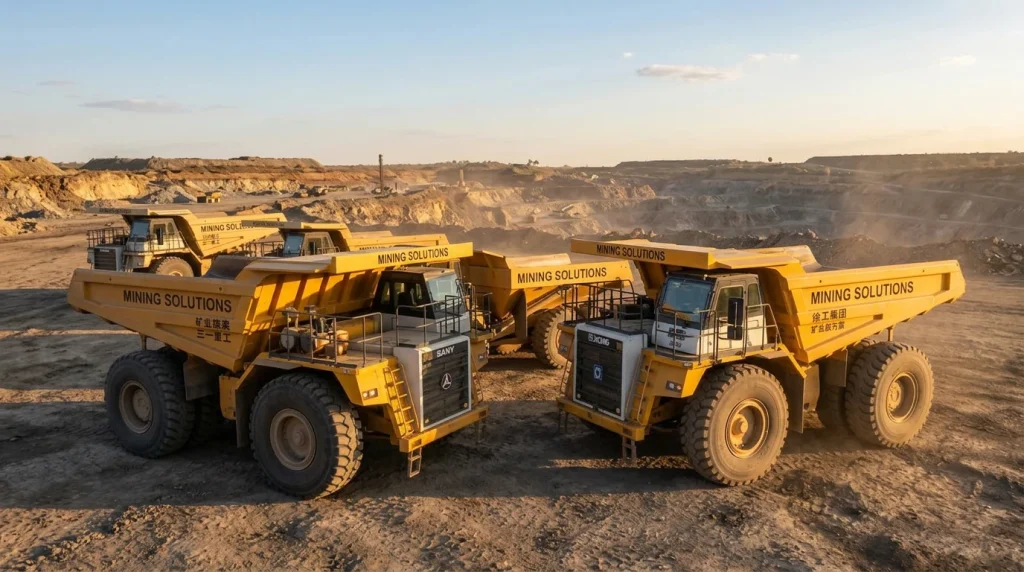
The core question most buyers ask is straightforward: why source haul trucks from China rather than established Western or Japanese brands? Three drivers stand out — cost-competitiveness, a rapidly widening model range, and reliability that has closed much of the historic gap.
Cost remains the headline advantage. Chinese-built mining trucks typically undercut equivalent global-brand units on capital expenditure, which frees budget for spares, training, or additional fleet numbers. For contractors operating on tight margins, that difference can decide whether a project pencils out.
The model range has expanded dramatically over the past decade. Where Chinese manufacturers once focused on light and medium haulers, several now field electric-drive ultra-class trucks that were previously the exclusive domain of a handful of global OEMs. This broadening means a buyer can standardize an entire fleet under one supplier relationship.
Reliability has improved in step. Widespread adoption of imported driveline components — engines, transmissions, and hydraulics from recognized global suppliers — has narrowed the durability gap that once made buyers hesitate. That said, quality still varies between OEMs and even between production lines, which is exactly why due diligence matters.
Demand is concentrated in emerging mining regions. Buyers across Africa, Southeast Asia, and Latin America are the fastest-growing customer base, drawn by favorable landed cost and increasingly capable after-sales networks. If you operate in one of these markets, you’re part of the dominant procurement trend right now. Our cooperative case library illustrates how these deployments play out in practice.
Quick Answer: Are Chinese Mining Trucks Worth It?
For most open-pit and quarry operations, yes — provided you buy carefully. Chinese mining dump trucks deliver strong value on capital cost and now cover every payload class, with reliability that suits typical duty cycles when paired with a solid spare-parts plan. The caveats are real: verify build quality per model line, confirm parts logistics to your site, and never treat purchase price as the whole cost. Match the truck to your mine, vet the supplier, and the value proposition holds.
Mining Dump Truck Fundamentals: Types & Terminology
Before comparing models, it pays to align on vocabulary. Getting the fundamentals right prevents costly mismatches between the equipment you buy and the conditions it will actually work in.
Rigid Frame Dump Trucks vs. Articulated Dump Trucks (ADT)
A rigid frame dump truck has a single, fixed chassis and steers via the front axle. These are the classic mining haulers — high payload, best suited to well-maintained haul roads and long, relatively straight cycles. Their strength is raw carrying capacity; their weakness is a larger turning radius and reduced performance on soft or uneven ground.
An articulated dump truck (ADT) pivots at a joint between the cab and the load body, giving it excellent maneuverability and traction on rough, wet, or steep terrain. ADTs generally carry less than large rigid trucks but shine where ground conditions defeat a rigid chassis — earthmoving, site preparation, and smaller operations with variable footing.
The practical rule: choose rigid frame for high-tonnage haulage on established roads, and ADTs where terrain is the limiting factor. Many mixed operations run both.
Off-Highway vs. On-Highway Classification
Mining haul trucks are off-highway machines. They exceed the width, weight, and axle-load limits that make a vehicle road-legal, and they lack the lighting, braking, and emissions certifications required for public roads. This classification has direct export consequences.
Because these units are not registered for public roads, they typically fall outside standard vehicle-type approval regimes and instead sit under machinery or industrial-equipment rules in the destination country. That changes which certifications apply and how the unit clears customs — a point we return to in the export section.
Key Specifications Buyers Must Understand
A handful of specifications determine whether a truck fits your operation. Learn these and you can compare any two units meaningfully.
- Payload capacity: The rated weight of material the truck carries, usually in metric tonnes. This is the headline spec.
- Gross vehicle weight (GVW): Total loaded weight — payload plus the truck itself. Critical for haul-road and ground-bearing calculations.
- Engine power: Expressed in kW or hp. Higher power supports faster cycles and steeper grades under load.
- Body volume: The heaped and struck capacity in cubic meters (m³). Matching volume to material density prevents under- or over-loading.
- Gradeability: The maximum slope the truck can climb loaded, expressed as a percentage.
- Drivetrain: Mechanical drive (engine through a transmission and driveline) versus electric drive (diesel engine driving a generator that powers wheel motors). Electric drive dominates the upper payload classes.
Payload Capacity Classes at a Glance
| Payload Class | Typical Range | Common Application |
|---|---|---|
| Light | ~32–45t | Quarries, small mines |
| Medium | ~50–90t | Open-pit mining |
| Heavy | ~100–220t | Large open-pit operations |
| Ultra-class | ~240–360t | Major surface mines |
Use these classes as a starting filter. Once you know your target tonnage, you can narrow the field of suitable manufacturers and models quickly. Browse the full range in our truck category catalog.
Leading Chinese Mining Dump Truck Manufacturers
The Chinese mining dump truck manufacturers landscape spans large state-owned enterprises, established heavy-equipment groups, and nimble private OEMs. Understanding who does what helps you shortlist intelligently.
Overview of the Manufacturer Landscape
Broadly, the market splits into two camps. State-owned and large industrial groups tend to command deep R&D resources and lead in ultra-class and electric-drive development. Private and mid-tier OEMs often compete on cost efficiency and breadth of model range, serving the high-volume light and medium segments.
Export orientation varies significantly. Some manufacturers have decades of overseas project experience with established parts depots abroad; others are newer to export and rely on trading intermediaries. R&D maturity — reflected in in-house component design versus assembly of bought-in parts — is a useful proxy for long-term support capability.
For buyers, the takeaway is that “Chinese OEM” is not a monolithic category. The right partner depends on your payload class, your region, and how much after-sales infrastructure the supplier can genuinely offer near your site. Learn more about how we evaluate partners on our company background page.
Profiles of Major Players
Several well-known Chinese groups produce off-highway rigid dump trucks across payload classes. Recognized heavy-vehicle and construction-machinery manufacturers have moved into mining haulage, offering models spanning the medium through ultra-class range. Specialist mining-equipment makers concentrate on the heavy and ultra-class end, frequently pairing imported engines with electric drivelines.
Rather than rank brands by name — market positioning shifts, and specific claims deserve independent verification — focus on the attributes that matter: proven payload range in the class you need, drivetrain options, the maturity of the parts network in your region, and documented export experience. Any specific market-share or ranking figure should be treated as 【数据待核实】 until confirmed directly with the manufacturer.
Comparison of Top Chinese Manufacturers
| Manufacturer Focus | Strengths | Considerations |
|---|---|---|
| Ultra-class specialists | Large payload capacity, mature electric-drive technology, strong engineering support | Higher capital cost, longer parts lead times for specialized components |
| Mid-tier volume OEMs | Cost efficiency, wide model range, faster availability of common spares | Quality control can vary across production lines; verify per model |
| Established heavy-equipment groups | Broad service networks, financing options, brand recognition abroad | Pricing premium over pure-cost competitors |
| Newer export entrants | Aggressive pricing, flexible customization | Thinner overseas support; scrutinize references carefully |
China Mining Dump Truck Models & Specifications
This section maps directly to how buyers search for China mining dump truck models — by tier. We’ll move from entry haulers up through ultra-class units.
Entry & Mid-Tier Models (32t–90t)
This band serves quarries, aggregate operations, and small-to-medium open-pit mines. Models here almost universally use mechanical drivetrains: a diesel engine driving through a torque converter and automatic transmission to the rear axle.
Engine pairings in this class typically source from established diesel manufacturers, and duty cycles favor shorter hauls with frequent loading. Buyers in this range prioritize fuel efficiency, ease of maintenance, and low spare-parts cost — all areas where Chinese OEMs are strongly competitive.
If your operation runs multiple short cycles per hour on reasonable haul roads, a well-chosen mid-tier rigid truck offers the best value in the entire market. This is the segment where buying mining dump trucks from China makes the most immediate financial sense.
Heavy-Duty Models (100t–220t)
The heavy class is where the mechanical-versus-electric-drive decision becomes central. Mechanical drive remains viable and simpler to service in remote locations. Electric drive — where the engine powers a generator feeding wheel motors — offers better performance on long grades, superior dynamic braking, and reduced mechanical wear, at the cost of more specialized service knowledge.
Component sourcing matters enormously here. The best Chinese mining haul trucks in this class typically integrate imported engines and control systems, while tires are a major consideration given their cost and availability. Confirm tire sizes are stocked in your region before committing.
For large open-pit operations, this class often represents the workhorse fleet. The choice between drive types should be driven by haul-road profile, site remoteness, and the technical depth of your maintenance team.
Ultra-Class Haul Trucks (240t+)
Ultra-class trucks are engineering-intensive machines. Chinese OEMs have entered this space with electric-drive units aimed at major surface mines, positioning against long-established global benchmarks.
Realistic expectations are important. While Chinese ultra-class trucks have narrowed the performance gap, buyers at this level should benchmark honestly on availability, structural durability, and the depth of engineering support — not headline price alone. At this scale, an hour of unplanned downtime can dwarf any purchase-price saving.
These units are also the most complex to ship and commission, which brings us to specifications and logistics.
Representative Model Specification Table
| Class | Payload | Engine Power (approx.) | Body Volume (approx.) | Drive Type |
|---|---|---|---|---|
| Entry / Mid-tier | ~32–45t | ~250–350 kW | ~20–28 m³ | Mechanical |
| Mid-tier | ~50–90t | ~400–600 kW | ~30–50 m³ | Mechanical |
| Heavy | ~100–150t | ~800–1100 kW | ~60–90 m³ | Mechanical / Electric |
| Heavy | ~150–220t | ~1200–1800 kW | ~90–130 m³ | Electric |
| Ultra-class | ~240–360t | ~2000+ kW | ~140–220 m³ | Electric |
Treat these as indicative planning ranges only. Exact figures differ by manufacturer and model — always request certified specification sheets before finalizing a purchase. Our team can help you compare verified specs through our customer service desk.
Realistic Pricing: CIF, FOB & Total Cost of Ownership
Commercial buyers want clarity on price structure. We won’t quote specific figures here — they move constantly with steel costs, component availability, and specification — but we can explain how pricing is built and where the real costs hide.
How Chinese Mining Truck Pricing Is Structured
Three trade terms dominate quotations. FOB (Free On Board) covers the truck delivered to the export port, with sea freight and insurance on the buyer. CIF (Cost, Insurance, Freight) adds ocean freight and marine insurance to the destination port. DDP (Delivered Duty Paid) extends further, with the seller handling import duties and delivery to your site.
The main cost drivers are payload class, drive type (electric drive commands a premium over mechanical), and the proportion of imported components. A truck built around an imported engine, transmission, and control electronics will price above an equivalent unit using domestic components.
Always clarify exactly what a quotation includes — spare-parts kits, tools, commissioning support, and warranty terms are frequently negotiable line items rather than assumed inclusions.
Indicative Price Bands by Payload Class
| Payload Class | Relative Capital Cost | Key Cost Influences |
|---|---|---|
| Light (~32–45t) | Lowest | Mechanical drive, domestic components |
| Medium (~50–90t) | Moderate | Engine choice, body configuration |
| Heavy (~100–220t) | High | Electric drive, imported drivetrain, tire cost |
| Ultra-class (~240t+) | Highest | Electric drive, engineering support, logistics |
The pattern is consistent: cost rises steeply with payload and with the shift to electric drive. For an accurate, current CIF quotation tailored to your destination port, contact a verified supplier directly rather than relying on general estimates.
Total Cost of Ownership Beyond Purchase Price
Purchase price is the beginning, not the end. Over a truck’s service life, operating costs typically dwarf the initial outlay. The major components are worth examining individually.
- Fuel or energy: The largest ongoing cost for most fleets. Engine efficiency and drivetrain type directly affect it.
- Tires: Mining tires are a substantial recurring expense, especially in the heavy and ultra-class ranges. Availability and price in your region can make or break the economics.
- Maintenance and parts: Routine servicing plus wear items. Parts price and lead time compound over years.
- Downtime: The hidden killer. A truck waiting on a part earns nothing while fixed costs continue.
- Resale: Residual value varies by brand recognition and condition in your market.
Experienced operators build a total-cost model before signing. A cheaper truck that sits idle waiting for parts is no bargain. Our knowledge base offers deeper guidance on running these calculations.
Exporting Mining Dump Trucks from China: The Process
Handling mining dump truck export from China well separates smooth deliveries from costly delays. Here’s a practical walkthrough of what the process actually involves.
Standards, Certifications & Compliance
Because mining haul trucks are off-highway equipment, they usually fall under machinery or industrial-equipment rules rather than road-vehicle type approval. For shipments to certain markets, CE marking considerations may apply, while other destinations enforce their own import and safety standards.
Always confirm destination-country requirements before ordering. Some countries impose emissions tiers even on off-highway diesel engines; others require pre-shipment inspection or specific safety documentation. Getting this wrong risks the unit being held at port.
Reputable suppliers will advise on the compliance path for your specific country. Treat any supplier who dismisses these questions as a red flag.
Required Export Documentation
A clean documentation package keeps customs clearance predictable. The core set includes:
- Commercial invoice — the definitive statement of value and terms.
- Packing list — itemized contents, weights, and dimensions.
- Bill of lading — the shipping contract and title document.
- Certificate of origin — often required for tariff and preference purposes.
- Inspection certificates — third-party pre-shipment inspection where required.
For heavy-duty mining truck export to Africa and other emerging markets, additional certificates such as conformity assessment documents are frequently mandatory. Verify the full list with a freight forwarder experienced in your route.
Shipping & Logistics for Oversized Machinery
Moving a mining truck across oceans is a logistics exercise in itself. Three main modes apply, each with trade-offs.
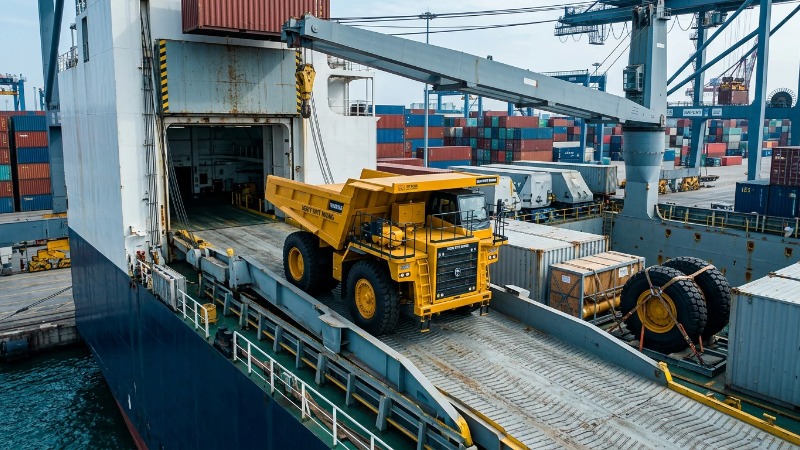
- RoRo (Roll-on/Roll-off): The unit is driven onto a vessel. Efficient for self-propelled trucks within size limits, but availability depends on route.
- Break-bulk: The truck is lifted aboard as project cargo. Handles oversized units RoRo cannot, at higher handling cost.
- CKD (Completely Knocked Down): The truck ships disassembled in containers and is reassembled on arrival. Cost-effective for large units and awkward routes, but requires skilled assembly at destination.
Ultra-class trucks almost always ship break-bulk or CKD because their assembled dimensions exceed container and RoRo limits. Factor port-handling capability and inland transport at the destination into your plan early.
Export Route Considerations by Region
| Region | Common Shipping Approach | Key Considerations |
|---|---|---|
| Africa | RoRo or break-bulk; CKD for remote sites | Port congestion, inland transport, conformity certificates |
| Southeast Asia | RoRo or container/CKD | Shorter transit, varied port capacity, local compliance |
| Latin America | Break-bulk or CKD | Longer transit, high-altitude operation, parts logistics |
How to Choose the Right Mining Dump Truck Supplier
Selecting a supplier is where experience pays off. A structured framework keeps the decision objective rather than price-driven.
Matching Truck Class to Your Mine Profile
Start with your operation, not the catalog. Assess your haul distance, maximum grade, the density of the material you move, and your target cycle time. These four factors point directly to the payload class and drivetrain that will serve you best.
Dense material needs matching body volume and structural strength; long, steep hauls favor electric drive; short, flat cycles reward simpler mechanical trucks. Buying too much truck wastes capital; too little truck strangles productivity.
Evaluating After-Sales Support & Parts Availability
Here is the lesson seasoned buyers repeat most: spare-parts logistics frequently outweigh unit price. A truck is only as productive as your ability to keep it running.
Map out parts availability before you buy. Where are wear items and consumables stocked? What are realistic lead times to your site? Can the supplier hold a critical-spares package locally? These answers matter more than a modest discount on the purchase.
Verifying Supplier Credibility
Trust, but verify. Independent factory audits and third-party pre-shipment inspection (in the style of major inspection agencies) protect your investment. Request trade references from buyers in similar markets and check them.
Payment terms also signal credibility. A letter of credit (L/C) offers strong buyer protection, while telegraphic transfer (T/T) is faster but riskier — structure milestone payments to keep leverage until delivery and inspection are complete. Reach out through our contact page to discuss terms and audits.
Supplier Evaluation Checklist
- Confirmed payload range and specifications in your target class
- Documented export experience to your region
- Local or regional spare-parts availability with quoted lead times
- Clear warranty terms and how they are enforced across borders
- Third-party inspection accepted and factory audit permitted
- Verifiable trade references from comparable operations
- Transparent, milestone-based payment terms
- Responsive technical and after-sales communication
Common Mistakes to Avoid When Importing
Most costly import problems are predictable — and avoidable. These are the pitfalls that recur across projects.
Underestimating Parts Lead Times & Consumables
The classic error is commissioning a new truck with no spares on the shelf. When the first wear item fails, the truck stops, and a part in transit from overseas can idle it for weeks. Stock critical spares and consumables before commissioning, not after the first breakdown.
Overlooking Drivetrain & Tire Compatibility
Tire size availability is a frequent blind spot. If your region cannot readily supply the truck’s tire size, you inherit a permanent logistics headache. Likewise, confirm your maintenance team can service the chosen drivetrain — an electric-drive truck in a site without electric-drive expertise is a risk.
Ignoring Local Compliance & Warranty Terms
Import restrictions and warranty enforceability catch buyers off guard. Confirm the unit can legally enter and operate in your jurisdiction, and read the warranty carefully — a warranty that cannot be enforced across borders offers little real protection. Clarify who covers what, and how claims are processed, before you sign.
Expert Perspective: What Seasoned Buyers Prioritize
Talk to operators who have run imported fleets for years and a consistent theme emerges. They rank uptime and parts networks well above headline price, and they benchmark performance honestly rather than trusting brochure figures.
“The cheapest truck at the port gate is rarely the cheapest truck over five years. Experienced fleet operators report that parts availability and honest performance benchmarking decide profitability far more than the initial discount.”
The practical implication is to weight your evaluation toward serviceability, spare-parts logistics, and realistic duty-cycle performance. A supplier who is transparent about limitations often proves more valuable than one who overclaims. Objectivity in your own assessment is the best protection against buyer’s remorse.
Pros & Cons: A Balanced View
No sourcing decision is one-sided. Here is an honest summary of the advantages and limitations of sourcing mining trucks from China.
| Advantages | Limitations |
|---|---|
| Strong capital-cost competitiveness across classes | Quality can vary between OEMs and model lines |
| Full model range from ~32t to ultra-class | Overseas support networks vary in depth |
| Improving reliability with imported drivetrain options | Parts lead times can be long for specialized components |
| Flexible customization and configuration | Compliance requirements differ by destination and need verification |
| Growing after-sales presence in emerging markets | Resale value less established than legacy global brands in some markets |
Weighed together, the balance favors Chinese haul trucks for buyers who do their homework — matching class to mine, vetting the supplier, and planning parts and logistics deliberately.
Frequently Asked Questions
What is the payload range of Chinese mining dump trucks?
Chinese mining dump trucks span roughly 32 tonnes at the light end to around 360 tonnes for ultra-class units. Light and medium classes (about 32t–90t) suit quarries and open-pit mining, while heavy and ultra-class trucks (100t–360t) serve large surface operations. Confirm exact rated payload on the certified specification sheet for any specific model.
How much does a mining dump truck from China cost?
Pricing varies too widely to quote a single figure — it depends on payload class, drive type, imported-component content, specification, and trade terms (FOB, CIF, or DDP). As a rule, cost rises steeply with payload and with the shift from mechanical to electric drive. For an accurate landed price, request a current CIF quotation from a verified supplier for your destination port.
What’s the difference between rigid and articulated dump trucks?
A rigid frame dump truck has a fixed chassis and higher payload, ideal for well-maintained haul roads and long cycles. An articulated dump truck (ADT) pivots at a joint for superior maneuverability and traction on soft or uneven terrain, typically at lower payload. Choose rigid for high-tonnage road haulage and ADTs where ground conditions are the constraint.
How are ultra-class mining trucks shipped internationally?
Ultra-class trucks exceed standard container and RoRo dimensions, so they usually ship as break-bulk project cargo or as CKD (completely knocked down) units in containers for reassembly on arrival. Both approaches require skilled handling and, for CKD, competent assembly at the destination. Plan port capability and inland transport early in the process.
Do Chinese mining trucks use imported engines and tires?
Many models, especially in the heavy and ultra-class ranges, integrate imported engines, transmissions, and control systems from established global suppliers, which supports reliability. Tires are a major cost and availability factor — always confirm the truck’s tire size is stocked in your region before purchase. Component sourcing varies by manufacturer and model, so verify it directly.
What after-sales support should I expect?
Expect a spare-parts supply plan, technical support, commissioning assistance, and clear warranty terms — but confirm the specifics, as support depth varies by supplier and region. Prioritize suppliers who can hold critical spares near your site and quote realistic parts lead times. After-sales capability often matters more to long-term profitability than the purchase price.
Conclusion & Next Steps
Sourcing mining dump trucks from China is a sound strategy for buyers who approach it methodically. Match the truck class to your mine profile, weigh mechanical versus electric drive against your site conditions, and never let purchase price overshadow total cost of ownership.
Verify your supplier through audits, third-party inspection, and trade references, and lock in a spare-parts and logistics plan before commissioning. Get those fundamentals right and Chinese haul trucks deliver genuine, lasting value across payload classes.
Call to Action
Ready to move forward? Request detailed specifications, arrange a factory audit, or get a tailored CIF quotation from a verified supplier. Explore the full lineup on our homepage, or reach out directly through our contact team to discuss your project requirements and destination logistics. Let’s match the right haul truck to your operation.