




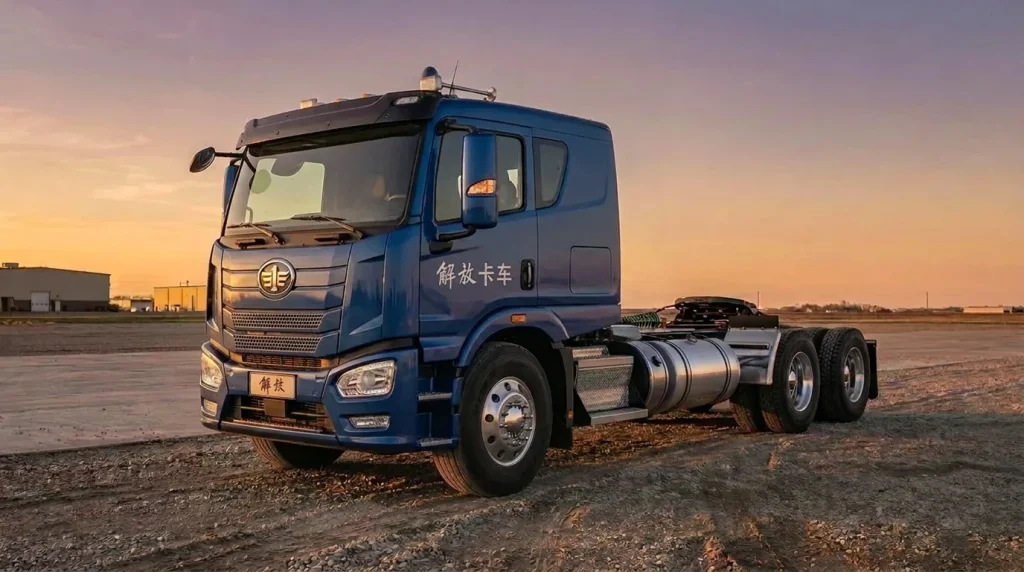
Heavy-duty tractor head buying guide: compare configs, powertrains & TCO to match the right prime mover to your fleet’s duty cycle.
A comprehensive resource for fleet managers, logistics operators, and commercial vehicle buyers navigating the heavy-duty tractor head market.
Choosing the right prime mover is one of the most consequential decisions a fleet operator will make. The tractor head sits at the heart of every tractor-trailer combination, and the wrong specification can quietly erode margins for years. Consequently, understanding the technical landscape matters far more than most buyers initially assume.
This guide walks industry professionals through configurations, models, powertrains, applications, and total cost of ownership. Throughout, we focus on practical decision-making rather than marketing gloss. By the end, you should be equipped to match hardware precisely to your duty cycle.
What Is a Heavy Duty Truck Tractor Head?
A heavy duty truck tractor head—also known as a prime mover, tractor unit, or simply a “tractor”—is the motorized front section of an articulated vehicle combination. It provides the engine, cab, and coupling mechanism needed to pull one or more trailers. Unlike a rigid truck, it carries no cargo body of its own.
Instead, the tractor head connects to a semi-trailer through a fifth wheel coupling. This articulation allows for tighter maneuvering and flexible trailer swapping. As a result, tractor heads dominate long-distance freight, heavy haul, and container transport worldwide.
For fleet operators, the tractor head represents both the largest capital outlay and the primary lever for operational efficiency. Fuel burn, driver comfort, uptime, and resale value all trace back to how this unit is specified. Therefore, treating it as a strategic asset—rather than a commodity purchase—pays dividends.
Tractor Head vs. Rigid Truck vs. Semi Truck Tractor Units
Confusion between vehicle categories is common, even among experienced buyers. A rigid truck integrates the cab and cargo body on a single chassis, making it ideal for urban delivery and fixed-body applications. However, it lacks the payload flexibility of an articulated setup.
By contrast, semi truck tractor units pull detachable trailers, enabling one tractor to service many trailers across a network. This decoupling of power and payload is precisely why line-haul operators favor tractor heads. It maximizes asset utilization while minimizing idle time.
The term “semi truck tractor units” is largely a North American designation, while “prime mover” prevails in Australia and parts of Asia. Regardless of nomenclature, the core function remains identical. Understanding these regional terms helps when sourcing internationally.
Core Components of a Prime Mover Truck
Every prime mover truck shares a set of foundational systems. The fifth wheel is the horseshoe-shaped coupling plate that locks onto the trailer’s kingpin. Its position and rating directly influence weight distribution and legal payload.
The chassis, or frame, bears all structural loads and dictates the vehicle’s durability under stress. Heavy haul units use thicker frame rails and reinforced cross-members. Meanwhile, the cab houses the driver and, in sleeper configurations, provides overnight accommodation.
The powertrain—engine, transmission, and drive axles—converts diesel or alternative fuel into tractive effort. Finally, the coupling and braking systems integrate the tractor with the trailer for synchronized stopping. Together, these components define the vehicle’s capability envelope.
Key Terminology Glossary for Industry Professionals
Precise language prevents costly specification errors. Below are the essential terms referenced throughout this guide.
- GVWR (Gross Vehicle Weight Rating): The maximum permissible weight of the tractor head alone, including chassis, fuel, and driver.
- GCWR (Gross Combination Weight Rating): The maximum weight of the tractor plus fully loaded trailer combination.
- Axle Configuration: Notation such as 6×4, describing total wheel positions versus driven wheel positions.
- Tare Weight: The unladen weight of the vehicle, which subtracts directly from usable payload.
- Fifth Wheel Offset: The fore-aft position of the coupling, affecting axle loading balance.
- Drivetrain: The combination of engine, transmission, driveshaft, and drive axles delivering power to the road.
Mastering these terms allows buyers to communicate clearly with manufacturers and avoid mismatched orders. For a deeper foundation, our knowledge base covers many of these concepts in dedicated articles.
Axle Configurations Explained: 4×2, 6×4, 6×2, and 8×4
Axle configuration is arguably the most searched—and most misunderstood—technical topic in the tractor head segment. The notation is simple once decoded: the first number counts total wheel-ends, the second counts driven wheel-ends. Thus a 6×4 has six wheel positions with four driven.
Selecting the right layout affects traction, payload, fuel economy, and regulatory compliance simultaneously. Consequently, no single configuration is universally best. The optimal choice always flows from the intended duty cycle.
6×4 Tractor Head Configurations — The Industry Workhorse
The 6×4 remains the dominant layout for long-haul and heavy applications globally. With two driven rear axles, it delivers superior traction on grades, in poor weather, and under heavy loads. This makes it the default for over-the-road freight.
Furthermore, the tandem drive axle set distributes weight across two axles, allowing higher legal payloads in most jurisdictions. Heavy haul operators particularly value this stability. When loads climb toward maximum GCWR, the 6×4 rarely disappoints.
The trade-off is modestly higher fuel consumption and tare weight compared to lighter layouts. Yet for demanding work, the reliability and traction margin justify the cost. Among 6×4 tractor head configurations, buyers can further tune ratios, suspension, and axle ratings to their routes.
4×2 Configurations for Regional and Lightweight Haulage
The 4×2 configuration features a single drive axle and a single steer axle. Its reduced tare weight and lower rolling resistance translate directly into better fuel economy. For regional distribution and lighter payloads, this efficiency advantage is compelling.
On smooth, paved routes with moderate loads, the 4×2 excels. It also carries a lower purchase and maintenance burden, which appeals to cost-conscious operators. Many European city-to-city delivery fleets rely on it heavily.
However, the single drive axle limits traction and maximum load capacity. In wet, icy, or hilly terrain, drivers may notice reduced grip. Therefore, buyers should reserve the 4×2 for on-road, lightweight duty cycles where its strengths shine.
6×2 and 8×4 for Specialized Loads
The 6×2 layout adds a third axle for load-bearing without driving it, sometimes as a liftable “lazy” axle. When empty, raising the axle reduces tire wear and fuel use. When loaded, it lowers ground pressure and increases legal payload.
Meanwhile, the 8×4 configuration incorporates four axles for maximum stability and payload. This layout suits heavy haul and severe-service applications where combination weights soar. Mining, tanker, and oversized load transport frequently demand it.
Both configurations serve niche but important roles. Selecting them requires careful attention to regional axle-load laws and route conditions. When applied correctly, they unlock capacities that standard layouts cannot match.
Comparison Table — Axle Configurations by Application, Payload & Fuel Economy
| Configuration | Typical GCWR Range | Best Terrain | Fuel Economy | Primary Application |
|---|---|---|---|---|
| 4×2 | Up to ~40 tonnes | Paved, flat | Excellent | Regional distribution, light line-haul |
| 6×2 | Up to ~44 tonnes | Paved, mixed | Very good | Fuel-sensitive long-haul, variable loads |
| 6×4 | Up to ~70+ tonnes | Grades, poor weather, off-road | Moderate | Long-haul, heavy haul, construction |
| 8×4 | 100+ tonnes | Severe service, off-road | Lower | Oversized loads, mining, tankers |
Use this matrix as a starting point rather than a final answer. Local regulations and route specifics will always refine the choice. To explore models across every layout, browse our complete truck category page.
Heavy Duty Truck Tractor Head Models: Leading Brands & Specs
The global market offers dozens of credible heavy duty truck tractor head models. They cluster broadly into North American, European, and Asian manufacturing traditions. Each brings distinct engineering philosophies and value propositions.
Understanding these differences helps buyers align brand strengths with operational priorities. For instance, some prioritize rugged simplicity, while others emphasize fuel efficiency and driver comfort. Below, we survey the leading players.
North American Models (Freightliner, Kenworth, Peterbilt, International)
North American tractor heads are built for the continent’s long distances and heavy weights. The Freightliner Cascadia leads in aerodynamic efficiency and represents one of the best-selling Class 8 units in the region. Its refined airflow management measurably lowers fuel burn.
The Kenworth T680 and Peterbilt Model 579 balance efficiency with premium driver environments. Both are favorites among owner-operators who value comfort on long routes. Meanwhile, the International LT Series competes strongly on total cost of ownership and connected diagnostics.
These models typically pair with high-output diesel engines and spacious sleeper cabs. They dominate over-the-road freight across the United States and Canada. For heavy haul applications, upgraded frame and axle packages are readily available.
European Models (Volvo, Scania, MAN, Mercedes-Benz Actros, DAF)
European tractor units emphasize aerodynamics, safety technology, and driver ergonomics. The Mercedes-Benz Actros and Volvo FH lead in fuel-saving innovations and advanced driver assistance. Their cab-over-engine designs suit Europe’s tighter length regulations.
The Scania R and S Series enjoys a strong reputation for reliability and modular engineering. Fleet managers appreciate the ease of matching specification to duty. MAN TGX and DAF XF/XG round out the segment with competitive efficiency and comfort.
All European models comply with Euro VI emission standards, integrating sophisticated exhaust aftertreatment. This regulatory alignment makes them the default across the EU and many export markets. Their driver-centric cabins also aid retention in tight labor markets.
Asian & Emerging Market Models (Sinotruk, FAW, Shacman, Isuzu Giga)
Asian manufacturers have rapidly closed the quality gap while maintaining strong value positioning. Sinotruk, FAW, and Shacman supply robust 6×4 tractor heads to heavy haul and construction markets worldwide. Their durability under harsh conditions has earned genuine respect.
The Isuzu Giga and other Japanese units offer refined reliability and lower operating costs. These brands are particularly popular across Southeast Asia, Africa, and Latin America. Global buyers increasingly view them as credible alternatives to Western marques.
Emerging-market models often excel in serviceability and parts availability within their regions. For operators in developing markets, this practical support outweighs badge prestige. Our cooperative case studies illustrate how these units perform in real deployments.
Heavy Duty Truck Head Specifications Comparison Table
| Model | Origin | Horsepower Range | Peak Torque | Cab Type | Typical GCWR |
|---|---|---|---|---|---|
| Freightliner Cascadia | North America | 400–600 hp | Up to 2,050 lb-ft | Sleeper / Day | Up to 80,000 lb+ |
| Volvo FH | Europe | 420–750 hp | Up to 3,550 Nm | Cab-over Sleeper | Up to 44 t (higher spec) |
| Scania R Series | Europe | 410–770 hp | Up to 3,700 Nm | Cab-over Sleeper | Up to 60+ t heavy haul |
| Sinotruk HOWO | Asia | 380–540 hp | Up to 2,500 Nm | Sleeper | Up to 70+ t |
| Kenworth T680 | North America | 400–565 hp | Up to 1,850 lb-ft | Sleeper / Day | Up to 80,000 lb+ |
Specifications vary by market and model year, so always confirm current data with the supplier. These figures nonetheless illustrate the competitive landscape. For tailored guidance, our team is ready to help via the contact page.
Diesel Engine Truck Models & Powertrain Options
The powertrain is the heart of any tractor head decision. It dictates pulling power, fuel economy, and long-term reliability. Among diesel engine truck models, a handful of engine platforms power the vast majority of heavy units.
Matching engine output to load and terrain prevents both under-powered struggle and over-powered waste. Consequently, powertrain selection deserves careful analysis rather than default choices. Below, we examine the key platforms and pairings.
Common Diesel Engine Platforms and Horsepower Ranges
The Cummins X15 remains a benchmark for versatility, spanning efficiency-focused and high-output variants. It powers countless North American tractor heads across every application. Fleet managers trust its proven durability and broad service network.
The Detroit DD Series, integrated with Freightliner drivetrains, delivers strong fuel economy through tight system integration. Meanwhile, the Volvo D13 and Scania DC13 anchor European efficiency leadership. Both offer excellent torque curves for laden hauling.
Horsepower ranges typically span from around 400 hp for regional work to 600 hp or more for heavy haul. Torque, not just horsepower, ultimately determines pulling strength at low engine speeds. Therefore, evaluate both figures against your grade profiles.
Transmission Options — Manual, AMT, and Automatic
Transmission choice profoundly affects fuel economy, driver satisfaction, and drivetrain longevity. Traditional manual gearboxes remain popular where operators prize control and low acquisition cost. However, their share is steadily declining.
Automated Manual Transmissions (AMT) now dominate the premium segment. They optimize shift points automatically, improving fuel economy and reducing driveline stress. Crucially, they also lower the skill barrier for new drivers, aiding recruitment.
Fully automatic transmissions appear in select applications requiring smooth, frequent shifting, such as drayage and urban work. Each option carries trade-offs in cost, efficiency, and maintenance. Aligning the transmission to duty cycle protects both budget and driver retention.
Alternative Powertrains — Natural Gas, Electric & Hydrogen
As of 2026, alternative powertrains are advancing but remain application-specific. Natural gas tractor heads offer lower emissions and stable fuel costs in regions with mature refueling infrastructure. They already serve certain regional and port fleets effectively.
Battery-electric tractor heads have proven viable for short-haul, drayage, and predictable regional routes. Their range and charging time still constrain long-haul deployment, though the technology improves each year. Total-cost economics are strengthening as battery costs fall.
Hydrogen fuel-cell units remain earlier in commercialization, with pilot fleets demonstrating long-range potential. Realistic mainstream adoption for heavy long-haul is expected to unfold gradually through the late 2020s. For now, diesel retains its dominance in demanding heavy haul roles.
Engine & Transmission Pairing Table by Application
| Application | Recommended Power | Preferred Transmission | Notes |
|---|---|---|---|
| Regional distribution | 400–450 hp | AMT | Efficiency prioritized; consider electric for fixed routes |
| Long-haul line-haul | 450–550 hp | AMT | Aero + high torque for cruising economy |
| Heavy haul / oversized | 550–600+ hp | AMT or Manual | Maximum torque; deep reduction ratios |
| Construction / off-road | 430–540 hp | Manual or AMT | Durability and traction control emphasized |
| Port / drayage | 350–450 hp | Automatic / Electric | Frequent stops favor smooth, low-emission options |
These pairings offer a reliable starting framework. Fine-tune ratios and specifications with your supplier to match precise routes. Our customer service team can help translate these principles into a concrete build sheet.

Heavy Duty Truck Tractor Head Applications by Industry
The right tractor head is always defined by its work. Mapping models and configurations to real-world scenarios prevents costly mismatches. Below, we examine the four dominant application categories.
Each industry imposes distinct demands on traction, payload, and duty intensity. Recognizing these patterns simplifies specification. It also clarifies where premium features earn their keep versus where they add needless cost.
Long-Haul and Line-Haul Logistics
Over-the-road freight prioritizes fuel efficiency, aerodynamics, and driver comfort above all. Long distances at steady highway speeds make every fractional efficiency gain meaningful. Aerodynamic cabs and optimized drivetrains therefore dominate this segment.
Sleeper cabs enable multi-day trips and support driver wellbeing on extended routes. Semi truck tractor head applications in this space also emphasize connectivity for route optimization. Fuel represents the single largest operating expense, so efficiency features pay back quickly.
Heavy Haul and Oversized Load Transport
Heavy haul truck applications demand maximum GCWR, multi-axle setups, and reinforced chassis. Loads such as industrial machinery, transformers, and prefabricated structures push combinations toward extreme weights. Here, brute capability outranks fuel economy.
The 6×4 and 8×4 configurations dominate, often with high-output engines exceeding 550 hp. Reinforced frames, upgraded axles, and deep transmission ratios enable controlled movement of massive loads. Stability and braking capacity become paramount safety considerations.
Operators in this niche also weigh permit compliance and route planning heavily. A properly specified heavy haul tractor head reduces risk and downtime substantially. The margin for specification error is small when stakes are this high.
Construction, Mining & Off-Road Duty
Severe-service environments reward ruggedness over refinement. Construction and mining operations subject tractor heads to dust, uneven terrain, and constant load cycling. Tipper-trailer and reinforced configurations withstand this punishment.
The 6×4 layout provides essential traction on unpaved sites and loose surfaces. Upgraded suspension, protective plating, and robust cooling systems extend service life. Durability directly translates into uptime, which drives profitability in these sectors.
Asian brands frequently perform strongly here due to their robust engineering and cost efficiency. Many operators find the value equation compelling for demanding site work. Our tractor category listings feature configurations built for exactly these conditions.
Port, Intermodal & Container Drayage
Port and container operations involve short-haul, high-frequency coupling cycles. Terminal tractors and drayage-optimized units emphasize maneuverability and rapid trailer swaps. Long-distance aerodynamics matter little in this context.
Because routes are short and predictable, port operations are prime candidates for electric powertrains. Frequent stops and controlled environments suit battery technology well. Consequently, many ports are pioneering zero-emission tractor deployments.
Day cabs, rather than sleepers, dominate here since drivers return home nightly. Reliability under intense daily cycling remains the key selection criterion. Downtime at a busy terminal cascades quickly into costly congestion.
Application-to-Model Recommendation Matrix
| Industry / Application | Ideal Configuration | Suggested Model Class | Cab Preference |
|---|---|---|---|
| Long-haul logistics | 6×4 or 6×2 | Cascadia, Volvo FH, Scania R | Sleeper |
| Heavy haul / oversized | 6×4 or 8×4 | High-output Scania, Sinotruk, T680 heavy spec | Sleeper / Day |
| Construction / mining | 6×4 | Sinotruk HOWO, Shacman, FAW | Day / Short Sleeper |
| Port / drayage | 4×2 or 6×4 | Electric / day-cab diesel units | Day |
| Regional distribution | 4×2 | Isuzu Giga, mid-range European units | Day |
Treat this matrix as directional guidance shaped by your specific network. Local regulations, load profiles, and driver patterns will refine the choice. When ready, our specialists can validate your shortlist against real deployment data.
How to Choose the Best Tractor Head for Hauling
Selecting the best tractor head for hauling requires a structured framework, not intuition alone. Too many buyers anchor on purchase price and overlook lifetime economics. A disciplined process avoids that trap.
The following steps guide fleet managers through the core decision variables. Each factor interacts with the others, so consider them holistically. Rushing this stage frequently produces expensive regret.
Matching Payload and GCWR to Your Duty Cycle
Specification must mirror the heaviest routine load, not the average. Under-specifying invites premature wear, overheating, and safety risks under peak demand. Over-specifying, meanwhile, wastes capital and fuel on unused capacity.
Begin by documenting your maximum GCWR across all planned routes. Then, add a reasonable margin for growth and unexpected loads. This anchors every downstream choice, from axle configuration to engine output.
Terrain compounds these calculations significantly. A route with sustained grades demands more torque than flat mileage of equal weight. Accounting for topography early prevents mid-service disappointment.
Total Cost of Ownership Beyond Purchase Price
Purchase price represents only a fraction of a tractor head’s lifetime cost. Fuel typically dominates, often exceeding the acquisition cost several times over across the service life. Consequently, efficiency features frequently justify their premium.
Maintenance, tires, insurance, and downtime all accumulate steadily. A slightly cheaper unit with poor reliability can prove far more expensive over five years. Resale value, meanwhile, recovers a meaningful share of the original investment.
Wise buyers model total cost of ownership across the full ownership horizon. This analysis often reverses conclusions drawn from sticker price alone. Our company background page explains how we help operators build these models.
New vs. Used vs. Leasing Considerations
The acquisition method carries significant financial and operational consequences. New units offer the latest efficiency, full warranty, and predictable reliability. However, they demand the largest upfront capital commitment.
Used tractor heads lower entry cost and suit budget-conscious or seasonal operators. The trade-off is higher maintenance risk and shorter remaining service life. Thorough inspection and documented history are essential when buying used.
Leasing preserves capital and shifts residual-value risk to the lessor. It suits growing fleets that value flexibility and predictable monthly costs. Each path fits different balance sheets, so align the method with your financial strategy.
Buyer’s Decision Checklist
- Document maximum GCWR across all routes and add a growth margin.
- Map terrain and grade profiles to torque requirements.
- Match axle configuration to load, traction, and legal limits.
- Model total cost of ownership, not just purchase price.
- Confirm parts availability and service network in your region.
- Evaluate driver comfort features against retention goals.
- Verify emission compliance for all operating jurisdictions.
- Compare new, used, and leasing scenarios financially.
- Review warranty terms and aftersales support depth.
- Request references or case studies for comparable deployments.
Work through each item before committing to a purchase order. This discipline consistently produces better long-term outcomes. When questions arise, the contact us page connects you directly with specialists.
6×4 Truck Tractor Head Price & Cost Analysis
Pricing for tractor heads varies widely by region, brand tier, and specification. Rather than quoting figures that shift with markets and currencies, this section focuses on the factors that shape cost. Understanding these levers empowers smarter negotiation.
The 6×4 segment, as the industry workhorse, spans an especially broad pricing spectrum. Value-segment units and premium flagships occupy very different tiers. Aligning expectations with duty requirements keeps budgets realistic.
Price Ranges by Region and Brand Tier
Broadly, the market divides into premium, mid-tier, and value segments. Premium European and North American brands command the highest prices, reflecting advanced technology and refinement. Their efficiency and comfort features target long-haul fleets with high mileage.
Mid-tier options balance capability with more accessible pricing. Value-segment brands, largely from Asian manufacturers, deliver strong capability at lower acquisition cost. As of 2026 market conditions, this value tier continues gaining global share.
Regional factors—import duties, local assembly, and currency—further influence final pricing. A model’s cost can differ substantially between markets. Sourcing strategically across borders sometimes unlocks meaningful savings.
Factors That Influence Tractor Head Pricing
Several specification choices drive the 6×4 truck tractor head price up or down. Engine output ranks among the largest, with higher-horsepower variants costing more. Emission compliance technology also adds expense, particularly for the latest standards.
Cab type matters significantly, with full sleepers costing more than day cabs. Options packages—premium interiors, advanced safety systems, and connectivity—accumulate quickly. Axle ratings, suspension, and transmission choice round out the major variables.
Buyers should map each option against genuine operational need. Paying for unused features erodes return on investment. A focused, needs-based specification consistently delivers the best value.
Financing, Warranty & Aftersales Support
The sticker price tells only part of the story. Financing terms materially affect the true cost of ownership over time. Favorable rates and structures can offset a higher headline price.
Warranty coverage protects against early-life failures and unexpected repair bills. Longer, more comprehensive warranties reduce financial exposure meaningfully. Evaluate coverage depth alongside the base price.
Aftersales support—parts availability, service network reach, and response times—determines uptime. A well-supported unit keeps earning revenue reliably. This dimension often separates a good purchase from a costly one.
Estimated Price Comparison Table by Model & Configuration
| Model / Segment | Configuration | Relative Price Tier | Key Value Driver |
|---|---|---|---|
| Premium European flagship | 6×4 Sleeper | Highest | Efficiency, comfort, technology |
| Premium North American | 6×4 Sleeper | High | Aerodynamics, resale value |
| Mid-tier global brand | 6×4 Day / Sleeper | Moderate | Balanced capability and cost |
| Value-segment Asian | 6×4 Sleeper | Lower | Durability at accessible cost |
| Regional 4×2 unit | 4×2 Day | Lowest | Fuel economy, light-duty value |
Relative tiers help frame expectations without fixing figures to volatile markets. For current, market-specific quotations tailored to your build, reach out directly. Our team provides transparent guidance through the customer service portal.
Maintenance, Reliability & Lifecycle Management
A tractor head’s value extends far beyond its purchase. Disciplined maintenance maximizes uptime, safety, and eventual resale value. Neglect, by contrast, compounds costs and shortens service life.
Proactive lifecycle management treats the vehicle as a long-term revenue asset. This mindset shapes everything from service intervals to trade-in timing. The payoff appears clearly on the balance sheet.
Preventive Maintenance Schedules for Heavy Duty Tractors
Preventive maintenance follows the engine and driveline’s designed intervals. Oil and filter changes, coolant checks, and fuel system servicing anchor the routine. Following manufacturer schedules preserves warranty coverage and reliability.
Braking systems demand particular attention given their safety criticality. Regular inspection of pads, drums, and air systems prevents dangerous failures. Driveline components—clutches, differentials, and driveshafts—also require scheduled review.
Documenting every service builds a maintenance history that supports resale value later. Fleet telematics increasingly automate this tracking, flagging issues before they escalate. Consistent, recorded care is the foundation of long-term reliability.
Common Failure Points and Cost-Saving Strategies
Certain components fail more predictably than others. Turbochargers, EGR and aftertreatment systems, and electrical connections rank among frequent culprits. Anticipating these failures enables proactive replacement during planned downtime.
Tire management offers substantial savings when handled systematically. Correct inflation, alignment, and rotation dramatically extend tire life. Since tires represent a major recurring cost, this discipline pays continuously.
Fuel quality and driver behavior also influence longevity more than many realize. Training drivers in efficient techniques reduces both fuel burn and mechanical stress. Small operational habits accumulate into significant savings over years.
Maximizing Resale and Trade-In Value
Resale value recovers a meaningful portion of the initial investment. Comprehensive service documentation reassures buyers and commands stronger prices. A well-kept maintenance log is genuinely worth money at trade-in.
Specification choices influence residual value too. Popular configurations and well-regarded brands resell more easily than niche builds. Reasonable mileage benchmarks and clean cosmetic condition further support value retention.
Timing the trade-in before major component overhauls often optimizes returns. Selling while the unit remains desirable avoids sunk repair costs. Strategic disposal is as important as strategic acquisition.
Regulatory & Emission Standards Impacting Tractor Head Selection
Regulation shapes which models operators can legally run. Emission and weight rules differ sharply across regions and evolve continually. Ignoring them risks fines, exclusion from markets, and stranded assets.
Forward-looking buyers factor coming regulations into today’s purchases. A unit compliant only with soon-to-be-superseded standards may lose value quickly. Compliance planning therefore protects long-term investment.
Global Emission Standards (Euro VI, EPA, China VI)
Europe’s Euro VI standard sets stringent limits on particulates and nitrogen oxides. Compliant tractor heads use advanced aftertreatment, including SCR and diesel particulate filters. These systems add cost but enable market access across the EU.
In North America, EPA regulations govern emissions with comparably strict thresholds. China’s China VI standard has aligned the region with global leaders. Together, these frameworks push manufacturers toward cleaner, more efficient engines.
Understanding which standard applies in each operating market is essential. Cross-border operators must ensure compliance everywhere they run. Selecting the highest applicable standard often future-proofs the purchase.
Weight, Length & Axle Load Regulations
Legal weight and dimension limits directly dictate configuration choices. Maximum axle loads determine how many axles a combination requires for a given payload. Exceeding these limits invites penalties and safety hazards.
Length regulations particularly influence cab design, favoring cab-over layouts in space-constrained Europe. Overall combination length caps affect trailer pairing decisions. These rules explain much of the regional variation in tractor head design.
Because regulations vary by jurisdiction, buyers must verify local rules before ordering. A configuration legal in one market may be non-compliant in another. Confirming this early prevents expensive specification mistakes.
Frequently Asked Questions (FAQ)
What is the difference between a 6×4 and 4×2 tractor head?
A 6×4 tractor head has three axles with two driven rear axles, delivering superior traction and higher payload capacity for heavy and demanding routes. A 4×2 has two axles with a single drive axle, offering better fuel economy and lower cost for lighter, on-road regional work. The right choice depends on your load weight, terrain, and duty cycle.
How much does a heavy duty truck tractor head cost?
Pricing varies significantly by brand tier, region, engine output, cab type, and options. Premium European and North American models sit at the top of the range, while value-segment Asian brands offer strong capability at more accessible levels. For an accurate, build-specific quote reflecting current market conditions, contact our sales team directly.
Which tractor head is best for heavy haul applications?
Heavy haul applications favor 6×4 or 8×4 configurations paired with high-output engines exceeding 550 hp and reinforced chassis. Models such as high-spec Scania units, Sinotruk heavy variants, and heavy-duty North American tractors excel here. Stability, braking capacity, and high GCWR ratings are the critical selection criteria.
What horsepower do I need for hauling heavy loads?
For long-haul line-haul work, 450–550 hp is typical, while heavy haul and oversized transport often require 550–600 hp or more. Torque matters as much as horsepower, since it determines pulling strength on grades. Match output to your maximum GCWR and route topography rather than defaulting to the highest available figure.
How long does a heavy duty tractor head last?
With disciplined preventive maintenance, a heavy duty tractor head commonly delivers well over a million kilometres of service. Engine platforms like the Cummins X15 or Volvo D13 are engineered for extended lifecycles. Consistent servicing, quality fuel, and skilled driving significantly extend both reliability and resale value.
Are electric tractor heads viable for long-haul operations yet?
As of 2026, battery-electric tractor heads are proven for short-haul, drayage, and predictable regional routes but still face range and charging constraints for long-haul. Hydrogen fuel-cell units show promise for longer distances but remain earlier in commercialization. For demanding long-haul heavy work today, diesel remains the practical choice while alternatives mature.
Conclusion & Next Steps
Selecting the right heavy duty truck tractor head is fundamentally about alignment. The best unit is the one matched precisely to your load, terrain, regulations, and financial strategy. No single model wins universally—context decides everything.
Throughout this guide, we have emphasized structured decision-making over shortcuts. Configuration, powertrain, application, and total cost of ownership all interlock. Weighing them holistically consistently produces the strongest outcomes.
Regulatory compliance and lifecycle management then protect that investment over years of service. From axle layout to aftersales support, every choice compounds. Disciplined buyers reap the rewards in uptime, efficiency, and resale value.
Ready to Choose Your Next Tractor Head?
Turning this knowledge into the right purchase is where our team adds real value. Whether you operate a single unit or a growing fleet, we help match specifications to your exact application. Our specialists translate technical detail into confident, cost-effective decisions.
Explore our full lineup on the tractor head category page, or learn about our track record through our