




Master the 6×4 prime mover: decode axle formulas, towing capacity & sourcing tips. Expert buying guide for fleet operators & truck buyers.
A comprehensive technical resource for fleet operators, logistics managers, and commercial truck buyers evaluating 6×4 prime movers for demanding freight operations.
Few vehicle configurations have shaped modern freight logistics as profoundly as the 6×4 prime mover. When operators need to move heavy loads across long distances, over challenging terrain, and through years of relentless duty cycles, this platform remains the workhorse of choice. Yet many buyers still underestimate just how much engineering complexity sits behind that simple wheel-formula label.
This guide breaks down everything a professional purchaser needs to know. From drivetrain mechanics to lubrication systems, from towing capacity to sourcing strategy, we cover the technical and commercial factors that separate a smart investment from a costly mistake.
What Is a 6×4 Tractor Truck? Understanding the Configuration
A 6×4 tractor truck is a heavy-duty prime mover engineered to haul semi-trailers in demanding commercial environments. The number “6×4” describes its axle arrangement, which we will decode in detail shortly.
In practical terms, this configuration dominates the long-haul and heavy-duty segments for good reason. It delivers the traction, payload capacity, and durability that lighter setups simply cannot match. Consequently, fleets running interstate freight, port drayage, and construction logistics gravitate toward it.
Furthermore, the platform strikes a balance between performance and operating cost. While it carries more mechanical weight than lighter alternatives, its payload advantages typically justify that trade-off in heavy applications.
Decoding the 6×4 Drive Axle Wheel Formula
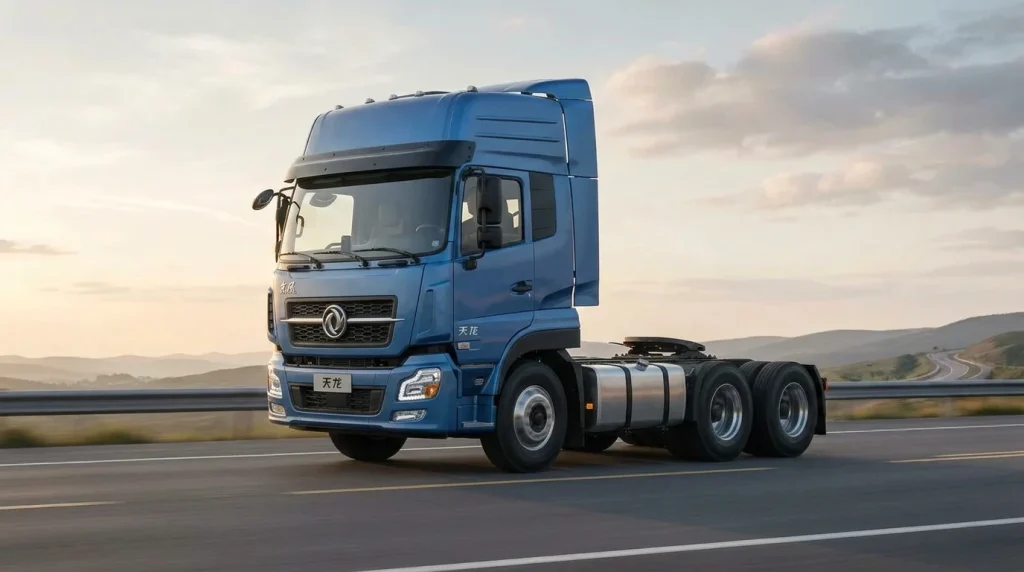
The wheel formula notation follows a straightforward logic. The first number represents the total wheel positions (hubs) on the vehicle, while the second indicates how many of those are powered, or driven.
So in a 6×4 layout, there are six wheel positions in total and four of them receive engine power. The vehicle uses one steering front axle and two rear drive axles arranged in a tandem group. This tandem group is what gives the truck its distinctive traction and load-bearing personality.
Importantly, this counting method treats dual-tire positions as a single hub. Therefore a rear tandem with dual tires on each side still counts as driven wheel positions, not individual tires. Understanding the drive axle wheel formula helps buyers quickly interpret spec sheets across different manufacturers.
Anatomy of a Heavy-Duty Tractor Unit
Every 6×4 tractor unit shares a set of core structural and mechanical components. Recognizing these parts helps operators evaluate quality and plan maintenance.
- Cab: Houses the driver, controls, and increasingly sophisticated comfort and safety systems. Available as day cab or sleeper depending on route length.
- Engine bay: Contains the diesel powerplant, cooling package, and supporting systems that generate the torque needed for heavy hauling.
- Chassis frame: The steel ladder frame that carries all loads and mounting points. Frame strength directly affects durability.
- Fifth wheel: The coupling plate that connects the tractor to the trailer kingpin, transferring load and steering forces.
- Tandem drive axles: Two powered rear axles that distribute payload and deliver traction across both units.
Together, these systems form a cohesive machine built for continuous heavy work. Weakness in any one area compromises the whole vehicle, which is why sourcing from a reputable supplier matters so much.
6×4 vs 4×2 vs 6×2: Configuration Comparison
To position the 6×4 correctly, buyers should understand how it compares against other common semi truck axle configurations. Each layout serves a distinct operational profile.
| Configuration | Total Axles | Driven Axles | Best Suited For |
|---|---|---|---|
| 4×2 | 2 | 1 | Light regional haul, flat terrain, fuel-priority routes |
| 6×2 | 3 | 1 | Higher payload with fuel savings on good roads |
| 6×4 | 3 | 2 | Heavy loads, grades, poor roads, maximum traction |
As the table shows, the 6×4 sacrifices a small amount of fuel economy for a substantial gain in traction and payload capability. For heavy-duty missions, that trade is almost always worthwhile.
6×4 Tractor Truck Specifications: Technical Deep Dive
Professional buyers evaluate measurable specifications long before signing a purchase order. This section examines the technical figures that matter most when comparing 6×4 tractor truck specifications across models and manufacturers.
Getting these numbers right ensures the vehicle can handle its intended workload without premature wear. Conversely, mismatched specs lead to overloaded components, poor fuel returns, and shortened service life.
Engine, Power Output & Torque Range
The heart of any heavy-duty tractor is its diesel engine. Modern 6×4 units typically feature displacements ranging from roughly 9 to 13 liters, though heavier applications may go larger.
Horsepower bands commonly span from about 340 hp to over 500 hp. Meanwhile, torque figures often exceed 1,800 Nm at the upper end, delivered across a broad, flat curve. This wide torque plateau is critical because it lets the truck pull heavy loads from low engine speeds.
Notably, torque matters more than peak horsepower in heavy hauling. A strong low-end torque curve reduces gear hunting on grades and improves overall drivability under load. Therefore, savvy buyers study the full torque curve rather than fixating on a single headline number.
Heavy-Duty Semi-Trailer Towing Capacity & GCWR
Gross Combination Weight Rating (GCWR) is arguably the single most important spec for hauling. It defines the maximum combined weight of the tractor, trailer, and cargo that the vehicle can legally and safely handle.
For typical 6×4 prime movers, GCWR often falls between 40 and 100 tonnes depending on configuration and market regulations. Specialized heavy-haul variants can exceed even these figures when equipped with reinforced drivelines.
Real-world heavy-duty semi-trailer towing capacity, however, depends on more than the number on paper. Route gradients, ambient temperature, altitude, and axle load limits all influence what the truck can practically move. Consequently, prudent operators build a safety margin into their calculations rather than running at the absolute rated ceiling.
Sample Specification Table
The following comparative table illustrates representative specifications across three hypothetical 6×4 model tiers. Use it as a framework for evaluating real quotations.
| Spec | Standard Tier | Heavy-Duty Tier | Extreme-Duty Tier |
|---|---|---|---|
| Horsepower | 380 hp | 440 hp | 500+ hp |
| Peak Torque | 1,700 Nm | 2,100 Nm | 2,500 Nm |
| GCWR | 40 tonnes | 70 tonnes | 100+ tonnes |
| Wheelbase | 3,600 mm | 3,800 mm | 4,000 mm |
| Fuel Tank Capacity | 400 L | 600 L | 800 L |
These figures demonstrate how power, weight rating, and fuel capacity scale together as duty demands increase. Matching the correct tier to your workload prevents both under-provisioning and wasteful over-specification.
Transmission & Drivetrain Options
Transmission choice significantly affects driver experience, fuel efficiency, and maintenance. Three main options pair with 6×4 drive axle configurations.
- Manual transmission: Offers simplicity, lower upfront cost, and easy field repair. Still popular in markets with limited service infrastructure.
- Automated Manual Transmission (AMT): Combines manual efficiency with automatic convenience. Reduces driver fatigue and optimizes shift points for fuel economy.
- Full automatic: Delivers the smoothest operation, especially in stop-start drayage. Typically the most expensive and complex option.
For long-haul operations, AMT has become the increasingly dominant choice. It balances economy, reliability, and comfort in a way that suits modern fleet priorities. To explore the full range of drivetrain options available, review the complete truck category listings from a specialized supplier.
The 6×4 Drive Axle Configuration Explained
The tandem drive axle setup defines the 6×4 platform. This section examines exactly how that configuration works and why it delivers such compelling advantages for heavy hauling.
How Tandem Drive Axles Distribute Load
In a tandem arrangement, two closely spaced rear axles share the vehicle’s rear-end load. This distribution keeps individual axle loads within legal limits even as total payload rises.
Because the weight spreads across two axles rather than one, each axle experiences lower stress. As a result, tire wear, suspension fatigue, and road damage all decrease relative to a single-axle equivalent carrying the same load.
Moreover, this arrangement improves stability. The longer effective footprint resists pitching and enhances control when hauling heavy or shifting cargo. These characteristics make the 6×4 configuration ideal for demanding commercial freight hauling applications.
Traction Advantages on Grades and Poor Roads
With two driven axles instead of one, the 6×4 puts engine power to the ground through twice as many contact points. This directly translates into superior traction.
On steep grades, the difference is dramatic. A single driven axle can easily lose grip when heavily loaded on an incline, whereas tandem drive axles maintain forward momentum far more reliably. Similarly, on muddy construction sites or unpaved routes, the extra driven wheels prevent bogging down.
While all-wheel drive prime movers offer even more traction, they add considerable cost and weight. For most heavy-duty road missions, the 6×4 hits the practical sweet spot between capability and economy.
Inter-Axle Differentials & Power Delivery
An inter-axle differential sits between the two drive axles to balance torque distribution. Its job is to allow the axles to rotate at slightly different speeds during cornering while still sharing driving force.
Many 6×4 units also feature a lockable inter-axle differential. When engaged, this lock forces both axles to turn together, maximizing traction in low-grip conditions such as ice, mud, or loose gravel.
Proper use of these differentials extends component life and prevents driveline windup. Consequently, driver training on differential operation pays real dividends in reliability and reduced repair costs.
Inside the Engine Lubrication System: The Critical Foundation
Lubrication is the unsung hero of heavy-duty reliability. Given the extreme duty cycles a 6×4 endures, its lubrication system must perform flawlessly for hundreds of thousands of kilometers.
Understanding how this system works helps operators maintain it correctly. In turn, disciplined maintenance dramatically extends engine life and protects a substantial capital investment.
How the Gerotor Oil Pump Works
At the center of the lubrication circuit sits the gerotor oil pump. This compact, efficient design uses two rotors to draw oil from the sump and push it under pressure throughout the engine.
The gerotor oil pump operates on a simple but elegant principle. As the inner rotor turns inside the outer rotor, the spaces between their lobes expand and contract. This expansion creates suction that pulls oil in, while the subsequent contraction forces it out under pressure.
Because this design has few moving parts and delivers steady flow, it suits the continuous high demand of heavy-duty engines. Reliable oil pressure keeps critical bearing surfaces protected even at sustained high loads.
Oil Pump Gears and Rotor Design
The geometry of the oil pump gears and rotor determines how much oil the pump moves per revolution. Inner and outer rotor profiles are precision-machined to minimize leakage between chambers.
A tighter clearance between rotors improves displacement efficiency, meaning more oil delivered per turn. This efficiency matters most at low engine speeds, such as idle or slow off-road crawling, when oil demand remains high but pump speed is low.
Wear on these rotors gradually reduces pumping efficiency over time. Therefore, monitoring oil pressure trends can reveal early rotor wear before it becomes a catastrophic failure.
Oil Pressure Relief Valve Function
Engines require oil pressure within a specific window. Too little pressure causes bearing failure, while too much can rupture seals or over-stress the system.
The oil pressure relief valve exists to prevent over-pressurization. When pressure exceeds a preset threshold, the valve opens and diverts excess oil back to the sump. This protects the entire lubrication circuit from damage.
During cold starts, oil is thick and pressure spikes rapidly. The relief valve is especially important in these moments, releasing surplus pressure until the oil warms and thins. A stuck or worn relief valve is a common yet often overlooked source of lubrication problems.
Oil Pickup Tube and Screen Maintenance
Before oil reaches the pump, it passes through the oil pickup tube and screen. This screen filters out large debris that could otherwise damage the pump or clog oil galleries.
Over time, sludge and contaminants accumulate on the screen. A partially blocked pickup restricts oil flow, starving the engine of lubrication precisely when it needs protection most. This scenario is a leading cause of expensive engine failures.
Regular inspection of the pickup tube and screen, typically during major service intervals, prevents this hidden risk. Using quality oil and changing it on schedule keeps the screen clear and the pump fed. For deeper technical guidance on component care, the knowledge base resources offer valuable maintenance references.
Lubrication System Maintenance Intervals
Following a disciplined maintenance schedule is the cheapest insurance available for a heavy-duty engine. The table below outlines representative service intervals for a hard-working 6×4 unit.
| Component / Task | Recommended Interval | Notes |
|---|---|---|
| Engine oil change | 15,000–25,000 km | Shorter for severe duty or dusty conditions |
| Oil filter replacement | Every oil change | Use OEM-spec filters |
| Oil pickup screen inspection | 100,000 km or major service | Check for sludge buildup |
| Oil pump inspection | 200,000–300,000 km | Assess rotor wear and pressure output |
| Relief valve check | During pump inspection | Verify free movement |
These intervals serve as a general guideline. Always defer to the manufacturer’s specific recommendations for your engine model and operating environment.
Key Benefits of Choosing a 6×4 Tractor Truck
Beyond raw specifications, the 6×4 platform delivers tangible operational value. This section connects its configuration features to the business outcomes that matter to fleet owners.
Superior Payload and Hauling Capacity
The tandem drive axle group allows the truck to carry more legal payload than lighter configurations. Because the load spreads across two axles, operators can maximize revenue per trip within axle-weight regulations.
For businesses moving dense, heavy freight, this capacity advantage is decisive. A single extra tonne of legal payload per load compounds into significant revenue over a vehicle’s lifetime.
Additionally, the robust driveline handles those heavy loads without excessive strain. This durability under load is exactly why the 6×4 remains the default choice for serious hauling.
6×4 Tractor Truck Fuel Efficiency Realities
It would be misleading to claim the 6×4 is the most fuel-efficient configuration. The extra driven axle adds rotational mass and rolling resistance, which does consume additional fuel.
However, diesel tractor truck fuel efficiency must be evaluated per tonne of freight moved, not per kilometer alone. When hauling near capacity, the 6×4 often delivers excellent fuel economy relative to the payload it carries.
Modern engine management, aerodynamic cabs, and AMT gearboxes have narrowed the gap further. Consequently, well-specified 6×4 units achieve fuel returns that surprise operators accustomed to older-generation trucks.
Durability and Extended Service Life
Heavy-duty design principles run throughout the 6×4 platform. Reinforced frames, robust axles, and stout drivelines are built to endure years of punishing use.
For commercial trucking fleet vehicles that accumulate high annual mileage, this durability is essential. A well-maintained unit can serve reliably for a million kilometers or more before major overhaul.
This longevity directly reduces the cost per kilometer over the vehicle’s life. In heavy-duty economics, durability and profitability go hand in hand.
Resale Value and Total Cost of Ownership
Total cost of ownership (TCO) considers far more than the purchase figure. It encompasses fuel, maintenance, downtime, and eventual resale value across the entire ownership period.
Well-built 6×4 tractors tend to retain strong resale value because demand for capable heavy haulers remains constant. A durable, well-documented truck commands a better price on the secondary market.
Therefore, the wisest buyers weigh long-term TCO rather than upfront cost alone. A slightly higher initial investment in quality frequently produces lower lifetime expenses. Companies with proven track records, such as those featured in verified cooperative case studies, demonstrate this value clearly.
6×4 Tractor Truck vs 4×2: Which Should You Buy?
The choice between 6×4 and 4×2 is one of the most common decisions buyers face. Getting it right depends on matching configuration to real operational needs.
Terrain and Route Considerations
Terrain is the single biggest factor in this decision. On flat, well-paved highways with moderate loads, a 4×2 often performs admirably while sipping less fuel.
However, the moment routes include steep grades, poor road surfaces, or unpaved sections, the 6×4 becomes essential. Its superior traction prevents the wheelspin and stalling that plague single-drive-axle trucks on demanding terrain.
Likewise, heavy loads shift the balance decisively toward the 6×4. When maximum payload is the priority, the tandem axle advantage is difficult to ignore.
Cost, Weight, and Efficiency Trade-Offs
Every configuration choice involves trade-offs. The table below summarizes the key differences buyers should weigh.
| Factor | 4×2 Tractor | 6×4 Tractor |
|---|---|---|
| Upfront cost | Lower | Higher |
| Fuel burn (empty/light) | Better | Slightly higher |
| Maximum payload | Lower | Higher |
| Traction on grades | Limited | Excellent |
| Maintenance complexity | Simpler | More components |
| Best terrain | Flat, paved | Varied, heavy-duty |
This comparison highlights why 6×4 vs 4×2 is never a one-size-fits-all answer. The correct choice flows directly from your specific operating profile.
Fleet Application Decision Framework
To simplify the decision, apply a straightforward framework based on your dominant operating conditions.
- Choose 4×2 if: routes are flat and paved, loads are moderate, and fuel economy is the top priority.
- Choose 6×4 if: routes include grades or rough surfaces, loads are heavy, or traction and durability are paramount.
- Mixed fleets: Many operators run both, assigning each configuration to the routes where it excels.
Ultimately, honest assessment of your real workload leads to the right answer. When in doubt, err toward the more capable 6×4 for heavy-duty missions.
Heavy-Duty 6×4 Tractor Truck Applications
The versatility of the 6×4 configuration shines across a wide range of industries. Understanding these applications helps buyers confirm the platform fits their sector.
Long-Haul Commercial Freight Hauling
Interstate and cross-border logistics represent the classic 6×4 use case. These operations demand vehicles that can run continuously at highway speeds while carrying maximum legal payload.
The platform’s durability and load capacity make it ideal here. Long-haul carriers value the ability to cover vast distances reliably, day after day, with minimal downtime.
Furthermore, the comfortable sleeper cabs available on these units support driver welfare on extended routes. This combination of capability and comfort keeps freight moving efficiently.
Construction, Mining & Bulk Material Transport
Construction and mining sites present some of the harshest conditions imaginable. Unpaved roads, steep gradients, and extreme loads test any vehicle to its limits.
Here the tandem drive axle traction becomes indispensable. The 6×4 pulls heavy trailers of aggregates, ore, or equipment across terrain that would defeat a single-drive-axle truck.
Its rugged construction also withstands the dust, vibration, and impact of off-road work. For bulk material transport, few configurations offer comparable dependability.
Container and Port Drayage Operations
Port drayage involves short, heavy hauls between terminals, yards, and warehouses. Though distances are short, container weights are substantial and stop-start cycles are frequent.
The 6×4 handles these dense loads with ease. Its robust driveline tolerates the constant coupling, maneuvering, and heavy pulling that characterize drayage work.
Automatic or AMT transmissions further ease the demanding stop-start rhythm. As a result, the platform remains a staple of container logistics worldwide.
Specialized Heavy Equipment Transport
Moving oversized or exceptionally heavy loads requires purpose-built capability. Lowboy trailers carrying excavators, cranes, or industrial machinery demand serious pulling power.
Heavy duty tractor units in 6×4 form provide the traction and torque needed for these specialized tasks. Their high GCWR ratings accommodate loads that lighter trucks cannot legally or safely handle.
For heavy equipment haulers, investing in a properly specified 6×4 is not optional but fundamental. The platform’s strength directly enables these high-value transport missions.
Leading 6×4 Tractor Truck Manufacturers & Models
The global market offers a rich selection of 6×4 manufacturers. This section surveys the landscape to help buyers navigate their options confidently.
HOWO Tractor Trucks Overview
HOWO tractor trucks have earned a strong reputation in the heavy-duty segment. Produced by a major Chinese heavy duty truck manufacturer, they combine robust engineering with competitive value.
These vehicles are widely deployed across emerging and established markets alike. Their reputation for durability under harsh conditions has made them a popular choice for demanding freight and construction applications.
Buyers appreciate the balance HOWO strikes between capability and cost. For operators seeking proven heavy-duty performance without premium pricing, the brand consistently ranks among the top considerations.
Foton Commercial Vehicle Lineup
Foton offers one of the broadest commercial vehicle ranges in the industry. Its lineup spans heavy tractors down to light commercial trucks and pickups, giving buyers exceptional flexibility.
Foton truck models are known for solid engineering and extensive dealer support in many regions. This breadth makes the brand attractive to fleets that operate diverse vehicle types under one supplier relationship.
For businesses seeking a single-source partner across weight classes, Foton’s comprehensive catalog is a genuine advantage. Learn more about product breadth and company background on the about us page.
Foton Tunland Price & Foton Pickup Specifications
While the 6×4 tractor is a heavy-duty platform, some buyers also evaluate lighter vehicles for support roles. The Foton Tunland pickup is a notable example, popular for its rugged utility.
Foton pickup specifications typically emphasize durability, decent payload, and capable diesel powertrains suited to work environments. The Foton Tunland positions itself as a practical workhorse for businesses needing a versatile utility vehicle.
Regarding pricing, values vary considerably by market, specification, and import factors. For accurate, current figures and Foton light truck payload capacity details, buyers should consult an authorized Foton commercial vehicle dealer directly. Reaching out through the contact page is the most reliable way to obtain up-to-date information.
Comparative Manufacturer Overview
The following table compares leading Chinese heavy duty truck manufacturers across key parameters. Use it as a starting reference when shortlisting suppliers.
| Manufacturer Focus | Typical Power Range | GCWR Focus | Market Positioning |
|---|---|---|---|
| HOWO heavy tractors | 380–500 hp | 40–100 t | Value heavy-duty haul |
| Foton heavy tractors | 360–480 hp | 40–90 t | Broad lineup, wide support |
| Foton light trucks | 120–180 hp | Light-medium | Utility and distribution |
| Premium heavy tractors | 440–550 hp | 70–120 t | Extreme-duty applications |
This overview illustrates the diversity available in today’s market. Matching manufacturer strengths to your operational needs is a crucial early step in procurement.
Sourcing 6×4 Tractor Trucks: Import & Supplier Guide
For international buyers, sourcing strategy is as important as vehicle selection. This section offers practical procurement guidance for fleet and import buyers.
Tractor Truck Import from China: What to Know
Importing a tractor truck from China involves several considerations beyond the vehicle itself. Regulations, certifications, and logistics all play decisive roles.
First, verify that the vehicle meets your country’s emissions and safety standards. Certification requirements vary widely, and non-compliant units can be refused entry or blocked from registration.
Second, plan the logistics carefully. Shipping method, port handling, customs clearance, and inland transport all affect landed cost and delivery timing. Working with an experienced supplier who understands export processes greatly reduces friction.
Selecting a Reliable China Truck OEM Supplier
Choosing the right China truck OEM supplier can make or break your import experience. Diligent vetting protects you from quality and reliability risks.
- Manufacturing credentials: Confirm production capacity, quality certifications, and export experience.
- Track record: Request references and review documented case histories with similar buyers.
- Communication: Responsive, transparent communication signals a supplier that will support you after the sale.
- Customization: Verify the supplier can meet your specification and compliance requirements.
A trustworthy partner adds value far beyond the transaction. Explore documented outcomes and buyer experiences among published cooperative case studies to gauge reliability.
Finding a Foton Commercial Vehicle Dealer
Access to a capable Foton commercial vehicle dealer significantly improves ownership confidence. Local dealer support ensures parts availability and technical assistance.
When evaluating dealers, prioritize those with established parts inventories and trained service technicians. A strong after-sales network minimizes downtime, which is critical for revenue-generating vehicles.
Additionally, dealers who understand your specific application can advise on the ideal specification. This expertise helps you avoid costly configuration mistakes at the point of purchase.
Warranty, Parts & After-Sales Support Checklist
Long-term ownership confidence rests on solid after-sales arrangements. Before committing, confirm these essential points.
- Warranty coverage: Understand duration, scope, and claim procedures.
- Parts availability: Verify local or expedited access to genuine components.
- Technical support: Confirm access to manuals, training, and remote assistance.
- Service network: Identify authorized service points along your operating routes.
Thorough attention to these factors safeguards your investment for years. For dedicated assistance with any of these concerns, the customer service team stands ready to help.
Buyer’s Decision Checklist: Selecting the Best 6×4 Tractor Truck for Hauling
With so many variables, a structured checklist keeps the buying process focused. This section distills the guide into actionable steps for professional purchasers.
Matching Specs to Your Operational Profile
Begin by documenting your actual operating conditions in detail. Consider typical load weights, route terrain, distances, and climate.
Next, align power, axle rating, and GCWR to those demands. The engine must deliver adequate torque for your grades, while the GCWR must comfortably exceed your heaviest combined weight with margin.
Finally, confirm the transmission and axle configuration suit your driving pattern. A stop-start drayage operation has very different needs from steady long-haul cruising. Matching specifications precisely prevents both under-provisioning and wasteful over-specification.
Budget vs Performance Priorities
Every buyer faces the tension between budget and performance. The key is to think in terms of total cost of ownership rather than sticker figures alone.
A cheaper truck that underperforms or requires frequent repair often costs more over its life. Conversely, investing in appropriate capability and quality typically yields lower cost per kilometer.
Therefore, define your non-negotiable performance requirements first, then optimize cost within that envelope. This disciplined approach consistently produces the best value. To browse a curated selection aligned with these principles, visit the main product homepage.
Frequently Asked Questions (FAQ)
What does 6×4 mean on a tractor truck?
The notation 6×4 describes the wheel formula. The first number, six, indicates the total wheel positions or hubs on the vehicle. The second number, four, indicates how many of those are powered by the engine. In practice, this means one front steering axle and two rear drive axles arranged as a tandem group.
How much can a 6×4 tractor truck tow?
Towing capacity depends on the specific model and its Gross Combination Weight Rating. Typical 6×4 units offer a GCWR ranging from around 40 tonnes to 100 tonnes, with specialized heavy-haul variants exceeding that. Real-world capacity also depends on terrain, altitude, and regulatory limits, so operators should always build in a safety margin.
Is a 6×4 more fuel-efficient than a 6×2?
Generally, a 6×2 is slightly more fuel-efficient on light or empty runs because it has only one driven axle, reducing rolling resistance. However, when hauling heavy loads on difficult terrain, the 6×4 provides superior traction and stability. Fuel efficiency should be judged per tonne of freight moved, where the 6×4 often performs very competitively under heavy load.
What is the lifespan of a 6×4 tractor truck?
With proper maintenance, a quality 6×4 tractor can reliably serve for a million kilometers or more before requiring major overhaul. Disciplined lubrication maintenance, timely servicing, and quality parts are the primary factors that determine longevity. Well-cared-for units frequently deliver many years of profitable operation.
Are Chinese 6×4 tractor trucks reliable for import?
Modern Chinese heavy-duty trucks have made significant quality strides and are widely used across global markets. Reliability depends heavily on choosing a reputable manufacturer and a trustworthy supplier. When buyers verify certifications, quality credentials, and after-sales support, imported 6×4 units can offer excellent value and dependable service.
How often should the oil pump and lubrication system be serviced?
Engine oil should typically be changed every 15,000 to 25,000 kilometers, with shorter intervals for severe duty. The oil pickup screen warrants inspection around every 100,000 kilometers, while the oil pump itself is usually inspected between 200,000 and 300,000 kilometers. Always follow the specific manufacturer recommendations for your engine and operating conditions.
Conclusion & Next Steps
The 6×4 tractor truck endures as the backbone of heavy-duty freight for compelling reasons. It delivers an unmatched combination of payload capacity, traction, and durability that lighter configurations simply cannot replicate.
Throughout this guide, we have examined the platform from every angle. From the drive axle wheel formula and lubrication system to real-world applications and sourcing strategy, the message is consistent: the 6×4 rewards buyers who understand and respect its engineering.
For operators moving heavy loads across demanding routes, this configuration remains the intelligent choice. Its balance of capability and long-term value continues to justify its dominance in the heavy-duty segment.
Ready to Equip Your Fleet? (Call to Action)
Now is the time to turn knowledge into action. Whether you are expanding your fleet or replacing aging units, the right 6×4 tractor truck can transform your operational efficiency and profitability.
Take the next step with confidence. Request detailed specifications, compare models, and connect with a verified China truck OEM supplier today. Browse the full truck category catalog to explore your options, or contact our team directly for personalized guidance tailored to your hauling needs.
Your next heavy-duty workhorse is within reach. Reach out now and equip your fleet for the demanding work ahead.