




China Heavy Duty Tractor Trucks: A 2026 Sourcing Guide for Fleet Operators & Importers—specs, costs, supplier tips & logistics insights.
For fleet operators, importers, and procurement teams navigating the global commercial vehicle market, China has become impossible to ignore. Over the past two decades, the country has transformed from a low-cost assembler into a genuine powerhouse of heavy truck engineering.
This guide exists to give industry professionals a practical, no-nonsense roadmap. Whether you manage a growing logistics operation in Africa, run a construction fleet in the Middle East, or import commercial units for resale in South America, the decisions you make around sourcing matter enormously.
We will walk through supplier selection, technical specifications, engine internals, import logistics, and total cost of ownership. Along the way, you will find comparison tables, real-world data points, and honest discussion of the pitfalls that trip up first-time buyers.
Sourcing a truck is easy. Sourcing the right truck, from the right partner, and landing it profitably in your market — that takes strategy.
Why Source Heavy Duty Tractor Trucks from China
The case for Chinese-built prime movers rests on three pillars: scale, price, and rapidly improving quality. Each of these deserves a closer look, because the reality on the ground has shifted dramatically in recent years.
China now produces more commercial vehicles than any other nation. That production volume creates a competitive supply base, mature component ecosystems, and export channels tuned for international buyers. For anyone evaluating heavy duty tractor trucks China offers, understanding this backdrop is the first step.
China’s Commercial Vehicle Manufacturing Landscape
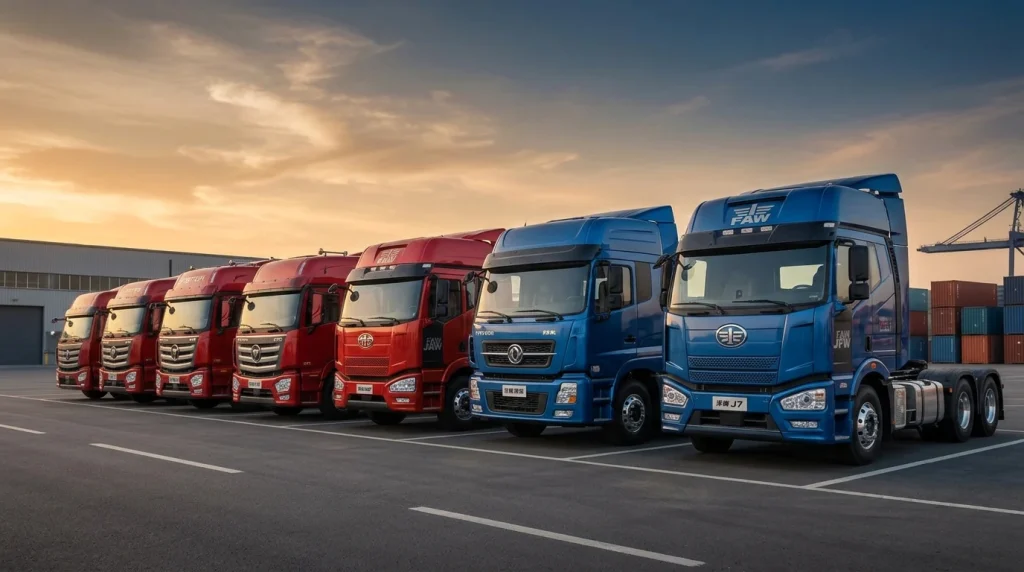
China’s heavy truck sector is enormous by any measure. Annual production of medium and heavy commercial vehicles regularly sits in the range of one to one-and-a-half million units, with a substantial share destined for export markets across Asia, Africa, and Latin America.
Export growth has been particularly striking. Chinese heavy truck exports climbed sharply through the early 2020s, driven by demand in developing economies and competitive pricing that Western brands struggle to match.
The table below summarizes recent industry figures to frame the discussion.
| Metric | Approximate Figure | Notes |
|---|---|---|
| Annual heavy truck production | ~900,000–1,100,000 units | Fluctuates with domestic demand cycles |
| Heavy truck export volume (recent) | ~250,000–320,000 units/year | Strong growth vs. prior decade |
| Major export destinations | Africa, Middle East, Southeast Asia, Latin America, CIS | Diverse regional footprint |
| Leading OEM market share | Top 5 brands ~80% of exports | Sinotruk, FAW, Dongfeng, Shacman, Foton |
These numbers illustrate why so many procurement professionals now shortlist Chinese manufacturers alongside — or ahead of — traditional European and Japanese suppliers.
Cost Advantages vs. Western and Japanese Brands
The most obvious draw is capital cost. A comparable 6×4 tractor unit from a leading Chinese OEM typically carries a substantially lower purchase price than an equivalent European or American tractor.
This gap stems from lower labor costs, integrated domestic supply chains, and immense economies of scale. Importantly, the savings are not confined to the sticker figure — financing, insurance, and initial parts stocking all scale down proportionally.
That said, savvy buyers look past the headline. The smarter question is always about landed cost and lifecycle economics, which we cover in detail later. For now, the takeaway is simple: on upfront capital, Chinese heavy duty trucks consistently deliver a meaningful advantage.
Quality Evolution and Global Certifications
Quality perceptions lag reality by several years, and nowhere is this truer than with Chinese trucks. Modern units from tier-one OEMs increasingly meet stringent international standards.
Emission compliance has advanced fast. Many export-grade engines meet Euro V or Euro VI equivalents, and manufacturers offer EPA-oriented configurations for markets that require them. For Gulf buyers, GCC certification is widely available, while ADR compliance supports hazardous-goods transport.
- EPA — configurations for North American and aligned markets
- Euro V / Euro VI — European emission tiers for cleaner operation
- GCC — Gulf Cooperation Council conformity for Middle East registration
- ADR — dangerous-goods transport compliance
Reputable partners such as Mettle Truck can help verify which certifications a specific model carries, saving buyers from costly homologation surprises at the port of entry.
Leading Chinese Heavy Duty Truck Manufacturers
Before comparing specifications, it helps to know the players. The Chinese heavy truck market is dominated by a handful of established brands, each with distinct strengths.
Understanding their positioning lets you match a manufacturer to your operational profile — long-haul, regional distribution, construction, or mixed-fleet duty.
HOWO (Sinotruk) Tractor Trucks
Sinotruk’s HOWO brand is arguably the most recognized Chinese heavy truck name in export markets. HOWO tractor trucks have earned a reputation for rugged simplicity and wide parts availability.
The HOWO range spans 6×4 and 8×4 configurations with engines commonly rated between 371 and 540 horsepower. These units excel in demanding environments where durability and easy field repair matter more than premium comfort.
Target markets include Africa, Southeast Asia, and the CIS region, where HOWO’s balance of price and toughness has built substantial brand loyalty over the years.
FAW, Dongfeng, and Shacman
Beyond Sinotruk, three other giants round out the tier-one group of Chinese heavy duty truck manufacturers.
FAW (First Automobile Works) is one of China’s oldest automakers, offering the J6 and JH6 tractor series with strong long-haul credentials. Its trucks are known for solid drivetrains and competitive fuel economy.
Dongfeng brings deep engineering heritage and a broad model lineup, frequently favored for regional distribution and versatile applications. Its partnerships with global brands have elevated component quality.
Shacman (Shaanxi Automobile) specializes in heavy haulage and construction, with the popular X3000 and F3000 series widely deployed in mining and infrastructure work. Buyers seeking a robust heavy duty tractor truck for punishing duty cycles often shortlist Shacman.
Foton Commercial Vehicles
Foton deserves special attention because of its breadth. Few manufacturers span the heavy, medium, and light segments as comprehensively, making Foton a natural choice for operators building mixed fleets.
From long-haul prime movers down to compact pickups, the Foton range allows a single supplier relationship to cover diverse vehicle needs — a genuine advantage for procurement efficiency.
Foton Auman Heavy Duty Tractor Units
The Foton Auman line targets the heavy end. These tractor units are engineered for long-haul and regional operations, with engine options frequently in the 380 to 500 horsepower band and both 6×4 and 6×2 layouts available.
Auman cabs increasingly feature ergonomic sleeper configurations, aiming to compete on driver comfort as well as capability. For fleets running extended routes, this focus on cab quality reduces fatigue and improves retention.
Typical applications include container haulage, bulk transport, and intercity freight, where the balance of payload capacity and reliability drives purchasing decisions.
Foton Tunland and Light Truck Range
At the lighter end, the Foton Tunland pickup and associated light commercial vehicles round out the portfolio. While Foton Tunland price positioning varies by market and specification, the platform is generally viewed as strong value in the mid-size pickup category.
Foton light truck payload capacity spans a useful range depending on model, making these units suitable for urban distribution, service fleets, and last-mile delivery. Typical Foton pickup specifications include turbo-diesel engines, dual-cab options, and payload ratings tuned for commercial rather than lifestyle use.
For buyers assembling a mixed fleet, sourcing both heavy tractors and light utility vehicles through one channel simplifies logistics. Working with an established Foton commercial vehicle dealer streamlines that process considerably. You can explore the full spectrum on the truck category page.
Supplier Comparison Table
The table below offers a high-level, side-by-side view. Price bands are shown qualitatively rather than numerically, in keeping with responsible sourcing practice — actual figures depend heavily on spec and volume.
| Manufacturer | Core Strength | Key Export Markets | Typical Warranty | Relative Price Band |
|---|---|---|---|---|
| HOWO (Sinotruk) | Rugged simplicity, parts availability | Africa, SE Asia, CIS | 1 yr / limited km | Value |
| FAW | Long-haul drivetrains, fuel economy | Africa, Middle East, LatAm | 1–2 yr | Mid |
| Dongfeng | Versatility, component quality | Global, broad reach | 1–2 yr | Mid |
| Shacman | Heavy haulage, construction | Middle East, Africa, mining regions | 1 yr | Mid-Value |
| Foton | Full-range coverage, mixed fleets | Global, diverse segments | 1–2 yr | Value–Mid |
Use this as a starting filter, then dig into model-level specifications for shortlisted candidates.
Understanding Tractor Truck Specifications
Specifications are where procurement decisions are won or lost. A truck that looks identical on a brochure can perform very differently under load, in heat, or on grades.
This section covers the technical fundamentals every professional buyer should evaluate before committing capital.
Engine and Horsepower Options
Engine choice drives everything downstream — fuel economy, gradeability, payload, and reliability. Most China truck OEM suppliers offer a tiered lineup to match different duty cycles.
Common displacement ranges from roughly 9 to 13 liters for heavy tractors, with power ratings spanning 340 to 540 horsepower. Emission tiers vary by destination, from Euro III in less-regulated markets up to Euro VI equivalents where required.
| Duty Profile | Typical Displacement | Power Range | Common Emission Tier |
|---|---|---|---|
| Regional distribution | 9–11 L | 340–400 hp | Euro III–V |
| Long-haul highway | 11–13 L | 400–500 hp | Euro V–VI |
| Heavy haulage / mining | 12–13 L | 440–540 hp | Euro III–V |
When in doubt, match engine rating to your heaviest routine gross combination weight, not your average load. Undersizing an engine is a common and expensive mistake.
6×4 Tractor Truck Specifications Explained
The 6×4 layout is the workhorse of global heavy transport, and understanding it thoroughly pays dividends. In this configuration, the truck has three axles total, with two of them driven.
Detailed 6×4 tractor truck specifications typically include a front steer axle plus a tandem rear drive-axle group. This arrangement delivers excellent traction and load distribution for heavy trailers.
- Front axle capacity — commonly 7–9 tons
- Rear tandem capacity — commonly 13–18 tons combined
- Fifth wheel — typically 50mm or 90mm king pin compatibility
- Wheelbase options — selected to balance maneuverability and stability
For most long-haul and heavy freight applications, the 6×4 remains the default choice — and the most widely stocked configuration among exporters.
Semi Truck Axle Configurations
Axle layout determines traction, legal payload, and cost. Understanding the main semi truck axle configurations helps you avoid over- or under-specifying your fleet.
| Configuration | Total Axles | Driven Axles | Best For |
|---|---|---|---|
| 4×2 | 2 | 1 | Light regional, good roads, fuel economy |
| 6×2 | 3 | 1 | Higher payload with lower fuel burn |
| 6×4 | 3 | 2 | Heavy haulage, mixed terrain, traction |
| 8×4 | 4 | 2 | Very heavy loads, tippers, mixers |
The choice among heavy duty tractor units hinges on load, terrain, and fuel priorities. A 6×2, for example, saves fuel on good roads but suffers on loose or steep ground compared to a 6×4.
Drive Axle Wheel Formula Guide
The notation like “6×4” is called the drive axle wheel formula, and reading it correctly prevents costly misunderstandings.
The first number is the total count of wheel positions (counting dual wheels as one). The second number is how many of those positions are driven. So a 6×4 has six wheel positions and four driven — meaning two driven axles.
- 4×2 — 4 wheel positions, 2 driven (one drive axle)
- 6×4 — 6 wheel positions, 4 driven (two drive axles)
- 8×4 — 8 wheel positions, 4 driven (two drive, two steer)
- 6×6 — 6 wheel positions, all six driven (full traction)
Getting the wheel formula right ensures you order a truck that physically matches your terrain and legal weight limits.
All-Wheel Drive Prime Movers
For off-road, construction, and mining fleets, all-wheel drive prime movers can be worth the premium. Configurations like 6×6 provide traction on unpaved, muddy, or steep ground where a 6×4 would spin.
The trade-off is cost, weight, and slightly higher fuel consumption. As a rule of thumb, specify all-wheel drive only when a meaningful share of your operating hours occur off sealed roads.
For predominantly highway operations, all-wheel drive simply adds expense without payback. Match the drivetrain to the job, not to the brochure.
Transmission, Cab, and Chassis Options
Beyond the driveline, three specification areas shape daily operation and driver satisfaction.
Transmission: Manual gearboxes remain popular for their simplicity and repairability, but automated manual transmissions (AMT) are gaining ground. AMTs reduce driver fatigue and can improve fuel economy on long routes.
Cab: Options range from day cabs for regional work to full sleeper cabs for long-haul. Sleeper comfort directly affects driver retention, an increasingly important consideration in tight labor markets.
Chassis: For heavy or overloaded conditions common in emerging markets, reinforced chassis frames and heavier suspension are worth specifying. Discuss frame thickness and cross-member design with your supplier upfront.
The Engine Lubrication System: What Buyers Must Know
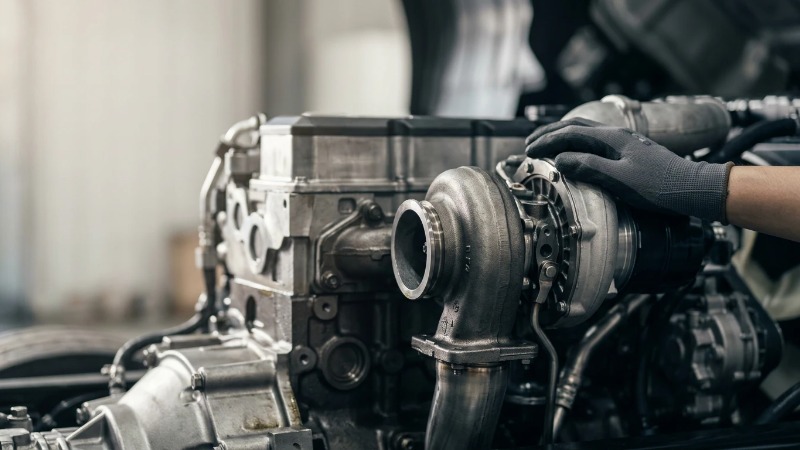
Here is a component category almost nobody scrutinizes during procurement — yet it quietly determines engine longevity. The engine lubrication system keeps everything alive under heavy-duty load.
A brief deep-dive here will make you a sharper buyer and a more credible negotiator when discussing durability with suppliers.
How the Engine Lubrication System Works
The lubrication system circulates oil to reduce friction, dissipate heat, and carry away contaminants. Under the sustained high loads a tractor truck endures, this system works constantly and hard.
When it fails — through pump wear, blockage, or pressure loss — engine damage follows quickly and expensively. That is why understanding its components matters for anyone buying at scale.
Reliable lubrication is the difference between an engine that lasts a million kilometers and one that grenades at 300,000. It deserves attention during spec review, not after a failure.
Gerotor Oil Pump and Component Breakdown
At the heart of the system sits the oil pump. Many modern heavy engines use a gerotor oil pump, a compact and efficient design that delivers consistent oil flow across engine speeds.
The gerotor pump relies on an inner and outer rotor with slightly different tooth counts. As they rotate, the changing cavity volume draws oil in and pushes it out — smooth, reliable, and durable.
The oil pump gears and rotor are precision components. Wear here reduces oil pressure and flow, so quality manufacturing tolerances are critical. When evaluating suppliers, asking about pump sourcing and tolerances signals a serious buyer.
Oil Pressure Relief Valve
The oil pressure relief valve protects the engine from excessive oil pressure, particularly during cold starts when oil is thick.
Without this valve, pressure spikes could damage seals, gaskets, and the oil cooler. When it opens, it diverts excess oil back to the sump, maintaining safe operating pressure.
A properly calibrated relief valve is a small part with outsized importance — a detail worth confirming on any engine you plan to run hard for years.
Oil Pickup Tube and Screen
The oil pickup tube and screen sit at the bottom of the system, drawing oil from the sump into the pump. The screen provides a first line of contamination control.
If this screen clogs — with sludge, debris, or degraded oil — flow drops and the engine can starve of lubrication. Regular oil changes keep the screen clear, but component quality also matters.
Together, these lubrication components form a chain where the weakest link determines engine life. Buyers who understand them make better long-term decisions.
Maintenance and Spare Parts Availability
All of this matters little if you cannot source parts in your market. Assessing OEM parts supply chains is a non-negotiable step before purchase.
Ask potential suppliers about parts warehousing, regional distributors, and typical lead times for consumables and wear items. A truck is only as serviceable as its parts pipeline.
The best partners maintain robust spares support. Detailed guidance on maintenance planning and OEM parts is available through the knowledge base, which is worth reviewing before you finalize any order.
How to Import Tractor Trucks from China
With specifications settled, attention turns to execution. The process of tractor truck import from China is well-trodden but detail-intensive.
Getting each stage right protects your capital and your delivery timeline. Here is the step-by-step framework professionals use.
Identifying Verified China Tractor Truck Suppliers
Your first task is separating genuine partners from opportunists. There are three broad supplier types to understand.
- OEM factories — direct manufacturers, best for large volumes and customization
- Authorized dealers — vetted intermediaries with factory backing and export experience
- Trading companies — flexible sourcing across brands, quality varies widely
When vetting China truck OEM suppliers, verify business licenses, export history, and physical facilities. Video factory tours, third-party audits, and reference checks are all standard due diligence. Learn more about a supplier’s credentials on the about us page.
Requesting Quotes and Negotiating Terms
Once you have shortlisted suppliers, request detailed quotations. Precision here prevents disputes later.
Clarify Incoterms explicitly — FOB, CIF, and CFR each shift responsibility differently. For volume buyers, buy Chinese tractor trucks wholesale arrangements can improve unit economics, though minimum order quantities apply.
Negotiate not just price but also spare parts packages, warranty terms, documentation, and delivery timelines. The cheapest quote rarely represents the best value once support is factored in.
Contracts, Payment, and Quality Inspection
A robust contract is your safety net. It should specify exact specifications, quantities, delivery dates, penalties for delay, and quality standards.
Payment structures commonly involve a deposit followed by balance against shipping documents. Letters of credit offer strong protection for larger orders, balancing risk between buyer and seller.
Never skip pre-shipment inspection. A qualified third-party inspector verifies that units match the contract before they leave China — catching problems while you still have leverage.
Shipping, Customs, and Homologation
Physical logistics come next. Two main shipping methods dominate for vehicles.
RoRo (Roll-on/Roll-off) is typically the most economical for drivable units, with trucks driven directly onto specialized vessels. Container shipping suits partially disassembled units or markets without RoRo port access.
On arrival, customs clearance, import duties, and homologation await. Destination-country registration often requires specific certifications and inspections, so plan homologation early rather than discovering requirements at the port.
Import Cost Breakdown Table
Landed cost is what actually matters. The table below shows the structure of a typical calculation, expressed as proportional cost categories rather than fixed figures.
| Cost Component | Description | Typical Weight in Landed Cost |
|---|---|---|
| FOB unit price | Vehicle cost at Chinese port | Largest single component |
| Ocean freight | RoRo or container shipping | Moderate |
| Marine insurance | Cargo protection in transit | Small |
| Import duties & taxes | Destination-specific tariffs | Variable, can be significant |
| Customs clearance & handling | Port and broker fees | Small |
| Homologation & registration | Certification and plating | Small to moderate |
| Inland transport | Port to final destination | Small |
Always model total landed cost before committing. Duties and homologation vary dramatically by country and can turn an apparent bargain into a break-even deal.
Evaluating Total Cost of Ownership
Purchase price is a starting line, not a finish line. True competitiveness reveals itself over years of operation.
Total cost of ownership (TCO) captures fuel, maintenance, downtime, warranty support, and resale value. This is where the smartest buyers make their money.
Fuel Efficiency and Operating Costs
Fuel is usually the single largest operating expense for commercial trucking fleet vehicles. Even small efficiency differences compound massively over a truck’s life.
Real-world fuel consumption for modern Chinese 6×4 tractors typically falls in the range of 30 to 40 liters per 100 km under laden highway conditions, depending on load, terrain, and driving behavior.
| Operating Condition | Approximate Consumption | Key Variable |
|---|---|---|
| Laden highway, flat | 30–34 L/100km | Aerodynamics, speed |
| Laden mixed terrain | 34–40 L/100km | Gradient, load |
| Heavy haulage / off-road | 40+ L/100km | Traction, weight |
Specifying an AMT and appropriate axle ratios, plus training drivers, can shave several percent off fuel bills — a direct boost to margin.
Warranty, Support, and Resale Value
After-sales network strength is easy to overlook and expensive to ignore. A strong local support presence dramatically reduces downtime.
Chinese OEMs have invested heavily in expanding overseas service and parts networks, though coverage still varies by region. Investigate the support footprint in your specific market before buying.
Resale value depends on brand recognition, parts availability, and general condition. Well-maintained units from established brands like HOWO and Foton tend to hold value better in markets where those brands are common. Our customer service team can outline the support structure available for each model.
TCO Comparison Table
The table below illustrates how different factors combine over a multi-year ownership period, ranked qualitatively.
| Factor | HOWO | FAW | Foton | Shacman |
|---|---|---|---|---|
| Purchase capital | Low | Moderate | Low-Moderate | Low-Moderate |
| Fuel efficiency | Good | Very Good | Good | Good |
| Parts availability | Excellent | Good | Good | Good |
| Resale value | Strong | Moderate | Moderate | Moderate |
| Best fit | Rugged duty | Long-haul | Mixed fleet | Heavy haulage |
There is no universal winner — only the best fit for your operating profile. Use TCO thinking to align the choice with how you actually run trucks.
Common Pitfalls and How to Avoid Them
Even seasoned importers stumble. The following risks account for most costly disappointments, and all of them are avoidable with discipline.
Forewarned is forearmed. Treat this section as a pre-purchase checklist.
Supplier Fraud and Verification Red Flags
Fraud remains a real risk in any high-value cross-border trade. Certain warning signs should trigger caution when selecting China tractor truck suppliers and manufacturers.
- Prices dramatically below the market norm
- Refusal to allow third-party inspection
- Requests for full payment upfront with no protections
- Inconsistent company details or unverifiable licenses
- Pressure to skip contracts or rush decisions
When any of these appear, slow down and verify. Legitimate suppliers welcome due diligence; fraudsters resist it.
Specification Mismatches and Regional Compliance
A truck that runs perfectly in China may be illegal to register in your market. Emission tiers, axle weight limits, and safety equipment requirements differ by country.
Confirm every regulatory detail before ordering — right-hand vs. left-hand drive, lighting standards, emission compliance, and permissible dimensions. Getting this wrong can strand vehicles at the border.
Document these requirements in the contract so responsibility is clear. A good supplier will proactively flag compliance considerations for your destination.
Parts and Service Gaps in Destination Markets
The most reliable truck becomes a liability if you cannot service it. Plan maintenance support before purchase, not after a breakdown.
Map out local dealers, independent workshops familiar with the brand, and parts stockists. Where gaps exist, negotiate an initial spare-parts package to cover the first year of operation.
Reviewing real deployment stories on the cooperative case page can reveal how other operators solved service challenges in similar markets.
Frequently Asked Questions
What is the minimum order quantity to import tractor trucks from China?
Minimum order quantities vary by supplier and vehicle type. Some OEMs and dealers accommodate single-unit or small orders for standard models, while wholesale pricing and full customization typically require larger volumes. Discuss your target quantity early, as it directly influences pricing, lead time, and negotiating leverage.
How long does delivery take when importing tractor trucks from China?
Total lead time combines production and shipping. In-stock standard units may ship within a few weeks, while custom-built configurations often require several weeks to a couple of months of production. Ocean transit then adds anywhere from two to six weeks depending on destination and shipping method. Homologation and clearance at arrival add further time, so build a realistic buffer into your planning.
Are Chinese heavy duty trucks reliable for long-haul operations?
Modern tier-one Chinese trucks have proven capable of demanding long-haul duty, provided you specify appropriately and maintain them properly. Choosing the right engine rating, transmission, and cab for the route matters enormously. Reliability also depends on adhering to service intervals and using quality lubricants and parts. Many operators run these trucks for hundreds of thousands of kilometers successfully.
What certifications should Chinese tractor trucks have for my market?
Required certifications depend entirely on your destination country. Common requirements include emission compliance (Euro tiers or EPA equivalents), GCC conformity for Gulf states, and ADR certification for dangerous-goods transport. Always confirm the exact regulatory requirements with your local authorities and ensure the supplier can provide matching documentation before ordering.
How do HOWO tractor trucks compare to Foton commercial vehicles?
HOWO tractor trucks are prized for rugged simplicity, wide parts availability, and strong resale in many export markets, making them ideal for demanding conditions. Foton commercial vehicles offer broader range coverage across heavy, medium, and light segments, which suits operators building mixed fleets. The better choice depends on whether you prioritize single-segment toughness or multi-segment fleet consolidation.
What warranty terms do Chinese heavy duty truck manufacturers typically offer?
Warranty coverage generally spans one to two years or a defined mileage limit, whichever comes first. Terms vary by manufacturer and often exclude wear items and consumables. The practical value of any warranty depends heavily on local service network strength, so always confirm how claims are handled in your specific market before purchase.
Get Started: Source Your Fleet with Confidence
Sourcing heavy duty tractor trucks from China is a genuine opportunity — but only when approached with strategy, diligence, and the right partner. You now have the framework to evaluate manufacturers, decode specifications, understand critical components, manage import logistics, and think in true total-cost terms.
The next step is to translate this knowledge into action. Whether you are placing your first order or scaling an existing fleet, expert guidance shortens the learning curve and protects your investment.
Ready to move forward? Here is how to begin:
- Request supplier introductions — get matched with verified manufacturers for your target models
- Download a specification checklist — ensure nothing critical is overlooked before ordering
- Speak with a sourcing consultant — receive a personalized quote tailored to your market and volume
Take the first step today. Contact our team to discuss your requirements, or browse the full lineup on the Mettle Truck homepage. With the right sourcing partner behind you, building a capable, cost-effective fleet from China is well within reach.
Source smart. Import with confidence. Operate profitably.