





Introduction
Bulk material haulage forms the backbone of every construction and mining project. Without reliable dumping vehicles, earthwork transport, rock hauling, and site cleanup will slow down drastically. In turn, project timelines stretch longer, and overall operational costs rise uncontrollably.
For fleet owners, contractors, and project managers worldwide, choosing the right tipper truck is never a random decision. It directly impacts daily output, long-term maintenance budgets, and overall project profitability. Different road conditions, load volumes, and working environments require completely different truck configurations.
In today’s global heavy machinery market, Sinotruk HOWO tipper trucks stand out as one of the most trusted options. Unlike overpriced Western brands and unstable local second-hand trucks, HOWO dump trucks balance durability, performance, and affordability perfectly.
Among its full product lineup, the 6×4 and 8×4 two axle configurations cover almost all mainstream engineering scenarios. However, most overseas buyers struggle to tell which model fits their business best. Many new buyers end up overspending on excess capacity or purchasing underpowered trucks that cannot handle daily workloads.
This practical guide breaks down every detail of HOWO 6×4 and 8×4 tipper trucks. It includes real usable specifications, on-site application differences, structural advantages, export customization options, and procurement advice. Unlike generic online articles, this content combines real export cases and long-term overseas operation experience.
Furthermore, this article aims to help you avoid common purchasing mistakes. It also helps you match the exact truck model based on your local road conditions, project types, and daily transportation volumes. For verified factory pricing and customized configurations, feel free to connect with the professional team at Mettlead Truck official website.
Why HOWO Tipper Trucks Dominate Global Engineering Markets
Before diving into model differences, it is essential to understand why HOWO tipper trucks maintain steady popularity across Africa, Southeast Asia, the Middle East, and Latin America. Its market dominance does not rely on marketing hype. Instead, it comes from field-verified performance and cost advantages.
First of all, HOWO trucks adopt industrial-grade reinforced manufacturing standards. All core load-bearing structures, including the main chassis, longitudinal beams, and cargo box, use thickened high-strength steel. This design resists deformation even under continuous heavy-load operation and harsh site conditions.
In addition, the overall failure rate of HOWO tipper trucks is extremely low. Every core component, from the engine and gearbox to the hydraulic lifting system, undergoes strict factory testing. For fleet operators, low failure rates mean fewer downtime losses and more stable daily project output.
Moreover, the cost-performance gap between HOWO trucks and other mainstream brands is obvious. Under equivalent load and power parameters, HOWO export trucks save nearly half of the total procurement cost. Meanwhile, global spare parts accessibility greatly reduces long-term maintenance pressure.
Besides hardware advantages, HOWO supports flexible export-oriented modifications. It adapts to different national traffic rules, emission standards, and road limitations. Whether you need right-hand drive conversion or standard emission adjustment, the factory can complete one-stop customization before shipment.
Lastly, mature cross-border export processes lower the threshold for overseas buyers. Professional suppliers can handle quality inspection, document sorting, customs declaration, and ocean shipping. If you want to learn systematic purchasing knowledge for Chinese engineering vehicles, you can browse our truck procurement knowledge base.
Basic Axle Layout Knowledge: 6×4 vs 8×4 Tipper Trucks
To select a suitable tipper truck, you must first master the logic of axle layout. Simply put, the axle number determines the maximum load capacity, driving stability, road adaptability, and service life of the vehicle.
The 6×4 configuration represents six total wheels and four driving wheels. It uses three axles in total. This layout is the most classic and mature solution for medium and heavy-duty engineering transportation. It balances flexibility, fuel consumption, and load capacity perfectly.
On the other hand, the 8×4 configuration means eight total wheels and four driving wheels. With four axles installed, the vehicle has an extra group of load-bearing axles. This structure disperses ground pressure greatly and improves overall heavy-load stability.
As a result, 6×4 tipper trucks are more suitable for general construction and medium-distance transportation. Meanwhile, 8×4 tipper trucks excel in super-heavy load, short-distance, and high-frequency mining scenarios.
In short, axle layout is the core factor that separates the application scenarios of these two models. Confusing the two will directly lead to increased fuel consumption, reduced operational efficiency, or even premature vehicle damage.
Complete Specifications of HOWO 6×4 Tipper Truck
The HOWO 6×4 tipper truck is the most widely used export-grade dump truck in the HOWO product series. It serves as the mainstream model for global municipal construction, road renovation, quarry stone transportation, and ordinary earthwork projects.
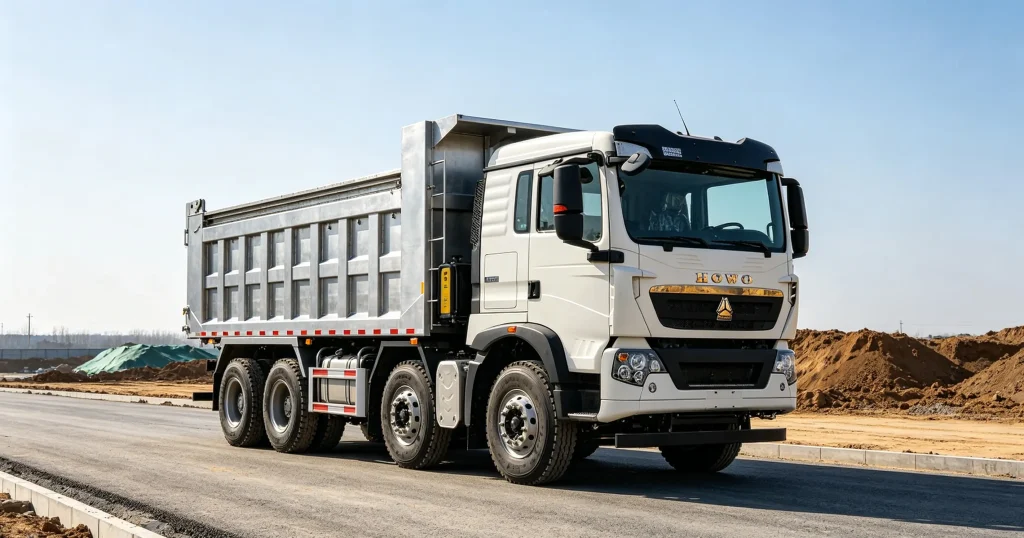
Overall Dimension & Weight: The standard vehicle length ranges from 9.5m to 11m, with a width of 2.5m and a height of 3.4m. The curb weight is approximately 12 tons. The standard safe load capacity ranges from 25 tons to 30 tons, fully meeting conventional engineering transportation needs.
Power Configuration: The most popular export power options include 371HP, 375HP, and 420HP Sinotruk original diesel engines. These engines feature low-speed high torque output. They perform stably during full-load startup, slope climbing, and muddy road driving.
Transmission System: It matches 10-speed or 12-speed manual gearboxes. The gear shifting logic adapts to engineering working conditions. It provides strong torque transmission and excellent wear resistance for long-term frequent operation.
Chassis & Suspension: Equipped with double rear drive axles and reinforced heavy-duty suspension systems. The thickened integral longitudinal beam effectively resists torsion. It avoids chassis deformation under long-term heavy-load working conditions.
Cargo Box Parameters: The standard cargo box size supports customized lengths from 5.6m to 6.8m. The plate thickness adopts 8mm floor and 6mm side plates as standard. Buyers can choose thickened wear-resistant plates according to mining and heavy stone transportation needs.
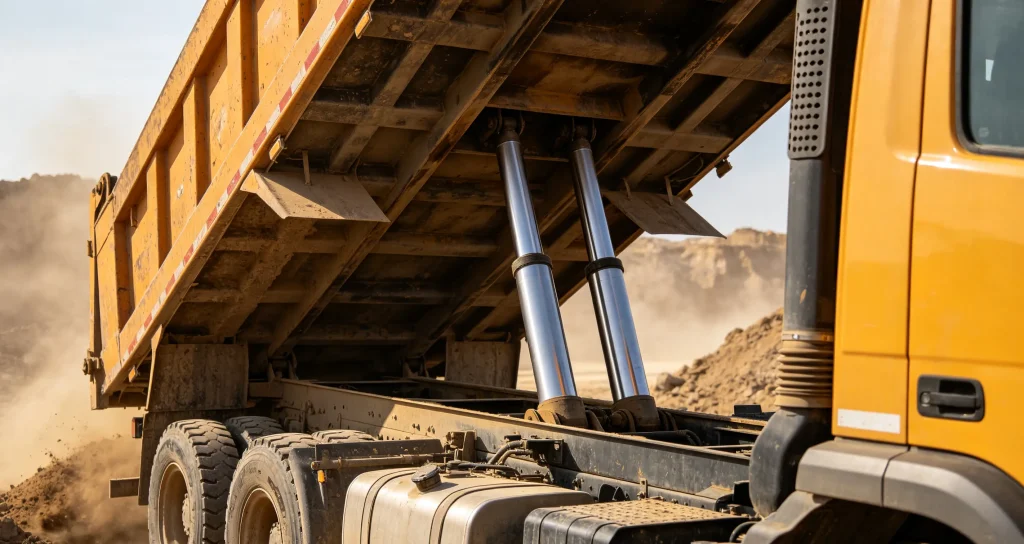
Hydraulic System: Adopts double-acting balanced hydraulic cylinders. The lifting process is stable and uniform. The whole unloading cycle takes only 20 to 30 seconds. The system features anti-leakage and anti-aging performance for long-term high-frequency use.
Applicable Working Conditions: This model fits urban municipal construction, highway maintenance, ordinary quarry transportation, rural infrastructure projects, and medium-distance bulk material haulage. It is flexible, fuel-efficient, and low-maintenance for daily engineering operations.
For buyers who focus on cost stability and versatile adaptability, the HOWO 6×4 tipper truck is always the priority choice. It covers over 70% of conventional engineering transportation scenarios worldwide.
Complete Specifications of HOWO 8×4 Tipper Truck
Different from the versatile 6×4 model, the HOWO 8×4 tipper truck is positioned as a super-heavy duty engineering dump vehicle. It targets high-load, high-intensity, and short-distance bulk transportation scenarios that require large single-vehicle throughput.
Overall Dimension & Weight: The total vehicle length extends from 11m to 12.5m. The width remains 2.5m, and the height is 3.5m. The curb weight reaches about 16 tons. Its standard safe load capacity can reach 40 tons to 45 tons, far exceeding the 6×4 model.
Power Configuration: The mainstream power versions are 400HP, 420HP, and 440HP high-power diesel engines. The maximum torque output is higher than the 6×4 model. It provides stronger power reserve for super-heavy load startup and climbing.
Transmission System: Equipped with 12-speed heavy-duty manual gearboxes with enhanced torque bearing capacity. The gear ratio is optimized for heavy-load starting and low-speed high-torque operation. It effectively avoids gear wear and power loss under full-load conditions.
Chassis & Suspension: Four-axle load-bearing structure greatly disperses ground pressure. The reinforced balanced suspension system adapts frequent bumpy road driving. The overall chassis rigidity is upgraded to cope with long-term ultra-heavy load operation.
Cargo Box Parameters: The cargo box length ranges from 6.8m to 8.2m. The box volume is significantly larger than the 6×4 model. The standard plate thickness is thickened accordingly. Wear-resistant and impact-resistant customized versions are available for mining scenarios.
Hydraulic System: Matched with high-flow multi-stage hydraulic cylinders. It supports stable lifting under 45-ton full-load conditions. The lifting speed is reasonable, and the reset is smooth. The system maintains stable performance even after thousands of continuous unloading cycles.
Applicable Working Conditions: This model is mainly used for open-pit mining, large-scale earth filling, port bulk cargo handling, and large quarry stone transportation. It improves single-vehicle transportation volume and greatly shortens project construction cycles.
In areas with flat site terrain and short transportation distances, the HOWO 8×4 tipper truck can significantly improve fleet operation efficiency. It is the best choice for large-scale engineering projects pursuing high daily output.
Core Structural Advantages of HOWO Tipper Trucks
Both HOWO 6×4 and 8×4 tipper trucks adopt Sinotruk’s mature heavy-duty vehicle manufacturing technology. Their structural design fully considers the complex and changeable characteristics of engineering working conditions.
First, the integral stamping chassis improves overall rigidity. The one-piece longitudinal beam avoids splicing gaps. It effectively resists torsion and impact during long-term bumpy driving and heavy-load unloading.
Second, the reinforced cargo box design enhances wear resistance. The high-strength steel plate body resists impact from stones, ores, and earth materials. It reduces local deformation and plate damage caused by frequent loading and unloading.
In addition, the optimized hydraulic protection structure prolongs service life. The hydraulic cylinder is equipped with dustproof and anti-collision devices. It avoids sand and mud erosion on construction sites, reducing hydraulic failure rates.
Moreover, the heat dissipation system is upgraded for engineering scenarios. Long-term full-load operation will not cause overheating. It ensures continuous and stable operation of the vehicle in high-temperature environments and high-intensity working states.
Finally, the cab adopts shock absorption and noise reduction design. It improves driving comfort for long-hour operators. Meanwhile, the overall safety structure reduces driving risks on complex construction roads.
Practical Application Scenarios of HOWO 6×4 Tipper Truck
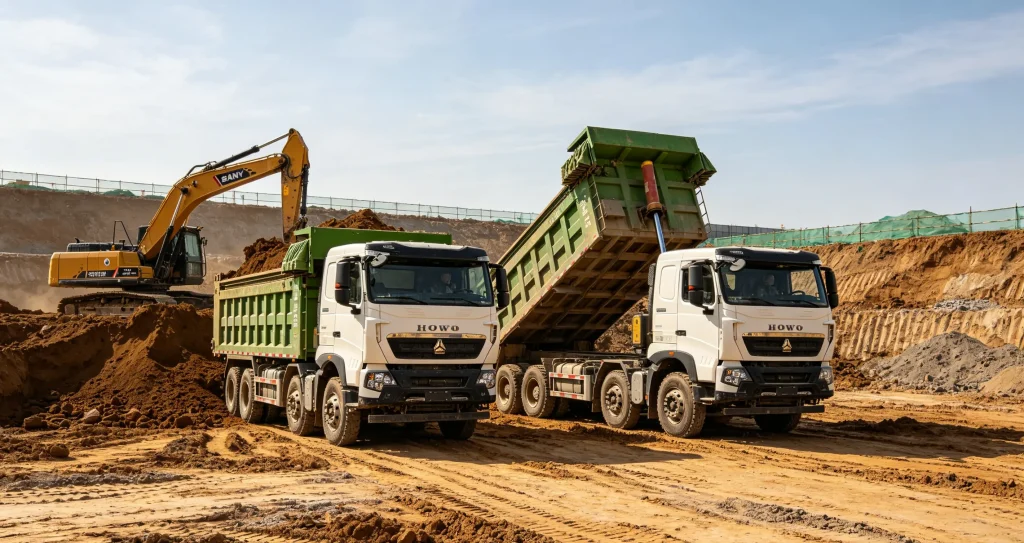
Thanks to its balanced performance and flexible adaptability, the HOWO 6×4 tipper truck covers the widest range of engineering scenarios. It is the most cost-effective model for small and medium-sized engineering fleets.
Municipal Construction Projects: For urban road renovation, community foundation backfilling, and urban garbage and construction waste transportation, the 6×4 model has moderate body size. It adapts to narrow urban road passages and meets urban load limit standards.
Highway & Road Infrastructure: During highway pavement paving, subgrade filling, and road slope repair, the 6×4 tipper truck balances fuel consumption and transportation volume. It is suitable for medium-distance material circulation and continuous operation.
Ordinary Quarry Transportation: For medium and small quarries producing sandstone and ordinary stones, the 25–30 ton load capacity fully meets daily output needs. It avoids resource waste caused by excessive vehicle configuration.
Rural & Remote Area Construction: Rural road conditions are relatively bumpy and narrow. The 6×4 model has flexible steering and strong road adaptability. It can pass complex rural road sections stably without chassis scratching.
Water Conservancy Projects: River dredging, reservoir foundation backfilling, and water conservancy earthwork transportation all require stable and durable dump trucks. The 6×4 model’s low failure rate ensures uninterrupted project progress.
In general, if your project involves diversified working conditions and mixed transportation needs, the HOWO 6×4 tipper truck will bring the highest comprehensive return on investment. It is also the most popular export model in full HOWO heavy truck product lineup.
Practical Application Scenarios of HOWO 8×4 Tipper Truck
The HOWO 8×4 tipper truck targets high-load and high-efficiency engineering scenarios. It focuses on large-scale projects that pursue single-vehicle high throughput and short-cycle construction.
Open-Pit Mining Operations: Mining sites have large material reserves and short transportation distances. The 40+ ton super load capacity greatly reduces the number of round trips. It effectively improves ore and soil transportation efficiency for mining enterprises.
Large-Scale Land Reclamation: Land filling and foundation earthwork require massive bulk material transportation. The large-volume cargo box of the 8×4 model cuts down construction time significantly and accelerates project progress.
Port & Terminal Bulk Handling: Ports need continuous and high-frequency bulk cargo transportation. The 8×4 tipper truck’s stable heavy-load performance adapts uninterrupted shift work, reducing fleet replacement frequency.
Large Quarry Hard Rock Transportation: Large quarries produce heavy hard rock materials. The 8×4 reinforced cargo box and super load-bearing chassis resist heavy impact and long-term high-load operation wear.
National Key Infrastructure Projects: Large-scale highway networks, bridge foundations, and industrial park construction require massive earthwork. The high efficiency of the 8×4 model can perfectly match large-scale project construction rhythms.
If your business focuses on large-scale heavy engineering and pursues maximum daily output, the HOWO 8×4 tipper truck is the most professional and efficient choice.
HOWO 6×4 vs 8×4 Tipper Truck: How to Choose for Your Business
Many buyers struggle with model selection simply because they lack clear scenario matching standards. Here is a straightforward and practical selection guide based on real export experience.
Choose HOWO 6×4 Tipper Truck if: Your projects are mainly municipal works, road maintenance, medium and small quarries, and medium-distance transportation. You have limited fleet budgets and pursue low daily fuel consumption and low maintenance costs. Your local roads have load restrictions and narrow passage limits.
Choose HOWO 8×4 Tipper Truck if: You focus on mining, large earthwork, port transportation, and large quarry projects. Your working distance is short, and you need extremely high daily transportation volume. Your site terrain is flat without strict load restrictions, and you prioritize construction efficiency over fuel savings.
In short-distance heavy-load scenarios, the efficiency improvement of the 8×4 model far outweighs the slight increase in fuel consumption. In medium-distance mixed scenarios, the 6×4 model’s cost performance is more prominent.
Export Customization Options for HOWO Tipper Trucks
One of the biggest advantages of exporting HOWO trucks is flexible personalized customization. Factory modifications fully comply with local policies and working condition needs of different countries.
Left-Hand Drive & Right-Hand Drive Conversion: The factory supports free switching between LHD and RHD. It meets road traffic rules in Southeast Asia, Africa, and other right-hand traffic regions. All modification procedures follow export standard specifications.
Multi-Emission Standard Matching: It supports Euro 2, Euro 3, Euro 4, Euro 5, and Euro 6 emission configurations. Buyers can select corresponding standards according to local customs clearance and road driving requirements.
Cargo Box Customization: Adjust box length, height, plate thickness, and wear-resistant layers. Special anti-corrosion treatment is available for humid and corrosive working environments.
Chassis & Height Adjustment: Optimize chassis height for bumpy mountain roads or flat urban roads. Adjust suspension hardness to adapt to local road quality.
Appearance & Functional Configuration: Customize paint colors, logo styles, and auxiliary lighting systems. Add toolboxes, protective plates, and anti-slip devices according to usage habits.
All customized vehicles complete factory debugging before delivery. No secondary modification is needed locally. To learn standardized export modification rules, you can check right-hand drive export modification standards.
Import Process & Shipment Guide for Overseas Buyers
For first-time Chinese truck importers, the cross-border procurement process may seem complicated. In fact, standardized export suppliers can simplify the whole process into clear steps.
Step 1: Demand Confirmation Clarify project type, load demand, local road rules, emission requirements, and quantity. Professional sales teams provide targeted model and configuration matching solutions.
Step 2: Quotation & Contract Signing Confirm unit price, customization content, delivery cycle, payment terms, and shipping methods. Sign a formal export contract to guarantee both parties’ rights and interests.
Step 3: Production & Quality Inspection Arrange factory production according to customized requirements. Complete full vehicle quality inspection, performance testing, and parameter calibration before leaving the factory.
Step 4: Document Preparation Sort out export invoices, packing lists, factory qualification certificates, vehicle inspection reports, and customs clearance documents to ensure smooth customs clearance.
Step 5: Ocean Shipment & Tracking Arrange container loading or bulk carrier shipment. Provide real-time shipping tracking information until the goods arrive at the destination port.
Step 6: After-Sales Docking Provide destination port guidance, vehicle commissioning guidance, and long-term spare parts supply support.
If you want to master the complete cross-border truck purchasing process, refer to our detailed complete Chinese heavy truck import tutorial.
After-Sales Service & Spare Parts Support
After-sales service is the core guarantee for long-term vehicle operation. Many overseas buyers worry about difficult spare parts procurement and lagging technical support after purchasing Chinese trucks.
In fact, HOWO series trucks have a global mature spare parts system. Core wearing parts, engine parts, hydraulic accessories, and chassis parts are universally available and affordable.
Professional export suppliers provide long-term spare parts supply services. They can quickly deliver required accessories to destination ports, avoiding long-term vehicle shutdown caused by part shortages.
In addition, remote technical support is available 24/7. Professional engineers solve daily operation faults, maintenance problems, and commissioning issues through online guidance.
For large fleet orders, on-site technical training and after-sales docking services can be provided. To inquire about exclusive after-sales and quotation services, you can submit factory direct quotation request.
Real Global Cooperation Cases
Up to now, HOWO 6×4 and 8×4 tipper trucks have been exported to more than 50 countries and regions worldwide. They have accumulated a large number of verified on-site operation cases.
In West African regions such as Nigeria and Ghana, a large number of HOWO 6×4 tipper trucks serve local road construction and municipal renovation projects. Their stable performance and low maintenance costs are highly recognized by local contractors.
In Central Asian mining areas such as Uzbekistan and Tajikistan, customized HOWO 8×4 heavy-duty tipper trucks undertake local ore transportation tasks. The super load capacity greatly improves mining output efficiency.
In Southeast Asian countries such as Kenya and Tanzania, mixed fleets of 6×4 and 8×4 models match local diversified engineering needs. They cover urban construction, road upgrading, and quarry transportation scenarios.
These real overseas cases fully prove the strong environmental adaptability and scenario matching ability of HOWO tipper trucks. You can browse more real project displays via global customer cooperation cases.
Frequently Asked Questions About HOWO Tipper Trucks
Q1: What is the main difference between HOWO 6×4 and 8×4 tipper trucks?
A1: The core difference lies in axle quantity and load capacity. The 6×4 model focuses on medium-load, flexible, and fuel-saving conventional engineering scenarios. The 8×4 model targets super-heavy load, high-efficiency, and short-distance large-scale projects.
Q2: Can HOWO tipper trucks be modified for right-hand drive?
A2: Yes. The factory supports full RHD customization. All modifications comply with export standards and local traffic rules, ensuring legal road driving.
Q3: What is the delivery cycle for export HOWO tipper trucks?
A3: Standard stock models can be delivered within 7–10 days. Customized models require 15–25 days of production cycles, depending on modification content.
Q4: Are spare parts easy to obtain overseas?
A4: Absolutely. HOWO has a complete global spare parts supply system. All common wearing parts can be supplied stably with low prices and fast delivery.
Q5: What payment terms are supported for export orders?
A5: Flexible terms including T/T and L/C are supported. Formal export contracts are signed to protect the legitimate rights and interests of both buyers and sellers.
Conclusion
HOWO 6×4 and 8×4 tipper trucks are two core mature models in Sinotruk’s heavy-duty engineering vehicle series. They cover medium-load conventional engineering and super-heavy load large-scale engineering scenarios respectively, forming a complete and efficient product matching system.
The 6×4 tipper truck wins by flexibility, fuel economy, and ultra-high cost performance. It is the best choice for small and medium-sized fleets and diversified conventional projects. The 8×4 tipper truck relies on super load capacity and high operational efficiency to serve large-scale mining, earthwork, and infrastructure construction projects.
Both models inherit HOWO’s military-grade manufacturing quality, low failure rate advantages, and flexible export customization capabilities. For global engineering buyers, choosing the right model according to actual working conditions is the key to maximizing project profits.
Whether you need standard factory models or personalized customized solutions, you can obtain one-stop professional export services and competitive factory prices through Mettlead Truck.