




Introduction
Fleet operators, construction contractors and vehicle dealers across the world keep searching for practical commercial transport solutions. Rising operational costs put heavy pressure on business budgets, so many decision-makers start looking for cost-effective alternatives to well-known western commercial vehicle brands.
Even though premium western commercial trucks deliver stable performance, their high unit price and expensive spare-part supplies eat into profit margins year after year. Used commercial trucks may lower upfront spending, yet hidden mechanical wear and lack of official factory support create unexpected risks for daily business operations.
For this reason, more overseas businesses turn to commercial trucks for sale from China. Chinese commercial vehicle manufacturers cover a full spectrum of truck categories, ranging from light-duty delivery vehicles up to heavy-haul tractor units and special engineering trucks. These vehicles adapt to diverse road conditions, climate zones and local working scenarios in different global regions.
Besides competitive pricing, modern Chinese commercial trucks come with flexible configuration options and mature export-oriented supporting services. Still, cross-border import comes with many hidden details. Without proper guidance, first-time buyers can easily fall into procurement traps, face customs clearance delays or receive units that fail local regulatory standards.
This complete import guide walks you through real-world buying experience, supplier screening, model selection, customization, document preparation and risk avoidance. If you want to check genuine factory-export vehicle displays, you can visit Mettlead Truck official website. Our team has supported hundreds of overseas commercial truck procurement projects for fleet buyers and resellers worldwide.
Why Global Businesses Choose Chinese Commercial Trucks
Multiple practical factors push global buyers toward Chinese commercial trucks, rather than relying only on low-price attraction. Each advantage directly addresses real-world pain points that commercial vehicle operators face day-to-day.
First of all, the overall cost-performance level stands out. Compared against equivalent-spec western commercial models, Chinese factory-new trucks reduce total investment significantly. This benefit becomes far more obvious when you carry out bulk fleet procurement. As a result, business owners can allocate more capital to site expansion, driver recruitment and other core operational links.
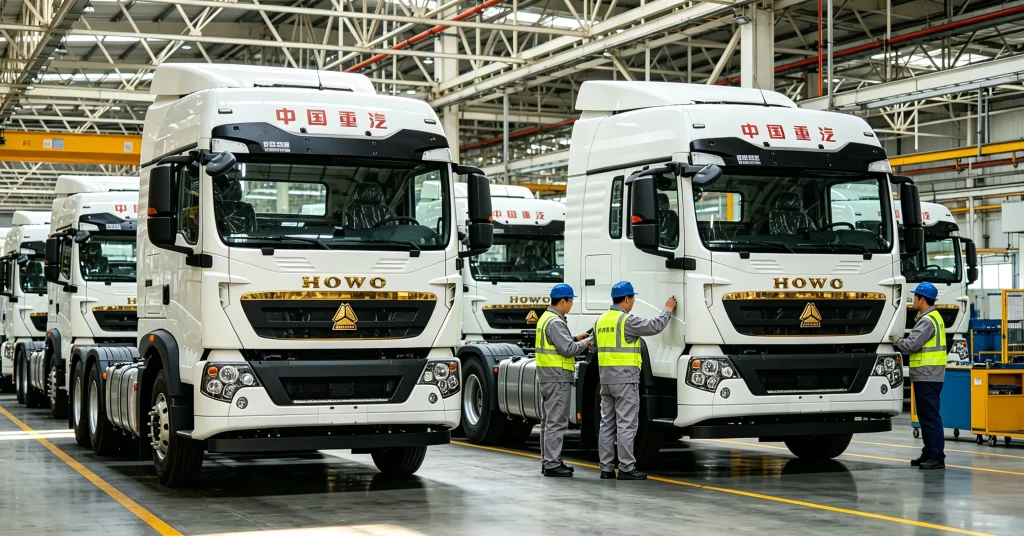
On top of pricing benefits, China owns a complete industrial supply chain for commercial vehicle production. Major manufacturers independently produce core assemblies including engines, gearboxes, chassis frames and braking systems. Every production link follows layered quality inspection workflows before finished vehicles roll off assembly lines.
In addition, strong configuration flexibility represents another major selling point. Since each country maintains unique traffic rules, emission requirements and actual working environments, one fixed vehicle setup cannot satisfy every overseas market. Reputable Chinese exporters can adjust steering position, power output, cargo-box structure and emission standards to match local market access rules.
Furthermore, spare-part availability supports long-term fleet running. A large volume of Chinese commercial truck accessories circulates in global markets. When vehicle components wear out under heavy-duty work, buyers can source replacement parts without facing extremely high costs or long waiting periods. This factor effectively cuts down vehicle downtime for your whole fleet.
Meanwhile, mature one-stop export services simplify complicated cross-border procedures. Instead of learning international trade knowledge from scratch, business buyers can cooperate with qualified exporters who handle documentation, shipping arrangement and pre-shipment inspection. If you want to understand how qualified suppliers organize overseas delivery workflows, you can read our article about how to choose a heavy truck manufacturer in China.
Main Categories of Commercial Trucks for Export from China
Chinese commercial truck factories produce rich product lines covering light, medium and heavy-duty grades. Different truck types serve separate business purposes, so clarifying your actual operation scenarios helps you narrow down suitable models quickly.
Before you place bulk orders, you need to confirm core operating parameters, such as typical cargo weight, daily driving distance, road surface condition and local regulatory limits. Blindly selecting popular export models without matching real-world usage will cause low operation efficiency and extra long-term loss.
Tractor Head Trucks for Inter-Regional Freight
Tractor heads belong to high-demand commercial truck products for international logistics businesses. They connect with different semi-trailers to finish container hauling, bulk-material transportation and large-cargo delivery tasks. Most export-oriented tractor-head models come with multiple horsepower options to fit light or heavy hauling demands.
These commercial vehicles focus on highway driving stability and fuel-saving performance. Reinforced chassis structures cope with long-time continuous running across intercity routes. Many global logistics fleets purchase tractor-head units in batches to expand their transport capacity. You can view real product specifications of mainstream export tractor units on our product category page.
Dump Trucks for Construction and Mining Operations
Dump trucks count as core commercial equipment for infrastructure building, mine exploitation and earth-moving projects. They transport gravel, ore, construction soil and waste materials on rough job-site terrain. 6×4 and 8×4 layouts represent the most common export configurations for overseas engineering projects.
Export-grade dump trucks usually adopt thickened wear-resistant cargo boxes and strengthened load-bearing components. Such upgrades help vehicles withstand frequent impact, dust erosion and round-the-clock cyclic operation. Buyers working in mining zones or large-scale road projects often prioritize these heavy-duty commercial truck units.
Cargo and Stake Trucks for Short-Haul Distribution
Cargo box trucks and stake-body commercial trucks suit short-distance urban and rural distribution work. Local commodity delivery, agricultural product circulation and small-batch freight businesses rely heavily on these practical vehicles. Their relatively compact body allows smooth travel on narrow streets and winding country roads.
Stake structures fix loose goods and prevent cargo sliding during transit. Light-to-medium-duty commercial trucks of this type consume moderate fuel and require only routine simple maintenance. They work well for small-scale transport companies and individual fleet operators in emerging markets.
Special-Purpose Commercial Engineering Trucks
Special-purpose commercial trucks cover multiple municipal and industrial scenarios. This category includes concrete mixers, fuel tank trucks, water sprinklers, garbage collection trucks and other custom-built commercial vehicles. Every special-use truck gets modified on standard heavy-duty truck chassis according to functional requirements.
Different cities and regions hold distinct standards for special-vehicle dimensions, tank capacity and equipment layout. Reliable Chinese commercial truck exporters can adjust body structures so finished vehicles satisfy local municipal inspection rules. For overseas buyers who run municipal service projects, custom special commercial trucks bring strong practical value.
Key Standards to Screen Qualified Chinese Commercial Truck Suppliers
A large number of trading companies advertise commercial trucks for sale from China online, yet service capability and product quality vary widely among different vendors. Some unqualified intermediaries attract orders with surprisingly low offers, but they deliver non-original vehicles, incomplete paperwork or almost zero after-sales support. Therefore, supplier verification becomes a critical step before you spend any deposit.
First, check whether the supplier holds valid OEM authorization documents from mainstream Chinese commercial truck brands. Formal authorization proves that the exporter can obtain genuine factory-new vehicles directly from original manufacturers. Without such certification, you face higher risks of receiving refurbished or reassembled trucks disguised as brand-new stock.
Second, verify international certification files including CE, ISO and SGS reports. These documents play an important role during destination-country customs clearance. Missing or falsified certificates may trigger cargo detention at ports and generate unexpected extra expenditure.
Third, look into the supplier’s historical overseas project records. Real-world cooperation cases reflect how well the team understands foreign import policies and on-site vehicle-usage conditions. You can browse verified project feedback through our cooperative-case page to get a clearer picture of real export-project workflows.
Fourth, confirm customization capacity. Ask whether the vendor can adjust steering mode, emission grade and vehicle body structure for your target market. If a supplier only sells fixed-spec ready-stock trucks without modification support, those vehicles may fail local regulatory requirements after arrival.
Fifth, pay attention to quotation transparency. Trustworthy exporters list every configuration item, service content and fee in formal written quotes. Watch out for vague oral commitments and abnormally low pricing far below normal market ranges. If you want to learn more about picking proper vendors, our related article about China heavy truck manufacturer for global truck buyers offers further practical reference.
Sixth, evaluate after-sales and spare-part supply capability. Cross-border commercial-truck investment represents long-term asset spending. When breakdowns happen in later operation phases, slow spare-part delivery will paralyze your fleet’s daily work. Hence, you need to confirm the supplier’s global spare-part logistics mechanism before signing contracts.
How to Match Commercial Truck Models With Your Actual Business Needs
Even high-quality commercial trucks cannot create expected returns if the model does not fit your business scenarios. Many overseas buyers focus merely on unit price and ignore scenario matching, which creates hidden economic losses in later operation stages.
Start by sorting out your core business attributes. Clarify whether your business focuses on long-distance highway logistics, mine-site earth-moving work, urban commodity distribution or municipal engineering tasks. Different operation environments set completely different requirements for power output, load-bearing capacity and vehicle body structure.
For long-distance cross-regional freight projects, tractor-head commercial trucks become your primary choice. You should select suitable horsepower according to average cargo weight and common driving routes. For mining and heavy construction sites, prioritize reinforced dump-truck units with wear-resistant cargo boxes and strong chassis performance.
Short-haul urban and rural distribution businesses gain maximum value from medium-duty cargo or stake-body commercial trucks. When you run municipal-service related projects, you need to pick special-purpose modified commercial trucks built upon qualified heavy-duty chassis.
Besides working scenarios, you also need to consider local objective conditions. Local road quality, average ambient temperature, humidity levels and official emission regulations all influence your final configuration decisions. For hot-climate zones, you can request enhanced heat-dissipation and dust-proof upgrades. For humid coastal areas, anti-rust chassis treatment will extend vehicle service life.
Moreover, think over your fleet-scale planning. Small-scale business operators may start with a small quantity of trial-order commercial trucks to test market feedback. Large dealers and big fleet enterprises can carry out bulk procurement to get better unit-cost advantages. Our contact-us page allows you to send your real-world business parameters so our sales team can recommend targeted commercial-truck solutions for your project.
Practical Customization Options for Export-Oriented Chinese Commercial Trucks
Standard factory base-model commercial trucks are designed for domestic Chinese market demands. In most cases, base versions cannot directly satisfy overseas market access rules. This makes reasonable factory-level customization indispensable for import buyers.
Steering-wheel position adjustment stands as one of the most frequent modification items. Many countries implement right-hand-drive traffic rules, while original Chinese factory stock uses left-hand drive. Qualified manufacturers finish steering-system conversion inside factories instead of conducting crude secondary refitting after vehicles leave assembly lines. Factory-completed modification guarantees overall vehicle reliability and avoids hidden safety hazards.
Emission-standard adjustment represents another essential customization item. Different countries enforce different exhaust-emission policies. Chinese commercial truck factories support multiple emission grades ranging from Euro 2 up to Euro 6. You must confirm local official emission requirements clearly before production starts, otherwise imported commercial trucks cannot register and run legally in destination territory.
Body-structure customization covers many flexible items. Buyers can adjust cargo-box thickness, internal compartment layout, tank capacity for special-purpose vehicles and exterior marking printing. These custom settings help commercial trucks adapt to local job-site habits and even support corporate brand building for fleet enterprises.
Climate-oriented component upgrades serve special-environment markets. For high-temperature desert regions, suppliers can upgrade cooling systems and dust-filtering assemblies. For rainy and humid territories, anti-corrosion chassis processing and waterproof electrical-system treatment will reduce later-stage breakdown frequency.
It is worth noting that all key customization work should happen during factory production. Post-factory manual refitting by third-party workshops will damage vehicle original performance and invalidate relevant certification documents. Unqualified post-assembly refitting also creates obstacles for customs clearance and local vehicle registration.
Full Step-by-Step Import Workflow for Buying Commercial Trucks from China
For first-time overseas buyers, cross-border commercial-truck import may look like a very complicated process. In reality, with support from a professional export partner, you do not need deep-specialized international-trade background to complete the whole procurement flow. The following steps show real-world operating logic for factory-direct commercial-truck import.
First, sort out your complete procurement requirements. Record truck category, target quantity, needed horsepower, steering mode, emission standard, local working-environment features and expected delivery timeline. Sending clear demand information helps sales engineers design matched commercial-truck solutions without repeated back-and-forth communication.
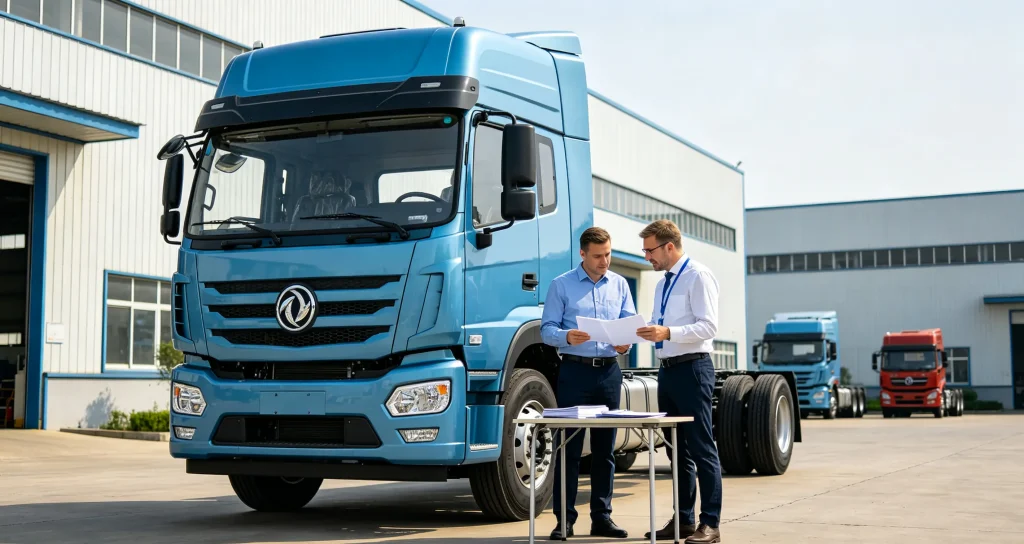
Second, receive formal written quotation and configuration scheme. Carefully check every listed item. Confirm truck chassis brand, core-component parameters, included export services and all listed fees. Raise questions immediately for any ambiguous content. After you confirm the plan, both sides sign a formal sales contract, and you arrange deposit payment to launch production arrangements.
Third, follow real-time production progress. Reliable exporters provide periodic production photos and short-video updates. You can track assembly status so you know exactly how your ordered commercial trucks are being built. If you find deviations from agreed configurations during production feedback, you can propose adjustments in time before manufacturing finishes.
Fourth, carry out pre-shipment full inspection once production finishes. You can appoint local third-party inspectors or rely on the supplier’s on-site inspection team to check vehicle appearance, core-component matching, function testing and document completeness. Never skip this inspection step. Confirm inspection results before you pay the remaining balance payment.
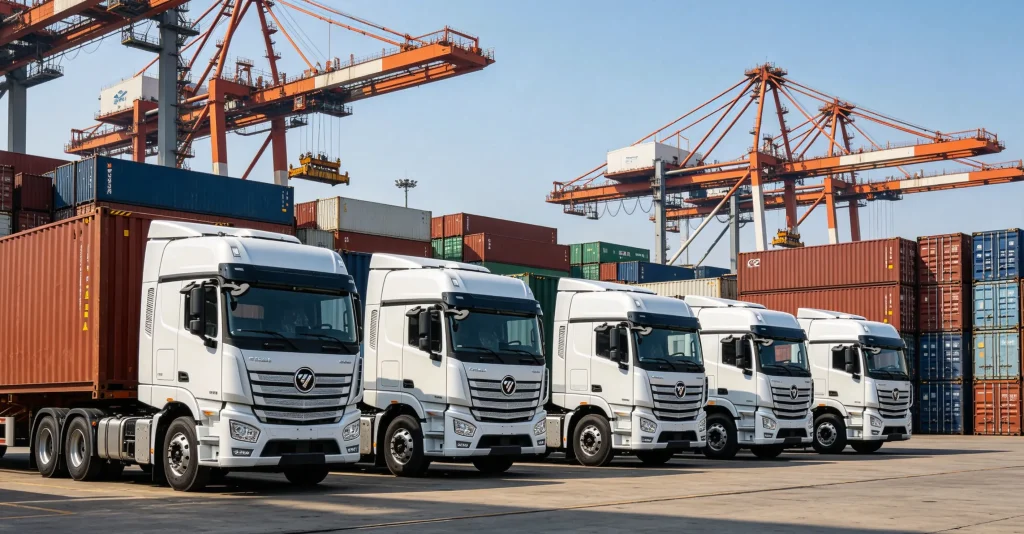
Fifth, handle export-declaration and sea-shipping arrangements. After balance payment arrives, the export team organizes container loading or ro-ro ship loading. They complete China-side customs declaration and prepare the full set of export documents. You will receive bill-of-lading copies and all supporting paperwork for your destination-country import-customs procedures.
Sixth, finish import customs clearance at destination port. Use the received document set to go through local import formalities, pay relevant import duties and taxes, then pick up your brand-new commercial trucks. After trucks arrive at your site, you can launch daily operation following official operation-manual guidance. You can find basic vehicle-maintenance knowledge inside our truck knowledge-base column.
Must-Have Documents for Commercial-Truck Import Customs Clearance
Complete, standard export documents form the foundation of smooth import customs clearance. Missing papers or non-standard file formats easily lead to cargo hold-up at seaports, storage-fee accumulation and schedule delays. Experienced Chinese commercial-truck exporters will prepare the full document package before shipment.
Common core documents include commercial invoice, packing list, original bill of lading and certificate of origin. Commercial invoices and packing lists support tariff calculation and cargo verification. Certificate-of-origin files can help buyers enjoy preferential-tariff policies in many trade-partner regions.
Besides above basic trade files, you also need product-related certification materials. This group covers factory inspection reports, international certification copies and original manufacturer qualification papers. Different countries add extra document requirements, so you need to clarify local import rules in advance and inform your Chinese supplier.
Keep in mind that all documents must match vehicle chassis numbers and engine numbers exactly. Any inconsistent data between papers and real-vehicle markings will cause customs-check failure. Reputable exporters double-check every document item before sending files to overseas buyers.
Common Procurement Risks and Practical Avoidance Solutions
Many first-time overseas buyers encounter avoidable risks when sourcing commercial trucks for sale from China. Understanding these typical pitfalls helps you protect your capital investment and keep your procurement project running smoothly.
The first trap is ultra-low misleading quotations. Some intermediaries release surprisingly low prices to attract inquiries. After you pay the deposit, they replace core components with inferior spare-parts or delay delivery repeatedly. You should compare multiple formal factory-direct quotes and stay away from offers far below normal market-price ranges.
Second, verbal-only service commitments bring hidden disputes. Some sales personnel promise generous after-sales terms during early-stage communication, yet those commitments never appear inside formal contracts. Once deposit transfers complete, those promised services disappear. Always require all important agreements to be written into official signed contracts.
Third, configuration mismatch caused by insufficient communication. If you do not clearly convey local regulatory standards, the supplier may produce commercial trucks that cannot register locally. For this problem, you need to sort out official local-market rules and pass full information to your supplier before production starts.
Fourth, insufficient after-sales and spare-part support. A number of trading companies finish delivery and stop providing follow-up service. When commercial trucks break down in later operation, buyers cannot obtain technical guidance or replacement parts. Before you sign contracts, confirm concrete spare-part supply channels and online-support mechanisms.
Regional Reference for Importing Chinese Commercial Trucks
Different global regions hold different market demands for imported Chinese commercial trucks. Local industry structure, road infrastructure, climate and regulatory frameworks shape buyers’ actual configuration preferences.
For African markets, construction and mining projects create huge demand for durable dump trucks and heavy-duty commercial vehicles. Buyers prioritize robust structures that cope with poor road conditions and high-dust environments. Meanwhile, many territories require right-hand-drive commercial-truck variants.
Southeast-Asian markets need large volumes of right-hand-drive commercial trucks for cross-border logistics, agricultural-goods transport and urban distribution. Humid local weather puts forward higher requirements for chassis anti-rust performance of imported commercial vehicles.
Middle-East market buyers focus on heat-resistance and dust-proof performance. Commercial trucks working in desert zones need upgraded cooling systems and effective dust-filter assemblies to maintain stable performance under high-temperature surroundings.
South-American purchasers pay close attention to cost-performance and component durability. Large-scale infrastructure projects need mixed fleets containing multiple commercial-truck types. Local import-tax policies and vehicle-registration rules also need full consideration before you place orders.
After-Sales Service and Global Spare-Part Supply for Imported Commercial Trucks
Purchasing commercial trucks represents long-term asset investment. Reliable after-sales support largely decides total-life-cycle running costs of your whole fleet. Without effective follow-up service, even high-quality commercial trucks will become heavy burdens once faults emerge.
Qualified Chinese commercial-truck exporters provide 24-hour online technical support. Professional engineers offer remote fault-diagnosis advice and daily-maintenance guidance. When operators meet confusing vehicle-fault phenomena, they can send photos or short-video materials to get fast troubleshooting suggestions.
In terms of spare-part supply, formal export suppliers maintain stable global-logistics channels for core commercial-truck components. When you need replacement parts, they can arrange shipment to cut fleet-downtime duration. Some key regions have cooperative local stock points to speed-up part delivery efficiency.
Business clients with bulk-fleet orders can obtain extra-optimized after-sales arrangements. This may include complimentary initial-batch consumable spare-parts, regular remote-maintenance training and priority-processing for urgent-part orders. Long-term cooperative partners can enjoy these extra-value service resources.
Tips for Bulk Commercial-Truck Procurement for Dealers and Large Fleet Operators
Vehicle dealers and large-scale fleet enterprises usually carry out bulk commercial-truck procurement. Compared with small-quantity trial orders, bulk purchasing brings better unit-cost advantages, yet it also raises higher requirements for supplier comprehensive capacity.
First of all, confirm the supplier’s mass-production and delivery capacity. You need to make sure the factory can finish your large-volume order within agreed timelines. Avoid situations where insufficient production capacity causes long-time delivery delays and disturbs your local business-plan arrangement.
Second, discuss long-term cooperation frameworks. If you plan to keep importing Chinese commercial trucks continuously, you can negotiate framework agreements covering price adjustment mechanisms, priority-production rights and exclusive-market related terms. Clear framework agreements reduce repeated communication work for every follow-up order.
Third, pay attention to parts-stock planning. For bulk-fleet buyers, you can synchronously order a certain quantity of wearing-consumption spare-parts together with truck orders. This measure helps you build local spare-part inventory and shorten response time for vehicle-repair work in later operation stages.
Fourth, arrange pre-shipment sampling inspection for big-batch orders. You can select partial units from the whole batch for detailed inspection to verify overall production-quality level. This step lowers collective-quality-risk probability for your large-volume commercial-truck shipment.
Frequently Asked Questions About Buying Commercial Trucks for Sale from China
Q1: Do I need huge order quantity to import Chinese commercial trucks?
A1: There is no strict minimum-order limit. Qualified exporters support single-unit trial orders as well as large-scale bulk fleet procurement. Small-volume orders usually adopt container or ro-ro shipping solutions.
Q2: How long is the typical production and delivery cycle?
A2: Ready-stock standard-spec commercial trucks can ship within 7-15 working days. Common customized orders take around 20-30 working-day production cycles. Complex special-purpose modified commercial trucks need 30-45 working-day manufacturing time, not counting sea-transit duration.
Q3: What international trade terms can I choose?
A3: Reputable Chinese commercial-truck exporters support FOB, CIF and DDP trade terms. You can pick suitable solutions according to your own international-trade operation capacity.
Q4: Can I get commercial-truck technical-manuals in my local language?
A4: We provide English-version operation-manuals as standard. For special-language requirements, you need to raise this demand in the early communication phase so the supplier can arrange document-making work in advance.
Q5: Are all exported commercial trucks brand-new factory-original units?
A5: Formal factory-direct export suppliers only deliver brand-new original commercial trucks. You should stay alert for vendors selling second-hand or refurbished vehicles disguised as new stock.
Q6: How do I handle vehicle-fault problems after commercial trucks arrive at my site?
A6: You can contact the supplier’s technical-support team. Provide fault-description text, photos or short-videos. Engineers will offer remote troubleshooting guidance and arrange corresponding spare-part delivery if component replacement becomes necessary.
Q7: Can Chinese commercial trucks meet my country’s local registration rules?
A7: This depends on whether you complete correct factory customization according to local official standards. You need to provide full local-registration-rule information to your supplier before production starts, so vehicles can be built to satisfy local access requirements.
Conclusion
Sourcing commercial trucks for sale from China offers viable, cost-effective transport-asset solutions for global fleet operators, construction contractors and commercial-vehicle dealers. Chinese commercial-truck product portfolios cover light-duty distribution vehicles all the way to heavy-haul and special-engineering trucks, with flexible factory customization to fit diverse overseas-market requirements.
Even so, successful import does not merely rely on low-priced vehicles. You need to screen qualified suppliers, clarify scenario-matching model requirements, complete reasonable factory-level modification, pay close attention to document integrity and stay alert to common procurement risks. Every link will influence your final import result and long-term fleet-operation benefit.
If you are looking for trustworthy Chinese commercial-truck export support, Mettlead Truck provides genuine OEM-source commercial trucks, full-set export documentation, tailored-market configuration schemes and continuous after-sales service. Whether you need small-quantity trial-order vehicles or large-volume bulk-fleet supplies, our team can deliver targeted solutions for your business. Feel free to reach out to our sales team for your free-of-charge configuration consultation and latest factory quotation.