Introduction
Global commercial vehicle markets keep expanding year by year.
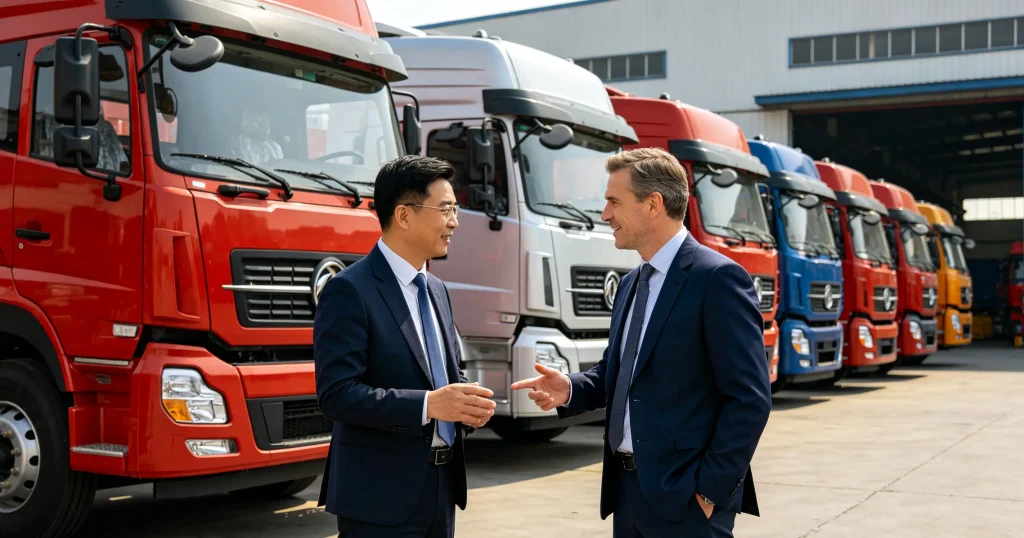
Fleet operators, local truck dealers, construction contractors and logistics companies are continuously hunting for stable vehicle sources.
For many overseas businesses, purchasing reliable commercial vehicles remains a big challenge.
Local branded trucks often come with extremely high purchase costs.
Meanwhile, second‑hand truck stock cannot fully satisfy large‑scale fleet expansion demands.
Against this background, more and more overseas buyers turn to professional China commercial vehicle supplier for long‑term cooperation.
Chinese commercial vehicle industry has built complete manufacturing chains over decades of development.
Major brands cover light trucks, medium‑duty trucks, heavy‑duty tractors, dump trucks, cargo trucks and special engineering vehicles.
Apart from rich product selections, factory‑direct prices and mature cross‑border export services attract buyers from Africa, Southeast Asia, Middle East and South America.
Even so, plenty of first‑time importers still face real obstacles in this field.
They may meet mixed‑level suppliers, unclear configuration options, confusing export procedures and incomplete document issues.
If you fail to pick a trustworthy truck export partner, your project will suffer delayed shipments, wrong vehicle specs or extra unexpected expenses.
This practical guide walks you through every critical part of cooperating with Chinese commercial vehicle exporters.
It covers mainstream product lines, core strengths of Chinese suppliers, key criteria to evaluate partners, full export workflow, common pitfalls and practical cooperation suggestions.
Whether you run a small local dealership or manage a large‑size international fleet, this material helps you make better sourcing decisions.
By working with experienced Chinese heavy truck exporters, global partners can get one‑stop vehicle consulting, configuration customization and whole‑set export solutions.
Why Choose a China Commercial Vehicle Supplier as Your Export Partner
Before you start contacting suppliers, you need to understand the real‑world advantages of Chinese commercial vehicle export business.
These strengths explain why countless overseas companies keep placing repeat orders year after year.
Diversified Commercial Vehicle Product Portfolio
First of all, China’s commercial vehicle manufacturers supply nearly all mainstream vehicle types for global operating scenarios.
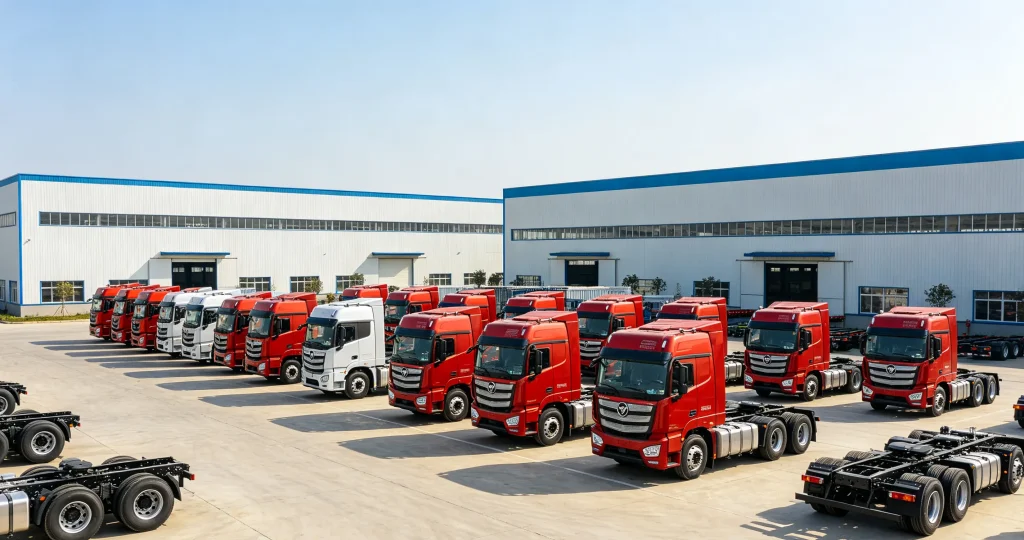
Heavy‑duty tractor heads serve long‑distance highway logistics and cross‑border transportation tasks.
Dump trucks fit mining sites, road construction projects and earth‑moving operations.
Cargo box trucks, tank trucks, garbage trucks and other special‑purpose vehicles can meet customized project requirements.
Light‑duty commercial vehicles support city distribution, short‑haul delivery and small‑scale freight business.
Well‑known domestic brands include HOWO, Shacman, FAW and Foton.
Each brand owns multiple series covering different power output, cab styles and chassis configurations.
As a result, buyers do not need to contact multiple manufacturers for different vehicle demands.
Competitive Factory‑Direct Cost Performance
In addition, industrial cluster effects bring obvious cost advantages for Chinese commercial vehicles.
Complete upstream and downstream component supply chains cut overall manufacturing expenditure effectively.
Compared with famous European and American truck brands, Chinese new commercial vehicles deliver acceptable durability under reasonable budgets.
You can allocate more capital on fleet scale expansion instead of paying excessive brand premium.
It is worth pointing out that low price never equals poor quality.
Top‑tier Chinese commercial vehicle factories adopt international‑standard production equipment and testing procedures.
For heavy‑load, high‑intensity working environments, you should prioritize official factory configurations rather than chasing extremely low quotations.
Flexible Customization for Overseas Market Needs
Furthermore, reliable China commercial vehicle supplier supports targeted modification for foreign market conditions.
For instance, they can adjust engine emission standards, right‑hand drive conversion, local‑spec tires and cabin interior layouts.
Different regions face varied climate and road conditions.
High‑temperature zones need enhanced heat dissipation systems; muddy mining areas require reinforced chassis structures.
Professional export partners will collect your local operating background and suggest proper vehicle setups.
This kind of personalized service greatly improves vehicle adaptability after arriving at destination countries.
Mature End‑to‑End Export Service Capacity
Another non‑ignorable merit lies in complete cross‑border trade supporting capabilities.
Many Chinese commercial vehicle suppliers have accumulated years of overseas shipment experience.
They are familiar with container loading, ro‑ro shipping, bulk vessel transportation and related operation details.
Qualified partners can produce commercial invoices, packing lists, inspection certificates and other customs‑clearance files.
For buyers who purchase trucks and matching spare parts together, cooperating with trusted Chinese heavy truck suppliers can simplify your whole procurement workflow.
Stable Production & Continuous Supply Capacity
Finally, large‑scale commercial vehicle factories maintain steady mass‑production capability.
Once you confirm long‑term framework orders, manufacturers can arrange batch delivery according to your project timeline.
This is critical for dealers who plan regular restocking or big infrastructure projects with phased vehicle delivery plans.
Main Types of Commercial Vehicles Available for Global Export
Every overseas business owns unique operating scenarios.
Understanding vehicle classifications helps you describe your demand clearly when communicating with your China commercial vehicle supplier.
Heavy‑Duty Tractor Head Trucks
Tractor heads occupy large proportion of China commercial vehicle export volume.
These vehicles mainly connect with different semi‑trailers for container transport, bulk goods haulage and cross‑border logistics.
Common power ranges cover 375hp, 400hp, 430hp, 460hp and higher horsepower options.
Buyers can select manual or automated transmission, different axle numbers and sleeper cab versions for long‑distance drivers.
Tractor heads suit logistics companies, freight forwarding enterprises and large‑scale transportation fleets.
Off‑Road & Highway Dump Trucks
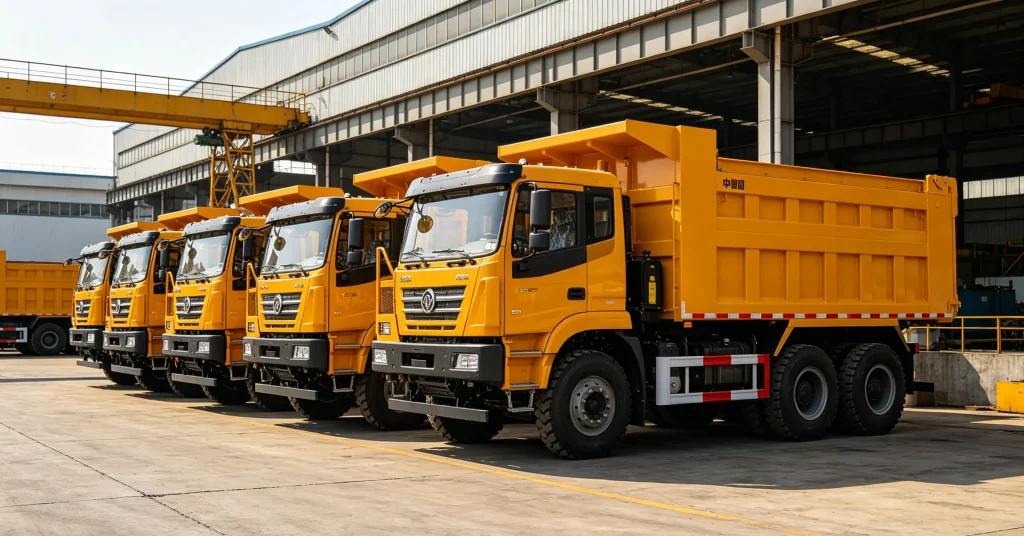
Dump trucks remain popular for construction, mining and quarry industries across the globe.
Highway‑type tipper trucks run on regular public roads for urban construction waste and sand‑stone transportation.
Off‑road mining dump trucks adopt reinforced frames, heavy‑duty axles and wear‑resistant cargo boxes.
They stand up to terrible road conditions inside mining zones.
Different cargo box capacities from 18 cubic meters up to over 40 cubic meters are optional.
Cargo & Box Type Commercial Trucks
Box‑body cargo trucks apply for general merchandise delivery, food transportation and commodity distribution.
Closed van boxes protect goods from rain, dust and sunlight exposure.
Stake‑type cargo trucks are good for transporting steel materials, lumber and other bulk palletized goods.
Medium‑duty and light‑duty cargo trucks fit city‑level distribution business.
Special‑Purpose Commercial Vehicles
Apart from standard trucks, Chinese factories produce various special engineering commercial vehicles for export.
This category includes fuel tank trucks, water tank trucks, cement mixer trucks, garbage disposal trucks and flat‑bed transport trucks.
Special vehicles usually require extra technical confirmation before order placement.
You need to clarify tank volume, working attachments and local import access requirements in advance.
Key Qualities to Evaluate a Reliable China Commercial Vehicle Supplier
Not every vendor calling itself “commercial vehicle exporter” can deliver satisfying cooperation results.
Some middlemen lack direct factory resources; others cannot guarantee post‑shipment technical support.
The following evaluation dimensions help you filter proper truck export partners step‑by‑step.
Verify Factory Resource & Brand Authorization
First and foremost, check whether your potential supplier holds formal brand sales authorization.
Authorized partners get direct vehicle supply from original OEM factories.
Their vehicle configuration, quality control and after‑sales follow official factory standards.
Pure intermediary traders may mix stock sources, which brings hidden risks for vehicle consistency and warranty validity.
You have the right to ask for authorization documents, factory visiting records and real batch export cases.
Assess Real Export Experience & Target‑Market Cases
Next, pay attention to their past export records for your target region.
A supplier familiar with your country will know local import rules, emission standards and common vehicle modification demands.
If they have served plenty of buyers from your market, they can avoid many avoidable mistakes in configuration selection and document preparation.
You can reach out through official contact channels to inquire about reference client cases and shipment samples.
Check Technical Communication & Configuration Confirmation Ability
Detailed technical communication plays a decisive role in cross‑border commercial vehicle purchasing.
Responsible export partners will listen to your actual working conditions instead of simply recommending hot‑selling stock models.
They should confirm engine brand, horsepower, axle ratio, tire specification, cab version and paint color item by item.
Every key parameter ought to be written clearly inside formal proforma invoice and sales contract.
Vague descriptions such as “similar standard truck” will easily trigger disagreements after goods arrival.
Inspect Logistics & Document Processing Competence
Commercial vehicles belong to over‑size heavy cargo.
Shipping arrangement needs rich practical experience.
R‑Ro vessel, bulk carrier or containerized transport solutions have different cost and delivery cycles.
Meanwhile, complete export documents are essential for smooth customs clearance at destination port.
Unqualified suppliers may provide incomplete papers, causing cargo detention and heavy fines.
Confirm After‑Sales & Spare‑Parts Supporting System
Furthermore, do not ignore after‑sales and spare‑parts supply capacity when selecting your China commercial vehicle supplier.
New commercial vehicles will need regular wearing‑part replacement and occasional component maintenance.
Excellent export partners can offer technical guidance and match corresponding spare‑part orders for your fleet.
Without stable spare‑parts backing, your brand‑new trucks may face long‑time downtime once components break down.
Standard Cooperation Workflow With China Commercial Vehicle Export Partner
Following standardized steps greatly lowers misunderstanding and procurement risks during international truck purchasing.
Below is the mature workflow summarized from large amounts of real‑world export projects.
Step one: Clarify your practical business requirements.
Sort out vehicle type, quantity, horsepower demand, working environment, target market and expected delivery timeline.
Suppliers rely on this information to give targeted recommendations instead of blind quotations.
Step two: Receive proposal and formal proforma invoice.
Qualified suppliers will list out full vehicle specs, unit price, total amount, production lead‑time and shipping options.
Read every clause carefully; raise questions for any ambiguous items.
Step three: Sign formal sales contract and arrange deposit payment.
All confirmed specifications, delivery time, document list and after‑sales terms must appear within contract text.
Step four: Factory production progress tracking.
During manufacturing period, reliable partners can send production photos, chassis number information and painting records.
Step five: Pre‑shipment inspection before loading.
You can check vehicle appearance, interior condition and core configuration against contract requirements.
Many buyers choose onsite inspection or video check before balance payment.
Step six: Organize sea transportation.
Select proper shipping method according to vehicle quantity and cost budget.
Supplier will book vessel space and finish local export customs declaration.
Step seven: Hand over full set of export documents and track marine logistics.
Original bill of lading and supporting documents will be sent to you for destination‑port customs clearance and vehicle registration.
For long‑term dealership cooperation, working with stable China commercial vehicle export partners helps you simplify repeated ordering procedures.
Important Export Documents for Importing Chinese Commercial Vehicles
Document preparation cannot be overlooked for cross‑border commercial‑vehicle import business.
Different countries have distinct local regulatory requirements, but several core files are universally necessary.
Commercial invoice records vehicle quantity, unit price and total contract value, used for import tax assessment.
Detailed packing list marks chassis numbers and corresponding vehicle information.
Bill of lading issued by shipping company acts as the key certificate for picking up goods at destination port.
Factory certificate of origin and vehicle inspection report prove product manufacturing background and quality status.
Some territories ask for special certification documents, which should be confirmed in early negotiation phase.
Common Pitfalls When Working With China Commercial Vehicle Supplier
Numerous overseas buyers run into avoidable troubles because of insufficient prior awareness.
Summarizing typical risks supports you to keep away from economic losses and project delays.
Over‑Attraction by Ultra‑Low Quotation
If one quotation is far below normal market range, you ought to stay highly alert.
Unrealistically low prices may come with downgraded configurations, refurbished assemblies or incomplete document support.
What you save at purchasing stage may turn into huge maintenance cost and fleet downtime afterwards.
Ambiguous Configuration Description
Verbal promises in chat messages do not protect your interests.
Every key parameter including engine brand, axle type and tire grade must be fixed inside contract and proforma invoice.
Without written confirmation, suppliers may deliver alternative parts that do not satisfy your operating needs.
Ignoring Local Import Policy Restrictions
Before placing orders, you need to learn your country’s import limitation for commercial vehicles.
Some regions set rules for emission standards, vehicle age limit and compulsory certification.
Even if vehicles are perfectly manufactured, you cannot complete customs clearance when they fail local regulatory requirements.
Underestimating After‑Sales & Spare‑Parts Demand
Many new buyers only focus on new truck purchase price.
They ignore long‑term spare‑parts supply after vehicles get into service.
Pick an export partner who can keep supporting you after trucks leave Chinese ports.
Suggestions for Long‑Term Partnership With Truck Export Partner
One‑time trial order is just the starting point.
Building stable long‑run cooperation brings more benefits for dealers and large fleet operators.
To begin with, share your market feedback timely with your supplier.
Tell them which configurations perform well locally and which parts wear quickly under your working conditions.
These feedback help suppliers optimize future vehicle proposals for your market.
Secondly, set reasonable order planning instead of emergency rush orders.
Commercial vehicle production and sea shipping both need fixed cycles.
Planned ordering prevents you from facing urgent vehicle shortage risk.
Thirdly, keep smooth technical communication for after‑sales incidents.
Professional export teams can provide troubleshooting guidance when you encounter vehicle operating questions.
If you aim to develop local commercial‑vehicle dealership business, cooperating with reliable Chinese commercial‑vehicle manufacturers & exporters can lay solid foundations for your business expansion.
Target Global Markets for Chinese Commercial Vehicle Export
Chinese commercial vehicles gain growing popularity across multiple continents.
African Markets
Large‑scale infrastructure construction pushes strong demand for heavy‑duty commercial vehicles in Africa.
Mining, road‑building and logistics sectors require plenty of dump trucks and tractor heads.
Chinese commercial vehicles adapt well to complex road conditions and high‑temperature climate in most African nations.
Southeast Asian Markets
Southeast Asian countries witness fast‑growing logistics and construction industries.
Right‑hand‑drive commercial‑vehicle versions are widely needed in many local markets.
Qualified China commercial vehicle supplier can finish RHD conversion according to official factory standards.
Middle East Markets
Middle‑east projects create continuous demand for heavy‑duty commercial vehicles.
Vehicles working in desert environments require enhanced heat dissipation and dust‑proof treatment.
Experienced export partners know these special local requirements clearly.
South American & Central Asian Markets
South America and Central Asia also import large volumes of Chinese commercial vehicles every year.
Local buyers value cost‑effective new trucks and accessible spare‑part resources.
Frequently Asked Questions About China Commercial Vehicle Supplier Cooperation
Q1: Can Chinese commercial vehicles be modified for right‑hand‑drive markets?
A1: Yes. Authorized suppliers can arrange official factory‑level RHD conversion for target countries which require right‑hand driving.
Q2: What is the typical lead‑time for new commercial vehicle orders?
A2: Stock‑available models can be delivered within short cycles. Custom‑configured vehicles normally take 25‑45 production days before shipment.
Q3: What shipping methods are available for commercial‑vehicle export?
A3: R‑Ro ship, bulk carrier and container loading are common options. Vehicle quantity and budget decide the most suitable solution.
Q4: Do suppliers provide spare‑parts support after truck export?
A4: Trustworthy export partners support follow‑up spare‑parts orders for your fleet maintenance. You can consult related service terms before signing contracts.
Q5: How to confirm vehicle configuration matches my requirements?
A5: All key specs should be written on proforma invoice and sales contract. Pre‑shipment photos or video inspection further verify real vehicle status.
Conclusion
Working with a competent China commercial vehicle supplier brings remarkable value for global fleet businesses and local truck dealers.
You gain access to rich vehicle selections, factory‑transparent pricing, feasible custom modification and complete cross‑border export services.
Nevertheless, high‑quality cooperation does not happen automatically.
You need to screen export partners prudently, clarify all technical parameters in written form and follow standard procurement procedures.
Avoid being misled by overly low‑price offers and never overlook local import policy constraints.
Once you establish stable partnership with a qualified truck export partner, your commercial‑vehicle supply chain will become far more predictable and efficient.
Whether you plan small‑volume trial purchasing or large‑scale long‑term framework orders, Chinese commercial‑vehicle industry can deliver practical solutions for your business growth.
If you are searching for dependable resources, you can connect with verified China commercial‑vehicle export partners to start your project consultation.