




Introduction
Across the entire African continent, infrastructure construction, mining development, cross-border logistics, and urban expansion continue to grow rapidly year by year.
As a result, local demand for heavy-duty commercial trucks has remained at a high level for a long time.
In the past, African markets mainly relied on second-hand European and Japanese trucks to meet operational needs.
However, aging vehicle conditions, scarce spare parts, and unstable after-sales support have gradually exposed many drawbacks of these old imported fleets.
In recent years, Chinese trucks have quickly become the mainstream choice for African buyers.
Thanks to solid build quality, strong environmental adaptability, and mature export systems, Chinese heavy truck brands now occupy more than half of Africa’s new truck import market.
For African fleet managers, local truck dealers, and engineering contractors, learning how to select suitable Chinese trucks and master standard export processes is essential for stable business growth.
Therefore, this complete guide systematically sorts out mainstream Chinese truck models suitable for Africa, market matching rules, professional export procedures, and practical procurement risk avoidance skills.
Whether you are new to Chinese truck imports or want to optimize your long-term supply chain, this guide can provide clear and actionable reference standards.
By cooperating with professional Chinese heavy truck exporters, African buyers can obtain stable, compliant, and cost-effective truck resources for local operation, covering full-category truck models and customized export solutions tailored for African markets.
Why Chinese Trucks Dominate the African Truck Market in 2026
Before understanding specific models and export steps, it is necessary to analyze the core advantages of Chinese trucks in the African market.
Only by recognizing market demand logic can buyers make more accurate purchasing decisions.
First of all, Chinese trucks feature extremely high environmental adaptability.
Most African operating scenarios are characterized by dusty air, high temperature all year round, uneven mountain roads, and long-distance barren road sections.
Major Chinese truck brands have long targeted emerging overseas markets for product optimization.
Their chassis reinforcement, dustproof design, high-temperature heat dissipation system, and durable mechanical structures are fully adapted to harsh African working conditions.
Secondly, Chinese trucks adopt mature and easy-to-maintain technical solutions.
Unlike European trucks that pursue high-precision electronic control systems, Chinese heavy trucks focus more on mechanical stability.
The structure is simple and clear, and the failure rate of core components is low.
More importantly, spare parts for Chinese trucks are widely available in Africa.
Local after-sales shops and spare parts warehouses in many African countries can quickly provide daily wearing parts, greatly reducing vehicle downtime.
In addition, professional Chinese heavy truck export suppliers provide highly flexible customized services.
They can adjust driving modes, emission standards, and chassis configurations according to different African national policies and road conditions.
This localized modification capability is one of the key reasons why Chinese trucks can quickly replace second-hand European and Japanese models.
Furthermore, the overall comprehensive cost of Chinese trucks is more friendly for African buyers.
While ensuring performance and durability, the overall procurement threshold and long-term maintenance costs are well controlled, which is very suitable for large-scale fleet investment and renewal in emerging markets.
Top Chinese Truck Brands Popular in African Markets
Not all Chinese truck models are suitable for African operating environments.
After years of market screening and actual operation verification, several mainstream Chinese brands have formed stable user reputations across Africa.
Each brand has its own scenario positioning and product advantages.
For this reason, buyers need to match the right brand according to their local business focus.
Sinotruk HOWO
Sinotruk HOWO is the most widely distributed Chinese heavy truck brand in Africa.
It has the largest market stock and the most complete spare parts system across African countries.
HOWO trucks are famous for their super durability and strong overload resistance.
They perform stably in mining, earthwork, long-distance logistics, and municipal construction scenarios.
The classic power assembly has been verified by decades of global market operations, with extremely low failure rate in high-temperature and dusty environments.
For most African fleet buyers, HOWO is the most stable and least risky conventional heavy truck choice.
Shacman
Shacman trucks are more inclined to professional heavy-load engineering scenarios.
Its chassis rigidity and structural reinforcement level are outstanding among Chinese brands.
Shacman performs excellently in ultra-heavy load transportation, quarry mining, and rugged mountain road operations.
Many large-scale African mining projects and road construction fleets prefer Shacman heavy trucks for long-term batch procurement.
If your local business focuses on high-intensity engineering operations, Shacman will be a more targeted option.
FAW
FAW trucks feature balanced comprehensive performance and comfortable driving experience.
They are more suitable for standard long-distance logistics and container transportation scenarios.
The vehicle fuel economy is optimized, which can effectively reduce daily operating costs for logistics fleets.
FAW has stable market share in East Africa, Southern Africa, and cross-border logistics corridors.
Dongfeng
Dongfeng covers a complete range of light, medium, and heavy-duty trucks.
It has strong flexibility in urban distribution, short-distance transportation, and multi-scenario mixed operations.
Dongfeng light and medium trucks are very popular in urban and suburban transportation markets in West Africa and Central Africa.
They are easy to drive and maintain, suitable for local retail dealer batch sales.
Foton
Foton trucks focus on cost performance and lightweight commercial transportation.
They are widely used in daily commodity transportation, small engineering operations, and urban service scenarios.
Foton’s lightweight and medium-duty models have strong market competitiveness in low-threshold batch procurement.
Best Chinese Truck Models for African Road & Working Conditions
Based on the actual road conditions, climate environment, and business types of African countries, we have sorted out the most practical and stable mainstream export models.
These models have been fully verified by local market operations and are the first choice for most African bulk procurement.
It is worth noting that this guide does not involve any specific quotation data.
Truck configurations, modification schemes, order quantities, and shipping cycles will affect the final comprehensive cost.
Buyers can obtain targeted and real-time official quotations through formal exporters.
Heavy-Duty Dump Trucks (Most In-Demand for African Engineering)
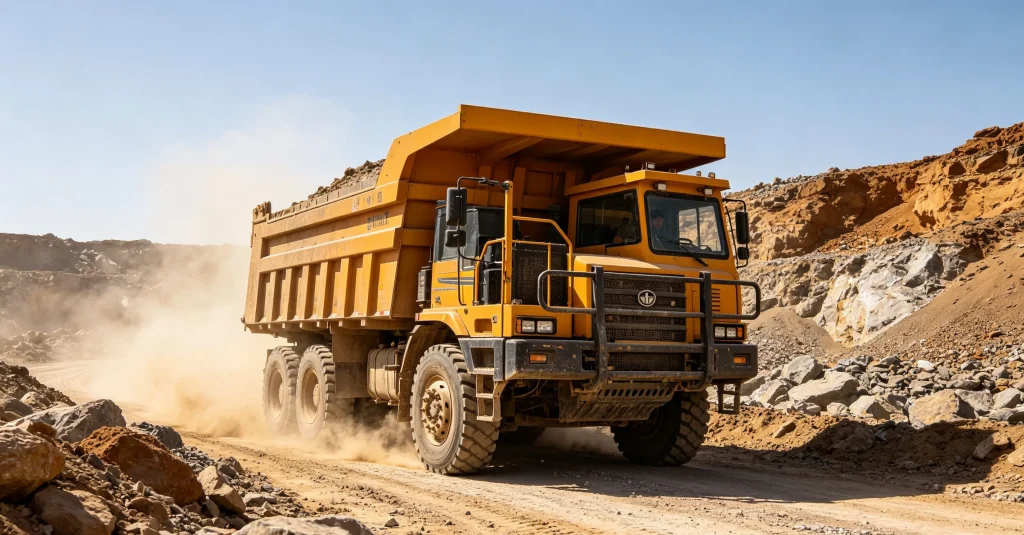
Dump trucks are the most imported truck type in Africa.
They are widely used in road renovation, mine exploitation, quarry operation, earthwork filling, and municipal construction.
Suitable African models mainly include 6×4 and 8×4 heavy-duty dump trucks.
These models adopt thickened high-strength steel cargo boxes and reinforced longitudinal beam structures.
They can adapt to frequent heavy-load unloading and impact working conditions.
The matched high-torque engine and stable hydraulic lifting system ensure efficient operation in dusty and high-temperature environments.
Formal exporters can adjust cargo box capacity, wall thickness, and chassis reinforcement standards according to local project intensity.
Dump trucks from Sinotruk HOWO and Shacman, supplied by formal Chinese heavy truck exporters, occupy the absolute mainstream of the African engineering truck market.
Tractor Head Trucks (Core for Cross-Border Logistics)
With the continuous improvement of African cross-border transportation networks, the demand for heavy-duty tractor heads keeps rising.
Tractor trucks are mainly used for container transportation, bulk cargo long-distance delivery, and cross-border freight lines.
Mainstream configurations include 6×4 heavy-duty tractor heads with high-power fuel-saving engines.
The chassis is stable and durable, adapting to long-hour continuous driving and complex road conditions.
Professional export models support left-hand drive and right-hand drive switching to meet the traffic rules of different African countries.
At the same time, multiple emission standard options are available to adapt to local urban access policies.
Cargo Trucks & Light-Duty Trucks (Urban Daily Transportation)
Urbanization construction in Africa drives stable demand for medium and light cargo trucks.
These vehicles are responsible for urban commodity distribution, building material transportation, and regional short-distance logistics.
Light-duty Chinese trucks feature flexible body, convenient operation, and low daily maintenance difficulty.
They are very suitable for small and medium-sized fleets and local retail dealers’ diversified order needs.
Special Engineering Trucks (Customized Infrastructure Support)
Many African national infrastructure projects require special engineering vehicles to support construction.
Chinese exporters can provide customized mixer trucks, water tank trucks, fuel tank trucks, and sanitation trucks.
All special vehicles are modified on official original chassis, with stable performance and compliant parameters.
They can smoothly pass local customs clearance and legal road operation procedures.
Key Configuration Customization for Chinese Trucks Exported to Africa
Standard domestic Chinese truck configurations cannot fully adapt to African local conditions.
Therefore, targeted factory-level customization is a necessary step for formal African export orders.
Only after localized modification completed by qualified Chinese heavy truck export manufacturers can the vehicle achieve stable operation and legal registration in Africa.
Left-Hand Drive & Right-Hand Drive Conversion
Many African countries implement right-hand traffic rules.
Professional Chinese truck exporters can complete official RHD conversion on the production line.
The whole set includes steering system switching, instrument calibration, circuit adjustment, and exterior mirror optimization.
Modified vehicles fully comply with local traffic laws and registration standards.
High Temperature & Dustproof Adaptation
Most African regions have high temperature all year round and serious road dust.
Export trucks can be equipped with enhanced heat dissipation systems, multi-layer dustproof filters, and closed protection structures.
This effectively reduces engine wear and component aging caused by harsh environments.
Heavy-Duty Reinforcement Configuration
A large number of African construction and mining roads are unpaved with poor road flatness.
Exporters can upgrade thickened cargo boxes, reinforced suspensions, and heavy-duty off-road tires.
The overall load-bearing capacity and impact resistance of the vehicle are significantly improved to adapt to high-intensity operation.
Low-Temperature Startup Adaptation for Highland Areas
For high-altitude and low-temperature regions in Southern and Eastern Africa, low-temperature startup configurations can be added.
Including battery heating, oil circuit anti-freezing, and auxiliary startup devices to ensure normal vehicle startup in cold weather.
Emission Standard Matching
Different African countries have different environmental protection access policies.
Formal exporters can flexibly match Euro 2 to Euro 5 emission standards to meet local urban driving restrictions.
How African Buyers Choose Reliable Chinese Truck Export Suppliers
Product quality and service level vary greatly among different Chinese truck suppliers.
Choosing the right exporter directly determines the safety of your procurement and the stability of long-term supply.
In order to help African buyers avoid industry traps, we have sorted out practical supplier screening standards.
Verify Official Factory Authorization Qualification
Reliable export suppliers must hold valid official brand authorization certificates.
This proves that the supplier has direct factory channels and can obtain 100% original brand-new vehicles.
Unauthorized middlemen often mix refurbished vehicles and assembled parts, bringing huge operational risks.
Check Complete Independent Export Qualification
Professional truck exporters have independent customs declaration and export rights.
They can provide a full set of standardized export documents required by African customs.
Incomplete documents will lead to cargo detention and inability to complete local registration.
Confirm Stable Supply Capacity & Inventory Scale
Excellent exporters have long-term stable factory cooperation quotas and offline vehicle yards.
They can support both small trial orders and large fleet batch orders, ensuring stable delivery cycles.
Evaluate Overseas Customization & Service Experience
Suppliers with rich African export experience in Chinese heavy truck exports can accurately match local policy requirements and working condition characteristics.
They can avoid configuration mismatch and policy non-compliance problems caused by unfamiliarity with overseas markets.
Inspect After-Sales & Spare Parts Support System
Long-term fleet operation must rely on stable spare parts supply and technical guidance.
Formal exporters have perfect spare parts reserve and remote technical support systems to help African buyers reduce vehicle failure downtime.
You can consult professional teams through online contact channels to verify supplier service professionalism, inquire about customized schemes, and obtain targeted export solutions for African truck procurement.
Standard Chinese Truck Export Process for African Buyers
Cross-border truck procurement involves many links, including model selection, customization, production, inspection, customs declaration, and shipping.
Standardized processes can effectively avoid errors and risks.
The following is the mature and repeatable African truck import process summarized from long-term export experience.
First, clarify local business scenarios and policy requirements.
Buyers need to confirm local traffic rules, emission restrictions, mainstream working conditions, and registration policies.
This is the premise for selecting models and determining customization schemes.
Second, communicate with professional exporters to match targeted vehicle solutions.
According to your order quantity and usage needs, professional Chinese heavy truck exporters will recommend the most suitable brand, model, and configuration combination.
Third, confirm the final scheme and sign a formal export contract.
The contract clearly records vehicle parameters, modification standards, delivery cycle, document list, and after-sales commitments to avoid subsequent disputes.
Fourth, pay the deposit through the official corporate account to start factory production.
During production, the exporter can provide real-time production photos and videos for buyers to track progress.
Fifth, complete full pre-shipment inspection.
Inspect vehicle appearance, engine performance, chassis parameters, and customized details one by one to ensure full compliance with contract standards.
Sixth, arrange balance payment and official factory packaging.
Standard seaworthy packaging can protect vehicles from sea wind and rain erosion during long-distance transportation.
Seventh, the exporter sorts out the full set of export documents and completes customs declaration and ocean shipping.
Eighth, track vessel logistics information until the goods arrive at the destination port.
Finally, use complete official documents to complete local customs clearance and vehicle registration.
Complete Export Document List Required for African Customs Clearance
Document compliance is the core key to smooth African import clearance.
Many buyers encounter cargo detention problems simply because of missing or non-standard documents.
Formal Chinese truck exporters will provide a complete one-stop document package.
The mainstream standard documents required for African truck import include the following types.
First, official factory certificate and vehicle qualification certificate.
Prove that the vehicle is a brand-new original factory product with compliant production parameters.
Second, formal commercial invoice and packing list.
Used for local tax declaration and customs value verification.
Third, official bill of lading issued by the shipping company.
It is the core document for picking up goods at the destination port.
Fourth, factory inspection report and quality certification documents.
Prove that the vehicle performance meets international export standards.
Fifth, customized parameter confirmation documents (if modified).
Ensure that local customs confirm the legality of vehicle modification items.
Different African countries have individual document supplement requirements.
Professional exporters will make targeted adjustments according to the destination country to ensure 100% clearance pass rate.
Common Procurement Risks & Avoidance Tips for African Truck Buyers
There are many hidden traps in the Chinese truck export industry.
Summarizing common risk points can help African buyers avoid unnecessary economic losses.
Ultra-Low Price Trap
Quotations far lower than the industry mainstream level must be high-risk signals.
Ultra-low-priced vehicles are often refurbished old cars, configuration-cut vehicles, or non-original assembled vehicles.
Such vehicles have no official quality guarantee and cannot be legally registered in Africa.
Vague Configuration Promise Trap
Some irregular suppliers promise high-end configurations but secretly reduce core parameters after receiving deposits.
Buyers can hardly find problems in the early stage, but frequent failures will occur after formal operation.
Therefore, all configuration details must be clearly written into the formal contract.
Incomplete Document Risk
Small middlemen cannot provide complete official documents.
Once the goods are shipped, buyers will face customs detention, fine deduction, or even cargo abandonment.
Cooperating with formal export enterprises can completely avoid this risk.
No After-Sales Support Trap
One-time transaction middlemen will not provide subsequent technical guidance and spare parts supply.
Vehicle failures can only be solved by buyers themselves, resulting in long-term fleet shutdown losses.
After-Sales Service & Spare Parts Support for Chinese Trucks in Africa
Perfect after-sales system is an important guarantee for long-term stable operation of African fleets.
Excellent Chinese truck exporters provide systematic overseas service support.
First, 24/7 online remote technical support.
Professional engineers can remotely guide daily maintenance and fault diagnosis to solve common vehicle problems in real time.
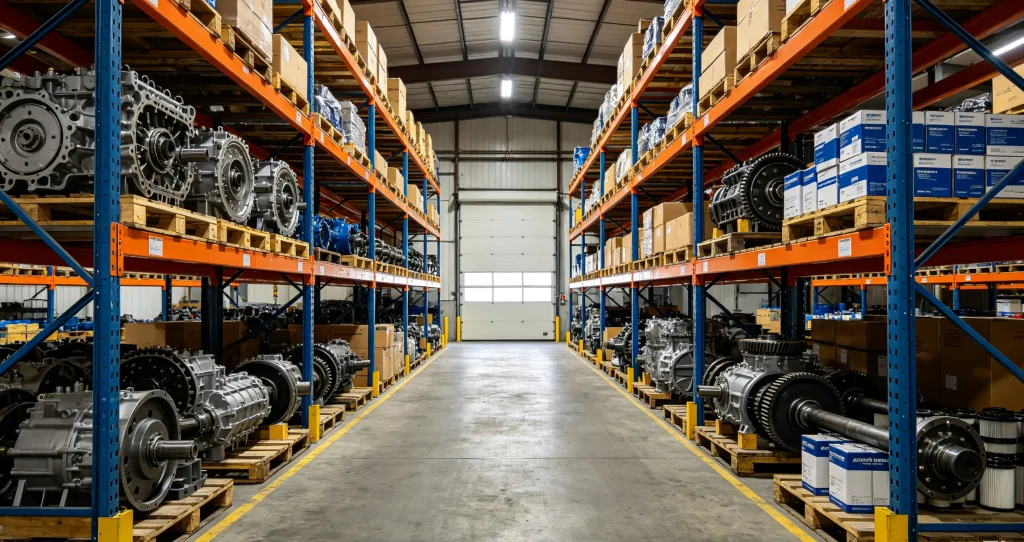
Second, global spare parts supply system.
Core wearing parts and vulnerable components are in long-term stock, supporting fast delivery to African countries.
Third, exclusive after-sales follow-up for bulk orders.
Large fleet procurement customers can obtain regular operation guidance and maintenance tutorials.
Fourth, long-term cooperative dealer training support.
Help local African dealers improve professional knowledge and after-sales service capabilities.
Why African Buyers Prefer Factory-Direct Chinese Truck Exports
Compared with middleman resale channels, factory-direct export has irreplaceable comprehensive advantages.
First, eliminate intermediate markup links.
Buyers can obtain standardized and transparent factory procurement costs without hidden charges.
Second, 100% original brand-new vehicle guarantee.
Factory-direct supply strictly controls production quality to avoid refurbished vehicles and assembled parts.
Third, standardized document output.
Formal exporters have complete document qualification capabilities to ensure smooth customs clearance in Africa.
Fourth, flexible customized service.
Only factory-level suppliers can complete personalized modification schemes that meet African local conditions.
Fifth, stable long-term after-sales guarantee.
Factory exporters focus on long-term cooperative relationships rather than one-time transactions.
They can provide continuous technical support and spare parts supply protection.
Regional Market Characteristics of Chinese Trucks in Africa
Different African regions have different business focuses and road characteristics.
Matching models according to regional market characteristics can improve operational efficiency and market adaptability.
West Africa Market
West African countries focus on urban construction, road renovation, and commodity transit logistics.
Dump trucks and medium-duty cargo trucks have the highest market demand.
The climate is hot and humid all year round, so dustproof and heat dissipation configurations need to be optimized.
East Africa Market
East Africa has prosperous cross-border logistics and port transit business.
Tractor head trucks are widely used in container transportation and long-distance freight.
Highway road conditions are relatively good, focusing on vehicle fuel economy and long-distance durability.
Southern Africa Market
Southern Africa has many mining and high-altitude areas.
Heavy-duty reinforced dump trucks and engineering special vehicles are more popular.
Low-temperature startup and anti-corrosion configurations are required for local environments.
Central Africa Market
Central Africa is dominated by mountainous roads and jungle construction scenarios.
Vehicles need strong climbing performance and complex road passing ability.
Reinforced chassis and off-road tire configurations are more suitable for local operations.
FAQs About Chinese Trucks Export to Africa
Q1: Are Chinese trucks suitable for African high-temperature and dusty environments?
A1: Yes. Export-oriented Chinese trucks are specially optimized for harsh African climates. Professional dustproof, heat dissipation, and anti-aging configurations ensure stable long-term operation.
Q2: Can customized Chinese trucks pass African local customs clearance?
A2: Formal factory modifications comply with international export standards. The complete document package supports legal customs clearance and vehicle registration in most African countries.
Q3: How long is the delivery cycle for Chinese trucks exported to Africa?
A3: Standard stock vehicles can be shipped quickly. Customized models take a reasonable production cycle according to modification complexity, with stable and controllable overall progress.
Q4: Do African markets have sufficient spare parts for Chinese trucks?
A4: At present, Chinese trucks have a huge stock in Africa. Local spare parts shops and overseas warehouses can provide most daily wearing parts, with very convenient maintenance conditions.
Q5: What kind of Chinese truck is most worthy of bulk investment in Africa?
A5: Dump trucks and tractor trucks are the most versatile and in-demand models in Africa. They have strong market adaptability and high resale value, suitable for dealer wholesale and fleet long-term operation.
Conclusion
As African infrastructure construction and economic development continue to accelerate, the market demand for high-quality Chinese trucks will continue to grow steadily.
Compared with traditional second-hand European and Japanese trucks, brand-new Chinese export trucks have obvious advantages in durability, adaptability, cost performance, and after-sales convenience.
For African local dealers, fleet operators, and engineering contractors, standardized import processes and scientific model selection are the keys to stable business development.
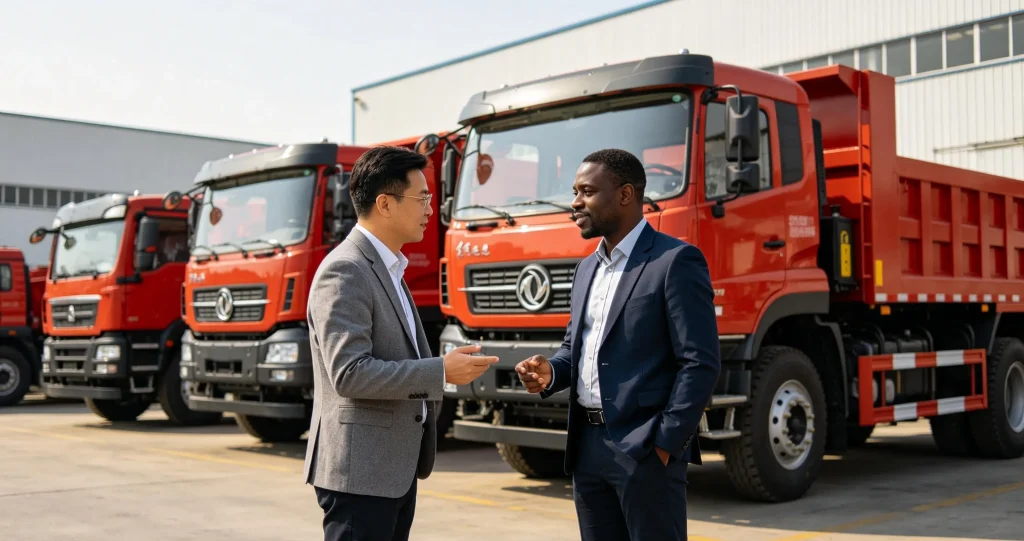
By cooperating with verified, factory-direct Chinese heavy truck exporters, buyers can avoid industry traps and obtain compliant, high-quality truck resources suitable for local African working conditions.
Whether it is small-batch trial procurement or large-scale fleet strategic cooperation, Chinese trucks can provide reliable equipment support for African market expansion.
In the future, Chinese commercial vehicles will continue to deepen their layout in Africa and become the core equipment powering local economic construction.