Introduction
For heavy-duty transportation, mining haulage, large-scale construction, and long-distance bulk logistics, 6×4 trucks remain the most popular and cost-effective axle configuration worldwide. Unlike lighter 4×2 trucks or heavier 8×4 models, 6×4 vehicles deliver balanced load capacity, powerful traction, and manageable operational costs.
In most global markets including Africa, the Middle East, Southeast Asia, and Central Asia, fleet operators and project contractors prioritize 6×4 trucks for daily heavy-load tasks. Their versatile design adapts to highways, mountain roads, muddy construction sites, and dusty mining zones.
Even so, many first-time and bulk buyers struggle with model selection, parameter matching, export customization, and supplier verification. A mismatched 6×4 truck can lead to low efficiency, high fuel consumption, frequent breakdowns, and unnecessary financial losses.
For this reason, we created this in-depth 6×4 truck buyer’s guide. It covers every critical step from basic configuration knowledge and model classification to parameter checking, market selection, customization, shipping, and after-sales support. Whether you need a single unit or fleet bulk orders, this guide helps you make risk-free, cost-saving purchasing decisions.
To access authentic factory-grade 6×4 truck resources and professional procurement support, you can cooperate with reliable Chinese heavy truck manufacturers with rich global export experience.
Chapter 1: What Is a 6×4 Truck? Basic Definition & Working Principle
Before comparing models and negotiating prices, it is essential to understand what a 6×4 truck is and how its axle configuration works. Many buyers confuse 6×4, 4×2, and 8×4 layouts, which directly affects purchase accuracy and operational adaptability.
Simply explained, truck axle codes follow a fixed rule. The first number stands for the total number of wheel groups, while the second number represents the number of driving wheel groups. A standard 6×4 truck has six wheel groups in total, with four driving wheels providing power.
In terms of structural layout, 6×4 trucks adopt a three-axle design. The front single axle is dedicated to steering only. Meanwhile, the two rear axles serve as dual drive axles to bear heavy loads and output power simultaneously.
Thanks to the dual rear drive axle design, 6×4 trucks gain two core advantages over lighter models. First, they offer far stronger load-bearing capacity. Second, they deliver superior traction on slippery, rugged, and unpaved roads.
Additionally, the three-axle structure distributes cargo weight evenly across the chassis. This design effectively reduces chassis deformation and tire wear during long-term heavy-load operation.
Compared with 8×4 heavy trucks, 6×4 models have fewer accessories and lower self-weight. This results in lower fuel consumption and simpler daily maintenance. Therefore, 6×4 trucks achieve a perfect balance between heavy-load performance and operational economy.
If you want to distinguish different truck axle configurations more clearly, you can check the professional truck axle configuration guide for detailed comparison and scenario analysis.
1.1 Core Structural Advantages of 6×4 Trucks
The structural design of 6×4 trucks is tailored for heavy-duty commercial scenarios. Every core component is optimized for durability and stability under continuous high-intensity operation.
First, the reinforced heavy-duty chassis. Most mainstream 6×4 trucks adopt thickened integral beam chassis. This structure resists torsion and deformation even under maximum payloads or uneven road impacts.
Second, dual rear drive axles with high torque output. The dual drive layout ensures sufficient power output when climbing slopes or starting with full loads. It also avoids wheel slipping on muddy and gravel roads.
Third, upgraded suspension systems. Standard 6×4 heavy trucks are equipped with thickened leaf spring suspensions. These suspensions bear heavy pressure steadily and reduce vehicle jitter during long-distance transportation.
Fourth, enlarged heat dissipation systems. Considering high-power engine operation and harsh working environments, export-grade 6×4 trucks feature oversized radiators. This prevents engine overheating in high-temperature desert and tropical regions.
1.2 Limitations of 6×4 Truck Configuration
Although 6×4 trucks are highly versatile, they still have obvious usage limitations. Understanding these drawbacks helps you avoid mismatched purchases.
To start with, 6×4 trucks have a longer wheelbase and larger turning radius. They are not suitable for narrow urban streets, crowded community roads, or small-scale indoor logistics scenarios.
Furthermore, their self-weight and fuel consumption are higher than 4×2 light trucks. For pure light-load urban distribution, 6×4 trucks will cause unnecessary cost waste.
Finally, 6×4 models cannot meet ultra-heavy load requirements exceeding 50 tons. For super-large engineering haulage, 8×4 or 10×4 heavy trucks remain the better choice.
Chapter 2: Main Types of 6×4 Trucks & Their Exclusive Use Cases
6×4 is a universal axle configuration. It can be matched with various upper body structures to form different functional truck models. Each type serves specific industrial and logistics scenarios.
Selecting the correct body type is more important than blindly pursuing high horsepower or low prices. Below are the four most mainstream 6×4 truck types for global sale and export.
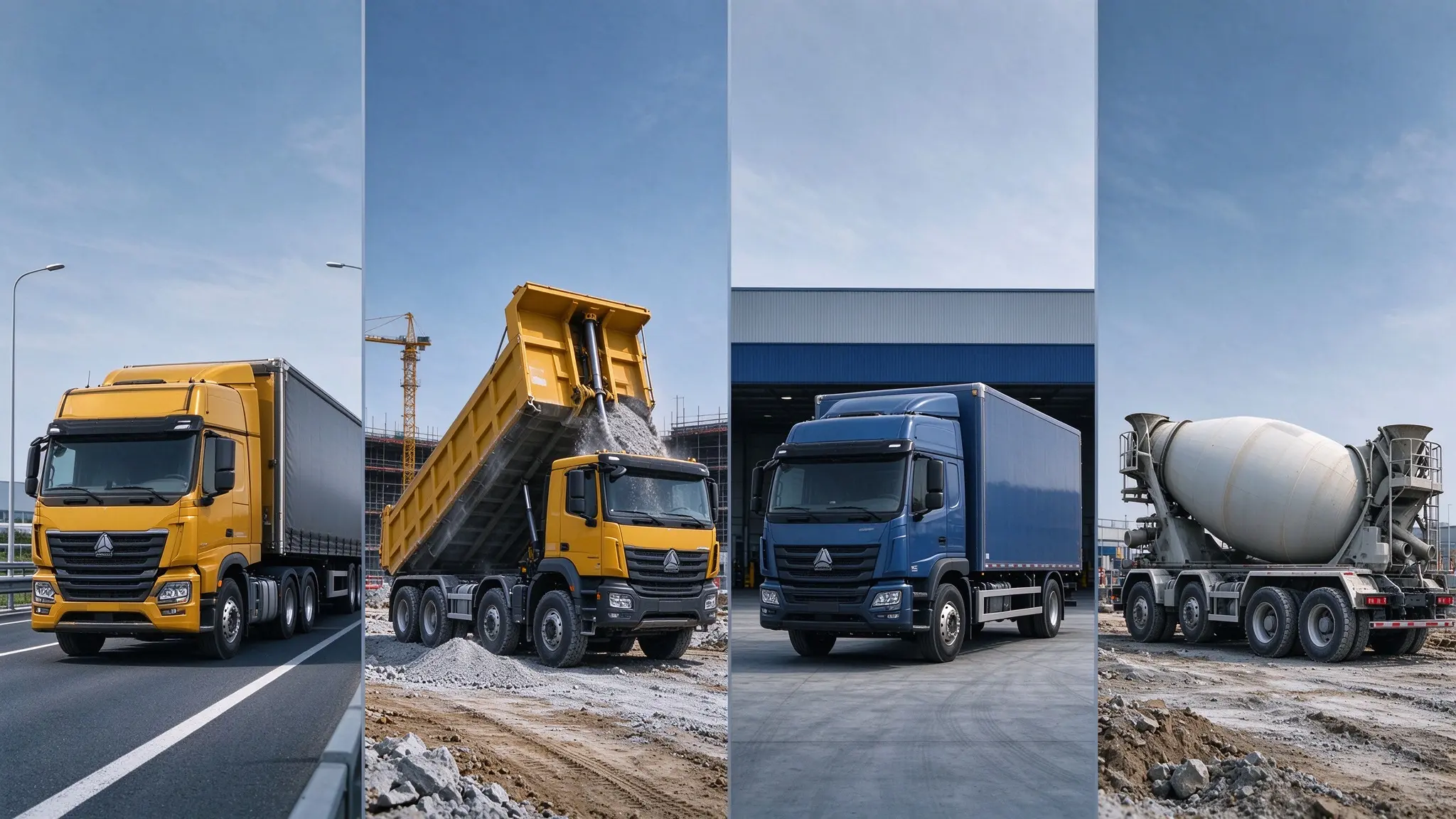
2.1 6×4 Tractor Truck (Prime Mover)
6×4 tractor trucks, also known as prime movers, are the most widely used long-haul logistics vehicles. They have no independent cargo box and are designed to connect with various semi-trailers.
Common matched trailers include flatbed trailers, container trailers, tank trailers, and bulk cargo trailers. This flexible combination enables multi-scenario transportation switching.
Equipped with high-power engines ranging from 371HP to 480HP, 6×4 tractors support continuous high-speed highway driving. They perfectly adapt to cross-country and cross-border long-distance bulk cargo transportation.
Moreover, the dual rear drive axles ensure stable traction when towing heavy trailers. They effectively avoid power insufficiency on long slopes and wet pavements.
This model is the first choice for professional logistics fleets, container transportation companies, and cross-border freight enterprises.
2.2 6×4 Tipper Truck (Dump Truck)
6×4 tipper trucks, or dump trucks, are specially customized for engineering and mining scenarios. They integrate a hydraulic lifting system and a high-strength cargo box.
The hydraulic system supports automatic cargo unloading without manual assistance. This greatly improves the efficiency of sand, gravel, soil, construction waste, and mineral material transportation.
Export-grade 6×4 dump trucks usually adopt reinforced box bodies and thickened wear-resistant steel plates. These upgrades resist impact and abrasion from hard bulk materials.
With strong off-road performance and heavy-load capacity, these trucks are widely used in mining sites, road construction, water conservancy projects, and urban foundation renovation.
2.3 6×4 Cargo Truck
6×4 cargo trucks include enclosed van cargo models and open flatbed models. They are suitable for medium and heavy bulk cargo transportation that does not require trailer matching.
Enclosed van 6×4 cargo trucks protect goods from sunlight, rain, dust, and theft. They are ideal for industrial parts, electronic materials, and daily commodity bulk transportation.
Flatbed 6×4 cargo trucks excel in transporting steel structures, mechanical equipment, and oversized building materials. Their open design simplifies loading and unloading operations.
Compared with tractor trucks, 6×4 cargo trucks have higher flexibility for short and medium-distance heavy-load shuttle transportation.
2.4 Special 6×4 Engineering Trucks
Based on the 6×4 heavy-duty chassis, manufacturers can customize various special engineering vehicles. Common types include 6×4 mixer trucks, fuel tank trucks, water sprinkler trucks, and garbage trucks.
The stable heavy-load chassis and powerful power system of 6×4 layouts provide reliable support for various special functional modifications.
These customized special trucks are commonly used in municipal engineering, environmental protection, infrastructure construction, and industrial supporting transportation.
You can browse full 6×4 truck product series to view complete model classifications and customized solutions for different industries.
Chapter 3: Core Advantages of Buying 6×4 Heavy-Duty Trucks
Global fleet buyers and engineering contractors consistently choose 6×4 trucks for heavy-duty operations. This popularity stems from their comprehensive advantages in performance, cost, and adaptability.
To help you fully recognize the value of 6×4 models, we summarize their five core competitive advantages compared with other axle configurations.
3.1 Super Heavy-Load Bearing Capacity
The most prominent advantage of 6×4 trucks is their excellent load capacity. The three-axle balanced layout supports a standard payload of 25 to 40 tons.
This load range completely covers mainstream heavy-duty transportation demands. It far exceeds the capacity of 4×2 light and medium trucks.
Meanwhile, the dual rear drive axles and reinforced chassis avoid chassis fatigue and structural deformation under long-term heavy-load operation. This ensures long-term stable vehicle performance.
3.2 Excellent Off-Road Traction & Road Adaptability
Unlike single-drive 4×2 trucks, 6×4 dual rear drive axles provide double power output. This greatly improves tire grip on complex road conditions.
Whether on muddy construction roads, dusty mining roads, gravel mountain roads, or rainy slippery pavements, 6×4 trucks maintain stable driving performance.
They effectively avoid wheel slipping, power loss, and vehicle stalling, which are common pain points of light-duty trucks in harsh working environments.
3.3 Balanced Fuel Consumption & Operational Cost
Many buyers mistakenly believe all heavy trucks consume excessive fuel. In fact, 6×4 trucks have obvious cost advantages in heavy-load scenarios.
When transporting heavy cargo above 25 tons, 6×4 trucks have lower unit fuel consumption than 8×4 heavy trucks. This is because 6×4 models have lighter self-weight and fewer running accessories.
At the same time, their maintenance costs are far lower than 8×4 trucks. The wearing parts are universal and affordable, and daily maintenance procedures are simpler.
For long-term fleet operation, 6×4 trucks can effectively reduce comprehensive operational costs and improve overall profit margins.
3.4 High Operational Stability & Long Service Life
Mainstream Chinese 6×4 trucks adopt mature military-grade manufacturing technology and high-quality core components. The overall failure rate is extremely low.
Engine, gearbox, drive axle, and chassis systems all undergo strict quality testing. These vehicles can adapt to high-intensity, uninterrupted daily operations.
With standardized maintenance, the service life of a qualified 6×4 truck can reach 8 to 12 years. This brings long-term stable return on investment for fleet buyers.
3.5 Flexible Customization for Global Markets
6×4 heavy trucks support diversified export customization. Buyers can adjust configurations according to local climate, road conditions, and certification standards.
Common customizable items include left-hand drive and right-hand drive switching, emission standard adjustment, high-temperature heat dissipation upgrades, dust-proof modifications, and anti-corrosion treatments.
This high flexibility allows 6×4 trucks to perfectly adapt to various harsh environments in Africa, the Middle East, Southeast Asia, and Central Asia.
Chapter 4: 6×4 Truck vs 4×2 vs 8×4 Truck: Detailed Configuration Comparison
Most procurement confusion comes from unclear configuration differences between 4×2, 6×4, and 8×4 trucks. Choosing the right axle configuration based on business scenarios is the first step of scientific procurement.
Below is a detailed comparative analysis of the three mainstream truck configurations to help you eliminate selection hesitation.
4.1 Load Capacity Comparison
4×2 trucks belong to light and medium-duty vehicles, with a suitable payload of 5 to 18 tons. They are only applicable for light cargo distribution.
6×4 trucks are standard heavy-duty vehicles, with a payload range of 25 to 40 tons. They cover most heavy-load logistics and engineering scenarios.
8×4 trucks are ultra-heavy-duty models, with a maximum payload exceeding 50 tons. They are mainly used for super-large engineering transportation and heavy bulk cargo haulage.
4.2 Road Adaptability Comparison
4×2 trucks have flexible steering and a small turning radius. They adapt to urban narrow roads but perform poorly on off-road and heavy-load slopes.
6×4 trucks balance flexibility and off-road performance. They run stably on highways and adapt to muddy, dusty, and gravel construction sites.
8×4 trucks have a large body and poor flexibility. They are only suitable for wide professional freight roads and large open construction sites.
4.3 Fuel Consumption & Maintenance Cost Comparison
4×2 trucks have the lowest fuel consumption and maintenance costs, suitable for low-budget light-load operation.
6×4 trucks have moderate fuel consumption and maintenance costs. Their cost performance is the highest in heavy-load scenarios.
8×4 trucks have the highest fuel consumption and accessory costs. They are only cost-effective for ultra-heavy load tasks.
4.4 Purchase Price Comparison
4×2 trucks have the lowest initial purchase price, friendly for individual drivers and small fleets.
6×4 trucks have a moderate purchase price with higher comprehensive performance. They are the mainstream choice for medium and large fleets.
8×4 trucks have high overall configuration costs and high entry thresholds, suitable for large engineering enterprises.
4.5 Scenario Matching Final Suggestion
Choose 4×2 trucks if your business focuses on urban distribution, light commodity transportation, and municipal auxiliary tasks.
Choose 6×4 trucks if you need long-distance heavy-load logistics, mining haulage, road construction, and bulk material transportation.
Choose 8×4 trucks only for ultra-heavy engineering transportation and super-large cargo haulage demands.
Chapter 5: Top Chinese 6×4 Truck Brands & Best-Selling Export Models
Chinese 6×4 heavy trucks occupy a dominant position in the global export market. Relying on mature manufacturing technology, stable quality, and cost-effective pricing, Chinese brands have won recognition in more than 50 countries worldwide.
The following are the most reliable mainstream 6×4 truck brands and classic export models in 2026, sorted by market reputation and user feedback.
5.1 SINOTRUK HOWO 6×4 Series (Most Popular Export Model)
SINOTRUK HOWO is the most exported Chinese heavy truck brand overseas. Its 6×4 series models are famous for durability, strong power, and low failure rate.
Classic mainstream models include HOWO 371HP/380HP/400HP/430HP 6×4 tractor trucks and dump trucks. These models adopt mature mechanical pump engines, which are not easily affected by harsh environments.
The mechanical pump engine design has simple structure and low maintenance difficulty. It is very suitable for African, Middle Eastern, and Central Asian markets with imperfect after-sales systems.
In addition, HOWO 6×4 trucks support comprehensive export upgrades, including high-temperature heat dissipation, three-stage dust prevention, and chassis anti-corrosion treatment.
Whether for mining haulage, long-distance logistics, or engineering construction, HOWO 6×4 models maintain excellent operational stability.
5.2 Shacman 6×4 Series (High Durability for Harsh Environments)
Shacman 6×4 trucks are built with military-grade manufacturing standards. They are specially optimized for high-intensity operation in harsh environments such as deserts, plateaus, and mining areas.
Shacman X3000 and F2000 6×4 series are mainstream export models. They feature reinforced chassis, upgraded suspension systems, and strong anti-fatigue performance.
These models have outstanding climbing performance and load stability. They are widely favored by mining project fleets and mountain road transportation teams.
Moreover, Shacman 6×4 trucks have strong corrosion resistance and high-temperature resistance, adapting to long-term high-temperature and dusty working conditions.
5.3 FAW 6×4 Series (Fuel-Saving & Cost-Effective)
FAW 6×4 heavy trucks focus on fuel economy and intelligent matching. The power system is precisely tuned to reduce unit fuel consumption during heavy-load driving.
FAW J6 and JK6 6×4 series models have reasonable gearbox matching and stable power output. They are very suitable for long-distance highway bulk cargo transportation.
With low comprehensive failure rate and universal spare parts, FAW 6×4 trucks effectively reduce long-term fleet operational costs.
5.4 SITRAK 6×4 Series (High-End Premium Export Model)
SITRAK is the high-end heavy truck brand of SINOTRUK. Its 6×4 series models adopt joint venture technology, with higher configuration and driving comfort.
Equipped with high-power Mann engines and ZF gearboxes, SITRAK 6×4 trucks deliver stronger power performance and higher transmission efficiency.
These high-end models are mainly used for high-standard cross-border logistics and high-value heavy cargo transportation, suitable for high-end fleet procurement.
To confirm brand authenticity and factory qualification of these 6×4 models, you can check our factory background and certification strength to avoid refurbished and modified non-export vehicles.
Chapter 6: Must-Check Parameter Checklist Before Buying 6×4 Trucks
Parameter matching determines whether the 6×4 truck can adapt to your working conditions. Many buyers only focus on price and appearance, ignoring core parameters, resulting in poor vehicle adaptability and frequent failures.
We have sorted out all must-check core parameters for 6×4 truck procurement to help you complete precise model selection.
6.1 Engine Horsepower & Torque Matching
The engine is the core power source of the 6×4 truck. Different working scenarios require different horsepower configurations.
For flat highway long-distance transportation, 371HP to 400HP models are sufficient, with better fuel economy.
For mountain roads, frequent slope climbing, and full-load mining operation, it is recommended to choose 430HP to 480HP high-torque versions to ensure sufficient power reserve.
For overseas harsh markets, mechanical pump engines are more recommended. They are more stable and easier to maintain than electronic control engines.
6.2 Wheelbase & Cargo Box Size Parameters
Wheelbase directly affects vehicle stability and cargo capacity. Standard 6×4 trucks have a mainstream wheelbase of 3900+1450mm.
Short wheelbase models are flexible and suitable for frequent site switching in mining and construction scenarios.
Long wheelbase models have larger cargo box volume, suitable for bulk material long-distance transportation.
For tipper trucks, the cargo box thickness and wear-resistant layer configuration must be checked. Thickened box bodies are required for hard mineral materials.
6.3 Chassis & Suspension Configuration
The chassis determines the load-bearing limit and service life of the truck. All export-grade 6×4 trucks must adopt thickened reinforced integral chassis.
For long-term heavy-load operation, avoid thin chassis customized models to prevent chassis torsion and deformation.
Suspension systems are mainly divided into leaf spring suspension and air suspension. Leaf spring suspension is durable and cost-effective, suitable for most engineering and logistics scenarios.
Air suspension is more comfortable and protects cargo, suitable for high-value cargo transportation, but with higher purchase and maintenance costs.
6.4 Tire Specification & Load Grade
6.5 Gearbox & Transmission System
6.6 Emission Standard Configuration
Chapter 7: Professional Export Customization for 6×4 Trucks (Global Market Adaptation)
7.1 High-Temperature Heat Dissipation Upgrade for Desert Regions
7.2 Three-Stage Dust Prevention Upgrade for Mining & Dusty Areas
7.3 Chassis Anti-Corrosion & Salt Spray Protection
7.4 Left-Hand Drive & Right-Hand Drive Switching
7.5 Local Certification Matching Upgrade
Chapter 8: How to Screen Reliable 6×4 Truck Suppliers & Avoid Procurement Risks
8.1 Core Qualification Verification Standards
8.2 Common Procurement Scams & Avoidance Methods
8.3 Advantages of Choosing Factory Direct Export Suppliers
Chapter 9: Complete Ordering Process for Export 6×4 Trucks
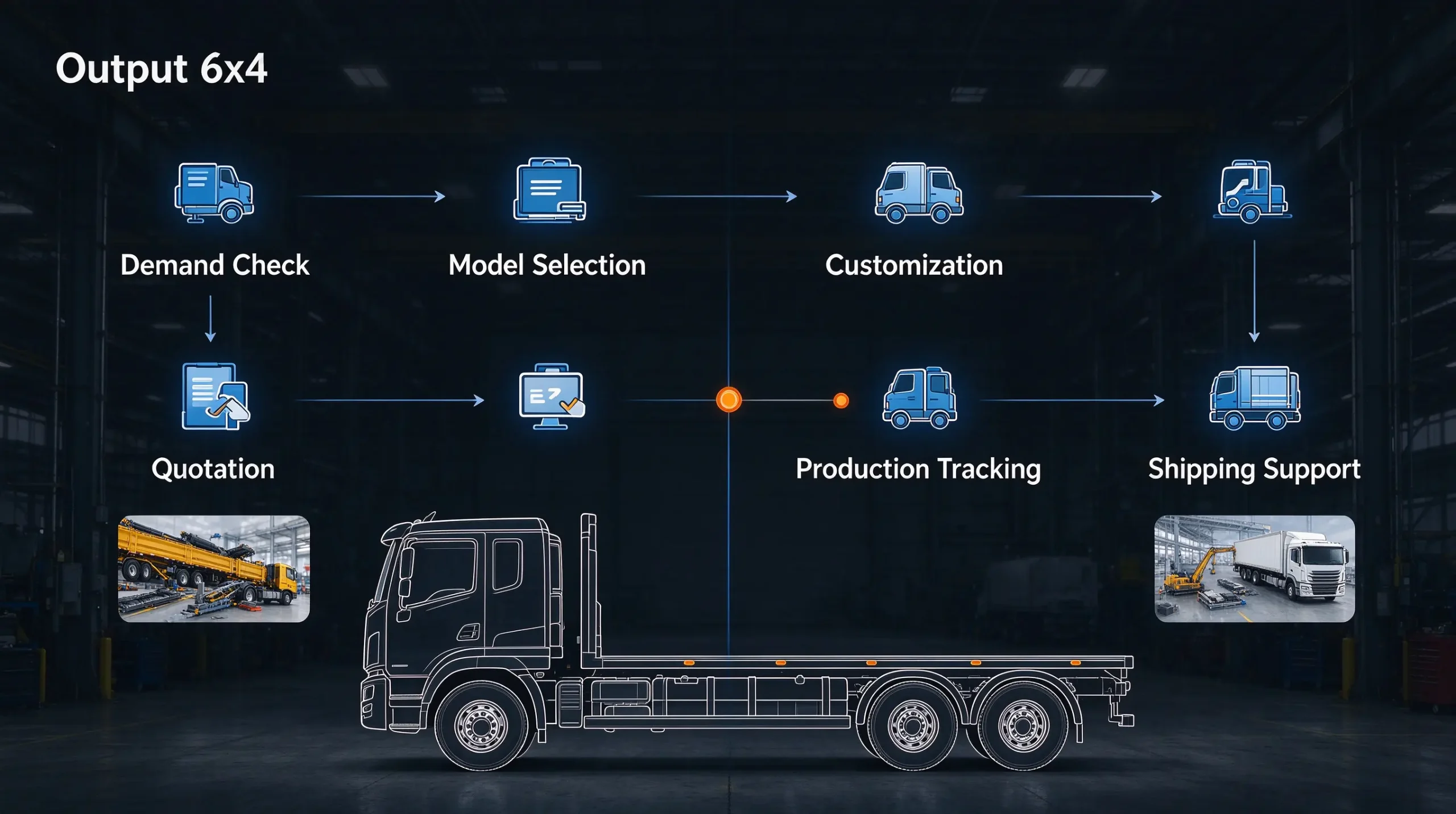
9.1 Demand Confirmation & Customization Scheme Design
9.2 Quotation Locking & Cost Breakdown
9.3 Formal Contract Signing
9.4 Production Progress Tracking
9.5 Full Pre-Shipment Quality Inspection
Chapter 10: Shipping, Customs Clearance & Overseas Landing Guidance
10.1 Shipping Mode Selection
10.2 Export Customs Clearance Process
10.3 Overseas Customs Clearance & Vehicle Registration